
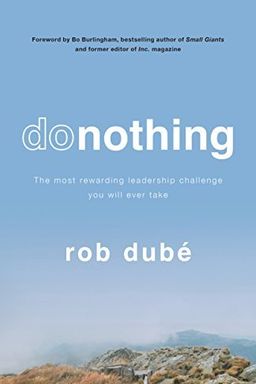
donothing cover

donothing

by Rob Dube

Explore the transformative power of meditation with Rob Dube. ''donothing'' reveals how a simple daily practice can revolutionize leadership, enhance business success, and improve personal well-being. Discover practical tips, scientific backing, and inspiring stories from successful leaders.

Shine: Freeing Your True Self for Inner Peace and Impact

What if your relentless drive for achievement—the same energy that built your success—was also hiding an inner emptiness? That’s the paradox at the heart of Shine: How Looking Inward Is the Key to Unlocking True Entrepreneurial Freedom by Gino Wickman and Rob Dube. The authors argue that while most driven entrepreneurs master the external game of building businesses, they often lose touch with their inner world—where peace, clarity, and authenticity reside.

Wickman and Dube contend that true entrepreneurial freedom doesn’t come from scaling a company or hitting financial milestones but from stripping away the ego-driven layers that obscure your True Self. When you combine drive with peace, you enter what they call Flowt—a state of creative ease, balance, and authentic impact. The book’s mission: to show you how to shed fear, trauma, and external validation so that your natural light can shine through.

The Dual Nature of Being Driven

The authors begin with a confession familiar to many entrepreneurs: success doesn’t always bring peace. Through Wickman’s personal story—rising from a painful childhood marked by trauma and shame to extraordinary business success—readers see the archetype of the driven achiever who’s outwardly thriving yet inwardly restless. This inner dissonance forces a truth: drive is both a blessing and a curse. It powers creativity and persistence but also masks deep wounds and addictions to work, recognition, or perfectionism.

The book lays bare the psychology of driven people using research (such as Dr. Douglas Brackmann’s work on dopamine receptor variations) showing that driven individuals literally require stronger stimulation to feel reward. That biology, the authors note, makes entrepreneurs gifted but also vulnerable to chasing intensity instead of contentment—until they learn to draw their energy from the inside out instead of the outside in.

From Outer Success to Inner Freedom

Wickman structures the book around two frameworks: The 3 Discoveries and The 10 Disciplines. The Discoveries offer the awareness that grounds real transformation; the Disciplines provide the tools to live it daily. The three discoveries are:

  • I Am Driven — recognizing drive as an innate part of your DNA, both powerful and perilous.
  • Decisions Are Made Out of Love or Fear — realizing that most actions come from ego-based fear or heart-based love.
  • It Is Possible to Be Driven and Have Peace — understanding that peace doesn’t dampen ambition; it amplifies authentic impact.

These discoveries act as the spiritual and psychological foundation of the book. Once you internalize them, the 10 Disciplines become practical structures for aligning your outer world with your inner truth—simple rules that create clarity, boundaries, and energy.

The 10 Disciplines: A Framework for Freedom

The Disciplines, such as 10-Year Thinking, Take Time Off, Be Still, and Say No Often, push you toward deliberate living rather than reactive overdrive. Each one addresses a common blind spot for high achievers—their short-term mindset, inability to rest, chronic overcommitment, or attachment to low-impact work. By setting anchors like daily stillness, structured rest, and ruthless focus, entrepreneurs can reclaim creative energy and emotional resilience.

Together, these habits form what Wickman calls a “foundation of freedom”—space in your mind and calendar to cultivate awareness and live as your authentic self. It’s not about self-help platitudes but about rewiring discipline around inner alignment instead of mere productivity. The authors illustrate how clients who integrated these practices not only scaled businesses sustainably but also became calmer, more present leaders, parents, and partners.

Why Inner Work is the Ultimate Growth Strategy

For Wickman and Dube, the promise of Shine is radical yet practical: inner peace and purpose don’t diminish your competitive edge—they multiply it. The real paradox is that when you stop gripping the accelerator out of fear and operate from love, clarity, and stillness, you actually perform better. Your decisions become sharper, your relationships improve, and creativity flows naturally—what the authors describe as “Flowt,” the seamless fusion of doing and being.

In essence, Shine is a playbook for entrepreneurs who’ve already “won” by conventional standards but suspect there’s something deeper to claim. It’s a call to trade busyness for presence, control for trust, and ego for authenticity. It’s not about quitting your drive but finally pointing it in the right direction—toward wholeness, peace, and purpose-driven impact.


Discovery #1: Understanding the Driven Mind

In the first Discovery, “I Am Driven,” Wickman invites readers to see their inner restlessness not as a flaw but as a unique blueprint. Being driven means your brain is wired for more—more growth, more creation, more forward motion. But this same fire that propels you can also consume you if left unchecked.

The Blessing and the Curse

Driven people are naturally self-motivated, competitive, and resistant to complacency. They push boundaries. Yet many of them, like Wickman and countless entrepreneurs he’s coached, eventually hit an emotional wall. They realize that no achievement, no accumulation of money or status, ever fills the quiet void inside. That persistent emptiness, he says, comes from ignoring your inner world while mastering the outer.

Entrepreneurs such as Brett Kaufman and Mark O’Donnell, featured in the book, exemplify this tension. Kaufman’s drive to succeed in real estate masked a perfectionist wound inherited from his father, while O’Donnell’s relentless ambition led to neglect of his family. Both stories show how the drive to “build more” often camouflages old hurts or feelings of inadequacy.

The Biology of Restlessness

The book integrates neuroscience to explain this pattern. Wickman cites Douglas Brackmann, PhD, whose research in Driven links high achievers to differences in dopamine receptors D2 and D4. Because their brains need more stimulation to feel rewarded, driven individuals constantly chase goals and novel experiences. It’s the biology behind both genius and burnout—a drive that fuels growth but resists contentment.

This insight reframes ambition from moral failing to neutral energy. The goal is not to extinguish drive but to channel it through conscious discipline. As Wickman puts it, your drive is sacred fuel; it only becomes destructive when hijacked by fear, ego, or compulsive overwork.

From Awareness to Integration

The first Discovery, then, is about awareness. When you recognize that being driven defines your wiring, you stop fighting it or apologizing for it. What follows is a shift in perspective: instead of using drive to chase validation, you can use it to deepen self-understanding. This awareness sets the stage for the next Discoveries—recognizing how fear masks itself as motivation and learning that real success unites drive with inner calm.


Discovery #2: Love Versus Fear Decisions

According to Wickman and Dube, every decision you make—whether hiring someone, replying to an email, or handling conflict—stems from one of two sources: love or fear. Understanding which force drives your choices can transform not just your business but your entire life.

The Ego’s Prison

The authors trace fear-based decision-making to the ego’s protective structure. Early wounds, shame, or trauma create emotional “armor” that filters experiences through insecurity. For entrepreneurs, this often looks like micromanaging employees, overworking to prove worth, or refusing to delegate out of fear of losing control. Wickman calls this the ego’s prison—self-created walls that feel like security but actually block freedom.

He recounts an entrepreneur who, as a child, froze when his absent father missed a birthday party, learning subconsciously that love could disappear. Decades later, his leadership was still fueled by the fear of being unwanted. In business conversations, he controlled everything to ensure no one could “let him down” again. It’s a vivid illustration of how old emotions quietly direct adult choices.

Shedding Layers and Processing Blocks

To reverse this pattern, Wickman introduces the Process One exercise: recall an emotional trigger, locate where it feels stored in your body, imagine its shape and color, and sit with it until it releases. The point is to notice rather than suppress. Over time, this awareness helps you identify blocked energy—anger, shame, sadness—that clouds perception and drains vitality.

This approach mirrors insights from Bessel van der Kolk’s The Body Keeps the Score and Michael Singer’s The Untethered Soul: unprocessed emotion lodges in the body and subtly dictates reactions until acknowledged. By processing rather than avoiding discomfort, you reclaim the energy once trapped in defense mechanisms.

Awareness as Liberation

Awareness, the authors insist, is half the battle. As psychologist Jon Kabat-Zinn teaches, “with awareness comes freedom.” Once you learn to pause and ask “Am I acting from love or fear?” you can move from instinct to choice. Love-based decisions come from your True Self—calm, wise, and intuitive—while fear-based ones come from ego’s anxiety about control or validation. Each time you choose love, you chip away more marble from the sculpture of your True Self.


Discovery #3: Uniting Drive and Peace

For decades, Wickman believed peace and entrepreneurial hunger couldn’t coexist. Peace felt weak; drive felt strong. The third Discovery shatters that myth: you can be driven and have peace simultaneously. In fact, uniting the two is what he calls the essence of the True Self.

The True Self Model

Wickman introduces a simple yet profound model: two circles—one for Impact (doing, creating, building) and one for Peace (being, loving, trusting). Where they overlap lies your True Self. Outside those circles are the barriers: pain, insecurity, trauma, fear. The task isn’t to chase peace but to remove those barriers so the peace already within can surface.

Rob Dube’s own transformation underscores the point. After adopting meditation and mindfulness during a career crisis, he found himself calmer and more intuitive. Ironically, that peace amplified his leadership effectiveness and business growth—proving that inner stillness strengthens rather than dulls ambition.

Flowt: The Fusion of Doing and Being

When drive and peace merge, you experience “Flowt,” a coined blend of flow and float. Time slows down. Creativity heightens. You act with precision but without tension, much like Mihaly Csikszentmihalyi’s flow state but infused with serenity. Wickman describes Flowt as operating from the inside out—making decisions grounded in love and intuition rather than fear or obligation.

This discovery becomes the compass for the rest of the book: your mission is not to calm your drive but to spiritualize it, transforming relentless achievement into effortless expression. As Wickman jokes, “It’s how I found my soul—and kept my business.”


Discipline #1: Practice 10-Year Thinking

Most entrepreneurs think in quarters or fiscal years. The first Discipline invites you to think in decade horizons. Shifting from short-term to long-term frames slows time, calms anxiety, and fosters more strategic decisions. As Wickman puts it: “People overestimate what they can achieve in a year but underestimate what they can achieve in ten.”

Creating a 10-Year Vision

Wickman guides readers through a visualization exercise: write today’s date ten years ahead, visualize your age and accomplishments, then describe your ideal life as though it already happened. Include details of both outer success and inner peace. This future-focused mindset acts like a magnet; by vividly defining the destination, you subconsciously align daily choices toward it. Price Pritchett’s You² and Dan Sullivan’s Strategic Coach echo this principle—clarity over time amplifies progress.

Stories abound of leaders applying this mindset. Lynn Rousseau initially dismissed the idea of planning a future at age 71 but used 10-Year Thinking to create a Coaching Academy, reorganizing her present work accordingly. Another client, Josh Holtzman, used it to grow a $4M company to $40M within a decade. In both cases, long-term clarity transformed short-term overwhelm into inspired focus.

Inner Peace Through Patience

Decade thinking doesn’t just build business resilience; it cultivates calm. Knowing that challenges like recessions or pandemics are momentary waves within longer cycles prevents panic. This patience generates peace—the inner steadiness that turns crisis into creative opportunity. Mentally, it’s liberating: when you plan for ten years, you stop measuring worth by today’s chaos.


Discipline #2: Take Time Off To Recharge

If thinking long-term expands your mental space, taking time off expands your emotional and creative one. Wickman insists: take 130 full days off per year and don’t think about work. That’s nearly one-third of your life dedicated to rest. It sounds impossible—but that’s the point. Entrepreneurs rarely rest; they numb themselves with busyness.

The Detox of Doing Nothing

In story after story, driven leaders learn that absence from work revives innovation. One client who took her first true vacation in years went through “work detox”—three restless days of guilt followed by liberating clarity. Another, Denver Nguyen, CEO of Wayfynder, returned from a two-week break with an entirely new company vision: helping people self-actualize at work. Wickman himself takes August off every year, calling it his “sabbatical for the soul.”

Rest as a Strategic Advantage

The science agrees. Sleep research shows that the deepest rest phases rejuvenate memory and creativity. Similarly, extended breaks allow subconscious processing to solve problems that working harder can’t. Time off isn’t indulgence—it’s leverage. As Stephen Covey said, “You have to sharpen the saw.” The irony, Wickman notes, is that intentional rest actually accelerates performance when you return.

Practically, he teaches readers to block 130 days—including weekends and holidays—and to guard them as sacred. No email, no business books, no quick office calls. Doing so requires confronting guilt and letting go of the ego that equates worth with activity. But on the other side is genuine vitality: a rested mind, restored relationships, and renewed purpose.


Discipline #3: Know Thyself—Be 100% You

Echoing the ancient Greek maxim carved at Delphi, “Know Thyself,” Wickman’s third Discipline calls for radical authenticity: be your True Self 24/7/365. Most entrepreneurs, he writes, spend enormous energy performing for different audiences—boss, employee, investor, friend—until they forget who they actually are.

The Cost of Chameleon Living

Wickman admits that for much of his career, he shape-shifted to fit contexts. The revelation came when six groups of his life—family, work, friends—collided at his surprise 30th birthday. “Who am I going to be tonight?” he asked himself, realizing he’d grown into a social contortionist. Dropping the act became an act of liberation. Authenticity, he discovered, is pure energy efficiency—you stop wasting fuel pretending.

Tools for Self-Discovery

Practical methods include personality assessments (Enneagram, Myers-Briggs), therapy, and feedback from trusted peers. The goal isn’t self-critique but clarity. Wickman suggests writing a “Who Am I Statement”—a concise declaration of your essence. His own: “I’m a cushy love ball, hardworking, passionate, and gritty.” For others, it might be “I am strength in compassion” or “I am learning to be curious.” The exercise dissolves shame and aligns behavior with truth.

From Self-Knowledge to Self-Expression

Knowing thyself isn’t an endpoint but a practice. As you live authentically, you stop apologizing for quirks and gifts. You attract relationships and opportunities that resonate with your genuine energy. Like a sculptor chiseling away marble, each act of truth exposes more of the masterpiece beneath—your True Self unmasked.


Discipline #4: Be Still Every Day

Perhaps the most transformative practice in Shine is stillness: sitting in silence for thirty minutes daily. For high performers addicted to motion, this is both terrifying and revolutionary. Wickman insists stillness isn’t inactivity—it’s an intentional pause that settles the turbulent “jar of sand” in your mind so clarity can emerge.

Four Forms of Stillness

The authors outline four pathways:

  • Meditation — Awareness through breath, detaching from thoughts without judgment.
  • Prayer — Surrendering control and connecting to a higher power or inner wisdom.
  • Journaling — Translating subconscious noise into clarity through stream of consciousness writing.
  • Contemplation — Quiet reflection on nature or meaningful ideas, letting insight surface spontaneously.

Each method leads to the same place: presence. Stillness allows suppressed emotions to surface and dissolve, creating both creative insight and healing. Like meditation teacher Jack Kornfield’s teachings on mindful awareness, stillness is less about quieting the mind and more about listening with compassion.

Transformative Outcomes

The ripple effects are profound—stress reduces, awareness heightens, and intuition awakens. Wickman writes that most of his best ideas for the book itself came during morning stillness. Over time, the practice shifts identity from “human doing” to “human being,” extending peace into every interaction. Viktor Frankl’s line captures its essence: “Between stimulus and response, there is a space.” Stillness enlarges that space—and within it lies your freedom.

Dig Deeper

Get personalized prompts to apply these lessons to your life and deepen your understanding.

Go Deeper

Get the Full Experience

Download Insight Books for AI-powered reflections, quizzes, and more.