
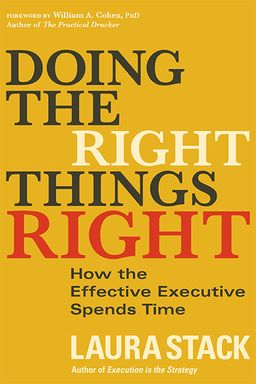
Doing the Right Things Right cover

Doing the Right Things Right

by Laura Stack

Doing the Right Things Right by Laura Stack reveals the core principles of effective leadership. Learn to manage teams, set clear goals, adapt to change, and foster a motivating work culture. This book equips you with the tools to achieve productive, profitable results while enhancing your leadership confidence.

Doing the Right Things Right: The Intersection of Effectiveness and Efficiency

How can you ensure that your efforts not only produce results but do so in the smartest, most sustainable way possible? In Doing the Right Things Right: How the Effective Executive Spends Time, productivity expert Laura Stack builds upon Peter Drucker’s groundbreaking classic, The Effective Executive, to answer that question for the 21st century. She argues that modern executives and knowledge workers must thrive at the intersection of effectiveness (doing the right things) and efficiency (doing things right). In essence, leadership today demands more than sound judgment—it requires the ability to act decisively, deliberately, and swiftly in an environment that never stops changing.

Stack contends that being productive is no longer about working longer hours or accomplishing more superficial tasks—it’s about aligning effort with purpose and results. The book builds out Drucker’s conceptual “what” with Stack’s pragmatic “how.” In twelve chapters structured around her 3T Leadership Model—THINK, TEAM, and TACTICS—she provides a comprehensive framework for managing time, people, and personal energy so leaders can deliver results faster with less chaos.

The Power of the 3Ts: Thinking, Team, and Tactical Work

According to Stack, every executive’s time is divided among three domains: Strategic Thinking (THINK), Team Focus (TEAM), and Tactical Work (TACTICS). As leaders rise through the ranks, they must spend less time in tactical execution and more time in strategic decision-making and team development. This shift mirrors the evolution of management itself—from command-and-control supervision to dynamic, participative leadership.

In the “THINK” category, Stack discusses the big-picture functions that shape direction: goal alignment, innovation, communication, and decision-making. These ensure that teams pursue the right priorities at the right times. In the “TEAM” category, leaders shape culture, motivate people, and promote growth, building a workplace that fosters creativity and results. Finally, “TACTICS” involves the day-to-day discipline of performing efficiently—managing technology, prioritizing high-value activities, staying agile, and maintaining personal balance.

Building on Drucker for a Digital Age

Peter Drucker famously wrote that leadership is about “doing the right things” rather than simply “doing things right.” Stack modernizes this insight for the post-digital workplace, where endless emails, instant communication, and constant change can easily bury strategic thinking in busywork. Her goal is to help leaders “do the right things right”—that is, combine vision with execution. She translates Drucker’s philosophy into actionable methods supported by 21st-century tools like cloud collaboration, agile processes, and mindful self-management.

To reinforce these ideas, Stack offers a diagnostic tool, the 3T Leadership Assessment, enabling readers to measure their own effectiveness across all leadership dimensions. The assessment helps identify which of the three Ts a leader currently over- or under-invests in—revealing whether they spend too much time on short-term tasks instead of long-term planning, or vice versa.

Why It Matters: The Modern Executive Dilemma

Stack’s argument matters because the modern workplace no longer rewards activity—it rewards impact. She quotes Drucker’s warning that “there is nothing so useless as doing efficiently that which should not be done at all,” highlighting how easy it is for well-intentioned professionals to be busy but ineffective. Through compelling examples—from Microsoft’s Chief Security Officer Mike Howard, who evolved from fire-fighting to strategic oversight, to CSS Farms’ practice of intentional communication—she demonstrates that effective leadership is about designing systems that prevent distraction and decision paralysis.

Ultimately, Doing the Right Things Right is about self-leadership as much as organizational leadership. Leaders must begin by aligning their own energy, routines, and focus before they can expect the same from their teams. The book closes with a call to balance—reminding readers that genuine productivity includes sustaining mental sharpness, physical wellness, and emotional resilience.

“Leaders manage time most productively at the intersection of effectiveness and efficiency. Once you know you’re spending time on the right things, you then focus on doing them right.” —Laura Stack

This book reframes productivity as a holistic discipline that integrates smart thought, strong teams, and swift tactical execution. If Drucker taught executives what they must do, Stack teaches them how to actually live it every day—helping today’s leaders do the right things right, in less time and with far greater impact.


Strategic Thinking: Setting Direction and Purpose

Laura Stack begins with the foundation of all leadership effectiveness: strategic thinking. She asks an essential question: what is the desired outcome? Executives who cannot answer this with clarity risk running productive teams in the wrong direction. The key, she insists, is to tie every action, discussion, and goal back to the organization’s larger mission.

Aligning Goals and Strategy

Goal alignment is the first principle of effective thinking. Stack likens teams without aligned goals to a “drunken octopus on roller skates”—busy but directionless. She urges leaders to anchor every team target in the organization’s strategic purpose, using an “Execution Continuum” that runs from values → mission → vision → strategy → objectives → tactics → actions. Every individual task should trace back to these fundamentals. Baylor Scott & White Health executive Janie Wade exemplifies this by ensuring that her team’s goals “support the plan and each other—while leaving room for unexpected opportunities.”

Alignment, Stack argues, is also psychological. A disconnected team cannot execute strategically because people don’t see why their work matters. Leaders must translate vision into language and behaviors that help employees find meaning in their tasks (a point echoed by Simon Sinek’s emphasis on “Start With Why”).

Embracing Change and Innovation

Change is the constant companion of strategy. Stack treats adaptability not as a luxury but as a survival skill. She recounts how Blackberry’s refusal to evolve beyond corporate customers doomed its dominance. By contrast, Nokia’s late but decisive rebirth in smartphones demonstrates her core truth: flexible companies live, rigid ones die.

The challenge, she says, is overcoming inertia—the powerful resistance to change within corporate culture. Leaders must invite innovation by granting their teams permission to experiment and fail intelligently. At Microsoft, for example, Mike Howard transformed reactive crisis management into proactive strategy by empowering others to handle operational fires while he focused on foresight and talent development. Innovation, Stack stresses, requires space, safety, and follow-through.

Communicating Vision and Making Decisions

Communication, in Stack’s model, connects thinking to execution. Leaders must not only define mission and vision but repeat them relentlessly until they become part of the team’s DNA. As John Hancock’s Senior Vice President Darren Smith discovered, scheduled “structured communication” prevents constant interruptions and keeps everyone synchronized.

Decision-making, the fourth pillar of strategic thinking, bridges contemplation and action. Stack’s advice is blunt: motion beats meditation once the facts are in. She cites corporate disasters like Time Warner’s overvalued AOL merger and Kodak’s refusal to commercialize its own digital camera as cautionary tales of indecision and arrogance. Yet she balances this with practical steps—anticipate ROI, evaluate opportunity costs, hedge with contingency plans, and proceed quickly. In a world of accelerating complexity, executives must decide with courage, not perfection.

“It’s better to take a wrong turn than no turn at all. You can always correct an error; you can’t correct inertia.” —Laura Stack

For Stack, thinking strategically means knowing why something matters and ensuring every tactic supports that “why.” Winning leaders blend clarity with speed: they align goals, embrace innovation, communicate relentlessly, and make decisions decisively. Strategic thinking, then, is not about endless analysis—it’s about thoughtful motion toward meaningful results.


Team Focus: Building Culture, Performance, and Loyalty

If strategic thinking defines the direction, team focus dictates the vehicle that gets you there. Laura Stack maintains that the effective executive is as much a coach as a commander—someone who cultivates culture, motivates performance, and fosters loyalty. The leader’s job is to make the team’s work easier, not harder.

Crafting a Productive Culture

Stack equates culture with soil: healthy soil yields growth, while toxic soil breeds decay. Yet many companies drown in “value-destructive complexity”—overthinking, bureaucracy, and outdated rules that waste billions. Leaders must streamline processes, simplify workflows, and remove obstacles. Practical advice includes rewarding efficiency, adding sunset clauses to projects, and empowering employees to eliminate bureaucratic waste themselves.

A powerful environment is also one that tolerates risk. Stack advised leaders to give high performers challenging tasks “with a real chance of failure.” Purpose and challenge, not comfort, drive engagement. When employees see that their courage is rewarded—not punished—they innovate freely.

Driving Performance Through Unity

Performance, she reminds us, is not about being busy—it’s about producing results. At Shaw Industries, executives practice “healthy debate” to ensure diversity of thought, while McDonald’s legendary operations manuals ensure that even teenagers can produce a consistent product worldwide. The lesson: substance triumphs over style. Excellence lives not in appearances but in repeatable performance systems.

Unity magnifies productivity. Stack recommends balancing accessibility with privacy—having an “open door,” but defining clear office hours for meaningful contact. When conflict arises, she supplies a simple mediation model: research the issue, hear both sides, investigate facts, and forge a written agreement. Fast resolution prevents resentment from poisoning productivity.

Motivation, Growth, and Gratitude

True motivation, Stack argues, extends beyond money. Rupert Murdoch’s approach—“engage minds and hearts”—mirrors her view that meaning outweighs mechanics. Engagement grows when leaders explain how individual contributions affect the big picture and reward progress regularly. Intrinsic rewards such as recognition, challenge, and trust fuel greater commitment than bonuses alone.

Her “ABCs of Motivation”—Analyze, Balance, Communicate, Direct, Expect, and Facilitate—provide an actionable framework. She adds, paraphrasing HubSpot CEO Brian Halligan’s “Mini-CEO” program: when employees prove exceptional, fire them—into leadership. Empowerment, not micromanagement, secures loyalty.

Finally, gratitude cements loyalty. When Robert Eckert took over struggling Mattel, his culture of appreciation transformed morale and profits. Stack warns against fake gratitude—overpraise leads to indifference—but genuine, specific recognition turns jobs into callings. In her words, “Gratitude is like the magic penny: the more you give it away, the richer you become.”


Tactical Excellence: High-Impact Work and Smart Technology

The third pillar of Stack’s model—Tactical Work—bridges precision with performance. Leaders often get lost in tactical overload, mistaking activity for achievement. Stack’s mission is to help you focus on what she calls “high-impact activities,” guard your time, and use technology as a servant, not a master.

Valuing Time as a Strategic Asset

You can’t lead effectively if you treat your time casually. Stack urges executives to value time in proportion to their responsibility—if your decisions are worth thousands of dollars an hour, guard each minute like cash. Delegation, she stresses, is not indulgent; it’s professional. Leaders must hand off everything that someone else can do cheaper or faster, keeping only the decisions that demand their expertise.

She tells the story of a manager who saved $50 a night by staying in a distant hotel—only to lose hours each day commuting, wasting more in time value than the savings justified. False economy, Stack warns, is the enemy of productivity. Her formula: time equals impact, not effort.

Eliminating Time-Wasters and Redefining Meetings

Stack is ruthless about cutting time-sinks. She advises establishing interruption-free work zones, trimming useless meetings, and empowering people to make decisions without excessive sign-off. Microsoft’s Mike Howard notes that he now spends less than 20 percent of his time on tactical fires because his team is trusted to manage the rest—a perfect example of leadership leverage.

Her meeting protocol is a masterclass in efficiency: call a meeting only when essential, start on time, use a clear facilitator, and end promptly. Include only those who must decide, not those who merely attend. “If I’m just going to sit there like a bump on a log,” Howard told her, “I have better things to do.”

Mastering Technology Without Becoming Its Victim

Digital tools can empower or enslave. Stack warns leaders to manage technology instead of letting it manage them. Her 6-D Information Management System™Discard, Delegate, Do, Date, Drawer, Deter—acts as triage for email and data overload. Only handle each piece of information once and decide immediately what to do with it. This reduces mental clutter and speeds decision cycles (similar to David Allen’s “Getting Things Done” workflow).

She also advocates deliberate disconnection: no late-night emailing, no compulsive smartphone checks, no social media “infobesity.” Technology should accelerate business, not anxiety. As she reminds us, “The tools are for you to use; don’t let them use you.”

“Productivity isn’t about doing more things. It’s about doing the right things faster and better.” —Laura Stack

Tactical excellence, for Stack, means high precision with low friction. When you control your inputs—time, data, and attention—you multiply your output. The effective executive doesn’t just execute faster; they execute cleaner, leaving no wasted motion behind.


Agility, Learning, and Sustained Balance

For all her emphasis on speed and systems, Laura Stack closes with a deeply human message: leaders cannot pour from an empty cup. Her final sections on Agility and Balance tie the entire productivity philosophy back to personal sustainability. Execution fails when leaders burn out.

Agility as the Core of Modern Leadership

Agility, she writes, is strength under motion—the ability to shift direction rapidly while maintaining composure. Companies like Blackberry collapsed when they lost this flexibility. Darren Smith of John Hancock Investments notes that to remain competitive, “velocity and flexibility are more crucial than ever.” Stack translates this into daily leadership behavior: examine projects from all angles, break them into modular parts, and empower cross-trained teams to adapt. If one element stalls, the rest should keep moving. Her metaphor: “You can’t whistle a symphony—it takes an orchestra.”

To sustain agility, you must also avoid building indispensable heroes. No one, including you, should be irreplaceable. Redundant skills, documentation, and succession planning keep organizations alive when key people depart. Stack’s hard truth: “Would you buy a car with parts you can’t replace?”

Continuous Improvement and Learning ROI

Stack elevates learning into a measurable investment. Training is not a cost but an engine of ROI—Motorola, she notes, gained 30 percent productivity growth within three years of systematic training. When employees are equipped and confident, mistakes shrink and innovation rises. Leaders must schedule regular brainstorming to examine workflows, remove redundancy, and update procedures just as engineers upgrade software code.

She reframes coaching as the future of management: leaders as facilitators rather than autocrats. Coaching ignites accountability and ownership, empowering teams to think and act like mini-CEOs—a direct echo of Drucker’s “self-directed professional.”

Balance: Protecting the Mental Engine

Finally, Stack grounds her system in self-care. The titles of her wellness sections could double as productivity metrics: Sleep, Eat, Hydrate, Exercise, and Think. She reminds executives that mental acuity follows physical discipline; exhaustion breeds poor decisions. Quoting Shakespeare—“Sleep knits up the ravell’d sleave of care”—she frames rest as a productivity tool, not a luxury.

Her “hard reboot” ritual—checking into a local hotel for 48 hours to reset, plan, and think—is a vivid demonstration of intentional pause. She also encourages creating joyful workspaces, with natural light, meaningful décor, and occasional fun. Happiness isn’t frivolous—it energizes focus. “Productive achievement,” she quotes psychologist Nathaniel Branden, “is a consequence of health and self-esteem, not its cause.”

To lead effectively over time, you must master the art of sprinting and resting. Stack closes with Darren Smith’s reflection: “Business and life are not marathons but a series of sprints.” Agility, learning, and balance form the sustaining rhythm of modern leadership—helping you not only do the right things right but keep doing them for the long run.

Dig Deeper

Get personalized prompts to apply these lessons to your life and deepen your understanding.

Go Deeper

Get the Full Experience

Download Insight Books for AI-powered reflections, quizzes, and more.