
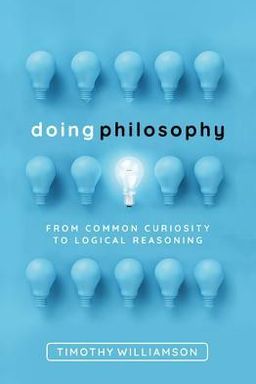
Doing Philosophy cover

Doing Philosophy

by Timothy Williamson

Doing Philosophy by Timothy Williamson challenges the notion of philosophy''s irrelevance in the scientific age. It highlights philosophy''s enduring importance in understanding language, logic, and reasoning, offering practical insights into clearer thinking and effective communication.

Doing Philosophy as a Rigorous Human Science

What does it really mean to do philosophy? Have you ever found yourself asking deep questions—about knowledge, truth, or morality—and wondering whether those questions have real answers? In Doing Philosophy, Timothy Williamson argues that philosophy is not an airy art of speculation or an obsolete rival of science but a non-natural science in its own right—one that asks the most general questions about reality and uses disciplined reasoning, imagination, and analysis to answer them. He believes that when properly practiced, philosophy progresses, tests theories, and refines its methods just as other sciences do.

Throughout the book, Williamson explores how philosophers think—how they use arguments, thought experiments, formal logic, conceptual clarity, and imagination to expand what we know. He insists that philosophy begins from common sense, uses disputation and counterexamples to test ideas, and discovers new conceptual limits through systematic reasoning. In his view, philosophy’s methods have much in common with mathematics and the theoretical side of the natural sciences. It’s not mystical; it’s a form of disciplined inquiry into the most abstract features of reality, built on the ordinary intellectual capacities all humans share.

Philosophy’s Scientific Ambition

Williamson opens with a surprising metaphor—the rugby player Jean-Pierre Rives, who emphasized clear, simple, systematic thinking to guide his strategy on the field. Rives becomes a stand-in for a modern philosopher: someone who must break complex moves (or questions) into clear parts and rebuild them with rigor. For Williamson, this Cartesian clarity—derived from René Descartes’ call for distinct understanding—is emblematic of good philosophical method. But unlike Descartes, Williamson rejects the unnecessary leap into extreme doubt. He believes philosophy improves knowledge rather than demolishing it. Philosophy, he says, is about direction, not destruction.

The core of the book is an attempt to show that philosophy can make genuine theoretical progress despite its abstract subject matter. Just as physics investigates matter and motion, philosophy investigates knowledge, truth, possibility, and value. It doesn’t compete with science—it complements it. Where science uses empirical testing to uncover specific laws, philosophy uses logical and conceptual tools to understand the framework that makes those laws and observations intelligible. Both forms of inquiry seek universality: science over what exists in nature, philosophy over what’s possible in general.

From Common Sense to Critique

Williamson’s starting point is pragmatic: you can only start from where you are. Every inquiry must begin with common sense—the shared knowledge, language, and reasoning skills ordinary humans use to navigate the world. This doesn’t mean that philosophy merely repeats folk beliefs. Quite the reverse: like science, it advances by identifying when common sense misleads us. But, as Williamson points out, even physics presupposes trust in sensory experience, communication, and memory. Common sense is both the starting ground and the periodic checkpoint of philosophical method. It’s what keeps philosophers from drifting into incoherent fantasies.

The chapters that follow trace how philosophers stretch, refine, and criticize this shared foundation. First come the forms of argument and disputation that define philosophical practice. Then comes conceptual clarification—how philosophers use and reshape language. Next, Williamson covers thought experiments and the imagination, showing how hypothetical cases test the boundaries of theories. Later, he introduces comparisons among competing theories, the logic of deduction and abduction, and explains how thought and history enrich philosophical knowledge. In short, he maps out the working “toolbox” of the modern philosopher.

Why Philosophy Still Matters

Williamson anticipates the most common objection: isn’t philosophy just abstract prose and unresolvable debate? His answer is direct. The appearance of stalemate betrays a misunderstanding of philosophical progress. Progress in philosophy, he says, is like progress in mathematical foundations or in theoretical physics. We see refinement rather than empirical breakthrough, and progress occurs when better theories outcompete weaker ones, when argumentation forces clarity, and when new formal or conceptual tools open up fresh avenues of thought.

In the closing chapters, Williamson also defends the enduring future of philosophy. Against pressures to turn it into psychology, political commentary, or literature, he urges readers to see philosophy as a continuing scientific endeavor. Its purpose is not self-help or polemic but understanding—using precise and reliable methods to pursue the most general truths. Philosophy’s tools will evolve, he predicts, not by abandoning its past but through self-correction and integration with the empirical sciences. In the long run, the refinement of philosophical methods is itself a form of progress.

Core Claim: Doing philosophy well means applying the same disciplined, self-corrective reasoning found in the sciences to the most abstract, fundamental questions. Philosophy is not obsolete—it is the study of everything science presupposes but cannot test.

In essence, Doing Philosophy is a defense of philosophy as an intellectually courageous and scientifically minded craft. It teaches you to think critically about what you know, how you know it, and why the questions that seem simplest—about knowledge, truth, meaning, and reality—are still the deepest ones we can ask.


Starting from Common Sense

Williamson begins where all philosophy begins: with common sense. You may not realize it, but every belief you have, from knowing that the coffee is hot to trusting that a tree stands outside your window, depends on basic cognitive capacities—seeing, remembering, understanding language. Even skeptics who doubt everything still rely on those same powers to do their doubting. Hence, like the traveler who “can’t start her journey from anywhere but here,” you must start philosophical reasoning from what you already know.

Building on Shared Human Capacities

Common sense, according to Williamson, isn’t merely a set of trivial facts; it’s the network of perceptual and rational abilities that make human knowledge possible. These include sensory perception, memory, communication, and imagination. He notes that while the content of common sense may vary by culture—in modern society we know the sun is larger than the Earth, while Stone Age people did not—the basic methods of reasoning and perception remain universal.

Yet philosophers disagree about whether to trust common sense. Thinkers like Thomas Reid and G.E. Moore defended it as the bedrock of all inquiry, while radicals like Bertrand Russell and Peter Unger suspected common sense of harboring outdated metaphysics. Williamson’s middle path is subtler: common sense is both fallible and indispensable. You must start with it but remain ready to test and, when warranted, revise it.

Testing Beliefs and Theories

Williamson emphasizes that philosophical theories are always held accountable to the reality checks of common-sense knowledge. He gives practical examples—a colleague’s theory of perception that implies you cannot see through a window, or McTaggart’s idea that time is unreal, which contradicts the everyday truth that breakfast follows waking. Those theories, quite simply, cannot be right. However elegant their reasoning, they collapse against ordinary experience. Common sense is not the end of philosophy, but it is a crucial check on philosophical excess.

Evidence, Fallibility, and Reliability

Williamson also challenges the idea that our evidence consists only of immediate appearances—how things seem subjectively. He argues that appearances are too private and fallible to serve as stable evidence: even our judgments of how things appear can be mistaken. That’s why both science and philosophy rely on public, sharable evidence—knowledge rooted in the common world that others can verify. A theory that denies the possibility of observation cuts off its own justification. For instance, a “scientific” claim that there are no observers at all undermines the very act of scientific discovery.

In this sense, Williamson aligns philosophy with the spirit of science: both trust fallible human faculties refined by correction, not by infallible insight. He closes the chapter with an evolutionary reflection: species like humans and impalas survived precisely because their ways of knowing track reality well enough to matter. Fallibility doesn’t discredit common sense—it explains why it works as a resilient, self-correcting system of belief.

Key Lesson: Philosophy must start from common sense but never stop there. Our cognitive tools evolved to help us survive, not to deceive us. Rejecting them wholesale leaves us with no ground from which to reason at all.


Philosophy as Argument and Debate

If you’ve ever listened to a heated academic debate, you might think philosophers just enjoy arguing. Williamson explains why disputation isn’t just verbal combat—it’s philosophy’s essential engine of progress. The life of philosophy unfolds not in sermons but in question and answer. He compares Q&A sessions at conferences to chess matches where each move tests the logic of the other’s position. These exchanges sharpen thought, expose flaws, and teach humility about one’s own reasoning.

The Value of Adversarial Discussion

Williamson explores the parallel between philosophy and law. In an adversarial trial, truth emerges by letting each side present its strongest case. Similarly, when philosophers defend opposing theories—determinism versus free will, realism versus idealism—each side forces the other to clarify and strengthen its reasoning. Of course, this process depends on shared respect for rules of argument and listening. A “gladiatorial” culture without fairness degenerates into bluster; but without criticism, errors persist unchallenged. Both cooperation and contest are required for truth to advance.

This idea links to medieval roots: disputations were once formal logic games known as obligationes. Scholars had to accept or reject premises according to strict logical rules, much like moves in a game. Williamson highlights that such structured play mirrors the rational aims of philosophy today—it trains thinkers to detect inconsistency and to reason clearly, even under pressure.

From Dialogue to Discovery

The dialogue format, from Plato to Galileo and Hume, embodies this interpersonal nature of philosophy. Plato’s dialogues dramatize inquiry itself—people testing what they and others believe. Galileo wrote his defense of heliocentrism as a dialogue to reveal truth through contrast, while Hume used imagined interlocutors to probe arguments for the existence of God. For Williamson, such forms reflect a deeper truth: philosophy progresses through collective reasoning, not solitary revelation.

Disputes, then, are cooperative ventures. When done well, they teach not just logic but intellectual virtues—listening, self-criticism, and the pleasure of clarity. A corrupt intellectual culture silences dissent; a healthy one prizes argument as the path to understanding. As Williamson writes, even rivalry and ambition can serve truth, provided the culture rewards valid reasoning over prestige.

Takeaway: Philosophical disputation is a cooperative contest. When guided by rules of listening and logic, criticism becomes the surest path to insight.


Clarifying Language and Concepts

Have you ever noticed arguments that go nowhere because people mean different things? Williamson calls this the philosopher’s allergy to ambiguity. In earlier centuries, C.E.M. Joad was famous for answering public questions with, “It all depends what you mean by…”. That phrase, he explains, still captures philosophy’s daily work. To think clearly is to clarify terms, but Williamson warns that this task is not as neutral or easy as it seems.

Beyond Verbal Traps

Clarifying a term like “free will” might dissolve superficial disputes but rarely ends inquiry. One person may define freedom as the ability to choose rationally; another, as acting without causal determination. Once the meanings are clear, the hard work begins: which conception best fits reality and moral responsibility? Williamson shows that genuine progress demands both linguistic precision and theoretical courage. Pure clarification, unconnected to real explanatory goals, becomes verbal tinkering.

Concepts, Conceptions, and Confusions

Williamson distinguishes between concepts—shared meanings, like “vixen = female fox”—and conceptions—the personal network of beliefs associated with a term. Because conceptions vary, people can disagree while sharing the same concept. He warns against reducing philosophy to “conceptual analysis” in the dictionary sense. Words like “know,” “cause,” or “woman” cannot be captured solely by tidy definitions; they gain meaning through complex human practices. He uses the debate about defining “woman” as a vivid example: biological, social, and self-identification criteria collide, and no linguistic fix alone can solve the moral and political dilemmas involved.

Williamson also critiques the obsession with conceptual truth—the idea that philosophy discovers truths built purely into our terms. Testing statements by universal assent (“everyone who understands it agrees it’s true”) fails once we consider dissent or moral evolution. For example, someone might reject “Red things are colored” due to social connotations of the word “colored.” Understanding persists despite disagreement, proving that concept and conviction can come apart.

Clarity as Theory, Not Definition

In the end, Williamson likens philosophical clarity to the precision of mathematics. Mathematicians rely on undefined terms (like “set” or “∈”) within coherent theories, not on complete definitions. Similarly, philosophers achieve clarity by developing strong, explanatory theories rather than endless wordplay. Clarity exposes mistakes; it doesn’t sterilize thought. Resisting clarity, he quips, is usually a way to hide confusion.

Lesson: Clarifying meaning is not about policing words—it’s about deepening understanding. Real clarity comes from building coherent theories that make disagreement explicit, not from pretending that perfect definitions will end argument.


Knowing Through Thought Experiments

What if you could test a philosophical idea not in a lab, but in your mind? Williamson’s chapter on thought experiments explains how imagination serves as philosophy’s experimental instrument. He recounts cases from Dharmottara’s ancient story of mistaken smoke to Edmund Gettier’s famous 1963 challenge to “justified true belief.” Both show how counterexamples—whether real or imagined—reveal hidden cracks in theories of knowledge.

Imagining as Testing

In Dharmottara’s example, a man reasonably believes there is a fire ahead because he sees what seems to be smoke—but it’s actually a cloud of flies. Though his belief is true and justified, it’s true by luck; he doesn’t know. The case shows that knowledge requires more than justified true belief. This insight, revived by Gettier centuries later, revolutionized epistemology. According to Williamson, the point doesn’t depend on running real-life smoke-trick experiments. The validity of the case arises from its possibility alone—our capacity to imagine it vividly reveals that the theory fails.

Moral Imagination and Ethical Progress

Williamson extends the method through Judith Jarvis Thomson’s “violinist” thought experiment on abortion. You wake to find yourself attached to a famous musician whose life depends on your kidneys. Are you morally obliged to stay connected for years? Most readers feel entitled to unplug, even if the violinist is a person. By analogy, pregnancy may also involve moral liberty without denying personhood. Here, thought experiment unveils moral nuance beyond slogans. And, as Williamson notes, replicating it in reality would be both impossible and unethical—precisely why imagination matters.

Imagination, Intuition, and Bias

Some critics dismiss such mental exercises as “armchair daydreaming.” Williamson replies that philosophers use imagination the same way scientists do when predicting hypothetical outcomes. Galileo’s imagined falling stones, Einstein’s “ride on a light beam,” and even Chalmers’s zombies exemplify this. The key difference is the domain: philosophers test conceptual necessity rather than empirical fact. Still, he warns against mystifying intuition. Judgments in thought experiments rely on the same cognitive capacities we use in everyday reasoning, not on mysterious insight. Like any human judgment, they’re fallible and can be biased. Cultural experiments once suggested that men and women, or East and West, respond differently; later psychological studies showed these differences mostly vanish when methods improve. Shared human cognition, evolved for realistic imagination, keeps thought experiments largely reliable—but never infallible.

Insight: Thought experiments are not mental tricks but disciplined uses of imagination. When done carefully, they are the philosopher’s laboratory—testing what must be or could be true when the world is safely imagined otherwise.

Dig Deeper

Get personalized prompts to apply these lessons to your life and deepen your understanding.

Go Deeper

Get the Full Experience

Download Insight Books for AI-powered reflections, quizzes, and more.