
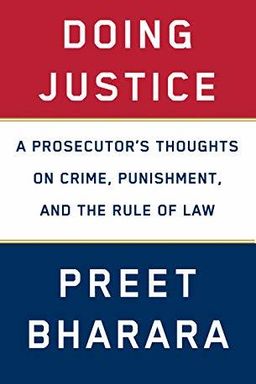
Doing Justice cover

Doing Justice

by Preet Bharara

Dive into the insightful world of justice with Preet Bharara, a former federal prosecutor. ''Doing Justice'' explores the intricate balance of truth, fairness, and humanity in legal proceedings through compelling cases and thoughtful reflections on law enforcement and reform.

The Fragile Pursuit of Truth

How do you find truth in a world of ambiguity, bias, and power? In this book, Preet Bharara draws on decades as a prosecutor to show that justice is less about certainty and more about disciplined humility. He argues that fair process—not slogans or speed—preserves truth in a complex system full of fallible humans. His stories of investigators, cooperators, judges, victims, and prisoners reveal that the justice system’s real integrity depends on people who combine logic with conscience.

Across its parts, the book takes you from investigative craft to courtroom persuasion to the dilemmas of punishment and mercy. It’s both memoir and manual—a primer on how justice truly works when no one has a perfect map. Bharara’s method is rooted in doubt: presume error, seek corroboration, admit uncertainty, and remember that the character of those who wield power determines what justice becomes.

The messy art of investigation

Bharara begins by reminding you that investigations are not Rubik’s cubes with guaranteed solutions. They are messy, uncertain journeys through conflicting evidence and fading memories. You must balance zeal with restraint, as hurry breeds error. Tacitus’s line—“truth is confirmed by inspection and delay”—frames this ethic: speed matters, but patience saves lives and reputations.

He uses the Menendez and Nemazee examples to show how easy narratives seduce even experts. The most dangerous mistake, Bharara insists, is forcing facts to fit a theory rather than testing theories against facts. Investigators succeed not by formulas but by judgment—and judgment depends on character as much as competence.

Bias, forensics, and humility

The Brandon Mayfield fingerprint debacle exposes how confirmation bias corrupts even expert science. Four trained examiners misidentified a print after the Madrid bombings, letting cultural assumptions—about religion and terrorism—reinforce their error. Bharara’s moral: always think you may be mistaken. Build systems that separate identity from analysis, welcome dissent, and require blind review. Institutions, like individuals, need humility to keep truth alive.

Humane toughness and correction

Elite investigators such as Kenny McCabe and John O’Malley embody justice’s best face—expert, patient, and morally grounded. McCabe’s exhaustive mastery of the Mafia and O’Malley’s courage to free the wrongly convicted show two sides of the same ethic: diligence and decency. Real investigators don’t just catch criminals; they correct mistakes. Their examples remind you that fairness requires steady humility as well as skill.

Empathy as strategy

In interrogation, Bharara upends Hollywood myths. Hanns Scharff, the humane WWII Luftwaffe interrogator, extracted secrets through respect and rapport, not brutality. The same approach worked in modern terrorism cases like Faisal Shahzad (Times Square) and David Headley (Mumbai). Torture, by contrast, yields noise. The practical lesson: good interrogators rely on preparation, patience, and empathy to make truth speak.

Moral and practical paradox

Bharara threads these early lessons through a larger paradox: the pursuit of justice requires both skepticism and courage. You must act boldly when facts justify it and walk away when they don’t. The book rejects idealized certainty and replaces it with a deeper credo—truth emerges only through disciplined doubt and the moral independence of those willing to delay, disagree, and persist.

(Note: Readers of investigative classics like Robert Caro’s The Power Broker will recognize Bharara’s fascination with process over outcome—the belief that institutions fail not from bad laws but from people who forget that power, left unexamined, bends truth. This book invites you to be the kind of person who resists that bend.)


Errors, Ethics, and Investigative Craft

You learn early that truth is fragile and that investigators can easily mistake confidence for competence. Bharara shows this through examples like the Mayfield fingerprint fiasco, the false Menendez assumptions, and the Nemazee fraud—a parade of cases where emotion and haste distorted reality. He teaches that discipline, not brilliance, prevents error: cross-check facts, welcome challenge, and let data unsettle your theory.

Bias as an invisible adversary

Confirmation bias works quietly. Once an idea seems plausible, teams defend it as identity. Bharara’s remedy is structural humility: independent verification, blind review, and cultures that reward dissent. Investigators must cultivate a mindset of inspection and delay—slowing down to let contradictions reveal themselves. This is not timidity; it’s precision.

Human character as evidence

Technical expertise alone cannot rescue a corrupt process. Bharara’s portraits of McCabe and O’Malley reveal virtues absent from manuals—curiosity, fairness, and compassion. McCabe’s quiet thoroughness dismantled mob empires; O’Malley’s moral courage freed six innocent people. The point: good investigators are moral craftsmen whose tools are patience, skepticism, and conscience.

Rapport versus brutality

In interrogation, cruelty backfires. Bharara cites Hanns Scharff’s humane methods during WWII and modern JTTF cases to prove that empathy elicits cooperation, while torture erases trust. The most effective strategy is psychological—the art of making a suspect want to talk. You control timing and tone, not through violence, but through insight into human pride and fear.

Practical creed

Follow the facts, question your certainties, and remember that patience is the highest evidence of professionalism.

When truth hides behind complexity or deception, Bharara’s message is to double down on virtue: build patient systems and fill them with skeptical, humane investigators who value process as much as result.


Charging Power and Restraint

Deciding to charge someone may be the most consequential act in public life. Bharara dissects that choice through the lens of law, psychology, and culture. Investigations often develop momentum—the collective pride and sunk cost that push teams toward indictment even when evidence weakens. The disciplined prosecutor must fight this pull and embrace walking away as an act of integrity.

Two-pronged test for prosecution

You must answer two questions: Do you believe the target is guilty? And can you prove it beyond a reasonable doubt? Both must be yes. Bharara calls this the moral and strategic pair every prosecutor must navigate. The second without the first is cynical politics; the first without the second is faith without evidence.

Case dilemmas

He illustrates lines through the Long Island Rail Road disability fraud, public corruption trials (Silver and Skelos), and preemptive threat cases like the “cannibal cop.” The Cannibal Cop’s chats stayed fantasy, but the Van Hise conspiracy involved tangible steps—showing the blurry frontier between thought and crime. The grand jury that declined to indict a camp escapee to visit his wife also demonstrates compassion’s place inside the rule of law.

Leadership as ethical design

Bharara argues that offices must “remove the bias toward prosecution.” By normalizing declination and rewarding judgment as much as wins, leaders preserve independence. Public appetite for vengeance should never substitute for reason. The mark of mastery is knowing when not to act.


Power, Culture, and Corruption

Crime doesn’t thrive only from greed; it flourishes in permissive cultures. Bharara explores how institutional incentives and tone from the top govern compliance. You can’t regulate ethics by memo—you must live them through visible, repeated choices. The SAC Capital and Wells Fargo scandals reveal how warped incentives turn smart professionals into chronic offenders.

The anatomy of bad culture

At SAC, leadership ignored warnings about hiring tainted traders; at Wells Fargo, impossible sales targets made fraud inevitable. Both signal a neglected truth: culture controls conduct. When top leaders reward only results, people rationalize corruption as competition. Ray Kelly’s NYPD reforms highlight the antidote—public accountability, elevated internal affairs, and moral credibility from the top.

Innovation within tradition

Bharara praises innovation that enhances justice without breaking rules. SDNY’s creative use of wiretaps for insider trading and its undercover digital “Card Shop” operation show how curiosity yields breakthroughs. Kurt Hafer’s human review of financial SARs—catching patterns algorithms missed—illustrates how human judgment and tech can complement, not replace, each other.

Operational lesson

Recruit innovators, empower dissent, and reapply old tools to new threats—the formula for ethical agility.

In short, culture is the long game of justice. Build one that values asking “why” over saying “yes.”


Trials, Storytelling, and Credibility

When cases reach court, evidence alone rarely persuades. Bharara reframes the trial as a civic story. Jurors respond to narrative, empathy, and credibility. Prosecutors must become teachers and storytellers who explain not only what happened but why it matters. A bad story with perfect evidence loses; a clear story with truth lives in memory.

Persuasion through narrative

He favors short reframes that condense morality into one line—Rajaratnam’s “They did their homework. But they cheated too.” Simplicity wins minds. Mock trials and focus groups, used in the Skelos case, test whether metaphors land. The best storytelling balances rigor with humility, letting facts breathe.

Judges and temperament

Justice also depends on courtroom personality. A judge’s style—patient or theatrical—shapes tone and tactics. Bharara recounts how SDNY managed adverse rulings through strategic negotiation. You must read the human behind the robe. Respect for process includes understanding temperament as a variable in justice, not a constant.

Victims’ voices

The SueAnn case, elevating a drug-addicted victim’s credibility through financial forensics, demonstrates moral storytelling: the courage to believe the unlikely truth. #MeToo cases further changed prosecutorial risk appetites, showing how public values reshape whom the system protects. Good prosecutors don’t just win—they give the marginalized their day in court.


Punishment, Mercy, and Moral Reform

Punishment tests not only defendants but also society’s conscience. Bharara ends with sentencing and confinement—the places where rules meet raw humanity. The Baby Carlina kidnapping case shows how mandatory minimums can collide with compassion, forcing prosecutors to balance punishment with mercy and victims’ trauma. The office’s decision to spare Carlina a trial by allowing discretionary sentencing defined mercy as courage, not weakness.

Justice after conviction

Inside prisons, culture determines whether punishment reforms or corrodes. Bharara’s accounts of Rikers—Jason Echevarria’s death after neglect and Ronald Spear’s killing by officers—reveal how institutional cruelty grows from apathy more than malice. Yet small interventions like Rikers Rovers, pairing juveniles with rescue dogs, prove that humane reform can cut through cynicism.

Forgiveness beyond law

The book closes with Rais Bhuiyan’s extraordinary forgiveness of Mark Stroman, the white supremacist who shot him. Bhuiyan’s attempt to save his assailant from execution reframes justice as moral evolution rather than vengeance. Stroman’s partial repentance before death suggests that mercy’s power extends beyond legal closure.

Moral of the journey

Justice is a continuum: from investigation to forgiveness. Its survival depends on those willing to act with integrity when every incentive points to haste, pride, or vengeance.

In the end, Bharara teaches that mercy, too, is truth seeking—a discipline that recognizes the humanity on both sides of the crime.

Dig Deeper

Get personalized prompts to apply these lessons to your life and deepen your understanding.

Go Deeper

Get the Full Experience

Download Insight Books for AI-powered reflections, quizzes, and more.