
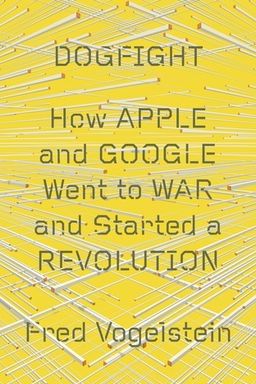
Dogfight cover

Dogfight

by Fred Vogelstein

Dogfight dives into the dramatic transformation from collaboration to rivalry between tech giants Apple and Google, revealing the intense battles and innovations that defined the smartphone era. Join Fred Vogelstein on a journey through secrecy, innovation, and the relentless drive for tech supremacy.

The Road Trip That Carried Einstein’s Brain and the Meaning of Wonder

What would it feel like to carry the mind of the greatest genius of the twentieth century across America? Michael Paterniti’s Driving Mr. Albert: A Trip Across America with Einstein’s Brain begins with that very question—and turns it into a deeply reflective travel narrative about curiosity, obsession, aging, and the mystery of human legacy. Through a literal and psychological road trip with Dr. Thomas Stoltz Harvey, the man who removed and secretly kept Einstein’s brain after the physicist’s death, Paterniti examines what happens when genius is reduced to matter and a life becomes a myth.

At its core, the book isn’t just about Einstein’s brain—it’s about what it means to chase meaning in an age of disconnection. Paterniti, a young writer in search of purpose, finds himself behind the wheel of a Buick Skylark beside an 84-year-old pathologist on a pilgrimage from Princeton, New Jersey, to California. In the trunk sloshes Einstein’s brain, sealed in Tupperware and hidden in a duffel bag like an ordinary lunch. What unfolds is an odyssey through American geography and philosophy—reflecting on science, fame, mortality, and the yearning for transcendence.

From Myth to Human Matter

After Einstein’s death in 1955, pathologist Thomas Harvey performed the autopsy at Princeton Hospital. Moved by scientific awe—or perhaps a strange compulsion—he removed Einstein’s brain, promising to study it for posterity. Instead, for decades he carried it with him, slicing, preserving, and distributing its pieces to curious researchers across the world. Paterniti’s encounter with Harvey decades later transforms that surreal possession into a symbol: the literal brain as the vessel of genius and the metaphorical brain as humanity’s search for meaning.

Harvey’s story, recounted in Paterniti’s lyrical and compassionate prose, becomes a mirror for our collective anxiety about mortality and greatness. Can brilliance survive decomposition? Can mind live apart from body? In following Harvey, Paterniti faces these questions himself—as a man struggling with his own direction, his aging parents, and his uncertain relationship with his girlfriend, Sara. The journey becomes both a reportage and a self-investigation, merging biography, travel writing, and philosophy in one long drive westward.

America as a Mirror of Mortality

The landscapes of the journey—rusted diners in Ohio, motel parking lots in Kansas, the deserts of New Mexico—reflect both Harvey’s mortality and the narrator’s longing to make sense of it. As they pass through small-town diners and roadside shrines, Paterniti portrays America as a nation obsessed with memory yet driven by speed. Einstein, who bent time and space, now becomes a cliché of American consumerism, his face printed on mugs and T-shirts—while his literal brain travels anonymously in a trunk.

“Simply having Einstein’s brain in the trunk rearranges the way you see everything,” Paterniti writes. “The places, the people, even the light—it all becomes relative.”

In this sense, Driving Mr. Albert becomes a travelogue of the American psyche—a blend of science and spirituality, flesh and myth. The book echoes the introspection of John Krakauer’s Into the Wild and the philosophical wanderlust of Robert Pirsig’s Zen and the Art of Motorcycle Maintenance, but with a twist: here, the relic of a genius replaces the open road as the central mystery.

Reckoning with Legacy and Love

Over the course of the trip, the relationship between Paterniti and Harvey oscillates between reverence and irritation, humor and heartbreak. Harvey, with his Green Beret hat and decades-old slouch, becomes a symbol of denial and persistence—haunted by controversy, failed marriages, and unfulfilled scientific ambition. Paterniti sees in him both a cautionary tale and an implicit question: what happens when one’s life becomes defined by another man’s greatness?

Their encounters—with William Burroughs in Kansas, or with Albert Einstein’s granddaughter Evelyn in Berkeley—serve as stations on a pilgrimage toward releasing the brain, and perhaps releasing the past. Through each meeting, Paterniti explores the fragile human stories that orbit genius: ambition, loneliness, and the futile attempt to capture eternity in jars and formulas. Meanwhile, his calls home to Sara reveal another kind of dissection—the autopsy of love strained by distance and doubt.

Why the Story Matters

Paterniti’s book resonates because it uses an eccentric real-life event to expose universal truths. In Einstein’s brain, he finds not answers about intelligence but questions about what we value and remember. The story sits at the intersection of history and mythmaking: the way humanity builds altars—intellectual or literal—to retain a sense of continuity in a universe governed by decay. The relationship between writer and doctor becomes a stand-in for everyone’s dialogue with mortality and meaning.

More than an investigative chronicle, Driving Mr. Albert reads as an elegy—for Einstein, for Harvey, and for a culture that confuses possession with understanding. As they reach California, the object they’ve carried all this way becomes what it always was: a cluster of cells, extraordinary only in the stories told about it. What remains is the journey—the long, improbable road between reverence and release.


The Myth and Matter of Genius

Paterniti uses Einstein’s brain to strip away the illusions we have about genius. For decades, people sought to uncover what made Einstein’s mind different—larger neurons, thicker cortices, more glial cells—but what emerges isn’t a medical revelation; it’s a meditation on humanity’s obsession with the physical residue of greatness. We want to find genius in the folds of gray matter because it reassures us that brilliance can be measured and maybe replicated. But Paterniti reminds you that genius is not in the tissue—it’s in the mystery.

Dissecting the Legend

When Harvey extracted the brain in 1955, he believed he was preserving the material of modern divinity. Yet instead of fame, he found banishment. He lost his job, his marriages, and his medical license. For forty years he guarded the brain in jars and boxes like a secret relic no one asked for. Einstein, the man who refused a presidency and preached simplicity, had asked to be cremated. The irony—one man craved anonymity, and another spent a lifetime carrying his remains—forms the emotional backbone of the book.

These contradictions mirror society’s mixed feelings about intellect itself. We worship Einstein as a saint of rational progress but reduce him to a celebrity caricature. We want the mystery without the math. (In Walter Isaacson’s Einstein: His Life and Universe, this same paradox surfaces: the icon is both human and myth, approachable yet unfathomable.) Through Harvey’s quiet life, Paterniti confronts what happens when knowledge becomes commodity—and when curiosity turns to desecration.

Einstein’s Flesh, Humanity’s Projection

Einstein’s brain becomes a mirror of everyone who touches it. For Harvey, it’s proof of purpose. For researchers like Marian Diamond or Sandra Witelson, it’s professional validation. For the Japanese scholar Kenji Sugimoto, who weeps upon receiving a sample, it’s spiritual connection—a relic that “brings harmony” like a saint’s bone. Even Einstein’s granddaughter, Evelyn, torn between disgust and curiosity, can’t escape its pull. Each person projects onto it their longing for certainty: scientific, moral, or existential.

Paterniti invites you to consider how we treat genius the way medieval societies treated relics: with reverence fueled by fear that meaning will vanish when the relic turns to dust. The brain that once imagined relativity now floats in formaldehyde—proof that even the greatest minds can’t outthink entropy.

The Paradox of Preservation

The deeper you follow Harvey, the more you see the spiritual cost of preservation. In trying to hold on to Einstein’s genius, Harvey loses track of his own life. His career collapses; his relationships dissolve. The relic he guarded infects him with a quiet form of madness—the belief that meaning can be contained. By the time Paterniti meets him, Harvey’s existence has shrunk to a basement, his past embalmed like the brain he cannot release. Genius, Paterniti suggests, isn’t about what you keep—it’s about what you let go.


A Nation of Roads and Ghosts

The road trip across America transforms the bizarre premise into allegory. For Paterniti, America itself is a kind of open autopsy—its landscape dissected to reveal nostalgia, myth, and contradiction. As Harvey and the narrator drive west—from decaying industry through prairie desolation to desert light—they’re really traveling through the layers of a century: the birth of science, the decay of idealism, and the triumph of restless desire.

Roads as Reflections

Every stop holds symbolic weight: Princeton’s academia, Kansas’s middle-American melancholy, Los Alamos’s atomic revelation. The visit with novelist William S. Burroughs collapses counterculture and pathology, genius and decay. Burroughs, fading and drugged, mirrors Einstein as another American saint undone by vision. Paterniti reveals that the “land of the free” is also a graveyard of abandoned ideals—each diner and motel a shrine to fleeting wonder.

The America of Driving Mr. Albert owes as much to Jack Kerouac as to Studs Terkel: a living geography of yearning and entropy. Every scene—the waitress in Flagstaff, the snow in Maine, the cardboard hotels—becomes a study in the relativity of time and memory. In keeping Einstein’s brain on ice, Harvey preserves what America keeps trying to: its myth of progress.

The Automobile as Pilgrimage

Their Buick Skylark becomes a chapel on wheels—a place of confession, tension, and fleeting revelation. For Paterniti, driving offers escape from paralysis; for Harvey, it offers one last motion through time. The car bridges generations, carrying not just Einstein’s tissue but two men’s hunger for meaning. Watching the old scientist’s ashes mirrored in the car’s rearview, Paterniti recognizes that movement is the modern substitute for faith: if you can’t resolve your life, you can at least keep going.


The Science of the Soul

While the journey is physical, its underlying question is metaphysical: can science explain the soul? Through Einstein’s letters, Paterniti revisits the physicist’s vision of a “cosmic religion” where awe replaced dogma. He contrasts that serene rationality with Harvey’s literal-minded faith in biology. The result is a meditation on how the scientific quest often masks a spiritual one.

Relativity and Religion

Einstein’s theories showed that time and space bend relative to perspective. Paterniti extends this idea to emotion and belief: what’s true depends on where you stand. The road becomes a metaphor for relativity applied to existence—every diner conversation, every sunset, an experiment in shifting frames of reference. Einstein sought an impersonal God of order; Harvey and Paterniti grapple with a personal God of coincidence and loss.

Faith in Matter

Harvey’s fixation on Einstein’s brain becomes a secular act of devotion. He believes the answers lie in tissue slides, just as medieval monks sought truth in relics. But Paterniti points out the irony: Harvey’s futile science becomes its own religion, complete with secrecy and guilt. He treats glass jars like reliquaries, whispers like prayers. In observing him, you recognize the sacred impulse beneath even the coldest inquiry—the need to make sense of death.

Ultimately, Paterniti suggests that the real theory unifying physics and faith is wonder: the willingness to look into the void and still feel awe.


Human Relationships in the Shadow of Genius

Amid science and travelogue, Paterniti grounds the narrative in love and loneliness. His affection for his girlfriend Sara runs parallel to Einstein’s and Harvey’s failures at intimacy. Each man, consumed by work or obsession, struggles to balance intellectual pursuit with connection. The brain becomes a cold counterweight to the human heart.

Love and Disconnection

While Harvey reminisces about his wives and alienations, Paterniti’s phone calls with Sara crackle with distance—she writing from Maine while he drives through oblivion. Einstein’s own letters to his wives Mileva and Elsa reveal similar emotional detachment: affection filtered through logic. The author weaves those stories together, creating a worldview where the pursuit of knowledge and intimacy continually collide.

Generations of Loss

Each woman—Sara, Elsa, Evelyn Einstein, even Harvey’s ex-wife Raye—embodies the cost of devotion to genius. Paterniti refuses to idealize intellect when it isolates. Amid his own uncertainty about family and adulthood, he sees that the road to enlightenment may also be the road away from love. In this, the book echoes Rebecca Solnit’s idea in A Field Guide to Getting Lost: wandering reveals you, but it also erases what you leave behind.


The Ethics of Curiosity

Throughout the narrative, Paterniti raises a moral puzzle: where does wonder become violation? Harvey insists he acted out of scientific duty when he removed the brain, yet everyone—Einstein’s family, Harvard colleagues, the media—saw theft. Paterniti’s own fascination with the doctor mirrors the larger human drive to probe what should remain private. Curiosity, he realizes, can be both sacred and predatory.

Curiosity’s Double Edge

The line between inquiry and exploitation blurs from the autopsy to the author’s tape recordings. Even literature becomes a kind of dissection: turning a man’s life into story. By humanizing Harvey rather than condemning him, Paterniti forces you to confront your own complicity in voyeurism. Why are we drawn to peek inside great minds—literally or metaphorically?

In this way, Driving Mr. Albert becomes an ethical reflection disguised as adventure. The question isn’t whether Harvey was right to keep the brain; it’s whether any of us can resist trying to solve the unsolvable.


In Search of Meaning and Surrender

By the end, Paterniti finds that meaning doesn’t lie in Einstein’s neurons but in the act of letting them go. In California, when the road trip culminates with Harvey meeting Einstein’s granddaughter Evelyn, the attempted reconciliation feels anticlimactic. The brain remains a riddle—small, fragile, half-forgotten on a back seat. That mundane ending is the point: the sacred object was always ordinary.

Harvey finally transfers the brain to another physician, surrendering his burden. The gesture redeems him—not through discovery but through release. For Paterniti, that release echoes his own. He reconnects with Sara, realizing that awe isn’t in objects or equations but in the fragile continuance of love, loss, and curiosity. Like Einstein’s theory of relativity, meaning shifts with perspective; it exists only in motion.

“We are always driving with our secrets in the trunk,” Paterniti concludes, “amazed by the cows and rainbows and palm trees.”

Driving Mr. Albert ultimately teaches that life’s mysteries are not meant to be solved, only carried for a while—and then released.

Dig Deeper

Get personalized prompts to apply these lessons to your life and deepen your understanding.

Go Deeper

Get the Full Experience

Download Insight Books for AI-powered reflections, quizzes, and more.