
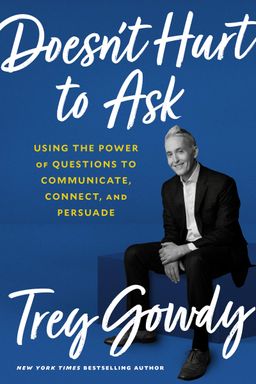
Doesn''t Hurt to Ask cover

Doesn''t Hurt to Ask

by Trey Gowdy

In ''Doesn''t Hurt to Ask,'' Trey Gowdy reveals how asking the right questions can transform your ability to persuade and connect with others. Learn how to guide conversations, earn trust, and subtly influence outcomes, whether in the courtroom, boardroom, or at home.

The Art of Persuasion Through Questions

Have you ever tried to change someone’s mind, only to be met with blank stares, defensiveness, or silence? In Doesn’t Hurt to Ask, former prosecutor and Congressman Trey Gowdy argues that persuasion isn’t about arguing harder — it’s about asking better questions. Persuasion, he contends, is not coercion or manipulation, but a subtle art rooted in curiosity, empathy, and preparation. Whether you’re persuading a jury in a courtroom, a coworker in a meeting, or a teenager at the dinner table, your greatest tool isn’t the perfect speech — it’s the right question asked at the right moment.

Gowdy’s central belief is simple yet demanding: Persuasion begins with listening. He learned in two decades as a prosecutor and eight years in Congress that people rarely change their minds by force. They change when they feel understood. This book, he tells us, is not a political memoir or legal manual but a manual for communicating truth effectively — how to turn conversations into discoveries and arguments into understanding through questions.

Truth Begins with Inquiry

Gowdy opens his exploration through his experiences both in the courtroom and in the U.S. Congress. Before he could convince a jury or a committee, he had to convince himself — by examining his motives and asking hard questions of his own beliefs. The power of asking questions, he explains, lies in its disarming humility. Questions, unlike declarations, invite dialogue rather than resistance. And as he notes repeatedly, even the toughest jury or political adversary responds better when they feel respected for their capacity to think independently.

To persuade anyone — a judge, a voter, or a child — you must first understand their perspective. Drawing on lessons from figures such as Judge George Ross Anderson Jr. and fellow lawmakers like Senator Tim Scott, Gowdy illustrates how authentic curiosity opens paths that logic alone cannot. His mentor Judge Anderson sent him into bars to listen to “real people” — not to argue, but to learn how they speak, what they fear, and how they think. Persuasion, Gowdy discovered, begins not with eloquence but with empathy.

Why Questions Beat Statements

Throughout the book, Gowdy contrasts questions with statements. A declarative statement, he explains, shuts doors. It makes you responsible for being perfectly right. But a question keeps you safe and curious. Even when you get something wrong, you can simply say, “That’s why I asked.” More importantly, a well-crafted question lets others reason themselves into agreement — a technique used masterfully by trial lawyers, psychologists, and teachers alike (similar to techniques in Dale Carnegie’s How to Win Friends and Influence People).

This shift from proclamation to exploration was transformative for Gowdy. In his courtroom work, he realized that asking witnesses specific, sequential questions built credibility with the jury far more effectively than grand speeches. Later in Washington, he saw how poorly modern politics embraced this approach — with leaders talking past one another, demanding “wins” instead of understanding. As he notes wryly, persuasion “requires a mind willing to move,” something politics rarely provides.

From Courtroom to Everyday Life

The lessons Gowdy offers extend beyond high-stakes settings. Every person, he argues, faces daily opportunities to persuade — a child to finish homework, a customer to choose a product, a friend to forgive. The key principles apply everywhere: Know your objective, know your audience, and calibrate your proof. Persuasion is not about dominance but collaboration — building an internal map of another’s beliefs and guiding them, gently, toward your conclusion. The best persuaders are the most persuadable people because they model the curiosity they hope to inspire.

Gowdy’s anecdotes — from death-penalty trials to awkward family dinners — reinforce that questions reveal character. They demand humility and preparation: understanding your facts, anticipating counterarguments, and knowing when to gently misalign expectations (as his colleague Sheria Clarke does masterfully). Learning the “burden of proof,” as in law, teaches you how much evidence you must provide depending on the size of your request.

Why This Matters Now

In today’s polarized world, Gowdy’s philosophy feels radically human. He laments that in politics, we often treat allies as self-evidently right (requiring 0% proof) and opponents as impossibly wrong (requiring 100% certainty). Reclaiming the middle — where open minds meet new evidence — is not just good communication; it’s democracy’s lifeblood. “Questions,” he writes, “keep us honest. They remind us that certainty is temporary.”

By the end of the book, Gowdy has woven a comprehensive toolkit: how to structure arguments like a prosecutor, empathize like a pastor, and speak with measured conviction like a teacher. Persuasion, he concludes, is not winning a debate but guiding others — and yourself — closer to truth. Whether you’re in the boardroom, classroom, or family room, the message stands clear: if you want to move people, stop talking at them and start asking them better questions.


Know Your Jury: Understanding Human Nature

Gowdy believes every conversation is a courtroom, and everyone you speak to is your jury. Whether it’s twelve jurors, your coworkers, or your family, success depends on how well you understand the people in front of you. In Chapter 4, “Know Your Jury,” he recounts painful early failures as a prosecutor — moments when his anxiety and detachment alienated jurors rather than convincing them. The turnaround came from a blunt mentor, Judge Ross Anderson Jr., who told him, “You have to learn how to talk to regular people.”

This advice set the foundation of Gowdy’s communication philosophy: you can’t persuade anyone you don’t understand. Human nature — with its hopes, fears, biases, and blind spots — must be your first study. That means learning how others think, not just what they think.

Learning Empathy and Open-Mindedness

The courtroom gave Gowdy thousands of small laboratories in human empathy. He describes jury selection as an “act of radical listening,” forcing him to confront how little self-awareness most people bring to their assumptions. Jurors are instructed to set aside what they “think” they know and judge only what’s proven — a discipline of open-mindedness that Gowdy urges readers to adopt in life. “Could you wipe your slate clean?” he asks. “Could you separate what you believe from what’s been proven?”

That ability — to stay curious despite convictions — is rare. But it’s essential for building trust and credibility. He illustrates this with a touching story about a conservative friend who reversed her stance on immigration after meeting undocumented parishioners at her church. It wasn’t statistics that persuaded her — it was a relationship. As Gowdy notes, “She changed her mind because of compassion, not a spreadsheet.”

Seeing Politics — and People — Differently

When Gowdy served on the House Ethics Committee, he saw that shared humanity firsthand. Behind closed doors, political rivals dropped their defenses to focus on fairness. His collaboration with Democrats like Jared Polis and Ted Deutch reminded him that persuasion thrives where decency does. Outside those walls, polarization returned, proving that persuasion dies when trust disappears. To bridge ideological divides — or family conflicts — he insists on seeing the other person as your “jury of one.”

“Sit down. Listen to real people. Know how they think. Know why they think it.”

Gowdy’s description of talking to the grieving father of a murdered child reminds us that empathy is not sentimental — it’s persuasive. Facts may convince, but compassion converts.

The lesson is timeless — echoed by Aristotle, Dale Carnegie, and Stephen Covey alike. To change minds, meet people where they are, not where you wish they were. It’s the beginning of all effective persuasion — and perhaps the most radical act left in an age of noise.


The Burden of Proof

Drawing from his years in the courtroom, Gowdy introduces readers to one of his most practical analogies: the “burden of proof.” In law, every case requires a level of persuasion — from reasonable suspicion to proof beyond a reasonable doubt. In life, you face the same spectrum every time you ask someone for something. The bigger the ask, the more evidence you need. “The larger the ask,” he writes, “the better you have to be.”

This principle redefines everyday persuasion. Borrowing money from a friend, arguing for a promotion, or convincing a colleague to take a risk all have their own burdens of proof. Gowdy classifies them into a “sliding scale,” teaching you to calibrate your proof — and patience — based on what’s at stake.

The Sliding Scale of Convincing

  • Consent (0% proof): Asking someone’s permission or opinion — “Are you open to hearing…” — requires almost no evidence.
  • Articulable Suspicion (20%): A hunch with modest support — enough to justify curiosity but not commitment.
  • Probable Cause (35-50%): Reasonable belief that something’s true. This is where most negotiations and pitches live.
  • Preponderance (50.1%): When evidence barely tips the scale. It’s “more likely than not.”
  • Clear and Convincing (75%): The standard for major life decisions — new jobs, college choices, marriage.
  • Beyond a Reasonable Doubt (95%): The level demanded for life-altering commitments — from convicting a person to changing your core beliefs.

When persuasion fails, it’s often because you’ve mismatched your proof to your request. One unforgettable example is Sheria Clarke’s strategy of intentional misalignment — exaggerating her “big ask” before revealing it’s something small. By preparing people to deny a major favor, she makes them relieved to accept the minor one (“Can I borrow a pen?”). This bit of psychological judo conditions generosity over time — teaching that trust is a cumulative persuasion asset.

Adjusting the Burden Mid-Conversation

Gowdy also urges readers to stay flexible: people’s emotional investments can shift your burden of proof in real time. What’s trivial to you might be sacred to them. “Read the room,” he advises. If you sense resistance, dial down your request or build more trust first. Persuasion is not conquest—it’s calibration. (This idea aligns with Robert Cialdini’s Influence, which shows how small, progressive steps yield bigger commitments.)

Understanding how much evidence each request truly requires makes persuasion less overwhelming and more strategic. You don’t need to prove everything beyond doubt — just enough to move the needle. And when you respect others’ convictions as much as your own, the proof will often speak for itself.


Authenticity: The Heart of Credibility

“Once you learn to fake sincerity, there’s nothing you can’t do.” David Stephens’ tongue-in-cheek advice to Gowdy became a lifelong touchstone for understanding authenticity. Of course, Gowdy insists, you can’t truly fake sincerity. People sense it. The point, rather, is to model the behaviors of sincerity — care, attention, humility — especially when you’re not feeling them naturally. Emotions don’t have to be constant; commitment does.

Authenticity, Gowdy writes, is the most persuasive force in human communication. It outshines intellect, trumps logic, and builds credibility even when your words falter. The most effective communicators, from teachers to lawyers to spouses, are those who feel what they say.

How to Be Real When You’re Not

We all have days when we don’t feel passionate about our work or our cause. Gowdy suggests expanding the lens: connect your argument to a principle larger than the moment. For example, he describes prosecuting an insignificant “disturbing school” case — a parent causing chaos at an elementary school — that he initially dismissed as a waste of time. But when he met the accused teacher, whose reputation for loving kids was on the line, Gowdy’s passion ignited. He took the case himself, moved by her integrity. Authenticity, he learned, is contagious.

Even emotionless moments can be elevated through engagement — sustained eye contact, genuine listening, positive body language. People will forgive your flaws long before they forgive your apathy. As former congressman Luis Gutiérrez told him, “People will vote for you if they don’t like you, but they’ll never vote for you if they think you don’t like them.”

What Kills Credibility

Lying, hypocrisy, and insult — these, Gowdy warns, are persuasion’s mortal enemies. He cites Nietzsche’s idea: “It’s not that I’m upset you lied. It’s that I can’t trust when you’ll tell the truth again.” In both court and politics, deception destroys not only arguments but relationships. Likewise, insults may win applause but lose hearts. Sarcasm validates allies yet alienates everyone else. Persuaders ask questions that open, not accusations that close.

Authenticity is not grand performance — it’s consistent respect. Be the kind of person whose audience wants to believe you. Then persuasion becomes less about proving your point and more about sharing your conviction.


The Power of Words and Precision

If words are lawyers’ tools, Gowdy treats them like scalpels, not sledgehammers. In Chapter 12, “A Word Is Worth a Thousand Words,” he warns that careless language is persuasion’s biggest saboteur. A single poorly chosen word can derail your credibility faster than a bad argument. His congressional questioning of a government official, who excused misconduct as “ignorance,” becomes a masterclass in exposing vagueness.

He shows that vague universals — like “everybody,” “always,” or “never” — make you vulnerable to contradiction. The more sweeping your claim, the easier it is to disprove. (This mirrors Jordan Peterson’s advice: “Be precise in your speech.”) In conversation or cross-examination, Gowdy uses others’ words against them by asking for definitions: “What do you mean by ‘beginning’? By ‘everybody’? By ‘good’?”

Words as Weapons and Shields

Precision, Gowdy explains, turns language into both offense and defense. Big, loud words like “always” or “everybody” can be weaponized — repackage them into absurd extremes and you can dismantle faulty logic. This tactic, which he calls repackaging, flips exaggeration on its head: “Surely you’re not saying all 14 million undocumented immigrants are valedictorians?” The point isn’t cruelty — it’s clarity.

In personal life too, repackaging helps defuse conflict. When your teenager says, “You never listen to me,” respond calmly: “Surely you don’t mean never, right? You mean today?” Humor plus precision keeps communication grounded. “Language,” Gowdy insists, “is transactional. It either builds trust or depletes it.”

Defining the Indefinable

His fascination with definitions even extends to moral and philosophical puzzles. In a darkly comic story involving a criminal who claimed to commit “suicide by nicotine patch,” Gowdy asks: what even counts as suicide? His Socratic dinner-table debates often spiral into meaning itself — “What do we mean by love? By justice? By good?” The result: We discover how easily sloppy language shapes sloppy thinking.

If you want to persuade effectively, Gowdy concludes, fall in love with words. Use them carefully, clearly, and generously — not to win, but to reveal truth.


Repetition, Repackaging, and Timing

Persuasion, Gowdy argues, is a craft of rhythm and recall. Like advertisers and prosecutors, persuaders rely on repetition to imprint key ideas. He calls this the “Rule of Seven”—people must hear something multiple times before believing or remembering it. Repetition signals importance. Lawyers do it with witnesses; marketers do it with slogans; parents do it instinctively.

He illustrates this with courtroom examples: In a murder case, instead of accusing the defendant broadly, he asks, again and again, “Where did you stab her first? The second time? The ninth?” By the ninth repetition, the jury feels the horror viscerally. “Repetition,” he says, “is the metronome of persuasion.”

The Art of Repackaging

Alongside repetition, Gowdy uses “repackaging” — reframing someone else’s argument to reveal its absurdity or emotional blind spots. When debating his daughter about political scandals, he doesn’t argue head-on. He turns her points into questions, exposes contradictions, and reframes the context. It’s persuasion without aggression: replace declaration with redefinition. Done humorously, it disarms rather than offends.

But repackaging also works defensively. When others distort your words into exaggerations — “So you’re saying you hate all cats?” — gently reclaim the frame. Clarify specifics. Hyperbole may catch attention but precision wins trust.

Knowing When to Stop

Persuasion’s final rhythm is knowing when to stop. “When you’re in a hole,” Gowdy jokes, “stop digging.” Overkill turns victories into victimhood. He warns politicians and speakers not to push past credibility into cruelty. A single strong point, well-timed and repeated, outweighs a torrent of over-argued noise. (In rhetorical theory, this builds kairos — the sense of “perfect timing.”)

Mastering repetition, repackaging, and restraint turns you from a talker into a tactician. To persuade long-term, echo your truth — don’t shout it.


Setting Realistic Expectations

In the book’s final section, Gowdy turns from tactics to temperament. Persuasion, he reminds us, is almost never total conversion. Expecting someone to reverse deeply held beliefs overnight is unrealistic and disrespectful. Instead, focus on incremental progress — creating understanding, not unanimity. As he writes, “Sometimes the greatest act of persuasion is persuading someone to stop fighting.”

Gowdy applies this insight to both politics and personal life. In Congress, he learned that differing convictions on guns, healthcare, or immigration rarely stemmed from malice but from life experiences. Trying to reach complete consensus is futile. Seeking commonality, however, is heroic. “Commonality, not consensus,” he says, “is the goal.”

From Winning to Succeeding

This shift in mindset — from winning to succeeding — transforms conflict. Persuasion isn’t about victory laps; it’s about small, steady moves toward empathy. His story of the Benghazi hearings reveals how unrealistic expectations doomed even careful investigations. The same holds true for everyday persuaders: you can’t expect miracles if your goals are mismatched with reality. “Set the right expectations,” he warns, “and you will rarely fail.”

In the courtroom, Gowdy learned this too — victories were often bittersweet. Even when the jury returned “guilty,” closure for victims was elusive. Persuasion, like justice, is a process without perfection.

Humility as the Endgame

The best persuaders, Gowdy concludes, are humble. Moses never reached the Promised Land, yet his leadership inspired generations. Persuaders, too, may never see the full fruits of their efforts. But each respectful conversation carves space for progress. “You may be the first in a long line,” he writes, “to move someone closer to truth.”

True persuasion endures not when you prove you’re right, but when you make it easier for others to someday change their minds. To do that, you need patience, sincerity, and faith in the slow work of truth.

Dig Deeper

Get personalized prompts to apply these lessons to your life and deepen your understanding.

Go Deeper

Get the Full Experience

Download Insight Books for AI-powered reflections, quizzes, and more.