
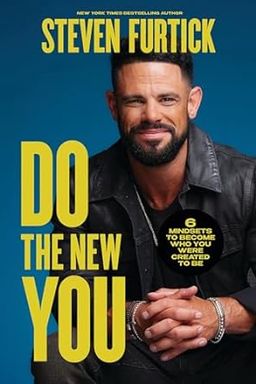
Do the New You cover

Do the New You

by Steven Furtick

Do the New You by Steven Furtick reveals six transformative mindsets to align yourself with God''s vision, guiding you from self-doubt to the authentic, God-given identity you were meant to embrace. Discover how to live your true calling, overcome challenges, and thrive by embracing the present with divine strength and confidence.

Becoming the “New You” God Already Knew

Who are you becoming—and who were you always meant to be? In Do the New You: 6 Mindsets to Become Who You Were Created to Be, pastor and author Steven Furtick challenges one of the most common cultural slogans: “Just do you.” Furtick argues that this phrase, while encouraging self-expression, is ultimately a trap. The “you” you think you are may be only one version—a limited, sometimes broken edition—of your true self. To truly flourish, Furtick says, you must let go of the “current you” and step into the “new you,” the version God designed from the very beginning.

Furtick’s guiding metaphor is deceptively simple: stop “doing you” as you are now and stop chasing “future you” who always seems out of reach. Instead, “do the new you”—the authentic self God already knows. He reminds us that the divine knew Jeremiah before his birth, implying that God knows each of us as full, rich, purposeful beings. You are not an accident of history or personality; you are the product of divine intention. The tension between who you are and who you’re meant to be is where transformation begins.

Escaping the Trap and the Treadmill

In the book’s opening, Furtick sets up two dangers: the “trap” of defining yourself only by your current limitations and experiences, and the “treadmill” of endlessly chasing a fantasy version of “future you.” The first keeps you stuck, and the second keeps you exhausted. Both, he writes, are born out of distorted self-perception. The cure is not more striving but more seeing—seeing yourself as God sees you. This new clarity brings stillness instead of striving and purpose instead of pressure.

He admits this shift isn’t instantaneous. It’s a “breakthrough with tension.” We live daily in the awkward space between self-acceptance and self-improvement, and learning to hold both is the spiritual art of transformation. Furtick models this duality with humor and humility—sharing moments when he feels like “Yoda, Warren Buffett, and Billy Graham all rolled into one,” followed by other days when he’s more like “Homer Simpson.” These self-aware confessions make the message deeply relatable: progress never happens without paradox.

The Six Mindsets: A Framework for Daily Renewal

The heart of Do the New You lies in six “mindsets”—affirmations designed to update your spiritual software. Each statement begins with truth and ends with action. Furtick presents them as simple language from heaven, doctrines turned into declarations:

  • 1. I’m not stuck unless I stop. Action Step: Commit to progress.
  • 2. Christ is in me. I am enough. Action Step: Accept your Self.
  • 3. With God there’s always a way, and by faith I will find it. Action Step: Focus on possibility.
  • 4. God is not against me, but he’s in it with me, working through me, fighting for me. Action Step: Walk in confidence.
  • 5. My joy is my job. Action Step: Own your emotions.
  • 6. God has given me everything I need for the season I’m in. Action Step: Embrace your now.

Each mindset builds on the last. Together they reprogram your inner dialogue from self-criticism to cooperation with divine grace. These aren’t mere affirmations; they are relational truths. You aren’t trying to become someone else—you’re uncovering the self God already sees clearly.

Why Transformation Begins in the Mind

Furtick draws heavily from Ephesians 4:22–24, which describes “putting off your old self” and being “made new in the attitude of your minds.” Change, he argues, begins not with willpower but with rewiring. Belief precedes behavior. You are transformed by choosing a new internal language. “You’re not who you are because of what you’ve done,” he writes, “but because of what’s been done in you.” Your thoughts form your patterns, and your patterns form your personhood.

Throughout the book, Furtick emphasizes that transformation is a partnership with God: divine grace plus human grit. Grace is God’s patience and power; grit is your persistence in applying truth. He dismantles any dualistic idea that God’s power excuses your effort or that your effort makes God unnecessary. Instead, he paints a relational model of formation—each choice, each mindset, each moment presents an opportunity to walk in step with a God who already knows your potential.

Why This Message Matters Now

In a world obsessed with self-help hacks and identity branding, Do the New You offers a spiritual alternative to perfection culture. The book belongs to a growing library of faith-based personal transformation messages (see also Craig Groeschel’s Winning the War in Your Mind or Joyce Meyer’s Battlefield of the Mind). But what distinguishes Furtick’s work is his mix of pastoral storytelling, psychological candor, and worshipper’s conviction. He doesn’t just teach theology; he translates it into therapy for the soul.

Ultimately, Furtick’s argument is simple but radical: you are not finished, but you are enough. The “new you” isn’t a goal to chase; it’s a gift to receive. The rest of the book walks through how to commit to progress, accept your God-aligned self, focus on divine possibility, walk with confidence, cultivate joy, and embrace your season with gratitude and courage. In essence, it is an invitation—not to hustle for transformation, but to partner with the One who already designed your becoming.


Mindset 1: You’re Not Stuck Unless You Stop

In the first mindset, Steven Furtick reframes stagnation as a state of belief, not circumstance. “Stuck” isn’t about your situation—it’s about surrendering to it. Using vivid storytelling, he illustrates how progress begins the moment you decide to keep moving, even when the outcome is uncertain. Through anecdotes of parenting tensions, ministry fatigue, and faith struggles, Furtick helps readers shift their focus from paralysis to pursuit.

The Wrestling Match of Life

One of the chapter’s most memorable metaphors comes from a wrestling match involving Furtick’s son Graham. He recalls a mother shouting from the bleachers, “Get up! Stand up!” to her exhausted child. The problem? The boy physically couldn’t. Furtick relates this to how people treat themselves and others when struggling: shouting motivational clichés isn’t helpful when someone is pinned under real emotional or spiritual weight. What we need, he says, is a companion in the struggle—just as God doesn’t shout from heaven but steps onto the mat with us.

He turns to Hebrews 4:15–16 to anchor the idea that Jesus empathizes with our weaknesses. The divine doesn’t demand instant resilience; He embodies it, encouraging progress over perfection. To be “unstuck,” then, is to recognize that any movement—seeking counsel, asking for help, choosing faith—is forward momentum.

Refusing to Argue for Your Limitations

Furtick explains that many people defend their dysfunctions out of misplaced loyalty to old habits. Drawing from his father’s grit and Les Brown’s quote, “If you argue for your limitations, you get to keep them,” he calls readers to stop being “defense attorneys for their weaknesses.” Choosing progress means refusing to negotiate with self-defeating narratives.

He illustrates this with biblical models: Israel wandering for forty years because they “saw themselves as grasshoppers,” and Jeremiah resisting his prophetic call with “I am too young.” Each story reveals that movement doesn’t start with external change—it starts with internal permission. As Furtick phrases it, “You’re not done learning, but you’re not dying either. You’re just growing.”

Choosing Progress Over Perfection

Progress doesn’t have to look heroic. Furtick’s counsel is practical: ask for help, experiment with new strategies, and acknowledge when you need rest. His own anecdote about financial mentorship shows that clarity, not brilliance, leads to forward movement. Just one conversation reframed his fear—all he needed was “a map.” This echoes psychologist Carol Dweck’s growth mindset theory (people who view failure as feedback adapt faster). Furtick translates that into theology: faith is holy curiosity in motion.

“Stuck” is a Story, Not a Sentence

You are only stuck if you make inertia your identity. With God, you are a work in progress—and progress is proof of presence.

The first mindset ends with action: Commit to progress. Whether through courage, therapy, or prayer, Furtick promises that every small step plants you on the path to the “new you.” You’re not stuck—just stopping too soon. Keep going.


Mindset 2: Christ In You—You Are Enough

The second mindset—“Christ is in me. I am enough.”—invites you to trade self-doubt for divine sufficiency. This isn’t self-esteem vocabulary; it’s spiritual identity. Furtick’s message is clear: your sense of worth cannot depend on productivity, performance, or perfection. It comes from the reality of Christ within you—an inexhaustible source of worth and capability. The goal is not to fix yourself, but to accept yourself.

From Scarcity to Sufficiency

One of Furtick’s most memorable examples comes from Olympic wrestler Helen Maroulis, who defeated a 13-time world champion while repeating, “Christ is in me; I am enough.” Her mantra, inspired by one of his sermons, encapsulates this truth: we can face overwhelming odds because enoughness comes from God, not grit. In everyday life, this mindset means that failure doesn’t define you—it refines you.

Furtick contrasts “I don’t have enough” with “I am not enough.” The former recognizes temporary limitation; the latter internalizes lack as identity. When you equate shortage with self, you live perpetually beneath your potential. Shifting focus to divine abundance frees you from the treadmill of proving worth.

Tricks Are for Kids

In a childhood story, Furtick trades a valuable Michael Jordan card for a pack of lesser cards. Why? Because he didn’t know its worth. It’s a vivid metaphor for how people trade their identity for approval, their calling for comfort, or their dignity for validation. “Tricks are for kids,” he quips, reminding readers that immaturity exchanges treasure for trinkets. The cure is maturity born of revelation: when you know your worth in Christ, you stop negotiating your value at discount prices.

Acceptance is the Hardest Faith

Furtick confesses that accepting Jesus was instantaneous—but accepting Steven has taken a lifetime. Many readers can relate: faith often feels easier than self-acceptance. He quotes Paul’s words, “By the grace of God I am what I am,” as both confession and celebration. Grace doesn’t erase your quirks or flaws—it fills them with meaning. Comparison kills contentment, but self-acceptance, grounded in divine presence, breeds peace.

Ultimately, this mindset turns religion from performance into participation. Jesus isn’t far off, observing your progress; He is alive within you, empowering it. Furtick concludes that “you are more than what you’re missing.” God’s “I Am” is the antidote to your “I’m not.” In Christ, you are enough, right now.


Mindset 3: With God, There’s Always a Way

The third mindset—“With God there’s always a way, and by faith I will find it”—develops spiritual optimism: the belief that possibility persists even when pathways don’t. Furtick ties this to what he calls “faith as navigation”—not knowing every destination but moving forward step by step. Using stories of modern reinvention and ancient perseverance, he teaches believers to expect divine creativity in impossible moments.

Forward, Not Finished

Furtick’s story of Rick Beato—a music producer who found global success on YouTube at age fifty-four—symbolizes this truth: your best work might still be ahead. Beato’s reinvention echoes God’s pattern of unfolding purpose through detours. Furtick reminds us that Moses, Joshua, and Esther all stepped into greatness through unexpected pivots. Faith, therefore, isn’t predicting outcomes—it’s participating in God’s ongoing invention.

“Weasel-Free” Mentality

Creativity and calling, Furtick says, require protection from inner critics—“weasels” that spoil the seeds of faith. Borrowing from Leviticus and The Artist’s Way by Julia Cameron, he names the “weasel” as self-sabotage: the cynical voice that kills dreams before they bloom. He literally hangs a sign in his studio reading, “Weasel-Free Since 2023.” The lesson: guard your imagination as sacred ground where God’s grace grows unseen ideas. Faith finds paths imagination first protects.

Flip the Question

One of Furtick’s most powerful shifts comes from Ecclesiastes 11:6: “Sow your seed in the morning…you do not know which will succeed.” Most people ask, “What if this fails?” Faith flips it: “What if this succeeds?” He writes, “Unsown seeds have a 100% failure rate.” Trying, failing, and learning are evidence of faith. Like Peter walking on water, you grow wetter before you grow wiser. Faith doesn’t remove fear; it repurposes it into courage.

Faith Finds a Way

You can’t always choose your circumstance, but you can choose your stance—hope over hesitation, action over anxiety.

In short, God is the Waymaker, but faith is how you find the way. Your role isn’t to rewrite the map; it’s to keep walking until the next step appears.


Mindset 4: God Is In It With You

The fourth mindset—“God is not against me, but He’s in it with me, working through me, fighting for me”—speaks to the human need for assurance. Furtick dismantles the fear of divine disappointment, reminding readers that God isn’t waiting for perfection before partnership. He uses engaging metaphors (from “lizard brain” panic to biblical leadership trials) to show how to replace fear with friendship with God.

Silencing the Lizard

In a story about teaching his daughter to swim underwater, Furtick introduces the concept of the “lizard brain”—that primitive voice of fear that yells, “You’re going to drown!” Her counterattack? “Shut up, lizard! I’m doing this.” It’s a charming metaphor for how believers must confront fear-based thinking. The “lizard” represents yesterday’s programming; faith represents today’s progress.

By blending psychology and theology, Furtick shows that your brain’s fight-or-flight response can’t always tell the difference between real danger and imagined rejection. Courage means moving forward despite noisy inner alarms. Fear becomes background noise; God becomes the steady voice in your ear.

Make Peace with Your Strength

Many churches glorify humility but mistake it for self-deprecation. Furtick redefines humility as harmony with God’s gifts. Drawing from Gideon’s insecurity and his own fear of “getting too big for his britches,” he encourages readers to celebrate divine strength without guilt. “If my kids create something great,” he says, “I don’t humble them—I celebrate them.” Similarly, God delights in our courage and creativity. The antidote to false humility is confident gratitude.

The God Who Fights For You

Echoing Judges 6, Furtick reminds us that God greeted fearful Gideon as “Mighty Warrior” while he hid in a winepress. This proves God never confuses your location with your identity. When you feel beaten down—financially, emotionally, spiritually—God sees potential, not paralysis. He commands, “Go in the strength you have.” What matters most isn’t what you have in your hands but Who’s handling your heart.

When life feels overwhelming, Furtick urges readers to repeat: God is with me, working through me, fighting for me. This is not positive thinking—it’s positional truth. You are defended, not deserted.


Mindset 5: My Joy Is My Job

“My joy is my job” might be the shortest mindset, but it’s also the hardest. Here, Furtick tackles emotional maturity with refreshing honesty. Happiness isn’t something done to you; it’s something done by you. Whether you’re a pastor, parent, or professional, you’re responsible for the environment inside your own head. Owning your emotions means that you don’t outsource your peace to other people.

The Hard Work of Happiness

Furtick admits that he’s not naturally cheerful. “Some people have resting blessed face,” he jokes, “I have the other kind.” But through therapy, gratitude, and spiritual reflection, he learned to treat joy as a discipline. Drawing inspiration from Psalm 118 (“This is the day the Lord has made; we will rejoice”), he explains that joy is an act of will, not whim. Like exercise, it’s daily work that strengthens your internal stability.

He developed tools such as the “Gr8ful 8”—naming eight things he’s thankful for while tracing his fingers—to shift focus from anxiety to appreciation. Gratitude, he contends, is God’s most accessible antidote to negativity. It’s not denial; it’s direction.

Ugly Trust and Honest Feelings

Some emotions aren’t pretty, and Furtick refuses to sanitize them. Using David’s psalms written “with spit in his beard,” he introduces the concept of “ugly trust”—faith that persists through chaos. True joy includes tears and tension. Owning your emotions means naming your fear without letting it run the show.

By integrating emotional validation with spiritual truth (echoing Brené Brown’s vulnerability research), Furtick offers a theology of feeling that avoids extremes of repression or indulgence. Jesus had emotions; so should you. But like Jesus, you must govern them under grace. Emotional ownership isn’t self-centered—it’s Spirit-centered.

“You might not control your first thought or emotion,” Furtick writes, “but you control what grows from it. Joy is holy responsibility.”

Furtick’s prescription is not giddiness but groundedness. The new you refuses to be ruled by storms within. Peace becomes a choice you protect rather than an emotion you pursue.


Mindset 6: God Has Given You Enough for Now

The final mindset—“God has given me everything I need for the season I’m in”—is both a capstone and a call to contentment. Furtick shows that spiritual maturity is not about having more, but seeing differently. God’s provision, he argues, is always seasonal: enough for this stage, not necessarily the next. Embracing your now requires gratitude, ingenuity, and trust.

Look to the Left

Drawing from the obscure story of Ehud—the left-handed deliverer in Judges—Furtick reveals how God uses “hidden strengths.” Ehud’s difference was his advantage; his left hand became his secret weapon. Likewise, what feels like your disadvantage may be divine design. “Stop wishing for a right-handed rescue,” he writes. “God’s doing a left-handed miracle.” This perspective redefines weakness as strategy.

Help Me Fail

In a training story, a bodybuilder repeats, “Help me fail,” before each final rep. The line becomes metaphor for holy perseverance: the point of failure is the place of growth. Furtick connects this to Paul’s words, “When I am weak, then I am strong.” God gives you what you need—even if that includes struggle—to grow in strength. Grace, like muscle, builds under resistance.

Be Found Fishing

When Peter didn’t know what to do after Jesus’ resurrection, he went fishing. Furtick reads this not as regression but as faith-in-action: Peter positioned himself where God had found him before. “Pick one. Do one,” Furtick repeats—counsel for anyone paralyzed by uncertainty. God meets movement. Faith is rarely about having full plans; it’s about taking small, faithful steps with what you already have.

This sixth mindset closes the book where it began: with choice. You may not control your conditions, but you control your cooperation. God chose you, equipped you, and placed you here on purpose. The question is whether you’ll choose yourself—and step into the version God always knew.

Dig Deeper

Get personalized prompts to apply these lessons to your life and deepen your understanding.

Go Deeper

Get the Full Experience

Download Insight Books for AI-powered reflections, quizzes, and more.