
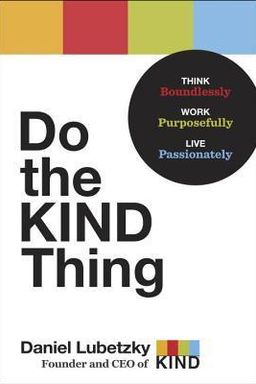
Do the KIND Thing cover

Do the KIND Thing

by Daniel Lubetzky

Do the KIND Thing reveals the secrets behind building a successful business that is both economically sustainable and socially impactful. Learn from Daniel Lubetzky''s journey with KIND Healthy Snacks and discover ten key tenets to create a brand that resonates with consumers and makes a positive difference in the world.

Doing the KIND Thing: Building Business with Purpose and Humanity

When was the last time you made a big decision without feeling like you had to choose between being practical and being principled? In his inspiring and deeply personal book, Do the KIND Thing: Think Boundlessly, Work Purposefully, Live Passionately, Daniel Lubetzky argues that this tradeoff is a false one. As the founder of KIND Snacks and a lifelong social entrepreneur, he built a company—and a philosophy—on the idea that you don’t have to choose between doing well and doing good. You can do both. His guiding principle, the “AND philosophy,” defies the belief that business success and social impact are mutually exclusive. Instead, Lubetzky invites you to consider that life’s most meaningful pursuits come from challenging false compromises.

The Power of the AND Philosophy

At the heart of Lubetzky’s philosophy is the simple idea that great things happen when you refuse to settle for “or.” As he puts it, thinking with “AND” means finding creative ways to honor multiple values that seem opposed—like being both tasty and healthy, honest and ambitious, or profitable and socially impactful. This mindset helped him reinvent the snack industry by designing bars with whole, visible ingredients that consumers could literally “see and pronounce.” By challenging a century of food manufacturing norms that prioritized cheap processing, Lubetzky built a brand that became synonymous with transparency, authenticity, and trust.

The AND philosophy is not just a branding idea—it’s a life strategy. It requires creative reasoning, humility, and willpower. Throughout the book, Lubetzky shows that there’s always a more creative third path waiting to be uncovered, but only if you challenge the assumptions limiting your decisions. This “think boundlessly” mindset shaped every chapter of KIND’s growth—from product design to marketing to leadership culture.

A Blueprint for Purposeful Entrepreneurship

Lubetzky’s own story turns this idea into a blueprint for entrepreneurs chasing purpose. As the son of a Holocaust survivor, he grew up understanding both the fragility of humanity and the transformative power of kindness. His father’s experience—being saved, in part, by the kindness of a German soldier—became the seed for Lubetzky’s lifelong commitment to bridge-building. Before KIND Snacks, he founded PeaceWorks, a company that brought together Arabs and Israelis to make and sell Mediterranean foods. Though PeaceWorks faced endless practical challenges, it planted the seed for a new kind of business—one that was “not-only-for-profit.”

In Do the KIND Thing, Lubetzky shares the long, messy, and at times painful evolution of this idea. He chronicles how early failures taught him discipline, how he overcame skepticism, and how he nearly lost everything multiple times before turning setbacks into stepping stones. The result is less a business memoir than a moral guide for anyone who wants to do work that matters—without losing their integrity or sanity in the process.

Ten Tenets for a Kinder Way to Succeed

The book’s structure revolves around ten principles—each an expansion of the AND philosophy. Together, they form what Lubetzky calls the “KIND BrAND Philosophy,” a framework that fuses personal growth with business strategy. These tenets include Purpose (leading with meaning), Grit (the discipline to persist), Truth and Discipline (staying loyal to your core), Simplicity (cutting through complexity), Originality (thinking boundlessly), Transparency and Authenticity (earning trust), Empathy (seeing the humanity in others), Trust (letting go to let others lead), and Ownership (creating a resourceful, values-driven culture).

These interlocking ideas serve both as company values and as universal life lessons. For instance, Lubetzky’s insistence on humility—his belief that success can easily slip into arrogance—echoes Jim Collins’s concept of “Level 5 Leadership” in Good to Great, where the best leaders combine ambition with selflessness. Both authors champion service-oriented leadership grounded in curiosity and humility.

Why This Message Matters Now

Lubetzky’s message hits home beyond the business world. In an age when many people feel forced to choose between profit and ethics, work and family, or ambition and sanity, Do the KIND Thing reminds you that meaningful success is about integration, not compromise. It challenges modern entrepreneurs—and anyone striving for balance—to replace “either/or” thinking with a relentless pursuit of “both/and” solutions.

This is why Lubetzky insists that humility, scrappiness, and long-term purpose must guide every venture. He’s wary of fads, short-term greed, or superficial “cause marketing.” Instead, he advocates for an authentic social mission anchored to a company’s DNA, not bolted on as PR. Companies that fake purpose, he warns, lose credibility fast; those that live it build movements. KIND grows out of that conviction—it’s not just a business that sells snacks, but a movement that inspires people to “Do the KIND Thing” in daily life.

What You’ll Learn

In the pages ahead, you’ll learn how Lubetzky harnessed Purpose to power his work, how Grit saw him through years of failure, and how Truth and Discipline kept his brand from selling out. You’ll see how Simplicity and Originality defined KIND’s aesthetic, how Transparency built trust, and how Empathy allowed the company’s social mission to blossom. You’ll also see Lubetzky’s leadership philosophy come to life—learning to Trust others to lead and fostering a culture of Ownership, Resourcefulness, and Accountability.

Ultimately, Do the KIND Thing offers more than a business model—it’s a moral compass for a modern world that too often rewards expedience over excellence. Lubetzky’s blend of candor, optimism, and pragmatism makes his story essential reading for anyone determined to create lasting impact—with both heart and brains fully engaged.


Purpose: Finding Meaning Beyond Profit

What gets you out of bed every morning? For Daniel Lubetzky, it was more than building a successful company—it was building a company that could make the world a little kinder. In Do the KIND Thing, he insists that financial success and moral purpose don’t have to compete. They can reinforce one another when you build a venture that addresses both a market need and a social mission.

The Roots of Purpose

Lubetzky’s sense of mission traces back to his father, a Holocaust survivor saved by small acts of compassion. That legacy shaped his first company, PeaceWorks, which used commerce to encourage collaboration among Arabs and Israelis. The idea was simple but powerful: people who do business together are less likely to hate each other. Although PeaceWorks struggled financially, its underlying philosophy—“business as a force for peace”—planted the core principle that would later become KIND’s soul.

The AND of Business and Humanity

When Lubetzky later founded KIND, his goal wasn’t just to build a better snack; it was to model a better capitalism. He wanted a company that would be both healthful and delicious, commercially viable and socially responsible. KIND’s motto—“Do the KIND Thing for your body, your taste buds, and your world”—embodied his belief that purpose should drive not just philanthropy but product design, marketing, and leadership.

That meant refusing “cause marketing” gimmicks that used social issues for profit. Instead of saying “buy this bar and save a child,” KIND focused on sincerity—letting actions speak for themselves. For example, the company’s KIND Movement invited consumers to perform small acts of kindness that triggered larger social donations. These campaigns encouraged participation, not purchase, subtly aligning profit with positive action.

Why Authentic Purpose Wins

Lubetzky cautions that fake purpose backfires. As he puts it, “consumers are extremely savvy.” They can smell insincerity a mile away. Real purpose isn’t an accessory—it’s your company’s DNA. Authentic purpose sustains a business during hard times, giving you resolve when profits falter. For KIND, purpose was the glue that held the company together through financial crises and market skepticism. It gave employees pride, consumers trust, and Lubetzky a reason never to quit.

Purpose, he reminds us, is not about personal glory or charity—it’s about meaning. As he writes, “It’s not selfless, it’s self-preserving.” Finding and living out your purpose keeps you grounded and fulfilled even when success feels far away. Whether you’re building a company, leading a team, or just trying to make a difference, purpose aligns effort with impact—and transforms business into a platform for good.


Grit: Persevering Through the Lean Years

What would you do if your dream business was barely hanging on? For years, Daniel Lubetzky lived that reality, building KIND from a one-room operation into a global brand—one faltering step at a time. His story is a case study in grit: the ability to endure, adapt, and keep showing up long after others would give up.

Grit Forged in Failure

Before KIND’s success, Lubetzky spent a decade struggling with PeaceWorks, his first for-profit social enterprise. He went broke, sold his products door-to-door, and slept surrounded by boxes of unsold inventory in his Manhattan apartment. His “office” was a basement next to a trash compactor. Yet even then, he refused defeat. Every conversation, every rejection, became a lesson. Slowly, iteration by iteration, he turned rejection into resilience.

The Two Phases of Entrepreneurship

Lubetzky distinguishes between two mental phases that define grit: the skeptic and the evangelist. In the skeptic stage, you question everything—research your idea, seek advice, and pressure-test your assumptions. But once you commit, you flip the switch to evangelist mode, shutting out doubt and attacking challenges head-on. This disciplined duality, he says, is essential. Without skepticism, bad ideas flourish. Without evangelism, great ones die too soon.

Endurance and Focus

Grit also means learning from failure instead of denying it. Lubetzky recalls walking the streets of New York selling sundried tomato spreads to every grocery store that would listen. Eventually, his persistence—as ridiculous as it seemed—won him a meeting with Zabar’s, the iconic gourmet retailer. The buyers ridiculed his early packaging but gave him valuable feedback. He fixed everything they mentioned and won their business. Grit, he realized, is active perseverance—it’s not just stubbornness, but the humility to learn and the nerve to keep moving.

In the end, his aha moment came when he created snack bars from whole fruit and nuts—products that embodied his philosophy of “AND.” But those years of rejection built the resilience that would define KIND’s DNA. As Angela Duckworth later wrote in her own book Grit, passion plus perseverance beats raw talent. Lubetzky lived that truth long before it was a buzzword.


Truth and Discipline: Staying Loyal to Your Brand

Once you succeed, how do you keep your integrity intact? Lubetzky argues that truth and discipline are the backbone of any lasting brand. The lesson came at a painful cost: his early company expanded too quickly and lost sight of its promise, flooding shelves with mediocre products that diluted customer trust. “One weak product,” he writes, “can infect the health of your entire brand.”

Focus and Consistency

After PeaceWorks’ failure, Lubetzky vowed never to compromise quality for growth. When he launched KIND, every product had to meet two non-negotiable standards—it had to be both healthful and tasty. The company rejected fads like “zero sugar” diets, preferring transparency to gimmicks. Even when rivals cut corners to lower costs, KIND refused. As Lubetzky puts it, “A brand is a promise—and a great brand is a promise well kept.”

Learning from Mistakes

He also learned from classic corporate missteps. Brands that chase trends or launch “me-too” products—like Kraft’s misguided expansion of Balance Bars—confuse consumers and erode trust. Lubetzky chose patience instead, developing KIND’s second act only after years of perfecting its core bars. That discipline led to thoughtful innovations like KIND Nuts & Spices and Healthy Grains, both aligned with the brand’s DNA of simplicity and nutrition.

His takeaway is timeless: stay ruthless about your brand’s truth. Whether you’re a start-up or an individual, make sure every new opportunity deepens your integrity rather than diluting it. In a world addicted to shortcuts, discipline is your most radical act of authenticity.


Keeping It Simple: The Art of Restraint

In an age of complexity, simplicity is a superpower. Lubetzky’s philosophy of keeping things simple applies to everything—product design, branding, company culture, and personal lifestyle. He learned it from his humble Lithuanian-Mexican grandfather, who taught that pride ruins perspective. Simplicity, Lubetzky says, is not about being naive—it’s about staying grounded enough to see clearly.

Simple Brands Win Trust

KIND’s very name reflects this mindset. It’s short, human, and meaningful—everything his earlier brand “Moshe & Ali’s World-Famous Gourmet Foods” was not. He learned the hard way that consumers crave clarity. The best brands speak plainly. That’s why KIND’s products have descriptive names like Dark Chocolate Cherry Cashew instead of abstract ones like “Joy Bar.” This commitment to Occam’s razor—choosing the simplest, truest expression—extends to how KIND labels ingredients: “foods you can see and pronounce.”

Grounded by Humility

For Lubetzky, simplicity is also a moral compass. It guards against arrogance and excess, particularly when success tempts comfort. Even after landing multimillion-dollar investments, he scavenged office furniture and monitored every expense to keep his team scrappy. As he writes, “The laurels of success can threaten one’s clear judgment more than the thorns of failure.” Staying simple means staying humble, curious, and hungry—qualities that money should never buy out of you.

Ultimately, simplicity is not minimalism for its own sake—it’s clarity with purpose. Whether naming a product or making a life choice, Lubetzky reminds you: question assumptions, strip away noise, and return to essence. The clearest path usually holds the most power.


Empathy: The Kindness That Scales

What if kindness wasn’t just nice—but strategic? In one of the book’s most personal chapters, Lubetzky shows how empathy is both a business advantage and a social responsibility. He links it to his father’s story—how small acts of compassion during the Holocaust literally saved lives—and explains how those lessons shaped everything from KIND’s internal culture to its public mission.

Kindness as a Competitive Edge

From day one, Lubetzky wanted KIND to stand for more than snacks. Through campaigns like #kindawesome and KIND Causes, the company made kindness contagious. Instead of paying for ads, they empowered consumers to recognize one another’s good deeds, turning kindness into the brand’s most powerful marketing engine. “People want to be protagonists in goodness,” Lubetzky explains. The result was authentic community engagement—proof that empathy can scale without losing its soul.

Leading with Humanity

Empathy also shaped KIND’s internal leadership. Lubetzky rejects the cold corporate norm of firing employees abruptly. Instead, he promotes transparent conversations and humane transitions. He insists that empathy is not weakness—it’s clarity with compassion. Leaders who truly see their people, he says, inspire loyalty and long-term success. In his words, “Empathy isn’t soft—it’s smart. Lack of it can destroy value.”

In the broader world, Lubetzky warns that empathy is humanity’s survival skill. He envisions a “universal values curriculum” teaching kids shared ethics across cultures—a bold dream drawn from his work in the Middle East. His message is universal: kindness fuels connection, and connection fuels progress. In business as in life, empathy is the most renewable resource we have.


Ownership and Resourcefulness: Building a Culture That Lasts

For Lubetzky, success isn’t about control—it’s about ownership. And ownership, he argues, is less about equity than about attitude. When team members think like owners, they act with integrity, initiative, and courage. In Do the KIND Thing, he describes how this mindset kept KIND resilient even during setbacks like losing Starbucks as a major retail partner.

From Scarcity to Resourcefulness

Lubetzky believes startups should balance frugality with creativity. Being lean keeps you scrappy, but a scarcity mindset stifles innovation. At KIND, resourcefulness became a value system: “We had to ask, ‘What’s the best way to grow—and how can we get there spending the least?’” The team learned that every penny is a test of principle. For Lubetzky, buying new office chairs isn’t just a budget line; it’s a cultural signal that says, “Are we still grounded?”

Leadership and Loyalty

Ownership also meant loyalty—to employees, investors, and ideals. When investors pressured him to sell or compromise, Lubetzky chose independence and integrity over quick profit. Later, when private equity partners VMG helped KIND grow, he repaid that trust by ensuring equitable structures and transparency. In return, they helped him build a world-class team that valued purpose over ego. “Ownership requires courage,” he says. “You can’t rent your values.”

That culture of ownership ultimately helped KIND bounce back from every blow. When Starbucks dropped their products, Lubetzky didn’t sulk—he rallied his team to target independent cafes nationwide. Months later, through perseverance (and empathy), Starbucks returned as a partner. His closing moral: ownership is not just financial stake; it’s emotional commitment—the belief that your mission is worth owning, even when the odds say otherwise.

Dig Deeper

Get personalized prompts to apply these lessons to your life and deepen your understanding.

Go Deeper

Get the Full Experience

Download Insight Books for AI-powered reflections, quizzes, and more.