
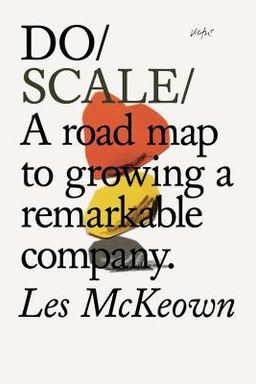
Do Scale cover

Do Scale

by Les McKeown

Do Scale offers a concise roadmap for business leaders aiming to scale sustainably. Les McKeown provides practical insights into evaluating scaling potential, overcoming entrepreneurial instincts, and building a robust team to ensure exponential growth without losing sight of core company values.

Scaling the Right Way: Building a Sustainable, Remarkable Company

Have you ever wondered why some businesses grow effortlessly while others crumble under the weight of their own success? In Do Scale: A Road Map to Growing a Remarkable Company, Les McKeown answers this by redefining what it truly means to scale — and by extension, what it takes to grow without losing your company’s soul. McKeown argues that scaling isn't about growing faster or getting bigger. It’s about building the ability to grow sustainably, at whatever size and in whatever market you choose, without burning out your team or your mission in the process.

McKeown, a veteran entrepreneur and leadership consultant, believes most founders get scaling wrong because they confuse it with unrestrained growth. They chase short-term gains, hero-worship startup myths, and rely on instinct instead of building repeatable systems. His core claim is that true scalability comes from mastering the mundane mechanics — systems, processes, and especially decision-making. Scaling, he argues, is about constructing an organization that can make High-Quality Team-Based Decisions (HQTBDM) consistently and quickly, no matter how large it gets.

Why Definitions Matter

McKeown begins by clarifying what scaling actually means. Borrowing from engineering, he defines scalability as "the ability over time to sustainably grow your organization to whatever size your industry or sector will allow." This distinction between scaling and merely growing is critical. Growth, especially linear or organic, can happen naturally as a company finds customers and adds revenue. Scaling, however, requires deliberate design. It’s about installing systems that can absorb complexity, support exponential curves, and scale decisions, not just products. Without those systems, companies hit what McKeown calls Whitewater — the stage where complexity overwhelms improvisation and heroic effort.

He also emphasizes that scaling should never be synonymous with a “get rich fast” culture or the glamour of Silicon Valley. The myth of the “scale-at-any-cost” startup is not only unrealistic but often fatal. Sustainable scaling, he insists, means planning for endurance, not racing to sell.

The Three-Part Journey

McKeown structures his roadmap into three main sections: Meaning, Mindset, and Road Map. Each builds on the last. In the Meaning section, he demystifies scaling and helps you determine when — and even if — your company should scale. The Mindset portion is about you, the founder or leader. It addresses the internal transformations required to shift from an impulsive, gut-driven entrepreneur to a deliberate, system-oriented leader. Finally, in Road Map, he gives the practical playbook for scaling — how to build a decision-making machine, create scalable people, and navigate complexity with clarity and alignment.

This three-part design echoes McKeown’s earlier work in Predictable Success, where he describes organizational growth as a lifecycle that must be managed with intention. In Do Scale, he zooms in on the pivotal inflection point — when an organization outgrows the founder’s instincts and must evolve into a process-driven enterprise.

From Myths to Mastery

To scale smartly, McKeown argues, founders must first shed two dangerous myths: the Magical Startup and the Mystical Founder. The Magical Startup myth celebrates chaos and speed as virtues, while the Mystical Founder myth romanticizes visionary leaders with uncanny intuition. Both distort reality. In truth, startups succeed when they stop acting like startups, and founders succeed when they build teams that can outperform their instincts. Scaling isn’t glamorous—it’s operational, disciplined, and grounded. “Scaling,” McKeown insists, “is built on mastering the mundane.”

The Core Conflict: Freedom vs. Focus

One of McKeown’s most relatable themes is the inner tension founders face during scaling: the conflict between autonomy and structure. Entrepreneurs crave freedom — it’s why they started their ventures. Yet scaling demands focus, standardization, and discipline, which can feel like imprisonment. The most visionary leaders, he notes, often self-sabotage at this stage by “getting in their own way.” His antidote? Recognize these impulses, delegate the “boring but essential” tasks, and find creative outlets outside the core business to avoid burnout. The key is learning to differentiate between being a Visionary and becoming what he calls the Arsonist — someone who burns down their own progress just to feel alive again.

Scaling Through Decisions, Not Declarations

At the heart of the book lies the concept of High-Quality Team-Based Decision-Making (HQTBDM). McKeown frames it as the “sleep-inducing” secret to scaling — not flashy, but essential. He shows how early-stage businesses rely on flockball (everyone running toward every crisis) and “superheroes” (individuals making unilateral decisions on instinct). As the organization grows, those same habits produce confusion and frustration. To move beyond chaos, teams must make decisions collaboratively, use data instead of anecdotes, and practice what he calls Dollar-Bill Management — unity so strong that no one could “get a dollar bill between” the team members’ alignment after decisions are made.

Why This Matters

McKeown closes by reminding readers why scaling matters—not just for entrepreneurs, but for entire industries and communities. Scalable organizations create stability, employment, and innovation that last beyond the founder’s involvement. But more personally, scaling well allows leaders to replace adrenaline with achievement, and chaos with sustainable creativity. As he writes, “Scaling isn’t the mountaintop; it’s learning how to climb every day without falling.”


Scaling vs. Growing: Sustainability Over Speed

Les McKeown begins his roadmap by drawing a crucial distinction between two deceptively similar ideas: scaling and growing. Most founders use these terms interchangeably, but treating them as synonyms leads to failure. Growth, says McKeown, is simply “getting bigger.” Scaling, on the other hand, is “getting better at getting bigger.” In other words, it’s not about size alone—it’s about building the capacity to sustain that size without constant chaos.

Linear vs. Exponential Growth

In McKeown’s model, organic growth is linear—steady, predictable, incremental. Scaling is exponential—a deliberate plan to expand market share as quickly as possible without sacrificing stability. But exponential doesn’t mean reckless. He contrasts scalable companies with those chasing “J-curves” at any cost (think dotcom-era startups). Without the sustainability parameter—profitability for businesses, surplus for nonprofits—those rapid rises lead to equally rapid collapses.

Planned vs. Unplanned Scaling

McKeown introduces another eye-opening difference: planned versus unplanned scaling. Planned scaling is intentional — guided by systems, processes, and leadership alignment. Unplanned scaling happens when demand suddenly outpaces operational capability (think a celebrity shout-out that triples orders overnight). The result? Overload, errors, and customer dissatisfaction. Planned scaling, he argues, prevents “whitewater” by ensuring your internal operations can handle external opportunities.

Why Focus Matters

The main differentiator between a scaling company and a growing one lies in focus. Scaling organizations have a primary objective: maximize sustainable market share. Growth-driven organizations often have competing goals—profitability, craftsmanship, or lifestyle balance—that dilute their ability to scale. McKeown urges leaders to make an honest decision: Is scaling your true ambition, or do you prefer well-paced organic growth? Not every founder should scale, he reminds us—and clarity here prevents burnout later.

(This echoes Jim Collins’ argument in Good to Great: greatness requires discipline and purpose, not just momentum.) Scaling is a choice that requires singular commitment to market reach and impact. Once you decide to scale, that becomes your guiding star.


The Startup and Founder Myths That Derail Growth

McKeown argues that much of today’s entrepreneurial advice is poisoned by mythmaking. Two narratives in particular—the “Magical Startup” and the “Mystical Founder”—create unrealistic expectations that destroy scalability. Both myths, while seductive, glorify chaos and charisma instead of discipline and design.

The Startup Fallacy

According to McKeown, the startup world is addicted to hype. Journalists and influencers celebrate novelty, speed, and failure as virtues (“fail fast, fail often”), blinding founders to the fact that 80% of startups fail. Startups are romanticized as incubators of creativity, when in reality, they are survival machines. The single valid goal of a startup, he writes, is to stop being one. Staying in perpetual startup mode—flexible, chaotic, improvisational—makes it impossible to scale sustainably.

Scalable companies, in contrast, shift from saying “yes” to everything (the startup reflex) to saying “yes” strategically. While startups can thrive on pivoting rapidly, scaling companies are killed by it. The agility that fuels early growth becomes fragility when complexity increases.

The Founder Illusion

The “Mystical Founder” myth tells us that great businesses are built by near-superhuman figures — think Jobs, Musk, or Gates — who have divine insight and unstoppable will. McKeown dismantles this idea, noting that most founders’ public personas are “marketing tools,” not operational truths. Founders must learn to separate their external persona (the visionary leader projecting confidence to investors and media) from their internal role (the collaborator who makes data-informed decisions as part of a team).

From Superhero to System Builder

Successful founders make one key shift: they stop leading by instinct and start leading through systems. McKeown encourages founders to use their charisma strategically — for press and investor relations — but never as a replacement for process. That means playing the “founder card” sparingly inside the organization. Scaling is about repeatability, not revelation. (This mirrors Eric Ries’s argument in The Lean Startup: what matters isn’t vision alone, but feedback loops and validated learning.)

By killing the startup and founder myths, McKeown liberates leaders to focus on what actually matters: building predictable success by mastering the boring, mechanical, and repeatable tasks that form the backbone of scalability.


When to Stop Trusting Your 'Golden Gut'

In early entrepreneurship, instinct is your superpower. McKeown calls this visceral intuition the “Golden Gut.” It’s the combination of knowledge, experience, insight, and execution that helps founders make snap decisions in the uncertain early days. But as your organization grows, this very strength becomes a liability. Scaling demands a shift from intuition-driven to data-driven decisions.

Why the Gut Fails at Scale

McKeown explains that as complexity grows, three changes occur: anecdotes stop being data, information multiplies exponentially, and unilateral decision-making dies. In small teams, you can shout a question across the office and have the answer in seconds. In scaling organizations, data sits across silos and systems. Continuing to “go with your gut” leads to decisions that are increasingly uninformed and out of sync.

The founder who once thrived on autonomy now becomes the organization’s bottleneck. McKeown wryly observes that many CEOs continue to operate as if their early instincts still match reality—often until they find their teams burned out or their growth stalled by contradictory top-down calls.

The Five Golden Rules

To transition from Golden Gut to scalable leader, McKeown offers five simple but radical habits:

  • Assume you no longer know everything required for a high-quality decision. Begin by asking, “What don’t I know?”
  • Assume you’ll never again make the best decisions alone. Ask, “Who else needs to be involved?”
  • Codify and store information ruthlessly. Build systems for retrieval or your gut will take over again.
  • Decentralize decision-making. Push responsibility down and out wherever possible.
  • Trust your intuition only when it’s constantly updated by fresh knowledge and experience.

This disciplined humility marks the difference between entrepreneurial passion and scalable leadership. Still, McKeown reassures readers: your instincts aren’t obsolete — they’re just no longer sufficient. They’re a compass, not an autopilot.


Getting Out of Your Own Way

One striking insight in Do Scale is psychological: the greatest obstacle to scaling is often the leader’s own mindset. Entrepreneurs, driven by freedom and creativity, struggle with the structure and repetition scaling demands. McKeown calls this the battle between the Visionary and the Arsonist. The visionary builds systems to sustain growth; the arsonist burns them down when they feel constrained.

Claustrophobia and Control

The feeling of being trapped by your own systems — what McKeown calls “scaling claustrophobia” — often causes what he describes as leadership whiplash. Founders get bored, frustrated, and tear apart processes they once championed. The result: chaos disguised as innovation. To break this cycle, he suggests recognizing early warning signs in your “self-talk” — those moments when you tell yourself, “I can do this boring thing just this once,” or “This structure is killing my creativity.”

Five Ways to Stay Scalable

McKeown recommends five coping strategies to keep visionaries from becoming arsonists:

  • Delegate the dull. If a task is vital but uninspiring, let someone else handle it.
  • Have a creative sandbox. Find an external outlet—mentoring, creative hobbies, or personal projects—so your need for novelty doesn’t sabotage your business.
  • Challenge the “curse of knowledge.” Hire or coach others to eventually know more than you do about specific functions.
  • Recognize your “7× bias.” Visionaries often underestimate how long tasks take by a factor of seven.
  • Seek progress, not perfection.

Together, these strategies create emotional airlocks that allow creativity to coexist with consistency—a balance McKeown argues is the secret to longevity in both leaders and organizations.


The Hidden Secret of Scaling: Team-Based Decisions

After years of studying successful organizations, McKeown reduces scalability to one deceptively simple concept: High-Quality Team-Based Decision-Making (HQTBDM). It might sound unglamorous, but it’s the system behind every sustainable scale story — from international NGOs to Fortune 500 firms. Without it, companies remain stuck in reactive chaos; with it, they unlock predictable momentum.

From Flockball to Framework

Early-stage companies grow through a high-energy mode McKeown calls “flockball”—where everyone chases every opportunity, improvising their way through crises. It’s exhilarating but temporary. As complexity rises, flockball collapses into confusion. The same superhero employees who once made miracles happen start tripping over each other. To survive this “whitewater” phase, companies need to slow down decision-making to speed up execution.

Four Shifts That Enable Scale

  • Move from individual decisions to team-based ones.
  • Separate making decisions from executing them—each requires different rhythms and roles.
  • Accept slower decision-making in exchange for faster, more reliable implementation.
  • Replace anecdotal input with real, measurable data.

This transformation—from gut to group, from speed to clarity—is what differentiates companies that plateau from those that scale indefinitely.


Building the Machine for Decision-Making

You can’t rely on good meetings alone to make great decisions. McKeown introduces the idea of designing a machine for decision-making: a set of organizational systems that route the right issues to the right people at the right time. This machine isn’t metaphorical—it’s your actual org chart, reimagined for flow, clarity, and repeatability.

Four Components of the Machine

  • The Org Chart: Clean it up. Remove false hierarchies, ambiguous dotted lines, or outdated structures. Every role should be precisely defined.
  • Job Specifications: Shift from “heads” (what current people do) to “hats” (what the organization needs). This reframing makes difficult conversations about accountability more objective and scalable.
  • Information Flow: Audit where data originates and how it travels. Eliminate bottlenecks and abandon email as your main information system.
  • Meeting Cadence: Separate planning from review meetings and design a rhythm (daily, weekly, monthly, quarterly, annual) to align strategy and execution.

By operationalizing decision-making, McKeown shows, you liberate leaders from firefighting and free teams to perform their roles with clarity and purpose. This machine is your company’s nervous system—the invisible infrastructure of scale.


Developing Scalable People and Culture

Even the best machine needs humans who know how to run it. In the final stage of his roadmap, McKeown focuses on people — teaching leaders how to cultivate “lateral managers” capable of making enterprise-wide decisions instead of simply managing their silos. This is where culture becomes the operating system of scaling.

Lateral Management and the Enterprise Commitment

McKeown introduces the mantra of scalable leadership: “When working in a team or group environment, I will place the interests of the enterprise ahead of my own.” This Enterprise Commitment flips the traditional pyramid of management, guiding teams to consider the organization’s success before individual goals. It’s a simple statement that reorients every decision toward shared growth.

Five Golden Practices for Scalable Teams

  • Adopt the Enterprise Commitment as a shared mantra.
  • Identify and satisfy internal customers with the same fervor you treat external ones.
  • Standardize your decision-making process — clarity beats speed.
  • Practice “Dollar-Bill Management” — full post-decision alignment.
  • Be “Ruthlessly Constructive” — vigorous debate inside meetings, unwavering unity outside.

The result? A culture resilient enough to absorb complexity without losing cohesion—a hallmark of every remarkable company McKeown has helped guide.

Dig Deeper

Get personalized prompts to apply these lessons to your life and deepen your understanding.

Go Deeper

Get the Full Experience

Download Insight Books for AI-powered reflections, quizzes, and more.