
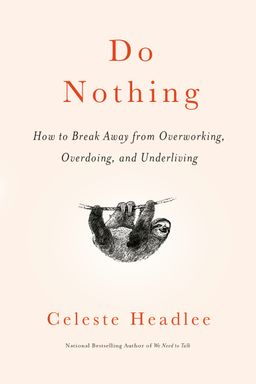
Do Nothing cover

Do Nothing

by Celeste Headlee

Do Nothing by Celeste Headlee reveals how our obsession with efficiency undermines our well-being and happiness. By exploring historical trends and offering practical advice, this book inspires readers to reclaim leisure as a vital component of a fulfilling life.

Breaking Free from the Cult of Efficiency

Have you ever felt like you're constantly doing more but somehow living less? In Do Nothing: How to Break Away from Overworking, Overdoing, and Underliving, Celeste Headlee asks you to confront a painful truth—our obsession with productivity has become a form of self-imposed bondage. She argues that the modern world has turned efficiency, output, and hustle into moral virtues, trapping us in the exhausting cycle of doing more for less satisfaction. We've mistaken constant action for progress and confused busyness with fulfillment.

Headlee traces this problem back centuries to the rise of the Industrial Revolution and the Protestant work ethic, suggesting that we’ve inherited a worldview in which idleness is sin and worth is measured by labor. Today, we respond to that inherited pressure by optimizing every moment of our lives—our work, health, fitness, even leisure—until we’re left more stressed and isolated than ever. Headlee’s message is both personal and radical: if we want to reclaim happiness, we must reject the cult of efficiency and rediscover our humanity through rest, leisure, and honest connection.

The Origins of Our Overwork

Headlee opens with a reflection on her own life—a driven journalist who, even after achieving financial stability, found herself more anxious and exhausted than ever. This personal crisis mirrored a cultural one. She realized that her habits weren't unique; they were expressions of a centuries-old ideology. From Martin Luther’s theology that sanctified hard work to Max Weber’s concept of the Protestant ethic fueling capitalism, our history glorifies labor as a pathway to virtue. What began as religion evolved into economic doctrine, embedding the idea that time equals money deep into the fabric of society.

By tracing this lineage, Headlee shows that technological advances didn’t create our busyness—they simply accelerated it. We were already conditioned to labor harder. The steam engine, factory clocks, and wage schedules transformed work into an hourly transaction, linking productivity directly to self-worth. Today’s smartphones and apps are merely digital descendants of those systems, keeping us tethered to tasks long after we’ve left our desks.

The Illusion of Efficiency

The cult of efficiency convinces us that every second must serve a measurable purpose—that leisure without productivity is waste, that faster is better. Yet Headlee dismantles this illusion with striking examples. She cites research showing that Greeks work the most hours in Europe but rank near the bottom in productivity—a reminder that effort isn’t synonymous with accomplishment. Efficiency, she writes, often disguises waste: when we spend more time planning to be productive than actually doing meaningful work.

This mindset extends beyond offices into our homes and relationships. We schedule “quality time” with our children as though love were a calendar entry, and we optimize hobbies, diets, and mindfulness practices until even relaxation feels like work. We’ve created systems to measure everything except joy—and that omission has left us lonely, burned out, and disconnected.

Technology, Isolation, and the Human Cost

While technology promises convenience and productivity, Headlee argues that it deepens isolation. Smartphones have made workers permanently reachable, leaking office life into home life until there’s no off switch. Constant communication erodes concentration, and social media replaces authentic conversation with curated performance. We equate digital activity with social engagement, but the result is more anxiety and less empathy.

Her stories reflect this paradox vividly: during a train trip across America, Headlee found peace not from endless connectivity but from enforced disconnection—no Wi-Fi, no inbox. That temporary isolation reminded her how noisy and frantic her mental world had become. Without the digital hum, she experienced rest that wasn’t idleness but reflection, a state that humans evolved to need but now resist.

Reclaiming Our Humanity

Headlee challenges us to take deliberate action against this cultural conditioning. Doing nothing, she clarifies, doesn’t mean laziness or neglect—it means restoration. Humans aren’t built for endless optimization; we thrive through social connection, play, leisure, and empathy. Returning to those instincts, she suggests, requires breaking inherited habits: limiting work hours, rediscovering hobbies, walking without a destination, and rebuilding face-to-face relationships.

In other words, doing nothing is a form of rebellion against an inhuman system. It’s a choice to value living over performing. “We work best,” Headlee concludes, “when we stop treating ourselves like machines.” Her call is not to abandon ambition but to recalibrate what progress means. True success, she argues, isn’t measured in hours or outputs—it’s measured in joy, connection, and the capacity to breathe easily through our days.


The Rise of the Cult of Work

How did work become our dominant religion? Headlee traces the roots of our overwork to two pivotal revolutions—the Protestant Reformation and the Industrial Revolution. Martin Luther’s belief that hard work glorified God, combined with capitalism’s hunger for growth, created the fusion of morality and labor we live with today. Max Weber later reinforced this idea with his landmark theory in The Protestant Ethic and the Spirit of Capitalism, arguing that disciplined, profit-driven work was proof of righteousness. From that moment, idleness wasn’t merely laziness—it was sin.

From Virtue to Profit

This moral foundation carried into the business world. Benjamin Franklin’s famous dictum—“time is money”—summed up the transformation perfectly. Work ethics became monetary ethics. As factories emerged, employers captured workers’ hours rather than their output, founding the idea that effort could be quantified through time. Wage labor replaced craftsmanship, stripping autonomy from workers who now “punched in” to prove their value.

Headlee notes that before industrialization, medieval villagers worked far fewer hours than we do now, often only six to eight hours a day with months of holidays. When the steam engine arrived, time shrank and clocks dictated life. Labor unions eventually fought for shorter hours, but just as society achieved rest, culture reasserted guilt around idleness. We learned to work harder voluntarily—to be admired, not exploited.

The Self-Made Myth

America glorified this ethos through stories like Frederick Douglass’s “Self-Made Men” speech and Horatio Alger’s Ragged Dick novels, where hard work alone led from rags to riches. The result was a national delusion: belief that success depends solely on personal effort. (Sociologists Michael Kraus and Jacinth Tan later showed Americans vastly overestimate upward mobility.) When opportunity failed, people blamed themselves, internalizing shame instead of questioning inequality.

By the twentieth century, figures like Henry Ford equated work with sanity and salvation. Ford’s statement, “Through work and work alone may health, wealth, and happiness be secured,” became secular scripture. Work replaced religion as our spiritual practice. The tragedy, as Max Weber foresaw, was that this drive would become an “iron cage,” trapping humans until “the last ton of coal is burnt.”

Modern Consequences

Headlee demonstrates how this inherited faith in work ethic still dominates our choices. We admire workaholics, shame leisure, and define identity by profession—asking “What do you do?” as if your job were your self. This mentality fuels burnout and obscures the fact that modern productivity gains could allow us to work half as much. Economists like John Maynard Keynes predicted a fifteen-hour workweek by 2030, yet instead we work more and rest less. The reason, Headlee writes, is cultural—not economic. We worship labor even when it no longer serves us.

You can see the effects everywhere: guilt in taking vacations, glorification of hustle videos, and the moral suspicion toward anyone seeking balance. To change course, Headlee insists, we must dismantle the myth that effort equals virtue. The goal isn’t to abandon discipline but to restore proportion—to remember that being human is not a job title.


The Price of Constant Productivity

We often assume that busyness equals success. Headlee reveals that this illusion hides staggering costs—mental, emotional, and physical. The more we chase optimization, the less efficient we actually become. This paradox is the heart of Do Nothing: overwork results not in productivity but depletion.

Time Scarcity and the Illusion of Value

Headlee cites research that the wealthy feel less time-rich than the poor. When our hours are financially quantified, they feel scarcer. People told to calculate their hourly wage became impatient even listening to beautiful music—they subconsciously wanted to "get back to work." The more value we place on time, the more guilty we feel wasting it, and the more stressful leisure becomes.

Ironically, despite technological convenience, we’re not even working more hours—just feeling more overwhelmed. As Headlee explains, modern work spills into evenings and weekends, erasing boundaries. Checking email at 9 p.m. doesn’t add hours to your day; it spreads your anxiety across twenty-four of them.

Technology as a False Savior

The smartphone epitomizes this paradox. We bought devices to save time but surrendered serenity instead. Your brain treats notifications like emergency alarms, flooding your body with stress hormones hundreds of times daily. Multitasking amplifies the chaos: every switch between tasks costs attention, tripling errors. Headlee’s own experience—writing faster without Wi-Fi during a train trip—illustrates how silence restores effectiveness.

She argues that we’ve misused technology as if humans were computers. Analog life moves slower but fosters thought—the very slowness that makes us human. Historian Jeremy Rifkin’s insight that computers operate “beyond the realm of consciousness” proves her point: humans aren’t meant to measure life by nanoseconds.

The Emotional Toll

Headlee lists the emotional fallout: chronic stress, anxiety, insomnia, and the disappearance of play. “Work has become more than work,” she notes—our offices mimic homes with kitchens and couches, blending spaces so thoroughly that we forget how to rest. Open-plan workplaces, designed to foster collaboration, often degrade privacy and focus. The result is burnout disguised as collaboration.

Ultimately, the cult of productivity extracts a profound cost—a quiet erosion of our capacity for empathy and creativity. True efficiency, Headlee reminds us, isn’t about speed but about depth. The cure isn’t another app or hack but a philosophy shift: from maximizing to humanizing.


Rediscovering Leisure and Play

Headlee’s antidote to the toxic pursuit of efficiency is radical simplicity: reclaim leisure—not as luxury but necessity. Leisure, she insists, is not the same as downtime. It’s purposeful non-productivity, an investment in joy. Aristotle defined happiness as the virtuous use of leisure; Headlee revives that idea for an era that’s lost its rhythm.

Leisure vs. Spare Time

Spare time simply fills gaps between work—a recharge before returning to labor. Leisure, on the other hand, exists outside that system. When you’re truly at leisure, you’re mentally detached from performance metrics. You’re not resting to recover productivity; you’re resting to enjoy being alive. Headlee quotes psychologist Sabine Sonnentag: psychological detachment from work is crucial for health and creativity.

She transforms this principle into practice by scheduling “untouchable days” with no email, texts, or notifications. At first, she failed—checking her inbox fourteen times before realizing her impulse—but over time, disconnection brought clarity. Productivity rose because peace returned. One day of deliberate rest rejuvenated her week more than caffeine or ambition ever could.

The Science of Idleness

The brain’s default mode network (DMN) activates during rest, processing memories, integrating emotions, and generating creativity. Neuroscientists say the DMN is responsible for empathy and innovation—proof that reflection requires idleness. (Alex Soojung-Kim Pang’s Rest echoes this science, showing that downtime powers genius.) By scheduling leisure, you allow the brain to make connections impossible during constant focus.

How to Practice Leisure

Headlee’s advice is delightfully analog: take walks without counting steps, read paper magazines, bake, garden, play crosswords, or simply stare out windows. “Enjoy leisure by enjoying leisure,” she writes. Leisure shouldn’t be optimized—it should be felt. Even watching cat videos, she adds, scientifically reduces stress.

In a world that celebrates hustle, this kind of leisure feels subversive. Yet Headlee’s message is clear: the choice to be idle is the choice to be human. The payoff isn’t measurable in hours—only in happiness.


The Need for Social Connection

Perhaps the most crucial chapter of Headlee’s argument is our biological need for connection. Humans, she reminds us, are social primates. Belonging isn’t optional—it’s survival. Loneliness has doubled since the 1990s, and isolation correlates with higher mortality than smoking. The tragedy is that while technology connects us virtually, it disconnects us emotionally.

Voices Over Texts

Headlee draws on research by Michael Kraus showing that people discern emotion and intellect more accurately through voice than text. When we read opinions online, we dehumanize the writer; when we hear them, empathy activates. Computers can’t mimic this “neural coupling” phenomenon, where listeners’ brain waves synchronize with speakers’. Conversation literally aligns minds—something emails and tweets can never do.

She urges replacing digital communication with phone calls and face-to-face talks. The presence of voices reconnects us to our evolutionary roots. Collaboration, compassion, and creativity grow through sound, not screens.

Community as Healing

From evolutionary biology to psychology, Headlee compiles compelling evidence: social belonging regulates health. Married couples who argue heal slower; supportive relationships accelerate recovery. Isolation physically damages us. Belonging fulfills psychological hunger deeper than income or status.

Her advice is simple yet transformative: talk to strangers, wave to neighbors, join clubs, call friends instead of texting, volunteer, and perform small acts of kindness. In experiments by Gillian Sandstrom, people who chatted briefly with baristas reported higher happiness than those who rushed through transactions. Efficiency, it turns out, makes us lonely.

Rediscover the Tribe

Belonging, Headlee insists, is not a nostalgic idea—it’s biological design. The “cult of efficiency” isolates us by prioritizing individual success over shared humanity. Restoring well-being requires a return to community: be social, collaborative, and kind. We don’t thrive through independence alone, but through interdependence. Smiling at someone in the elevator might be the smallest rebellion against the age of busyness—but perhaps the most powerful one.


Learning to Take the Long View

Celeste Headlee closes her argument with a challenge: stop measuring life in short-term goals and rediscover meaning through purpose. We’ve become goal-obsessed, tracking achievements rather than asking why we pursue them. She distinguishes between means goals—specific tasks like getting a promotion—and end goals—ultimate aims like happiness, compassion, or peace of mind. The tragedy of modern life is that we mistake the means for the end.

Ends vs. Means

When you sacrifice sleep for work emails, you’re chasing a means goal (productivity) rather than the end goal (well-being). You can ask “why?” repeatedly until you find your real intention—a technique borrowed from Toyota’s “Five Whys.” If your end goal is a meaningful life, your career decisions must support it, not sabotage it. Many people set arbitrary metrics—followers, paychecks, inbox zero—as proof of worth. But these are tools, not truths.

By thinking in ends, you learn flexibility. Failure to achieve one tactic no longer means failure overall. Instead of climbing ladder after ladder, you reorient toward what really matters. Happiness, not hustle, becomes your compass.

Redefining Progress

Headlee warns that our culture’s worship of growth—economic, personal, corporate—is unsustainable. Constant expansion isn’t thriving; it’s overheating. Economist Kate Raworth argues that we need economies that make us thrive whether or not they grow. Headlee applies that wisdom to individuals: we need lives that make us whole whether or not we achieve constant improvement.

Reclaiming the long view means accepting imperfection, resisting comparison, and letting contentment replace competition. It’s a philosophical shift from asking, “How fast can I get there?” to “Why am I going?”

Final Lessons

Headlee ends with ethical questions: if wealth correlates poorly with happiness, is it moral to reward workers only with money? Should we measure dignity by salary? Her answer is simple: our real wealth lies in relationships, creativity, and joy. Doing nothing is not abandoning ambition—it’s returning ambition to its human scale.

In that sense, Do Nothing isn’t a manual for laziness but a manifesto for living deliberately. Progress, Headlee insists, begins when you pause. To truly move forward, sometimes you must stop, breathe, and simply be.

Dig Deeper

Get personalized prompts to apply these lessons to your life and deepen your understanding.

Go Deeper

Get the Full Experience

Download Insight Books for AI-powered reflections, quizzes, and more.