
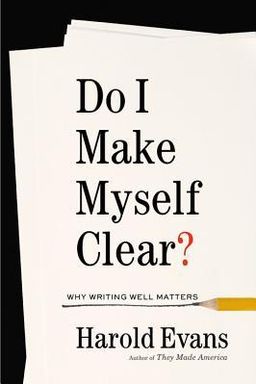
Do I Make Myself Clear cover

Do I Make Myself Clear

by Harold Evans

Harold Evans'' ''Do I Make Myself Clear?'' explores the vital role of clear writing in a world saturated with content and misinformation. Through practical advice and vivid examples, Evans empowers readers to craft messages that cut through noise and reveal truth, making it a must-read for aspiring writers and communicators.

The Moral Power of Clear Writing

Language shapes reality. In Do I Make Myself Clear?, Sir Harold Evans argues that clarity in writing is not merely aesthetic but ethical—a civic duty. Foggy language, he warns, conceals truth, corrupts thought, and costs lives. Evans borrows Dickens’s “Fog everywhere” from Bleak House to illustrate how bureaucratic and corporate opacity harms public decision-making. Through examples from politics, law, journalism, and business, he shows that every writer—professional or personal—has a moral stake in clarity.

Why Clarity Is a Moral Obligation

Evans links bad language directly to real-world damage. The 2008 housing collapse stemmed partly from mortgage documents so obscure that even experts misunderstood risk. In Flint, Michigan, citizens drank poisoned water while officials hid behind bureaucratic waffle. Similar fog infected the General Motors “customer satisfaction” phrasing that disguised deadly ignition faults. Evans’s point: words can harm when they obscure who acts and what consequences follow.

He echoes George Orwell’s warning in “Politics and the English Language”: vague political phrases dull conscience. Today, advertising “mumbo-jumbo,” corporate evasions, and social-media misinformation extend that corruption. (Evans’s argument parallels Steven Pinker’s The Sense of Style, but with sharper political urgency.)

Clarity as Civic Resistance

Evans calls clear language a form of resistance against manipulation. When journalists say a terrorist group “claimed credit” rather than “claimed responsibility,” they unwittingly award honor to murder. He replays Franklin Roosevelt’s wartime edit—changing “a date which will live in world history” to “a date which will live in infamy”—to show that word choice can rally nations or numb them. Language frames morality; precision restores accountability.

That principle underlies Evans’s editing of the White House report on the 2009 “Underwear Bomber.” Passive constructions (“mistakes were made,” “steps were taken”) let entire agencies dodge blame. Evans rewrites them into active, factual statements: “Analysts missed clues” and “Watchlist officers failed to connect intelligence.” You see how clearer phrasing forces recognition—and potential corrective action.

Your Daily Duty to Clarity

Evans reminds you that even ordinary writing influences decisions—emails, reports, posts. Each sentence either helps or obstructs understanding. If you make clarity your rule—asking “Does this help someone act or decide?”—you honor readers’ time and safeguard truth. That means naming actors, specifying outcomes, and pruning jargon. Clear writing becomes civic participation: preventing misunderstanding and deception.

Evans’s central lesson

Unclear prose isn’t neutral—it has a moral cost. Clarity protects public trust, reduces risk, and is the foundation of rational democracy.

Across the book, Evans combines diagnostics (sentence surgery), ethics (responsibility in word choice), and artistry (rhythm and structure) to teach you how clarity both reveals truth and communicates power. His message: write plainly, write precisely, and recognize every word as a decision with consequences.


The Sentence as a Living Organism

Evans treats the sentence as a living thing: if it stumbles, your reader suffers. In his “Sentence Clinic,” you learn to diagnose and cure common linguistic ailments with analytical precision. The key tools—finding subject and verb, deleting predatory clauses, chunking long sentences, and using active voice—turn bureaucratic sludge into readable prose.

Find the Engine: Subject and Verb

Every sentence runs on its verb. Evans teaches you to hunt for that driving force and move it near the beginning. In one federal regulation, the operative verb appears after thirty-five words; once brought forward, the paragraph drops from 165 words to 29. Ask: “Who does what?” That simple question can unlock dense layers of official phrasing.

Kill Predatory Clauses

Predatory openings delay meaning. Evans dissects a Colorado ballot question about slavery—it was phrased so opaquely voters could not tell if they were voting for or against the ban. His rewrite—“Shall we keep slavery and involuntary servitude as punishment for criminals?”—reveals how syntax determines understanding.

Chunk Long Sentences

When clauses multiply, comprehension dies. Evans shows how Gaza commission reports and economist analyses collapse under their own weight. He advises splitting overloaded sentences into shorter ones, each with a clear subject–verb–object structure. Asking “What failed? Why?” leads naturally to clarity.

Clinic mantra

Ask: “Who is doing what?” and “Can I say it in one active sentence?” If yes, write that version first, then layer detail after clarity is established.

The Clinic teaches you the editorial mindset of compression and accountability. Passive voice hides agency; active voice restores it. Verb-forward writing saves readers and clarifies blame. Once you train your ear for these symptoms, you not only write better—you expose the structures of evasion embedded in everyday language.


Practical Tools for Clarity

Evans transitions from diagnosis to method, showing how tools and habits sustain clarity. He surveys readability formulas, editing shortcuts, and linguistic hygiene. None replaces judgment, but all equip you to detect and fix the fog.

Readability Formulas: Use and Limits

From Flesch to Gunning, formulas measure sentence length and vocabulary complexity. They alert you when writing grows verbose or abstract. But Evans cautions: a backward sentence can score “readable.” Numbers flag trouble spots, not meaning. Use them diagnostically, then apply discernment to ensure rhythm and logic support comprehension.

Ten Shortcuts for Clear Writing

Evans converts decades of editorial instinct into ten habits—prefer active verbs, be specific, cut adverbs and adjectives, trim fat, enforce parallelism, use positive phrasing, vary rhythm, put people first, cleanse prepositions, and stop fearing repetition. Each rule condenses hundreds of micro-decisions into practice. (Stephen King’s kill-adverbs rule and George Orwell’s concreteness principle reappear here.)

Remove Language Parasites

Evans’s vivid metaphors—“zombie nouns,” “flesh-eaters,” “pleonasms”—turn editing into a hunt. Zombie nouns (implementation, participation) eat verbs and life; flesh-eaters (in the event of, in the field of) bloat syntax; pleonasms (free gift) waste meaning. Quick searches for -tion or -ment expose stylistic infection; replacing them with strong verbs restores energy.

Tool lesson

Formulas indicate; shortcuts repair; metaphors train your eye to spot the predators of clarity. Combine them to sustain transparent communication.

With these tools, you internalize editing as habit. Clarity ceases to be an ideal and becomes a craft—one measurable, repeatable, and ethical.


Precision and Word Choice

Clear sentences rely on precise words. Evans catalogues confusions that distort meaning and ethics—reign versus rein, ravage versus ravish, loan versus lend, martyr versus suicide bomber. These distinctions matter because each term carries moral, legal, or emotional weight.

Guard Accuracy and Tone

Mix-ups like “luxurious” versus “uxorious” amuse readers but erode credibility. Others, such as calling a violent killer a “martyr,” distort justice. Evans insists precision protects truth. He cites lexicographers and legal dictionaries to remind you that words like “refute” mean “disprove,” not “deny.” Such vigilance prevents careless inflation of meaning.

Check Morality in Language

Some errors are ethical, not stylistic. When GM labeled lethal engine faults “customer convenience,” people died. When the military used vague jargon like “softening the target,” a hospital was destroyed. Evans documents both catastrophes to show that euphemism kills caution. Correct phrasing forces moral confrontation; vague language invites negligence.

Precision rule

Ask whether your word choice names facts, assigns responsibility, and resists moral distortion. If it disguises reality, change it.

Evans’s lexicon of mistakes makes you alert to slippage as danger, not trivia. The right word doesn’t just sound correct—it tells the truth about events and people.


Business, Bureaucracy, and the Language of Obfuscation

Institutions thrive on opacity because fog protects power. Evans’s chapters on business and government prose show how jargon, euphemism, and passive syntax bury facts about money and accountability.

Corporate Gobbledygook

He dissects marketing releases (“deprecating the classic Admin console”) and legal clauses stuffed with “such information.” After simple rewrites, the same content becomes plain and decisive. The motive for vagueness is often defensive—protecting image, avoiding legal exposure. Evans’s advice: replace passive agents with subjects who act (“We will repair the car” instead of “repairs will be effected”).

Hidden Policy Harm

His “Social Security Buried Treasure” chapter exemplifies linguistic concealment. Senate language about “file and suspend” hid benefit changes costing retirees tens of thousands. Long sentences, dense cross-references, and legal phrasing (“such individual”) ensured few understood until too late. Evans translates these clauses into clear financial terms to show how literacy directly affects livelihoods.

Economic clarity rule

Opaque documents hide imbalance. If clarity threatens those in control, insist on plain English—it protects public money and trust.

Across examples—from Jack Abramoff’s lobbying to misleading organization names—Evans teaches that transparency in language equals accountability in policy. The writer’s duty is to expose, not obscure.


Rhythm, Structure, and Story

Clarity need not kill beauty. Evans demonstrates how rhythm, structure, and storytelling amplify precision. He moves from sentence mechanics to narrative form, showing you how style can heighten truth.

Sentence Music

Three patterns—loose, periodic, balanced—shape your prose. Loose sentences open with the main clause and build detail (ideal for explanation); periodic ones delay climax for drama (ideal for persuasion); balanced pairs contrast ideas for emphasis (ideal for judgment). Reading aloud exposes rhythm faults and helps you place stress where it belongs.

Conciseness and Narrative

Evans contrasts crisp leads (“Dead.” by James Thurber) with immersive reporting like Barry Bearak’s Kosovo minefield story. The point: story and economy coexist. Begin with who, what, where, when; expand only when emotion or complexity demands. He condenses long reports (Ebola, film press releases) without sacrifice of sense, proving economy serves empathy.

Rhythm lesson

Ear and ethics align: rhythm delivers impact, concision preserves integrity. Together they turn prose into memorable truth.

Evans concludes that precision and rhythm are not opposites. When done right, clarity sings. It moves readers and guides decisions—the highest mission of language.


Human Judgment in the Age of Machines

Finally, Evans asks whether machines can imitate human clarity. Through SCIgen—the MIT program that fabricated fake academic papers—he proves that syntactic smoothness can mask intellectual emptiness. Editors accepted meaningless jargon because it sounded academic, exposing how style without substance seduces even experts.

How to Detect False Clarity

Machine or fake writing often lacks concrete nouns—no people, places, or dates. Instead it floats in abstractions. Evans’s test: if removing one sentence makes the rest collapse, the paragraph has no structure. Real writing withstands scrutiny because facts anchor it.

Your Role in Humanizing Language

Human clarity demands judgment, empathy, and accountability—qualities algorithms lack. Evans’s closing message: technology may assist style, but only moral attention guarantees truth. Editors, readers, and writers must guard against mechanical fluency that conceals moral and factual emptiness.

Evans’s warning

Clarity cannot be automated. It demands human honesty—the courage to prefer awkward truth over elegant deceit.

This final insight binds the whole book: every sentence is a moral act. You cannot outsource conscience. Choose words that reveal, and you preserve humanity against both bureaucratic fog and machine-made illusion.

Dig Deeper

Get personalized prompts to apply these lessons to your life and deepen your understanding.

Go Deeper

Get the Full Experience

Download Insight Books for AI-powered reflections, quizzes, and more.