
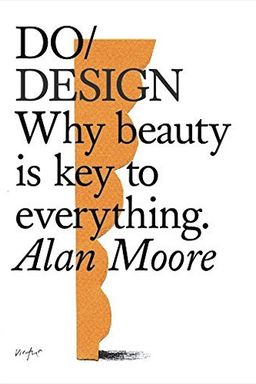
Do Design cover

Do Design

by Alan Moore

Do Design by Alan Moore challenges creatives to redefine beauty in design, extending beyond aesthetics to transform our lives and businesses. Through insights on craftsmanship, user experience, and collaborative innovation, it inspires readers to create enduring legacies of joy and functionality.

Why Beauty Is the Foundation of a Better World

When was the last time something truly beautiful stopped you in your tracks? Maybe a well-crafted chair, a breathtaking landscape, or a moment of unexpected kindness. In Do Design: Why Beauty Is Key to Everything, Alan Moore asks us to reconsider beauty—not as luxury or decoration, but as a fundamental principle that shapes how we live, work, and create. The question he poses is powerfully simple: what if we designed our lives, organizations, and creations around beauty?

Moore contends that beauty is not a fleeting aesthetic but an enduring quality that emerges when something is made with honesty, purpose, and care. Whether through a Shaker chair, a Pixar story, or the organic precision of a calligrapher’s brush, beautiful design uplifts humanity because it integrates utility, integrity, and spirit. The book becomes both a meditation and a manual on how you can craft a more meaningful, human world—through whatever you make.

Beauty as a Way of Being

At the heart of Moore’s philosophy lies the belief that beauty is the visible form of truth. Drawing on thinkers like Emerson, Frank Wilczek, and William Morris, he shows how simple, well-proportioned designs reflect fundamental patterns within nature. Physics, he reminds us, often yields the most elegant equations when describing how the universe works. And the same applies to good design—the most enduring objects and ideas are those aligned with harmony and simplicity rather than indulgent excess.

Moore argues that we’ve lost our connection to beauty by prioritizing speed, productivity, and profit over purpose. Yet when we attend to beauty—through crafting, making, or even noticing—the world slows and deepens. Beauty becomes an act of resistance, a declaration that life and work can be gracious, deliberate, and meaningful.

Learning from the Makers of Meaning

To ground this philosophy, Moore introduces us to exemplars of beauty in action. The Shakers, 19th-century craftspeople, lived by the maxim “That which is useful should also be beautiful.” Their chairs and homes embodied honesty and harmony—the result of patience, precision, and faith that even a chair should be fit for angels. Tashi Mannox, a Tibetan calligrapher, demonstrates that clarity of mind directly shapes the quality of one’s work: only through inner stillness can beauty emerge. And Doug Engelbart, inventor of the computer mouse, designed not just tools but a vision of humanity augmented through collaboration—another kind of beauty.

Each story reveals that beauty thrives when purpose, process, and spirit align. The craftsman’s discipline is mirrored in the poet’s integrity, the photographer’s empathy, and the entrepreneur’s imagination. Together they show you that artistry extends beyond aesthetics—it’s a moral and emotional practice of care.

Designing for Humanity

Moore challenges you to see design as far more than professional artistry. Every decision—how you speak, lead, or build a business—is a design choice that shapes culture. Beauty, therefore, is civic responsibility: it fosters connection and optimism. When products, systems, or communities embody honesty and grace, they elevate human life. Moore references companies like Yeo Valley Farms and Gränsfors Bruk, both of which prospered by aligning business ethics with craftsmanship, sustainability, and community—a tangible proof that beautiful practices yield enduring value.

Designing beautifully also means designing for the senses and emotions. From typography to architecture, every sensory experience shapes how we feel about the world and others. When we surround ourselves with carelessly made things, we internalize that carelessness. But in creating or choosing beauty, we affirm life’s worth.

Beauty as Connection and Purpose

Beauty connects us—to others, to place, to purpose. Moore closes the book with the astronaut Edgar Mitchell’s revelation of the Overview Effect: seeing Earth from space as a single, fragile, interconnected organism. That moment of awe inspires Mitchell’s call to “save the lover’s body”—to cherish life in all its unity. Moore’s message echoes this cosmic empathy: to live beautifully is to design with love for the “We,” not just the “Me.” Leadership, he argues, becomes beautiful when it serves compassion, openness, and shared creation—what Muhammad Ali poetically called “Me, We.”

In the end, Moore leaves you with both a challenge and a gift: to see every act of making as a moral act, every creation as a chance to bring more light into the world. Beauty isn’t an accessory—it’s an ethic. From the Shaker table to a poem by Seamus Heaney, from a simple garden to a global enterprise, what is beautiful endures because it’s rooted in truth, love, and care. “Do Design” ultimately reawakens your conviction that beauty—when practiced daily—can make the world not just better, but whole.


The Roots and Spirit of True Design

Moore begins his exploration of design by returning to its primal source: the union of human spirit and craft. Quoting Emerson and William Morris, he invites you to imagine a world where every action of design enriches life—where making is not about consumption but connection. Good design, he insists, is never superficial. It stems from deep roots of purpose and honesty, touching both body and soul.

Learning from the Shakers

The Shakers’ approach to design offers Moore a blueprint for timeless craftsmanship. Their belief that “God is in the details” translated into objects so simple yet so precise that they radiated spiritual harmony. A Shaker chair—with its four posts and woven tape seat—embodies grace through proportion rather than ornament. The Shakers worked as if they had “a thousand years to live and as if they would die tomorrow.” This patience, humility, and devotion to purpose forged utility into quiet poetry.

Moore draws a parallel between Shaker authenticity and modern design’s potential: beauty should never be a veneer but an outcome of truth. Designers today, he suggests, can learn from the Shakers’ “invisible culture” that shaped their work without written doctrine—context and belief, not style guides, made their creations profound.

Purpose Over Style

The core of great design lies in asking why. Why are you making this? For whom? Toward what end? Without purpose, design becomes indulgent or hollow. Moore’s embrace of Shaker values—utility, honesty, beauty—becomes a challenge to modern makers drowning in speed and trend. “Do not make that which is not useful,” said the Shakers. Today, that edict would mean designing technologies, spaces, and even policies that uplift human life rather than exploit attention or resources.

Design as a Spiritual Practice

Craft, for Moore, is inseparable from spirituality. The Shakers saw work as prayer, a practice that refined both object and self. Modern craftspeople—whether coding software, writing poetry, or baking bread—can reclaim that same reverence. When you work with care and presence, you partake in what he calls the roots of beauty: the alignment of form and inner integrity. It’s not nostalgia but renewal. Returning to roots doesn’t mean copying old designs—it means working from the same depth of love, patience, and truth that gave those designs life.

In Moore’s eyes, this philosophy extends far beyond furniture or architecture. It suggests a way to live more beautifully—to approach your everyday actions as crafts to be honed, balanced, and harmonized. Like a Shaker chair, your life can become both useful and beautiful—if guided by purpose, context, and care.


Stillness, Truth, and the Craft of the Mind

If craftsmanship begins with the hands, beauty of mind begins with stillness. Moore uses the stories of Morihei Ueshiba, Tashi Mannox, and Seamus Heaney to show that true mastery requires both technique and inner clarity. Each of these creators sought truth and calm as the basis of their work, revealing that design—like art or martial practice—is as much an inner discipline as an outer skill.

The Troubled Man and the Mountain

Morihei Ueshiba, founder of Aikido, retreated into the mountains after years of turmoil and emerged with a nonviolent form of martial art. His journey symbolizes a key truth: your purpose shapes your output. Without internal alignment, skill alone becomes sterile. Moore places this reflection alongside a warning—without philosophy, we become efficient but empty, productive but purposeless.

The Great Stillness of Creation

Tibetan calligrapher Tashi Mannox discovered that his emotions directly affected the precision of his lines. Anger created shakiness; clarity created balance. Over years of disciplined practice, he learned that the state of the maker is mirrored in the product. Moore connects this to modern creative life, where noise, speed, and multitasking often masquerade as productivity. True creativity, however, flows from stillness—a focus total enough that execution becomes meditation. Commitment gives you freedom, Tashi teaches; devotion releases creativity.

The Poet’s Quest for Truth

Seamus Heaney, described by Moore as a master craftsman of language, demonstrates that beauty flourishes where honesty meets empathy. Heaney’s poetry translates ordinary life—folding sheets with his mother, reflecting on conflict—into universal truth. His work reminds you that language itself is a design tool: it can dignify, illuminate, and connect. Moore quotes Heaney’s belief that poetry persuades the consciousness of its rightness even amid wrongness. To design beautifully, then, is to express truth even when the world obscures it.

Together, these lessons underscore that great design is more about the state of being than about form. Stillness, honesty, empathy—these are creative tools as vital as hammer or brush. Whether you code, draw, or lead, cultivating them refines the beauty of your work and your world.


Curiosity, Serendipity, and the Creative Mind

According to Moore, curiosity is the wellspring of creativity. The more open and inquisitive your mind, the more beautiful and original your designs become. In chapters centering on curiosity and serendipity, he celebrates unpredictability as an essential counterpart to craft. The creative mind, like the curious traveler, thrives on detours.

The Gift of Curiosity

Moore echoes John Steinbeck’s belief that “the free, exploring mind” is humanity’s most valuable asset. Curiosity, he says, questions fixed orthodoxies and authority—whether scientific, artistic, or institutional. From Galileo to Darwin to Steve Jobs, curiosity refused to accept no for an answer, continually probing for beauty in new forms of understanding. Moore reminds you that beauty isn’t born of certainty but of wonder—a quality the world often squeezes out of adults but which fuels innovation and compassion alike.

Welcoming Serendipity

In a charming metaphor, Moore personifies serendipity as an unexpected guest who never books an appointment. She appears in whispers or shocks—a “thunderbolt” of insight reminding you that accidents often conceal meaning. His advice: leave the door open for chance. By releasing control, you give space for novelty. This echoes scientific discovery and artistic improvisation alike; as physicist Louis Pasteur said, “Chance favors the prepared mind.”

Depth of Perception

Photographer Sebastião Salgado illustrates another dimension of curiosity: empathy. His “depth of field” comes not only from technical skill but from emotional closeness to his subjects. To truly see, Moore argues, is to enter another’s world without judgment. Empathetic seeing—whether through a lens or in conversation—expands your creative depth. Taken together, these lessons remind you: cultivate curiosity, invite serendipity, and see with compassion; they form the trinity of a living, vibrant imagination.

In a world obsessed with predictability, such openness may seem reckless. Yet for Moore it’s the very condition for beauty, for only curiosity keeps the creative spirit alive when certainty dulls the senses.


The Practice of Making the Beautiful New

Moore rejects the myth of effortless genius. Beauty, he says, is the result of daily practice, experimentation, and failure embraced with optimism. From comedian Bill Bailey’s creative process to Jony Ive’s design mastery at Apple, the journey to the new requires patience, skill, and faith that better is possible. His fourteen practices for creating enduring beauty form a hands-on philosophy any creator can use.

From Laughter to Lightbulbs

Bill Bailey’s creative quip—“I start with a laugh and work backwards”—captures the designer’s paradox: imagine the outcome first, then invent the path. This approach mirrors how Pixar, too, develops its worlds by starting with emotion, then building the mechanism that evokes it. Ed Catmull’s caution that “the greatest enemy of creative success is fortifying against failure” underpins Moore’s message: embrace error as progress. Every graze, every stumble, is part of birthing originality.

Tools, Materials, and Mastery

Moore reveres tools—not as objects, but as extensions of the maker’s heart. From worn chisels in a glass case to Apple’s ultrathin glass, tools shape how we shape the world. “Pick up a tool with truth and beauty in your heart,” he urges. Craft demands not just equipment but intimacy with material; Jony Ive’s relentless inquiry—“Why not glass like this? Why not polish the inside?”—reveals how mastery grows through questioning limits. The obsession with material truth produces objects that feel inevitable, simple, and alive.

Designing the Space Between the Lines

Typography, for Moore, becomes a metaphor for all creation. A master typographer told him to “start with the space between the lines,” reminding us that beauty also resides in negative space—in rhythm, silence, and restraint. Good design hides the ego of its maker; it feels effortless, though it arises from meticulous care. Derek Birdsall’s rule—design so it seems inevitable—captures this perfection: beauty is work well resolved.

Designing for the Senses

Moore’s sensual chapter celebrates how our bodies interpret design. Smell, touch, taste, sound, and sight are our instruments of meaning. Whether in a café, a woodshop, or a smartphone, what feels intuitive succeeds because it honors the human sensorium. Skeptics may deem tactile or emotional design unquantifiable—but to Moore, sensory richness is what transforms utility into joy. True success, he concludes, is not efficiency but resonance: work that touches hearts and keeps people returning with a smile.


Perseverance and the Beauty of Time

In the section Moore calls “Persevere,” beauty becomes entwined with time, patience, and purpose. Through stories of artists, gardeners, and motorcycle builders, he reminds you that greatness ripens slowly. Beauty cannot be rushed—it grows from devotion and persistence.

Learning from Time and Roots

In “Time is Earthed,” Moore recounts tending a beech hedge for twenty years. His father-in-law’s advice—“It’s the roots that matter, not the height”—becomes a metaphor for all lasting creation. Quick fixes die; deep roots endure. The same truth guided Willie Nelson’s late-blooming career and author Mary Wesley’s success at seventy. “You can’t rush greatness,” Moore says, “you can only prepare for it.”

Love as Craft

The rebuilding of vintage motorcycles by Hugo and Fred of Blitz Motorcycles exemplifies love in labor. They work without timesheets, restoring old frames into new life. Their motto: “Invest in love, it pays well in the end.” Like monks of metal, they show that passion plus patience yields objects infused with soul. Work, when loved, transforms into art; debt-free autonomy becomes wealth of spirit.

Gardens on Shingle Beaches

Artist Derek Jarman’s garden, grown on Dungeness’s desolate coast, embodies defiant beauty. Amid salt, wind, and stone, he cultivated life until his final days. “Paradise haunts gardens,” he wrote, “and some gardens are paradises.” Moore uses Jarman’s story to remind you that beauty often flourishes where conditions seem impossible. Like Jarman, you too can make beauty out of adversity by tending your “shingle beach”—the hard patch of life—and transforming it through care.


Collaborative Beauty and the Power of 'We'

Moore argues that beauty reaches its full expression only when shared. From leadership to collaboration, he explores how collective purpose transforms work from efficient to extraordinary. Through examples like Pixar, Yeo Valley Farms, and Muhammad Ali’s two-word poem, Moore reframes creativity as a community act.

The Beauty in Leadership

A leader, Moore says, must be “a work in progress.” Real authority is earned, not imposed—it is “a power voluntarily given by others.” Effective leaders lead through empathy and example, not domination. He tells of helping a state broadcaster redefine its identity by co-creating vision with its staff. By flattening hierarchy, making everyone part of the process, he fostered ownership. Leadership, he concludes, is an art of listening and enabling others to build the new.

People Embrace What They Create

In Moore’s favorite phrase, “people embrace what they create,” lies a philosophy of engagement. When individuals co-create their work, they invest energy, love, and meaning. This is how culture—whether of a company or community—thrives. Quoting Saint-Exupéry, he notes: “If you want to build a ship, teach them to yearn for the vast and endless sea.” Motivation rooted in shared vision outlasts any order or incentive.

From Me to We

Muhammad Ali captured humanity’s essence in his shortest poem: “Me. We.” Moore elevates this as a design principle. Beauty emerges when the individual (‘Me’) contributes fully to the collective (‘We’). The “We” binds culture, meaning, and ethics—it’s how societies, brands, and families flourish. He warns that modern life’s obsession with individualism has corroded this connection, but reviving the We is essential for a humane future.

Pixar’s Braintrust: Nurturing Beauty Together

Pixar exemplifies collaborative beauty through its “Braintrust” meetings, where candor, trust, and mutual respect elevate every story. “Every Pixar movie starts out sucky,” says Ed Catmull, “but through open, loving critique, we make it great.” For Moore, this process models how any team or community can evolve an idea from good to extraordinary. Openness, not ego, is the root of creative excellence—and the We is its fertile ground.


Designing for an Interconnected and Enduring Future

Bringing his journey full circle, Moore expands beauty to a planetary scale. Drawing from Edgar Mitchell’s “Overview Effect,” he asks us to see design not merely as an act of creation, but as a moral relationship with life itself. To design beautifully is to design in harmony with the systems—natural, social, emotional—that sustain us.

Salve Corpus Amanti: Save the Lover’s Body

Moore reinterprets Mitchell’s phrase as a design imperative. Humanity, nature, technology—all are interwoven bodies of one living system. To create in ignorance of this interconnection is to harm the whole. Through painter Gerhard Richter’s abstractions and writer Robert MacFarlane’s reflections, Moore shows how even chaos and fluidity have beauty when acknowledged as connected forces. The task of the designer, then, is humility: to work with, not against, nature’s patterns.

Living Off the Coast of Utopia

Moore ends on a poetic note. We can never reach Utopia, but we can live off its coast—sailing close enough to its light to guide us forward. Like Michelangelo’s David or Yeo Valley’s sustainable farms, striving for perfection, even if unattainable, gives life direction and joy. Cynicism settles for mediocrity; optimism, Moore says, is the only realistic way to build a better world.

The Philosophy of ‘Ing’

Moore closes with a celebration of verbs—making, painting, sowing, loving. He calls this “the philosophy of ‘ing’”: to keep doing, learning, evolving. Beauty, like life, is dynamic. Every time you engage in the act of sincere creation, you contribute to a more beautiful, interconnected ecology of being. In the end, Moore invites you to ask: What is your ‘ing’—your way of giving beauty back to the world?

Dig Deeper

Get personalized prompts to apply these lessons to your life and deepen your understanding.

Go Deeper

Get the Full Experience

Download Insight Books for AI-powered reflections, quizzes, and more.