
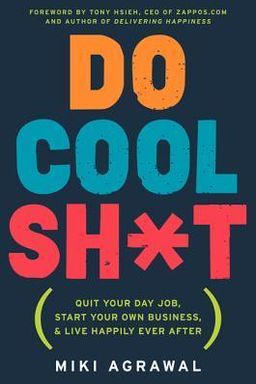
Do Cool Sht cover

Do Cool Sht

by Miki Agrawal

Do Cool Sh*t is a transformative guide for those ready to challenge the status quo and live life on their own terms. With practical steps and inspiring anecdotes, Miki Agrawal empowers readers to pursue their passions, overcome obstacles, and build meaningful relationships, creating a life filled with purpose and excitement.

Doing Cool Sh*t: Designing a Life You Love

What if “success” didn’t mean playing it safe, sitting in traffic, or climbing someone else’s corporate ladder? In Do Cool Sh*t, entrepreneur and activist Miki Agrawal argues that real success comes from designing a meaningful, adventurous life centered around passion, purpose, and community. She invites readers to challenge conventional paths, take creative risks, and forge fulfilling careers that also create social good.

Agrawal’s message isn’t abstract theory—it’s built on her own story. She shares how a corporate banker turned burned-out twenty-something became a serial social entrepreneur, launching ventures like WILD (a farm-to-table pizza restaurant), THINX (period-proof underwear that supports girls’ education in Africa), and Super Sprowtz (a children’s wellness initiative). Each business began with a personal problem—lactose intolerance, female hygiene shame, kids refusing vegetables—and became an opportunity to “do cool sh*t” that mattered. Her playbook combines hustle, community, generosity, and joyful experimentation.

Redefining Success

Agrawal opens by asking why we want to be “successful” in the first place. She recalls entrepreneur Tony Hsieh’s favorite question: when you keep asking why someone wants success, the answer always ends up being, “Because I want to be happy.” Her own definition evolved—from financial independence as a young banker, to freedom of time as a small-business owner, and finally to alignment with her potential and values. For her, success means living a full, passionate life that includes thriving work, healthy relationships, and contribution to the world.

Agrawal learned this after surviving 9/11—missing the attacks on the Twin Towers because she overslept. The close call reoriented her entire life: if she’d died that day, she realized she would have wasted her time pursuing someone else’s dream on Wall Street. That shock became her pivot from survival to intention: to make things she loved, with people she admired, that served something larger than herself.

A Roadmap for Creative Entrepreneurs

Across its twenty-one chapters, Do Cool Sh*t serves as both memoir and manual. Each story contains practical exercises—for example, crafting your “I-EX” (internal examination) to discover what you’re good at and passionate about, or her BET system (“Bullet, Eliminate, Take on”) for designing a circle of friends and collaborators who energize you rather than drain you. Agrawal’s advice revolves around courage in action: ask for what you want, create before you feel ready, get feedback fast, and treat every step as an experiment.

She insists business is not an impersonal arena—it’s built on people, not plans. “Business plans don’t raise dollars; people do,” she writes, encouraging aspiring founders to connect authentically with potential investors and customers through storytelling, events, and generosity. For Agrawal, the secret is excitement: genuine enthusiasm is contagious, and nothing attracts support like passion backed by thoughtful hustle.

Learning Through Resilience and Reinvention

While many business books gloss over failure, Agrawal recounts her disasters unflinchingly. From chaotic restaurant openings to being told “no” hundreds of times by investors, she illustrates how persistence and creativity turn setbacks into breakthroughs. Her storytelling feels personal and raw—whether she’s sneaking past New York Times security to hand-deliver press kits or recovering from two ACL surgeries after chasing her soccer dreams. Each “failure” becomes another rep in her resilience muscle.

Later in life, she distills her philosophy into an acronym that guides both love and work: L.A.C.E.—Looks, Adventure, Challenge, Enhance. It captures the balance of attraction, novelty, growth, and elevation that defines how she builds relationships and businesses alike. Ultimately, Agrawal emphasizes that purpose and play aren’t opposites—they belong together.

From Passion to Impact

Beyond building businesses, Agrawal cares about what business can build in the world. Inspired by her parents’ philanthropic ventures and mentors like Tony Hsieh, she embraces what she calls “double-bottom-line entrepreneurship”—doing good and doing well. Her ventures combine profit with purpose: WILD connects urban eaters to local farmers; THINX combats global period poverty; Super Sprowtz helps children discover the magic of healthy food. Giving back, she argues, isn’t separate from success—it’s proof of it.

At its heart, Do Cool Sh*t isn’t just about quitting your job or starting a business. It’s about rejecting autopilot living. Agrawal invites readers to redefine cool as courageous authenticity—to take risks, build meaningful communities, and fill their own “box of possibility” with adventures, friendships, and creations that matter. If Tony Hsieh’s Delivering Happiness gave us a playbook for joy through company culture, Agrawal’s book expands it into a blueprint for a joyful life.


Redefining Success on Your Own Terms

Miki Agrawal begins her story by asking: Why do you want to be successful? She learned from Tony Hsieh that when you keep asking this question, the final answer is usually simple: “Because I want to be happy.” Yet happiness is often misunderstood. We chase money, status, and approval, assuming they’ll deliver joy—but Agrawal’s journey shows these external wins rarely do. Real success, she argues, comes from living in alignment with your values, strengths, and curiosities.

Three Phases of Success

For Agrawal, success evolved through three distinct phases. At first, it meant financial freedom. Fresh out of Cornell, she joined Deutsche Bank and crunched numbers on Wall Street—until 9/11 made her question everything. Money couldn’t justify misery. In phase two, success meant freedom of time. She wanted autonomy, so she opened her own restaurant. After years of grinding, she realized freedom wasn’t enough either. Finally, success became self-actualization—being her fullest, most authentic self across business, love, health, and community.

By the end of her journey, Agrawal discovered that happiness and success aren’t destinations but by-products of living with purpose and curiosity. She says, “I want it all: a growing business, a great relationship, community, fitness, and new adventures.” Unlike traditional entrepreneurs who glorify sacrifice, she models integrated success—balancing impact and joy.

The 9/11 Turning Point

Agrawal’s near‑death experience on September 11, 2001 crystallized her philosophy. She was supposed to be in the World Trade Center that morning but overslept—a tiny shift that saved her life. Watching the towers fall from home made her realize how fragile time is. She sold her bike, bought a laptop, and wrote her first screenplay. That moment taught her that excuses and fear are luxuries; the only real risk is wasting time on work that doesn’t matter.

The Power of Asking “Why”

Agrawal encourages readers to use a simple exercise: when you’re unclear about your goals, ask yourself “Why?” five times. For example: Why do I want to start my own business? To make money. Why? To have freedom. Why? To spend time with people I love. Why? Because I feel alive when connected. Why? Because I want to be happy. That’s your true motive—and your real compass.

Ultimately, redefining success starts by redefining self‑worth. You don’t need a corporate title or startup millions to feel complete. You need purpose, people, and play—ingredients Agrawal layers throughout her book. (Similar to Viktor Frankl’s Man’s Search for Meaning, she insists purpose, not pleasure, creates lasting joy.)


Stray from the Group: Building Fearless Relationships

Agrawal’s London study‑abroad story epitomizes her rule: stray from the group. At a Boston University orientation in London, she and forty classmates were warned not to talk to strangers. Minutes later, she ignored that advice—veered off her bike tour, rode straight into a pickup soccer game at Hyde Park, and asked the group of British guys if she could play. That bold moment led to lifelong friendships and an entirely different kind of education in courage and connection.

Creating Mutually Beneficial (MB) Experiences

From that experience, Agrawal articulated her concept of MB: the mutually beneficial experience. Real growth happens when both sides give and get value—whether in internships, friendships, or work. Her miserable PR internship in London—where bosses ignored her and she made coffee all day—taught her that any relationship or job without mutual benefit drains energy. When she quit (the first BU student to ever do so) and instead worked for Lord Hugh Thomas of the House of Lords, she discovered her entrepreneurial spirit through independent, purpose‑driven work.

The BET Method: Audit Your Circle

To apply this lesson, Miki created the BET System: Bullet, Eliminate, Take On.
Bullet—List the people in your life who inspire you versus those who deplete you.
Eliminate—Reduce contact with negative, toxic, or energy‑sucking people.
Take On—Actively seek new connections aligned with your values and vision. She argues that when you prune social clutter, you create emotional oxygen for creativity and joy. (This mirrors Jim Rohn’s maxim: “You are the average of the five people you spend the most time with.”)

Leaving her internship solidified another entrepreneurial truth: discomfort is a compass. When something depletes you, step away and design your own rules. Straying from the group doesn’t just help you meet new people—it helps you meet new versions of yourself.


Turning Problems into Purpose

Agrawal’s first business was born not from a million‑dollar idea but from stomach pain. After repeated digestive issues, she realized she was lactose intolerant and couldn’t eat her favorite food—pizza. Discovering that European cheese didn’t hurt her prompted an insight: American dairy was filled with hormones and chemicals. That discovery turned frustration into innovation. She decided to create a pizzeria for people like her: one that served organic, hormone‑free, gluten‑optional, farm‑fresh pies. WILD (originally SLICE) became New York’s first “healthy pizza” restaurant.

The PIE Framework

To help others find opportunities in their own frustrations, Agrawal offers a simple model called PIE: Philanthropic, Intrapreneurial, and Entrepreneurial approaches. The Philanthropic path lets you use your skills to help nonprofits; the Intrapreneurial path lets you innovate within an existing company; and the Entrepreneurial path—her favorite—means going solo and creating a business from scratch. The right route depends on your risk tolerance and goals, but all start by asking, “What sucks in my world, and how can I fix it?”

Start Small, Learn Fast

Agrawal started on a shoestring budget at twenty‑six, learning construction, branding, and operations through trial and error. Her early mistakes—like opening before her staff was trained—became hard‑earned masterclasses in humility and persistence. Her restaurant’s first weeks were chaos, but she recovered by apologizing openly, improving systems, and winning back customers with honesty and free samples. “Business is iterative,” she writes. “Nothing is ever perfect—it often takes much longer than you expect.”

Her lesson is universal: every complaint hides a company. Whether it’s lactose intolerance, long commutes, or cultural taboos, problems become possibilities when approached with curiosity and courage.


The Power of People and Community

If there’s one theme that runs through Do Cool Sh*t, it’s community. Agrawal insists that every victory—creative, emotional, or financial—comes from collaboration. Her story is filled with examples: getting Tony Hsieh’s support began with a simple wave across a bar; raising money for WILD happened through intimate investor dinners filled with laughter, music, and food. “Business plans don’t raise dollars; people do,” she says. Connection—not credentials—is the true capital of entrepreneurship.

From Networking to Connecting

Agrawal redefines “networking” as connecting. Instead of trading business cards, she builds relationships around shared excitement and generosity. At her “Meeting of the Minds” dinners, she invited architects, chefs, and creatives to brainstorm her restaurant concept over good food and wine. The collaboration produced WILD’s name, brand, and mission—and gave everyone in the room ownership of its success. By turning professional relationships into shared experiences, she transformed contacts into allies.

MB in Action

Her principle of MB (mutually beneficial) relationships underlies every strategy. When she hosted investor parties, she hired aspiring chefs who gained exposure, invited journalists who got stories, and connected attendees with each other. Everyone left winning. This reciprocity reflects Tony Hsieh’s “ROC—return on community” philosophy: measure success not just in profit, but in connections strengthened.

For readers, Agrawal’s takeaway is simple and profound: build your tribe before you need it. Say yes to helping, introduce others generously, and let excitement be your magnet. As she puts it, “Genuine excitement builds believers.”


Doing Good and Doing Well

Agrawal’s mantra evolved into “doing good and doing well”—a modern version of capitalism with conscience. She witnessed it firsthand through her parents, who ran educational programs while raising three daughters, and mentors like Tony Hsieh, whose Downtown Project fused business with community renewal. For her, purpose and profit strengthen each other, not compete.

Integrating Social Impact

Her ventures demonstrate this philosophy. WILD sources ingredients from local farms and suppliers, supporting regional economies. Super Sprowtz uses puppets and storytelling to teach kids about healthy eating; its characters like Brian Broccoli and Colby Carrot turn vegetables into heroes. THINX, Agrawal’s underwear brand, tackles menstrual stigma while funding the production of reusable pads for girls in Africa. Each business solves a real problem, empowers communities, and earns sustainable profit.

She sees social entrepreneurship as both moral and strategic: consumers increasingly want products that reflect their values. Doing good becomes good business. (This echoes Muhammad Yunus’s microfinance movement and Blake Mycoskie’s TOMS model.)

Peer Pressure for Good

At the Clinton Global Initiative, Agrawal learned the power of public pledges. When innovators announce concrete impact goals, accountability breeds progress. She began encouraging communities to make similar commitments—to “peer‑pressure” one another into collective service rather than competition.

Her call to action is clear: fuse impact with income. Whether you start a company, launch a side project, or volunteer weekly, build social good into your blueprint. “You can have it all,” she reminds us, “but only if what you build helps others rise too.”


Evolving Through Iteration

The final chapters of Do Cool Sh*t reveal Agrawal’s core philosophy: life and business are iterative. You never “arrive”; you evolve. Each failure, reinvention, and success feeds the next version of yourself. She likens releasing outdated ideas to letting go of a nut in a raccoon trap: clinging kills progress. When she learned to detach from what no longer served her—be it a failing manager, a brand name, or a fear—she unlocked growth and freedom.

From WILD to THINX

After mastering restaurants, Agrawal tackled a taboo: menstruation. With her sister Radha and partner Antonia Dunbar, she launched THINX—underwear that’s leak‑resistant, beautiful, and purpose‑driven. For every pair sold, seven reusable pads are produced for Ugandan girls. The idea came after yet another “problem realization”—embarrassing accidents during her period. She iterated the product for years, financing through Kickstarter and eventually winning the Tribeca Disruptive Innovation Award. THINX exemplifies her evolutionary mindset: curiosity → problem → prototype → passion → impact.

Letting Go to Expand

Agrawal’s raccoon story reminds readers not to clutch old definitions of identity or success. “Let the nut go,” she writes, meaning release control so new opportunities can enter. Each reinvention—from soccer player to filmmaker to restaurateur to feminist inventor—required surrendering ego. She calls this process “an exercise in evolution,” and it’s her parting gift: progress isn’t linear; it’s a spiral of action, reflection, and renewal.

In her closing letter “To Our Children’s Children,” Agrawal urges future generations to chase curiosity, fill their lives with meaningful memories, and define “cool” as contribution. The ultimate experiment, she reminds us, is life itself—and the bravest entrepreneurs are those who keep iterating.

Dig Deeper

Get personalized prompts to apply these lessons to your life and deepen your understanding.

Go Deeper

Get the Full Experience

Download Insight Books for AI-powered reflections, quizzes, and more.