
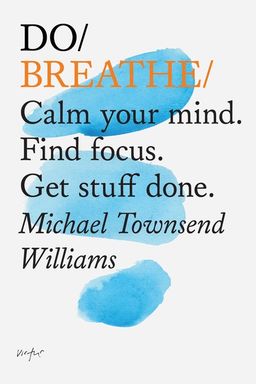
Do Breathe cover

Do Breathe

by Michael Townsend Williams

Do Breathe by Michael Townsend Williams guides you through adopting simple yet profound practices like mindful breathing and mindfulness to combat modern life''s stressors. Learn to streamline your life, embrace a growth mindset, and prioritize health for lasting peace and productivity.

Breathe: The Foundation of Calm and Clarity

When was the last time you noticed your own breath? In Do Breathe, Michael Townsend Williams argues that your breath is not simply an unconscious rhythm keeping you alive—it’s the anchor for presence, productivity, and peace. He contends that the way you breathe mirrors the way you live. By learning to breathe consciously and deliberately, you can transform stress into clarity, distraction into focus, and aimless busyness into meaningful action.

Williams writes from personal experience. Once a stressed advertising executive battling addiction, he rebuilt his life through yoga, mindfulness, and the transformative power of breathing. His journey led him from chaotic doing to intentional being—and, ultimately, to creating a bridge between the two. The book revolves around one simple but profound promise: calm your mind, find focus, and get stuff done. In other words, learn to do by learning to breathe.

The Breath as Your Body’s Bridge

According to Williams, the breath is the only system in the body we can both control deliberately and allow to operate automatically. It links mind and body, uniting the unconscious and conscious layers of experience. When your breath is erratic and shallow, your body sends signals of anxiety to your brain. Slow, rhythmic breathing does the reverse—it triggers your parasympathetic nervous system, slowing your heart rate, calming hormonal reactions, and improving cognitive clarity. He cites research showing that even a minute of deep breathing can clear stress hormones from the bloodstream, allowing your prefrontal cortex—the decision-making center of the brain—to regain control.

The simplicity of Williams’s approach makes it universally applicable. He advocates rediscovering how to breathe “like a baby”—from the belly, through the nose, and with slightly longer exhalations than inhalations. Babies breathe this way effortlessly, but adults lose this natural rhythm through stress, posture, and habit. Relearning it restores balance between body and mind, helping you reclaim the physical and emotional poise you were born with.

From Busyness to Conscious Doing

Williams observes that many of us equate productivity with chaos—we rush from one task to another, multitask endlessly, and chase constant stimulation. But beneath that motion lies anxiety and exhaustion. Breathing becomes shallow and fragmented, mirroring the pace of our distracted lives. The author calls for a radical slowing down—not to idle, but to do better.

By anchoring yourself in your breath, you create moments of choice. Between inhaling and exhaling lies a micro-pause where you can reclaim awareness. It’s in this space, Williams writes, where you can choose how to respond instead of react. This principle echoes Viktor Frankl’s insight: “Between stimulus and response there is a space. In that space is our power to choose our response.” Breathing restores access to that space, making action intentional instead of impulsive.

Preparing for Focus and Flow

The rest of the book builds on this foundation. Breathing leads to organization, courage, mindfulness, energy, focus, and finally flow—the state of effortless concentration described by psychologist Mihály Csíkszentmihályi. Williams weaves scientific research, Eastern philosophy, and modern productivity practices into a framework he calls welldoing: a life where being and doing are in harmony.

By breathing well, you gain clarity; by organizing your environment, you reduce mental clutter; by cultivating courage, you shift from fear to growth; by practicing mindfulness, you live more presently; by managing your energy, you become sustainably productive. Each step leads to greater focus and flow, enabling you to do what matters with calm attention. Williams’s message is not that life should be free of challenge, but that calm—the kind nurtured by breath—is the most powerful state from which to meet it.

“Every breath is a wave. Every thought is a wave. And every one of us is a wave,” Williams writes. By learning to surf those waves with awareness and rhythm, you can turn chaos into coherence and distraction into purpose.

Ultimately, Do Breathe is not a manual for doing less. It’s a guide to doing more of what truly matters—without burnout. The breath, Williams insists, is how you begin. It’s the first and last thing you’ll ever do, and every other meaningful act lies between those breaths.


Organise: Creating Mental Clarity Through Order

Williams contends that anxiety thrives in disorganization. Echoing productivity expert David Allen, he argues that our brains are poor storage devices. Trying to juggle endless to-do’s, emails, and appointments mentally only increases cognitive load. The antidote is externalizing chaos—getting everything out of your head and into a system. Organization, he insists, isn’t about being tidy; it’s about securing peace of mind.

The C.A.R.E. Framework

Williams teaches a simple model called C.A.R.E.—Collect, Arrange, Reflect, and Execute—to help you take control of your workload, both mentally and physically. Start by collecting all incoming information—emails, notes, messages—into unified “in-trays” instead of letting them scatter. Have one inbox at work, one at home, and one notebook or app for ideas. Then, arrange them systematically using to-do lists and digital or paper filing systems. Williams advises using verbs (“email,” “call,” “write”) to clarify concrete actions and limiting project planning to the first three next steps. This ensures momentum rather than paralysis through overplanning.

Reflection is what separates automation from mastery. Williams encourages scheduling a “meeting with yourself” each week—a psychological reset where you review calendars, commitments, and plans. Finally, execute. Once clarity replaces uncertainty, you’ll act with less resistance. The key is turning these phases into habits until organization becomes effortless muscle memory.

Declutter Mind and Space

Williams advocates a “mind sweep,” à la Allen’s Getting Things Done: Spend an uninterrupted hour listing every unresolved task or worry. Then declutter your physical workspace—the external mirrors the internal. He cites William Blake’s timeless advice: “Have nothing in your house that is not fit for purpose or beautiful.” By simplifying your surroundings, you make mental clarity a default state rather than an aspiration.

Ultimately, organization isn’t about creating sterile minimalism—it’s about freeing your attention. In Williams’s words, “You decide where your attention goes. You are in charge.” Order becomes the groundwork upon which creativity and calm naturally arise.


Courage: Facing Fear and Limiting Beliefs

Even with clear breathing and organization, you can’t focus if fear rules your mind. Williams devotes a chapter to courage—the willingness to stretch beyond comfort. Drawing from psychologist Carol Dweck’s research on fixed and growth mindsets, he explains how self-imposed limits (“I’m not good at this,” “I’m not confident enough”) quietly sabotage progress. Courage, he writes, begins with self-inquiry—examining your inner narratives and reprogramming them.

Grow Through Fear

Courage isn’t the absence of fear but the willingness to face it consciously. Williams urges readers to “eat the frog,” borrowing from Brian Tracy’s idea that the most challenging task should come first. When fear arises, his formula is: Breathe to calm the physiological reaction, Think through the next step, then Act—even in discomfort. As Danielle LaPorte puts it, “Surprise your doubts with action.”

From Expectation to Acceptance

Williams also warns about two mental traps: expectation and assumption. Expecting too much leads to disappointment; assuming too quickly leads to delusion. Instead, he draws from yoga philosophy’s “karma yoga”: act wholeheartedly but without attachment to the outcome. Detach, breathe, and do your best—then let go.

By adopting a growth mindset and reframing fear as feedback, you begin to live expansively. The chapter ends with exercises like writing a “Personal Paradigm Shift” (a new belief to replace an old limitation) and practicing Amy Cuddy’s “power pose”—small physical shifts that awaken psychological strength. Courage, in Williams’s view, is a muscle made strong through daily acts of brave honesty.


Mindfulness: Living in the Present Moment

In a world of endless distraction, mindfulness reconnects you to now. Williams defines mindfulness as “relaxed attention plus acceptance.” Rather than adopting dogmatic traditions, he distills it into everyday awareness—being curious about your breath, sensations, and surroundings without judgment. He reminds readers, “All of your life happens in the present moment.” Everything else is memory or imagination.

Relaxed Attention and Acceptance

Most people think focus requires tension. Williams flips this idea: relaxation sharpens attention. “Relaxed attention” allows presence without strain. Meanwhile, acceptance softens your fight against reality. By accepting what is, you regain the freedom to respond more wisely (echoing Jon Kabat-Zinn’s Full Catastrophe Living).

Training the Senses

Williams introduces sensory mindfulness exercises—“taste,” “smell,” “feel,” “see,” “listen.” Take a raisin, notice its texture, chew slowly; walk outside and observe without labeling. These simple practices awaken your sensory connection to life, grounding awareness in body rather than mind.

He advocates “pockets of stillness”—moments of reflection amid activity. Whether it’s brushing your teeth, making tea, or driving, perform it mindfully. The instruction, borrowed from Zen, is clear: “When walking, walk. When eating, eat.”

Through breathing, feeling, and sustained attention, mindfulness transforms even mundane routines into sacred pauses. You stop surviving days and start experiencing them.


Energy: Sustaining Yourself for the Long Game

Productivity depends not on time management but energy management. Williams reframes “energy” as a blend of physical, mental, and emotional fuel. Without replenishment, no technique can save you. His five-part blueprint—Sleep Better, Feed the Mind, Move More, Stop More, and Be Positive—offers a holistic system for sustainable vitality.

Sleep and Nutrition

Referencing research on sleep cycles and REM patterns, Williams describes sleep as a performance enhancer, not a luxury. Lost sleep impairs memory and mood; sufficient rest, on the other hand, boosts focus dramatically. He illustrates this through “Richard,” a fictional ad executive whose disorganized mornings drain him, then reimagines his day when structured with mindful rest and morning breathing. Nutrition follows the same logic. He lists “Top 10 Brain Foods” (from whole grains to blueberries) and introduces the Ayurvedic “Power Drink” made from almonds, dry fruits, saffron, and rose water—gentle rituals for intentional energy.

Movement, Rest, and Positivity

Physical activity boosts mental clarity. Twenty minutes of moderate movement daily, Williams notes, reduces disease and elevates mood. Equally, he insists on stopping. Every ninety minutes, rest—our bodies follow ultradian cycles akin to mini circadian rhythms. Silence, breaks, even short naps renew your nervous system.

Finally, positivity energizes as much as caffeine. Drawing from Barbara Fredrickson’s Positivity, Williams highlights the “3:1 positivity ratio”: savor positive emotions three times more than negative ones to thrive. Gratitude, amusement, inspiration—these states feed stamina. As he reminds, “Your body works better when your mood works better.”


Focus: Doing One Thing Well

Focus, Williams says, is not narrow fixation but attention aligned with purpose. Borrowing from productivity experts like Merlin Mann and meditation masters alike, he argues that clarity comes from knowing what you care about—and removing distractions that do not serve that cause. Modern life, he admits, trains us for fragmentation. Knowing how to direct your focus is modern mindfulness in motion.

The Science and Practice of Focus

In cognitive terms, focus relies on two abilities: shifting attention consciously and resisting distraction. Meditation strengthens both. As neuroscientist Richard Davidson’s studies show, meditators develop neurons that switch focus faster and sustain it longer. Steve Jobs likened meditation to clearing static from your mental signal—over time, subtle insights emerge. Williams pairs meditation with practical hacks: turning off notifications, tracking time with apps like RescueTime, and using the Pomodoro Technique (25-minute sprints separated by breaks). Discipline and awareness merge here.

Planning Around Energy, Not Clock Time

Williams encourages planning by context—What can I do here, now, and with my available energy? His rule: You can do anything, not everything (a nod to David Allen). Prioritize morning for creative, cognitively intense work; afternoons for reactive tasks. Protect uninterrupted periods for “deep work,” echoing Cal Newport’s emphasis on high-value concentration. When aligned with your passions, focus feels less like effort and more like flow.

The practical takeaway: simplify and care first. Focus arises naturally when distraction is removed and purpose clarified. “You don’t need more focus,” Williams suggests. “You need more meaning.”


Flow: The Harmony of Effortless Performance

Williams extends focus into flow—the state of seamless engagement where self-consciousness disappears and performance peaks. Drawing from Mihály Csíkszentmihályi’s research, he explains that flow occurs when skill slightly exceeds challenge. Too little challenge breeds boredom; too much creates anxiety. The key is balance, sustained by mindful breathing and energy cycles.

The Flow Cycle

Flow unfolds in four stages: Struggle, Release, Flow, and Recovery. Williams encourages readers to endure struggle long enough for competence to stabilize, then consciously release tension—through breathing, stillness, or trust. Only then does “the zone” appear. Afterward, rest; flow’s aftermath requires recharge to repeat.

The physiological dimension is equally crucial. Coherent breathing—matching heart rate rhythm to breath rhythm—creates harmony between sympathetic and parasympathetic systems. Using his Breathe Sync app, Williams teaches people to measure heart rate variability (HRV) to track stress and resilience (a concept echoed by Dr. Alan Watkins’s Coherence). When your body syncs, the mind follows—and flow arises.

Ultimately, flow represents unity: of doing and being, effort and ease. Yoga, meditation, and even digital tools can induce it. When breathing and focus align, your inner critic quiets, your timing sharpens, and work feels like play. Flow, Williams concludes, is your body’s natural intelligence fully expressed.


Habits: Building Consistency Through Awareness

Good intentions mean little without reliable habits. Williams borrows from Charles Duhigg’s “habit loop” to explain how automatic behaviors form and how to replace negative ones. Every habit has a cue, routine, and reward. By keeping the cue and reward but replacing the routine, you reprogram old patterns. Awareness is step one; mindfulness provides the space to intervene.

From Reaction to Response

Mindful breathing creates a buffer between stimulus and response. Instead of reacting impulsively, you learn to pause, notice triggers, and choose new behaviors. Williams recommends tracking cues using the “five whys” technique pioneered at Toyota—asking “why” repeatedly until root causes surface. For instance, chronic anger might originate not from external stress but shallow breathing.

Creating New Triggers and Cornerstone Habits

Williams suggests linking new habits to existing ones (“after brushing my teeth, I’ll take three mindful breaths”). Small anchors build momentum. He also introduces “cornerstone habits”—behaviors that trigger positive chains. Breathing well is his ultimate cornerstone habit: it influences focus, organization, emotional control, and even interpersonal connection. Start small, he says—five mindful breaths before every call or meal—and watch transformation cascade outward.

Habits are, in essence, automated mindfulness. They save mental energy for creativity and growth. When cultivated consciously, they become your allies in living deliberately rather than accidentally.


Welldoing: The Synthesis of Being and Doing

In the final chapter, Williams introduces his defining philosophy: welldoing. Traditionally, our world divides “wellbeing” (inner peace) from “doing” (outer success). Williams dissolves that split. Welldoing is dynamic balance—aligning effort with ease, ambition with awareness. It’s not about perfect equilibrium but harmonious movement, “riding the waves of life with skill and joy.”

The Dynamic Balance

Drawing from medicine’s evolution from “homeostasis” to “allostasis” (balance through change), Williams reframes wellbeing as adaptability. True calm isn’t stillness; it’s the capacity to move gracefully between rest and action. Breath embodies this: each inhalation (doing) balances each exhalation (being). Together they form rhythm—the essence of vitality.

From Stress to Passion

Williams quotes Simon Sinek: “Working hard for something we don’t care about is called stress. Working hard for something we love is called passion.” Welldoing transforms hard work into soulful work. When you breathe, organize, act courageously, stay mindful, protect energy, and focus with purpose, effort becomes expression, not strain.

The book closes with a loving exercise: breathe in awareness, breathe out acceptance; breathe in calm, breathe out letting go; breathe in energy, breathe out stillness. His final invitation is simple yet profound: “Breathe well. Be well. Do well.” Welldoing, therefore, is not a goal—it’s a way of moving through life with conscious rhythm and kind intention.

Dig Deeper

Get personalized prompts to apply these lessons to your life and deepen your understanding.

Go Deeper

Get the Full Experience

Download Insight Books for AI-powered reflections, quizzes, and more.