
Idea 1
The Vital Relationship Between Diversity and Complexity
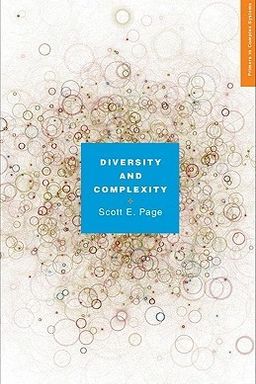
How can you make sense of a world that seems more intricate, unpredictable, and interconnected every day? In Diversity and Complexity, Scott E. Page argues that the secret lies in understanding diversity—not merely as social variety, but as a fundamental property of every complex system, from ecosystems and economies to neural networks and societies. Page contends that diversity is both the engine and the safeguard of complexity: it drives innovation, stability, and adaptability, even as it makes prediction and control more difficult.
At its core, Page’s argument wrestles with a provocative question: Why does more diversity make systems stronger rather than weaker? He shows that while homogeneity offers simplicity and order, it also makes systems brittle. Complex systems—the planet’s biospheres, global markets, scientific communities—require heterogeneous parts interacting over networks. Diversity introduces new rules, ideas, and responses; the resulting interactions generate emergent behaviors that can’t be explained by the sum of their parts. Through biology, economics, and sociology, Page maps how variance, variety, and compositional difference feed the adaptive resilience that keeps systems alive.
What Diversity Really Means
Page draws a crucial distinction between three types of diversity: variation within a type (differences among individuals of the same kind), diversity across types (different kinds altogether), and diversity of composition (how parts are arranged). A city, for example, isn’t just diverse because of its people, but because neighborhoods, infrastructures, and institutions form complex compositions. This layered diversity allows complexity to emerge—patterns of trade, culture, innovation, and adaptation that no planner could design in advance. He uses examples like markets, biological communities, and even simple games to demonstrate that interactions among diverse elements create stability and novelty simultaneously.
Complexity: Between Order and Chaos
Complexity, Page explains, is the sweet spot between order and randomness, what he calls living at the edge of chaos. It’s the state where systems exhibit interesting patterns that aren’t easily described or predicted. Entities—whether ants, humans, or algorithms—follow rules, adapt, and interact in networks. In doing so, they create emergent structures: societies, ecosystems, and cultures. He borrows from figures like Stephen Wolfram, Seth Lloyd, and Philip Anderson to show that more parts mean “more is different”: new rules emerge at higher levels of organization. Life, thought, and civilization itself result from this ladder of complexity in which diverse components create ever higher order phenomena.
Why Diversity Matters Now
Page links this interplay of diversity and complexity to real-world problems. From climate change to global finance, modern crises stem from interacting systems so intricate that simple solutions fail. Diversity isn’t just political correctness—it’s structural robustness. Just as genetic variation protects ecosystems from collapse, cognitive and institutional diversity protect societies from fragility. He reminds you that monocultures—whether of crops, ideas, or organizations—are dangerous. The Irish potato famine and the 2008 economic crash both resulted from uniformity that couldn’t cope with shocks. In complex systems, sameness is a recipe for catastrophe.
A Roadmap Through Complexity
Across nine chapters, Page builds a theory that moves from definitions to applications: how diversity is measured, how it evolves, what constraints shape it, and what benefits it brings. He demonstrates the mathematical, biological, and social mechanisms that generate diversity—mutation, recombination, representation, isolation—and the forces that limit it—space, energy, coordination, functionality, and adaptability. He then shows how variation contributes to exploration, why diversity stabilizes feedback systems, and how it enhances robustness, innovation, and creativity across complex networks. Ultimately, he argues that diversity is not just desirable; it’s necessary for survival in an ever more complicated world.
In short, Page’s work challenges you to see diversity not just as difference, but as design. It is nature’s way of ensuring that complex systems can endure change. And because our modern world is increasingly complex, managing—and harnessing—diversity becomes one of the defining tasks of our time.