
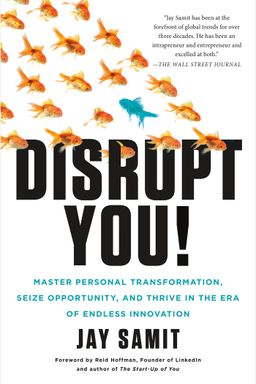
Idea 1
Disrupt Yourself Before the World Does
Jay Samit’s central message is that disruption is not something that merely happens around you—it is a force you can direct, both inward and outward. In Disrupt You!, he argues that success in today’s fast-changing economy comes from learning to “disrupt yourself” deliberately. Instead of fearing market shifts or technological revolutions, you rework your inner value chain—the beliefs, habits, and assumptions that shape your decisions—to become adaptable and opportunity-seeking.
Disruption, in Samit’s framework, is not about sudden destruction but about value reallocation. When a new technology or idea changes how value flows through an industry, massive potential energy is released. People who identify and capture that released value become the next leaders. This applies equally to individuals: if you change one weak link in your internal chain—how you think, act, present, or use time—you unlock new results that shift your trajectory entirely.
External and Internal Value Chains
Samit borrows the business concept of a “value chain” and applies it at two levels. Externally, industries and companies operate through linked stages—research, design, production, marketing, sales, and distribution. When technology or behavior alters one link, markets restructure. Internally, you have similar links: how you form beliefs (R&D), process ideas (production), present yourself (marketing), and spend time (distribution). The work of self-disruption starts by finding the failing link and upgrading it.
Samit’s own career demonstrates this mindset. After his early failure selling interactive lottery kiosks, he dissected his strengths and repurposed his hardware for airport information booths. A single change in target market salvaged his venture and set his entrepreneurial path. Later, he reframed failures again at EMI and Universal, turning constraints in corporate bureaucracy into intrapreneurial pilot labs. The core insight: change yourself first, and the opportunities will become visible.
Disruption vs. Innovation
Samit draws a sharp line between innovation and disruption. Innovation improves existing systems—better swords—but disruption changes the entire game—a revolver that makes swords obsolete. Understanding this distinction is vital. If your idea merely upgrades performance for current customers, you are innovating. If it redefines who pays, who benefits, or how the product reaches users, you are disrupting. (Christensen’s theory of disruptive innovation overlaps here but Samit emphasizes the actionable side: follow where value shifts, not abstract theory.)
Mapping Markets and Yourself
You can deconstruct any industry into links and hunt for the one easiest to disrupt. De Beers did this by marketing diamonds rather than mining them; Amazon did it by controlling distribution instead of production. Billy Myers exploited accessoires for PCs rather than building computers. Likewise, you can apply the same analysis inward—audit how you spend time, what stories define you, and where your focus leaks value. Rewire weak links strategically. Visualization, reframing beliefs, or strategic rebranding (as Samit did by adopting black apparel to match music-industry culture) represent controlled disruptions of your own brand.
The Roadmap for the Disruptor
Disruption succeeds only with planning. Samit’s “Disruptor’s Map” integrates dreams with deadlines. Write down specific five-year targets, reverse engineer milestones, and pack your “disruptor’s suitcase” with mentors, skills, and access. Treat yourself like a startup—define your market positioning, design your brand, and iterate fast. The map gives clarity and ensures every pivot aligns with measurable goals.
From Idea to Impact
Samit connects this philosophy to tangible outcomes. Pivot rapidly when data contradicts your assumptions—YouTube, Instagram, and Twitter were all born from rejected ideas. Capture released value through design, distribution, or partnerships. Use other people’s money (as Sony did with McDonald’s and United Airlines to launch Sony Connect) instead of seeking debt. Treat failure as fuel for reinvention, and learn to collaborate creatively. Disruption is no longer a privilege of inventors—it is a framework for anyone willing to learn, adapt, and act.
Core message
Every industry, every career, every belief system can be mapped, challenged, and restructured. The secret is not predicting the future—it is designing your internal and external systems to seize the value released when it arrives.