
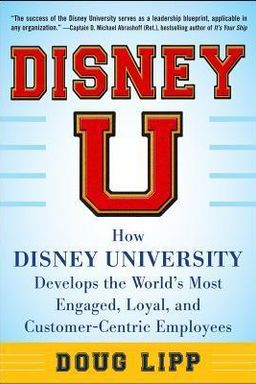
Disney U cover

Disney U

by Doug Lipp

Disney U reveals the secret sauce behind Disney''s enchanting customer experience and employee loyalty. Doug Lipp guides readers through Disney''s unique training and management philosophies, showing how embedding values and innovation leads to enduring success. Learn how to infuse your own business with Disney''s magic and create a dedicated workforce.

Creating the Happiest Workplace on Earth

How do some organizations cultivate such loyal, enthusiastic employees that their energy radiates to customers? That’s the central question behind Disney U: How Disney University Develops the World’s Most Engaged, Loyal, and Customer-Centric Employees by Doug Lipp. He asks how a global entertainment empire maintains its magic not just on-stage, but inside the hearts and minds of the people who make that magic possible. His answer begins with a surprising truth: at Disney, training is not about information—it’s about inspiring belief and behavior.

Lipp argues that the Disney University is more than a corporate training department—it’s the living conscience of a culture built by Walt Disney and Van Arsdale France. Founded to help ordinary people become part of an extraordinary show, the Disney University teaches everyone, from custodians to executives, how to carry out the core mission: “We create happiness.” But that simple phrase hides profound layers of organizational discipline, creativity, and empathy. This book shows you how values, leadership, and learning form the invisible architecture behind Disney’s enduring brand.

From Orange Groves to Magic Kingdoms

Lipp starts with the story of France, a training manager in post-war manufacturing who joined Walt Disney in 1955 just months before Disneyland’s opening. While Walt was building castles and attractions, France was designing the human side of the park—the cast who would make fantasy real. He created orientation programs that transformed new hires into cast members, teaching them to think of guests as their audience and the park as a stage. This language—on-stage versus backstage, good show versus bad show—became synonymous with Disney excellence. (Similarly, in The Service Profit Chain, Heskett et al. argue that internal service quality drives external customer loyalty.) France’s model linked respect for employees to happiness for guests, crystallizing Disney’s belief that culture is a performance where everyone plays a part.

The Four Circumstances: A Foundation of Values

At the center of Disney’s success lie what France called the Four Circumstances: Innovate, Support, Educate, and Entertain. They are less a training framework than an operating philosophy. Innovation encourages creative risk-taking; Support means visible commitment from leaders like Walt and Dick Nunis; Education turns every employee into a lifelong learner and culture bearer; Entertainment keeps learning joyful and memorable. These values infuse everything from orientation videos to executive seminars. Lipp insists that without leadership alignment and cultural storytelling, even the most detailed training manual collapses. (Compare this to Simon Sinek’s notion of “Start With Why”—a company’s purpose ignites people more than policy ever could.)

A Living Laboratory of Service

The Disney University operates as a “living laboratory,” where theory meets practice. In orientation, trainers like Monica and Hector teach recruits how to maintain good show through body language, cleanliness, and courtesy. During park tours, trainees see behind the scenes—literally stepping from backstage to on-stage—to understand how every detail, from rounded sidewalks to low windows, is designed for comfort and awe. They learn that “backstage behavior” must never leak on-stage; internal morale mirrors public experience. The immersive learning makes cast members emotionally invested in Disney’s story, not just its rules.

Why This Matters Beyond Disney

Lipp’s exploration goes beyond nostalgic storytelling—it’s a blueprint for any leader who wants sustainable engagement. Disney’s training system shows that long-term loyalty emerges not from perks or slogans but from cultural clarity and playfulness. France and Walt built a university that blends art and science, mixing creativity with accountability. Whether you lead a hospital, a hotel, or a startup, the lesson endures: happy employees create happy customers. And as Disney teaches, happiness isn’t accidental—it’s cultivated backstage, rehearsed daily, and delivered with authentic joy.


The Four Circumstances: Disney’s Cultural DNA

Van Arsdale France believed the Disney University’s success depended on four perennial values he called The Four Circumstances: innovate, support, educate, and entertain. These aren’t just educational tools—they’re the company’s cultural DNA. They reveal how Disney sustains creativity across generations without losing operational discipline.

Innovate: Never Rest on Laurels

France rejected the term ‘training department.’ It sounded bureaucratic and uninspired. Instead, he envisioned a university of adventure, where learning would stay fresh and future-oriented. In 1962’s memo, “hardening of the mental arteries,” he mocked complacency and demanded renewal. Walt Disney echoed this in his legendary line: “Disneyland will never be completed.” Creativity is a moral duty—leaders must challenge norms before habits calcify. (Peter Drucker’s concept of “organized abandonment” parallels this ethos of constant reinvention.)

Support: Leadership That Participates

No innovation survives without support from the top. France thrived under Walt and Dick Nunis, who personally championed training and involved themselves in orientation. Nunis ran dozens of cast member programs himself, showing management’s active commitment. This visibility built trust: employees believed the message because leaders lived it. Organizational alignment created cultural coherence—what France called overt and enthusiastic support.

Educate: Grow People, Not Just Skills

Education at Disney has emotional and practical layers. Walt established an in-house art school for animators in the 1930s because outside colleges couldn’t meet his standards. France echoed this approach—he created courses on leadership, communication, and hospitality that shaped employees into “Disneyland specialists.” Their curriculum emphasized history and tradition alongside people skills and technical expertise. Learning became a career-long journey, not a new-hire obligation.

Entertain: Laughter Is No Enemy to Learning

The final circumstance blends teaching and story. France insisted that dull manuals destroy morale; educational materials must charm, surprise, and delight. This reflects Walt’s pedagogical style—using animation and narrative to illuminate abstract ideas. At the Disney University, orientation sessions became shows in themselves: music, posters, humor, and role-play transformed theory into memorable experience. The takeaway? Education sticks when it moves hearts as well as minds. (Think of Dale Carnegie’s insight that emotion drives persuasion far more than logic.)


Good Show, Bad Show: The Art of Service

The distinction between good show and bad show may be Disney’s most enduring metaphor for service excellence. Van France and his trainers taught that employees—known as cast members—operate in two worlds: on-stage, where guests see them, and backstage, where preparation happens. The state of one determines the quality of the other.

Backstage Behavior Shapes On-Stage Magic

During orientation, characters like Sophie learn that cleanliness, friendliness, and respect backstage directly influence guest perception. Trainers Monica and Hector remind new hires that Goofy taking off his head in public would be “bad show”—a violation of illusion that destroys magic. Guests judge based on what they see on-stage, but harmony begins backstage, in how employees treat one another. France’s motto captured it perfectly: “We take care of the cast so they take care of the guests.”

Designing for Human Experience

Disney’s obsession with detail turns physical spaces into service tools. Curved sidewalks instead of hard angles reflect how people naturally walk; low storefront windows invite children’s eyes. Every design communicates empathy—anticipating how guests feel. Walt Disney once crouched to child height during construction to ensure little ones could see comfortably. This attention to movement and proportion underpins good show as much as smiling cast members do.

Lessons for Everyday Encounters

France urged employees to notice bad show in their own lives—rude clerks, distracted technicians, indifferent receptionists. Those small lapses equal Goofy unmasked. Respect and attentiveness transform ordinary transactions into moments of delight. Good show applies to every business, from hospitals to grocery stores: your backstage culture—how colleagues greet, support, and uplift each other—becomes visible to customers. (Herb Kelleher of Southwest Airlines voiced the same principle in aviation: treating employees with love yields hospitality in flight.)


Simplify the Complex: The SCSE Model

When The Disney Store struggled to deliver exceptional service, CEO Michael Eisner summoned the Disney University for help. Van France’s successors drew on his teaching philosophy to create The Disney Shopping Experience—a program built around a deceptively simple acronym: SCSE—Safety, Courtesy, Show, and Efficiency.

Safety: Always First

In theme parks, guests wander distracted, often oblivious to hazards. Cast members must protect them—even when guests resist help. Safety transcends logistics; it’s moral stewardship. Whether preventing spills in shops or ensuring playground equipment works smoothly, safety anchors trust.

Courtesy and Show: The Emotional Experience

Courtesy forms the tone; show sustains the illusion. Trainers taught store employees to greet with open palms and genuine smiles instead of robotic phrases. They even used plush Disney toys as icebreakers—holding up Mickey or Donald to invite conversation, much like a performer uses costume to remove social barriers. Learning by doing, cast members became actors in retail theatre, making memories instead of transactions.

Efficiency Without Dehumanization

France ranked efficiency last deliberately. Numbers matter, but never at the expense of humanity. A cashier who rushes through lines while scowling is efficient but unfriendly—bad show. A truly efficient system balances process with empathy. SCSE reminds managers that metrics must follow meaning, not replace it. (This mirrors W. Edwards Deming’s principle that quality begins with caring, not counting.)

From Soup to Bouillon Cube

Disney’s training team compared SCSE to reducing a massive pot of soup into a bouillon cube: distilling complexity into clarity. Cast members live by these four priorities daily; they’re memorable, measurable, and moral. For any company swamped in procedures, SCSE is a reminder: simplicity, repeated with sincerity, builds reliability.


Plussing the Show: The Discipline of Improvement

Walt Disney coined a phrase that became his motivational mantra: “Keep plussing the show.” It’s easy to associate Disney with creativity, but Lipp reveals its deeper secret—relentless improvement. Van France carried this value forward through his provocative leadership workshops, like Gentlemen, This Is a Guest!, teaching managers to evolve even when budgets tighten or attention drifts elsewhere.

No Excuses—Only Adaptation

In 1980, as Disneyland faced recession and corporate distraction from global expansions, France challenged rising cynicism. “There’s not one thing we can do about recession,” he said, “but we can improve our friendliness and fun.” His blunt tone mirrored Walt’s impatience with mediocrity. Excuses, France argued, are coward’s shortcuts. Leaders must replace complaint with collaboration.

Cultivating a Learning Mindset

Plussing means pushing beyond satisfaction. Every training session, staff meeting, and performance review becomes a chance to elevate the experience. France turned supervisors into mentors who coached rather than policed, demonstrating that improvement starts internally. Weekly five-minute huddles or mentoring on the job can reinforce culture far better than expensive seminars. Creativity is free, he liked to say—money might be tight, but imagination isn’t.

The Culture of Continuous Renewal

“Plussing” integrates Disney’s broader philosophy of never-ending development—echoing Japan’s kaizen and Pixar’s postmortem reviews. It balances art and science: emotional sincerity combined with operational detail. France’s tough-love approach restored pride in service and renewed faith in Walt’s dream. Any organization can adopt this: link feedback to purpose, empower teams to act on insights, and celebrate small victories that keep morale alive.


Managing Culture Change: The Cinderella Castle Meetings

When Walt Disney World’s turnover soared above 80 percent just two years after its 1971 opening, leaders faced an organizational crisis. The park had lost its spark. Van France’s successor and mentor Dick Nunis engineered one of the most creative interventions in corporate history—the meetings held in the unfinished tower of Cinderella Castle itself.

Symbolic Leadership in Action

Nunis chose this raw, concrete room as the venue for gathering all division vice presidents. The setting—a backstage area of the park’s most iconic structure—became metaphor for rebuilding from within. Leaders trudged up narrow stairs to confront uncomfortable truths: morale was collapsing, communication had fractured, and the honeymoon had ended. By convening inside the heart of the castle, Nunis turned symbolism into substance. (Compare this to modern leadership retreats held intentionally off-site to reset group identity.)

Collaboration Between University and Operations

The reform strategy centered on partnership between the Disney University and every operational division. France’s Four Circumstances guided the shift from isolation to synergy. The model paired centralized training—focused on culture and values—with decentralized on-the-job learning tailored to each department. HR managers embedded in divisions acted as connectors, using employee surveys to drive improvements. Accountability moved from abstract metrics to shared ownership.

Concrete Results: From Crisis to Commitment

Within two years, turnover dropped from 83 percent to 28 percent, and retention quadrupled. Initiatives such as daycare centers, cast recreation areas, and newsletters built emotional connection. By painting tunnels and redesigning break rooms, leaders signaled that even hidden spaces matter in morale. The Cinderella Castle meetings remind you that cultural transformation requires visibility, vulnerability, and respect—leaders must literally walk into unfinished rooms if they want to finish rebuilding trust.


Communicate Globally: Bridging Cultural Gaps

Before Tokyo Disneyland opened in 1983, cultural misunderstandings threatened even the park’s haunted attractions. The most famous: custodians cleaned the Haunted Mansion so thoroughly that they scrubbed away the fake cobwebs—an early lesson in cross-cultural communication. Doug Lipp uses this humorous but costly mistake to explore what Van France called the cultural iceberg.

Above and Below the Waterline

Language, gestures, and protocols form the small visible tip of culture—the above-water layer. The submerged mass consists of values, assumptions, and notions of common sense. For Americans, “haunted” means dusty and eerie; for Japanese custodians trained in hospital-clean environments, cleanliness meant prestige. Both groups acted logically within their own icebergs, yet their unspoken expectations collided. France’s advice—“Don’t assume they know what you mean by show business”—is timeless.

Neighborhoods Within Organizations

France extended the metaphor to internal subcultures or “neighborhoods”—engineering, food service, marketing, and finance—each with its jargon and worldview. Silos form when these microcultures stop communicating. France urged managers to walk the park, listen across functions, and rethink obsolete policies (like banning employees with braces). Inclusion, he argued, isn’t just moral—it’s operational necessity.

Balancing Values and Flexibility

Disney’s international expansions tested this balance. In Japan, leadership refused to serve alcohol despite cultural norms, believing in preserving family values; in France, they reversed the policy when local expectations differed. Even small disputes, like name-tag formats, required creativity: Japanese managers could use surnames at home but first names abroad. Cultural clarity rests on dialogue, not dogma. (Erin Meyer’s The Culture Map echoes this insight—effective global teams navigate values flexibly without losing identity.)

Universal Message: Respect Is the Language of Magic

The Haunted Mansion incident became a parable: clarity beats assumption. Whether in Japan, Paris, or any multicultural workplace, effective communication means diving beneath the iceberg. The moral: invest time to explain context, honor differences, and codify shared goals. The show must translate without losing its soul.


Work Hard, Play Hard: Sustaining Joy at Work

To keep morale fresh after decades of operation, The Walt Disney Company institutionalized fun. Van France discovered early that recreation at the studio and parks wasn’t frivolous—it was strategy. The result is a powerful cultural rhythm: work hard, play hard.

The Tradition of Play

France’s first exposure to Disney culture came when he saw animators shooting ping-pong and skipping meetings for softball. He realized creativity demands levity. At Disneyland, he launched the Disneyland Recreation Club, precursor to today’s Cast Activities. From Parking Lot Olympics to the annual Canoe Races on the Rivers of America, these traditions gave cast members a chance to laugh, compete, and bond outside their daily routines. Such rituals reinforce belonging and reduce turnover more effectively than formal incentives.

Humor and Communication

Even dry materials—like the company’s 1940s employee handbook The Ropes at Disney’s—used cartoons of mischievous wrenches to illustrate absenteeism rules. France borrowed this playful tone to write Backstage Disneyland, a satirical internal magazine that aired frustrations through humor, helping employees feel heard. Some of its contributors included comedic legends like Wally Boag and a young Steve Martin. Laughter became a feedback mechanism—a reminder that happiness starts within.

Celebrating Curiosity Through Games

Modern Cast Activities like Minnie’s Moonlit Madness—a night-time trivia and scavenger hunt—embody Walt’s belief that “too many people grow up.” Teams tied together by bungee cords race through the park solving clues about its design and lore, reinforcing education through entertainment. These events double as fundraisers for local charities, linking community service and fun—a synthesis of France’s Four Circumstances come to life.

Joy as Cultural Maintenance

Lipp concludes with Sophie, the trainee whose arm aches from rowing in the Cast Canoe Races. Her story exemplifies what keeps Disney magical: joy is not a perk but a process. Recreating and communicating—playing and learning—sustain the emotional climate that makes The Happiest Place on Earth thrive. For your own team, the lesson is simple yet profound: when people play together, they stay together.

Dig Deeper

Get personalized prompts to apply these lessons to your life and deepen your understanding.

Go Deeper

Get the Full Experience

Download Insight Books for AI-powered reflections, quizzes, and more.