
Idea 1
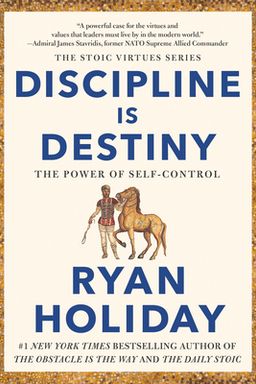
Discipline Is Destiny: Mastering the Self to Master Life
Why do so many of us who live in an age of abundance feel unfocused, anxious, and unfulfilled? In Discipline Is Destiny, bestselling philosopher Ryan Holiday argues that the answer lies in our weakening ability to govern ourselves. Drawing on the Stoic virtue of temperance—self-discipline in thought, body, and soul—Holiday declares that true freedom, creativity, and greatness begin with self-control. Temperance, he writes, is not about denial or punishment but command—the ability to act with intention rather than impulse, to rule over the self before aspiring to rule, create, or lead.
Building on his "Four Virtues" series that began with Courage Is Calling, Holiday shapes this book around the Stoic ideal of ruling oneself before ruling others. Through vivid historical stories—from Lou Gehrig’s iron streak to Queen Elizabeth II’s poise, from Marcus Aurelius’s composure to Eisenhower’s restraint—Holiday illustrates how self-discipline is the hinge on which all greatness turns. Success without discipline, he argues, inevitably collapses into chaos and self-destruction (as seen in the tragic excesses of Napoleon, Babe Ruth, and King George IV).
Freedom Requires Restraint
Holiday opens with a paradox: that true freedom is impossible without self-discipline. Citing President Eisenhower’s belief that "freedom is the opportunity for self-discipline," he underscores that mastery of self is prerequisite for mastery of circumstance. In a culture that equates liberty with indulgence, we have mistaken comfort for happiness. The Stoics—and Holiday—insist that the disciplined person is freer than the indulgent one, because they are bound to nothing but their own principles. The lazy, the gluttonous, the uncontrolled, by contrast, are enslaved by impulse.
Using the myth of Hercules at the crossroads, Holiday places the reader at a moral fork: one path leads to pleasure and ruin, the other to virtue and self-command. Like Hercules, each of us must choose daily between the life of ease and the life of excellence. This book is a manual for choosing the latter.
The Three Domains of Discipline
Holiday divides Discipline Is Destiny into three domains that frame the layered practice of temperance: The Body, The Temperament, and The Soul. Each section applies Stoic discipline across different planes of being. The first examines the external domain—how we treat our bodies, manage our time, and practice endurance. The second focuses on the inner domain—how we rule our appetites, emotions, and desires. The final section reaches into the magisterial—where discipline evolves into virtue and service, manifesting as leadership, compassion, and moral fortitude.
Through this tripartite structure, Holiday shows that discipline evolves: first, as control of the body; second, as command of the mind; and finally, as mastery of the soul. The path is incremental, ascetic, and lifelong—one that mirrors Aristotle’s notion that virtue is developed by practice, not precept. “We become temperate by doing temperate things,” Holiday reminds us, paraphrasing the great philosopher.
Discipline as the Foundation of All Virtue
Holiday teaches that discipline is the bedrock on which every other virtue—courage, justice, and wisdom—rests. Without self-command, courage becomes recklessness, justice collapses into bias, and wisdom dissolves into indulgence. "Discipline is destiny" because the self-disciplined person shapes their own character, while the undisciplined are swept along by vice, chance, and emotion.
“Most powerful is he who has himself in his own power,” the Stoic Seneca wrote—and Holiday uses this quote as both a challenge and a creed for readers in an age of unchecked appetites.
Why This Matters
Across chapters rich with narratives—Lou Gehrig playing through pain, Toni Morrison rising before dawn to write, Angela Merkel’s calm restraint—Holiday demonstrates that discipline sharpens freedom, amplifies creativity, and inoculates us against the decay of excess. He contrasts models of restraint (Eisenhower, Marcus Aurelius, Queen Elizabeth II) with the ruinous indulgence of others (Napoleon, Babe Ruth, King George IV), showing that greatness isn't achieved through unrestrained ambition but through the measured strength to control it.
Ultimately, Discipline Is Destiny is a guide for living deliberately. Its wisdom is both timeless and urgent: in mastering yourself, you forge your fate. The Stoics called this aretê—excellence in all dimensions of human life. Holiday’s message is clear: your destiny depends not on luck or talent but on your daily obedience to principle. The disciplined life is the good life—and mastering it, the ultimate form of greatness.