
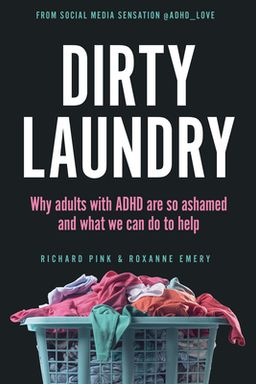
DIRTY LAUNDRY cover

DIRTY LAUNDRY

by Richard Pink & Roxanne Emery

Dirty Laundry delves into the chaotic yet humorous world of living with ADHD. Through real-life stories and practical advice, authors Richard Pink and Roxanne Emery offer insights into transforming shame into self-acceptance and understanding. Whether diagnosed or just curious, learn how to navigate ADHD''s challenges with humor, compassion, and practical solutions for a more fulfilling life.

Breaking the Shame Cycle of ADHD: Love, Laughter, and Radical Understanding

Have you ever spiraled into guilt for losing something, missing an appointment, or struggling with the simplest daily task—and then convinced yourself that you were simply lazy, careless, or broken? In Dirty Laundry, husband-and-wife duo Richard Pink and Roxanne Emery dismantle that destructive narrative. They argue that ADHD in adults is not just about distractibility or impulsivity—it’s a deeply misunderstood experience often buried under layers of shame. Their book is a funny, heartfelt, and brutally honest guide to peeling back those layers to reveal compassion, understanding, and healing.

What makes Dirty Laundry stand out among ADHD literature (alongside titles like Driven to Distraction by Hallowell and Ratey or Gabor Maté’s Scattered Minds) is how it braids together two perspectives: Roxanne’s firsthand stories of living with ADHD—complete with lost wallets, hyperfocus rabbit holes, and trampon mishaps—and Rich’s reflections as her neurotypical partner learning to love without judgement. The result is a love story wrapped inside a psychology manual; part memoir, part relationship guide, part survival strategy.

The Power of Removing Shame

From the very first chapters, Rox opens up about how undiagnosed ADHD left her feeling worthless for decades. Every forgotten bill or missed flight reinforced her belief that she was “stupid” or “lazy.” When she finally received a diagnosis at 36, she describes the moment as learning she wasn’t defective—her brain simply operated differently. That release from self-hatred, she explains, was not about being given a label but being given language to understand herself. Rich, too, reframes his understanding: instead of reading Rox’s behaviors as disrespectful or careless, he sees them as symptoms to navigate together. Their motto soon becomes: It’s not me against you. It’s us against ADHD.

Turning Symptoms into Stories

The book walks through ten symptoms—losing important things, time blindness, hyperfocus, hygiene struggles, cleaning chaos, financial issues, task avoidance, object constancy struggles, directional dyslexia, and impulsivity—each paired with a personal story and practical suggestions. These aren’t textbook definitions but raw, lived accounts: Rox sobbing at Brighton station after losing a wallet; Rich coaching her through calming breaths; or Rox missing two flights in one day because her brain bends time like a well-meaning but delusional wizard. Unlike manuals filled with checklists, Dirty Laundry breathes life into these moments, showing the emotional toll behind what may seem like small failures.

Non-Judgment and Compassion as Superpowers

Throughout, the authors return to two words: non-judgement and compassion. Rich admits that, before Rox’s diagnosis, his frustration often looked like anger or withdrawal. It wasn’t until he began practicing non-reactivity—staying kind and grounded even when furious about another lost item—that their relationship transformed. This echoes psychological research on co-regulation: when one partner stays calm, the other’s nervous system can settle, too. Their relationship becomes a laboratory for how empathy—not discipline—creates real behavioral change.

A Bridge Between Worlds

For readers, the dual narration is revelatory. Rox’s voice is confessional, chaotic, and wildly relatable; Rich’s is steady, structured, and humble. Together they show both the inner experience of ADHD—the racing thoughts, the shame, the impulsivity—and the outer experience of those who love ADHDers, who must learn to interpret what seems irrational as neurological. Their dynamic helps reframe ADHD not as an individual’s flaw but as a shared ecosystem that requires understanding on both sides.

“You can’t shame yourself into being more functional,” Rox declares. “Compassion and non-judgement will bring more positive change than shame ever will.”

From TikTok to Book to Movement

Interestingly, all of this started with a viral TikTok about Rox’s “trampon”—a self-rolled tampon she improvised during a hike. That one absurd, hilarious, honest moment became the foundation of a community that reached millions. People messaged them in tears, saying, “I thought it was just me.” That phrase—It’s not just me—captures the book’s real power. Dirty Laundry is a manifesto for neurodivergents to drop the lifelong mask of normalcy and finally exhale.

Why This Book Matters

What makes Dirty Laundry essential is not just its humor or honesty, but its practicality. Readers learn emotional regulation techniques, communication tools, and self-acceptance frameworks disguised in laugh-out-loud stories. More than a memoir, it’s a blueprint for how to build a home full of humanity—not perfection. By the final chapters, where Rox praises the “joys of ADHD” and Rich lists the gifts it’s brought to their relationship, ADHD has been reframed entirely: not as a disorder to battle, but as a difference to embrace. For anyone living with—or loving someone with—ADHD, this book says: you are not broken; you’ve just been trying to fold your brilliance into a world built for different wiring.


Losing Things and Finding Compassion

If you’ve ever misplaced your phone and immediately spiraled into panic and self-hate, you’ll recognize Rox’s world. She’s lost 13 phones, 18 wallets, and even—tragically—her dying mother’s final letter. Each loss, she explains, once triggered waves of shame, leading to self-harm and despair. What changed everything wasn’t another organizational hack but learning that her brain truly struggles with object permanence and executive function. ADHD wasn’t an excuse—it was an explanation. That simple knowledge transformed her self-talk from “I’m disgusting” to “I’m struggling, and I deserve compassion.”

From Self-Blame to Self-Understanding

Before diagnosis, each lost item became proof of worthlessness. Afterward, Rox began practicing emotional regulation—breathing deeply when panic struck—and setting up safety nets like spare keys and phone insurance. Rich’s role was pivotal: when she lost something, he met her with warmth, never anger. Together they reframed losing things as a shared challenge rather than her personal failure.

The Partner’s Perspective

Rich recalls being shocked at how deeply ashamed Rox felt. Where he once saw carelessness, he now sees neurological difference. His strategy shifted from scolding to co-regulation: first calm her emotions, then tackle the practical steps—canceling cards, calling lost property. He jokes that observers might think they’re breaking up in public when really they’re uniting against ADHD itself. This small, tender reframe encapsulates the entire book’s philosophy: understanding before fixing.

“It’s no longer me against Rox losing things,” Rich says. “It’s me and Rox against ADHD.”

In practical terms, the couple’s mantra is acceptance lowers stress. The less you fight the symptom, the more manageable it becomes. Their advice to readers: stop shaming yourself for forgetting, regulate emotions first, reduce stress triggers, and accept that imperfection is normal. Ironically, acceptance leads to better results than perfectionism ever could.


Time Blindness and the Myth of Punctuality

Time blindness may sound trivial, but Rox’s stories make it emotionally vivid. She once missed two flights to Los Angeles in the same day—not because she didn’t care, but because time quite literally doesn’t feel linear to her brain. For her, five minutes and forty-five minutes mean the same thing: both exist in the nebulous category of “not now.” ADHDers, she writes, don’t live in chronological time but in emotional time—right now or never.

The Emotional Weight of “Late”

A lifetime of lateness erodes self-esteem and relationships alike. Each missed train or meeting becomes further proof of failure. Rox’s turning point was learning radical acceptance: yes, she will probably always struggle with time—but shame won’t make her punctual. By communicating her challenges honestly (“I struggle with ADHD and time; thank you for your patience”), she reduces the panic and paradoxically arrives on time more often.

Rich’s Role: From Enforcement to Empathy

Rich once believed punctuality was a moral virtue. He’d sit tapping his watch while she sang upstairs in blissful ignorance of the clock. After Rox’s diagnosis, he recognized her lateness as neurological, not neglectful. His new approach became collaboration: questioning her gently (“Is that an ADHD five minutes or a real one?”), helping with planning, and injecting humor to diffuse tension. Together they replaced enforcement with empathy, resulting in fewer arguments—and surprisingly, fewer missed trains.

Their joint lesson: “It’s not disrespect—it’s time blindness. Remove the pressure, and you remove the shame.”

The couple’s strategies mirror mindfulness research (see Jon Kabat-Zinn) emphasizing presence over punishment. By reframing time not as a moral scorecard but as a system to collaboratively manage, Rox gains both functionality and self-worth. The goal isn’t fixing her clock—it’s building trust outside of it.


Hyperfocus: The Double-Edged Superpower

“Attention deficit?” Rox laughs. “I have attention surplus.” Hyperfocus, she explains, is the paradoxical ability to dive so deeply into something that the rest of the world disappears. It once masked her ADHD symptoms under the “gifted child” label. As a kid, she memorized entire books on ancient Egypt; as an adult, she could study for financial exams overnight yet forget daily basics. This intense yet selective attention became both her secret weapon and her undoing.

The Trap of Mislabeling Genius

Society rewarded her obsessions as brilliance, but when she couldn’t sustain them—jumping from accounting to trading to artistry—it interpreted the burnout as failure. Therapy helped her see that hyperfocus isn’t control; it’s compulsion. She can’t summon it at will. It comes when her brain finds enough novelty and challenge to release dopamine. Understanding that removed the impossible pressure to be “consistently exceptional.”

Managing the Power

The couple learned to manage hyperfocus rather than battle it. Rich now recognizes the “glint in her eye” as a warning sign she’s descending into an obsession—whether booking hotels or researching Freddie Mercury. He’ll bring snacks, water, and time reminders so she doesn’t burn out. By creating safe boundaries around her hyperfixations, they transform chaos into creativity.

“If I could control my hyperfocus, I’d be unstoppable—but maybe part of its magic is that I can’t,” Rox muses.

Their story echoes Dr. Edward Hallowell’s framing of ADHD as having a Ferrari brain with bicycle brakes. Instead of fighting the Ferrari, Dirty Laundry teaches you to steer it gently—to enjoy the speed when it comes, and know when to hit pause before the crash.


Shame-Free Self-Care and Domestic Survival

Few books tackle the mundane realities of ADHD with the humor and honesty that Rox does when describing hygiene and cleaning. “He sniffs the armpits of my bodysuits,” she jokes, “and that’s how I know he’s the one.” Behind the laughter is a painful truth: for years, she lived in shame-filled squalor—floordrobes, unwashed clothes, and weekly showers. Hygiene neglect wasn’t laziness; it was executive dysfunction. Even washing her hair could be as overwhelming as filing taxes. Diagnosis shifted that inner script from ‘gross’ to ‘struggling with energy management.’

Redefining Clean

The couple redefined success. Instead of aiming for perfection, they settled on “good enough.” Rich helped by creating mini-systems—like a “wear-again shelf” for semi-clean clothes—and by using humor as a bridge: “Babe, you’ve worn that jumper seven days. Shall I wash it or frame it?” Their home became a no-shame zone. Progress, not perfection, was the new goal.

Cleaning the Emotional Dirt

Cleaning, Rox realized, wasn’t about bleach and sponges; it was about clearing emotional clutter. After years of addiction and self-loathing, her healing began when she stopped watching “perfect-home” influencers and accepted she might forever be a “domestic jester,” not a goddess. Rich echoed this compassion, praising every small effort. Their motto—“celebrate the cup downstairs”—became a metaphor for how tiny wins rebuild self-esteem.

“No one can hate themselves into a version of themselves they like,” Rox writes. “That’s not how change works.”

The message transcends ADHD: true self-care begins with kindness, not criticism. Their home becomes a microcosm of acceptance—a place where laughter cleanses more than any mop ever could.


Money, Impulsivity, and Emotional Spending

When Rox recalls hiding under her bed as bailiffs dismantled her electricity meter, it’s not just a story about financial mismanagement—it’s about paralyzing shame. ADHD often turns money into an emotional battleground: impulsive spending for dopamine hits, unopened bills symbolizing avoidance, and the panic spiral of missed rent. Sobriety forced Rox to face the wreckage: she hadn’t opened official letters for years. Meeting Rich—a bank manager, ironically—became a turning point.

From Chaos to Control

Instead of judgment, Rich offered structure and empathy. Together, they opened envelopes, set up repayment plans, and cut up credit cards. He even safeguarded her savings while letting her contribute to household bills—ensuring autonomy without danger. Over time, Rox’s credit rating rose from abysmal to excellent. More importantly, her self-image shifted: she was no longer a “financial disaster” but someone learning a new skill.

Emotional Spending as Self-Soothing

The book links overspending to emotional regulation deficits. Rox’s shopping sprees were attempts to buy relief from anxiety. Rather than cutting off joy, she and Rich reframed purchases through awareness and planning. He calls her “generosity beautiful but risky.” Now, they pause before purchases and celebrate sensible choices like discounts—a neurodivergent version of exposure therapy for compulsion.

Rich’s golden rule: “Remove the shame before you remove the debt.”

By treating money as an emotional language, not just a logistical one, they turn financial healing into relationship intimacy—something few budgeting books ever accomplish.


ADHD and Love: From Treacle Suns to Real Partnership

The culminating theme of Dirty Laundry is heartbreakingly universal: how do you love someone whose emotions burn like wildfire and fade just as fast? Rox frames her romantic history through the lens of hyperfocus-on-people—a phenomenon where ADHDers fall into intoxicating, all-consuming love that later crashes into numbness. For years, she confused dopamine withdrawal for falling out of love. Every relationship ended when the “treacle sun”—that too-sweet, too-bright high—burned out. Her turning point came with choosing not to run from Rich when that crash hit.

Real Love After the Crash

In their most intimate chapter, Rox confesses, “I don’t know what’s happened to my feelings.” Instead of leaving, Rich listens. He sits in pain with her. This moment—him staying through her confusion—marks the birth of their real intimacy. For the first time, she learns that love doesn’t have to be constant fireworks; it can be quiet safety. They both begin therapy and create a language around emotional flux. Asking, “Any new hyperfocus crushes this week?” becomes a humorous way of maintaining transparency.

Honesty as Connection

Rather than pathologizing her emotional intensity, Rich celebrates it—when channeled into creativity and openness. Their key practice is radical honesty: sharing even uncomfortable feelings before they fester. This transforms jealousy and insecurity into growth. As Rox writes, “True love is being fully known and still loved.”

“People can be a hyperfocus,” she realizes. “And knowing that has saved every relationship since.”

Their model of love parallels modern attachment theory (see Amir Levine’s Attached): security is not about calmness alone but about being accepted in chaos. Rich’s compassion teaches that safety, not shame, is what makes neurodivergent love sustainable.


The Joys of ADHD: Turning Difference into Strength

By the book’s end, Rox circles back to joy—not the manic moments of obsession, but a steady appreciation for her own brain. She celebrates traits she once despised: her optimism, creativity, empathy, crisis management skills, and fast-learning mind. ADHD, she concludes, is both exhausting and extraordinary. With therapy, medication, and Rich’s support, the same impulsivity that once wrecked her finances built a movement reaching millions.

Redefining Success

The final pages feature both partners listing the gifts ADHD brings. For Rich, these include her humor, entrepreneurial spirit, and empathy with his children. For Rox, it’s the ability to generate joy and connection wherever she goes. What once seemed like dirty laundry is now clean insight: difference is not deficiency.

“With the right support, a neurodivergent brain can be a world-changing brain,” Rox writes.

The book closes as it began—with humor, warmth, and hope. ADHD doesn’t vanish, but the shame attached to it does. And that, in itself, is a revolution. For readers, the takeaway is simple yet profound: your brain isn’t broken; it’s brilliant—it just requires a different kind of love, including your own.

Dig Deeper

Get personalized prompts to apply these lessons to your life and deepen your understanding.

Go Deeper

Get the Full Experience

Download Insight Books for AI-powered reflections, quizzes, and more.