
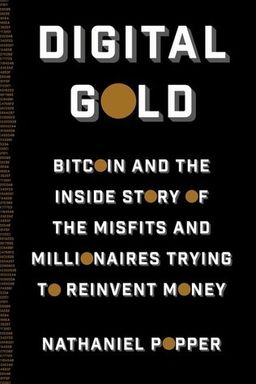
Digital Gold cover

Digital Gold

by Nathaniel Popper

Digital Gold delves into the incredible journey of Bitcoin, a digital currency that has transformed financial systems worldwide. From its mysterious creation to its role in challenging traditional banking, this book unveils Bitcoin''s potential to empower individuals and disrupt economies. Join the pioneers who shaped the cryptocurrency revolution and explore its profound impact on global finance.

Digital Gold and the Reinvention of Money

How can a string of code become both a political symbol and a global financial instrument? In Digital Gold, Nathaniel Popper argues that Bitcoin is more than a technology—it is a social movement that fuses cryptographic innovation with a deep distrust of centralized power. The story you follow is not only about computer scientists and code, but about the people who turned an idea for digital cash into a new kind of money—and a mirror reflecting global attitudes toward trust, privacy, and control.

Popper begins by showing how Bitcoin’s design replaced a mint or a central bank with mathematics. Satoshi Nakamoto’s 2008 white paper proposed a software protocol that could create digital scarcity—hard-coded trust enforced by proof-of-work and cryptography. That idea caught the attention of cryptographers like Hal Finney, the PGP developer who saw Bitcoin as the realization of long-standing Cypherpunk dreams: private money beyond government oversight. From that seed grew a cultural, technological, and eventually economic revolution.

From Code to Community

At first, Bitcoin was more experiment than economy. Early contributors like Finney, Martti Malmi, and Gavin Andresen debugged crashes, mined test blocks, and exchanged small amounts that had no real-world price. The project required not just software but social momentum. Forums, wikis, and faucet giveaways built participation. Martti rewrote documentation to explain the system in plain language; Gavin built tools like the faucet to distribute coins and demonstrate usability. You learn that social trust was the invisible architecture supporting the technical one: even a decentralized system needs credible people to bootstrap belief.

Cypherpunks, Libertarians, and the Politics of Privacy

Bitcoin emerged from a lineage of privacy-focused projects: David Chaum’s DigiCash, Wei Dai’s b-money, and Nick Szabo’s bit gold. The Cypherpunks who nurtured these efforts considered cryptography a tool of self-defense for individuals in an age of surveillance. Popper connects their ideological drive—Hal Finney’s privacy activism, Ross Ulbricht’s libertarianism—with Bitcoin’s architecture: pseudonymity, open verification, and resistance to censorship. Yet this design also exposed contradictions. Every transaction is public on the blockchain, enabling forensic analysis even while hiding real names. Privacy is partial, not absolute. This trade-off between transparency and anonymity shapes Bitcoin’s continuing political relevance.

Scarcity and the Monetary Rebellion

Satoshi’s code capped supply at 21 million coins, halving rewards over time. That mechanism became not just a technical constraint but a statement: in contrast to fiat currencies that central banks could expand, Bitcoin promised predictable scarcity. After the 2008 global financial crisis, that scarcity turned into a rallying cry for many early adopters—libertarians disillusioned with bailouts and monetary expansion saw Bitcoin as an opt-out system. Popper shows that this economic design created both ideological fervor and speculative fever. Investors like Erik Voorhees and Roger Ver treated scarcity as both moral principle and business opportunity, while others—like Wences Casares in inflation-plagued Argentina—saw it as practical salvation.

When Decentralization Meets Reality

As Bitcoin spread, its open, decentralized ideal collided with the need for infrastructure: exchanges, wallets, and miners. Each introduced new points of failure. Jed McCaleb’s Mt. Gox exchange, first a hobby project, became the dominant marketplace—and later a spectacular failure that erased user funds and trust. Mining, once accessible on home CPUs, industrialized into ASIC-driven megafarms, centralizing power and reshaping the network’s governance. Popper documents how participants confronted these contradictions: decentralization as aspiration versus convenience, scale, and profit as necessities.

Adoption Through Controversy

Bitcoin’s visibility exploded when tools like Tor paired with it to power Silk Road, the darknet marketplace created by Ross Ulbricht (“Dread Pirate Roberts”). That blend of anonymity and commerce demonstrated the technology’s functionality and provoked moral panic. Yet the Gawker coverage of Silk Road and the ensuing Senate hearings also mainstreamed Bitcoin’s name. Political responses divided the community: some doubled down on privacy tools; others, like Patrick Murck and the Bitcoin Foundation, sought regulator dialogue to preserve legitimacy. The tension between radical autonomy and mainstream acceptance became a defining theme—one still unresolved.

From Hobby to Institution

By 2013, Bitcoin transformed from experiment to industry. Professional services like Coinbase, Bitstamp, and Blockchain.info emerged to make Bitcoin accessible to average users. Institutional investors entered: the Winklevoss twins accumulated vast holdings, Pantera and Andreessen Horowitz invested in startups, and mining became professionalized. Governments began issuing guidance; Senate hearings gave legitimacy; Chinese investors fueled speculative manias. What started as a fringe experiment became a global financial phenomenon driven by both idealists and opportunists.

The Central Lesson

Across all of Popper’s stories runs a paradox: Bitcoin was designed to eliminate trust, yet its early survival depended on people who trusted each other enough to build, evangelize, and invest. It sought to remove institutions, yet created new ones. It promised democratized finance, yet rewarded those who understood complexity earliest. What the book ultimately shows you is that Bitcoin is not just a codebase—it’s a mirror of human incentives and a commentary on how societies decide who and what to trust.


The Architecture of Trustless Money

At Bitcoin’s core is a radical technical idea: you can create money that requires no central authority to verify ownership or issue supply. Popper walks you through Satoshi’s solution—combining cryptography, distributed consensus, and game theory into a living protocol. You learn how Bitcoin turns lines of code into a self-enforcing banking system backed not by law but by computation.

Addresses, Private Keys, and Digital Signatures

Every Bitcoin user controls an identity pair: a public address where coins are received and a private key used to authorize spending. These pieces work via public-key cryptography, meaning you can prove ownership without exposing your secret. When Hal Finney first tested Satoshi’s client, he confirmed that this scheme allowed transactions without trusting any central server. The private key becomes your proof of sovereignty—lose it, and your Bitcoins vanish; protect it, and you hold your wealth beyond bank reach.

The Blockchain and Consensus

The blockchain, a shared ledger of every transaction, is updated by miners solving proof-of-work puzzles. These puzzles make fraud costly and tie economic reward to honest behavior. Each new block validates transactions and extends the longest chain—the network’s single version of truth. Popper emphasizes that this process transforms political trust (faith in institutions) into mathematical trust (faith in computation). Proof-of-work, adapted from Adam Back’s hashcash, deters double spending and issues new coins through predictable block rewards, starting at 50 BTC per block in 2009 and halving over time.

Scarcity and Game Design

Satoshi embedded behavior-shaping incentives into code. The 21-million limit guarantees scarcity, and reward halving creates a self-adjusting monetary emission schedule that mimics gold’s finite nature. The network’s difficulty adjusts so a block is mined roughly every ten minutes regardless of total computing power. Together, these rules form an autonomous economic system that no government can inflate or devalue but that still depends on participant engagement—miners secure the network because it pays, not because of ideology alone.

Early Testing and Vulnerabilities

In Bitcoin’s infancy, its vulnerability came from its youth, not its math. Early users exchanged debug logs and patch suggestions via obscure mailing lists. Hal Finney mined the seventy-eighth block just days after launch. Bugs like the “1 RETURN” exploit showed that even a trustless protocol needs trusted developers to maintain integrity. Figures such as Gavin Andresen and Martti Malmi became de facto release managers, stabilizing the software while navigating the social dynamics of open-source development (similar to Linux or Apache communities).

The Shift from Institutional to Algorithmic Trust

Popper insists the technical design is ideological at heart. To use Bitcoin is to transfer faith from governments to code. Instead of trusting a bank ledger or a central banker’s discretion, you trust that anyone with enough computing power can join the consensus and that economic incentives prevent large-scale cheating. This inversion of trust becomes the conceptual backbone for everything the community builds later—from markets to political arguments about freedom and control.


Cypherpunks and the Politics of Privacy

Popper roots Bitcoin in the Cypherpunk movement—a loose network of programmers and activists who believed cryptography could empower individuals against surveillance. Figures like Hal Finney embodied this ideology, arguing that privacy isn’t secrecy—it’s control over information. To understand Bitcoin’s ethos, you must understand this cultural genealogy.

From DigiCash to Decentralization

David Chaum’s DigiCash in the 1990s proved digital cash was possible but failed because it was centralized—a corporation issued coins and could fail. That failure convinced Finney, Wei Dai, and Szabo that any future system had to remove trusted intermediaries. Bitcoin’s structure—peer-to-peer and open-source—arose directly from this conclusion. Satoshi incorporated cryptographic primitives the Cypherpunks had theorized but never implemented in a sustainable network.

Pseudonymity and Its Limits

Bitcoin offers pseudonymity: transactions are public, but addresses don’t reveal personal identities. This partial privacy allows verification without requiring identity disclosure. Yet as Popper observes, open ledgers enable forensic tracking. Chain analysis could correlate transactions with patterns, undercutting early Cypherpunk dreams of perfect anonymity. This tension re-emerged with Silk Road when pseudonymity met law enforcement’s data analytics.

Privacy as Political and Practical Motivation

For many early users, privacy was not abstract philosophy but survival. Activists, people in authoritarian nations, and businesspeople in overregulated economies used Bitcoin to evade seizure and censorship. Popper recounts examples from China and Argentina, where families historically hid wealth in gold, now using encrypted wallets instead. Ross Ulbricht’s Silk Road—built on Tor and Bitcoin—turned those values into practice, creating a frictionless private economy outside government reach.

The Political Cost of Privacy

The same attributes that guard autonomy also attract scrutiny. Bitcoin’s role on Silk Road and WikiLeaks triggered backlash, inviting Senate hearings and moral panic. Yet, paradoxically, those events publicized Bitcoin to millions. Popper’s insight: every iteration of privacy innovation invites new social negotiation—between freedom and regulation, between empowerment and abuse.


Building Community and Bootstrapping Trust

Bitcoin would not have survived on code alone. Popper shows that its success depended on people who transformed an abstract idea into a living ecosystem. They built tools, told stories, and created reasons for new users to care. This sociological layer of technology is Bitcoin’s real bootstrap narrative.

From Mailing Lists to Movement

Early communities formed on cryptography mailing lists and forums, where Satoshi, Hal, and Martti corresponded. When Hal mined the first blocks, others soon followed. Gavin Andresen created a faucet to give away 5,000 BTC to newcomers—an early form of user acquisition. Laszlo Hanyecz’s pizza purchase in May 2010 gave the network a human story: 10,000 BTC exchanged for two pizzas became a benchmark of both faith and folly.

Trust Through Reputation

In a network without banks, reputation became the new currency. Martti Malmi, Gavin, and early public evangelists used their real identities, anchoring credibility for newcomers suspicious of an anonymous founder. This “human trust layer” substituted for institutional guarantees. Forums, IRC chats, and informal meetups became social infrastructure where norms of responsibility formed informally but effectively.

The Role of Services

Exchanges like Mt. Gox and BitInstant, wallets, and payment tools gave Bitcoin tangible utility. But each time entrepreneurs built convenience layers, they reintroduced central points of failure—precisely what the protocol aimed to eliminate. When Mt. Gox crashed in 2011 and again in 2014, users learned the hard way that decentralization ends where custodial accounts begin.

Narrative as Network Effect

Popper highlights the importance of storytelling: Slashdot coverage, Gawker’s Silk Road piece, and investor meetups at Lake Tahoe turned abstract innovation into cultural momentum. Each cycle of publicity brought speculative surges and ideological recruits, proving that communities don’t just build software—they build meaning.


Exchanges, Custody, and the Cost of Convenience

Money needs markets, and Bitcoin’s markets introduced new risks disguised as services. Popper devotes several chapters to showing how exchanges and wallets, though essential, mirrored the vulnerabilities of the traditional financial system they aimed to replace.

Mt. Gox and Centralization Failures

Originally coded by Jed McCaleb as a trading site for game cards, Mt. Gox became Bitcoin’s largest exchange under Mark Karpeles. But with centralized control came fragility: weak security, opaque operations, and poor banking relationships. In 2011 a hack crashed prices from $17 to near zero; in 2014, transaction malleability and missing funds led to bankruptcy and the disappearance of 650,000 customer Bitcoins. The episode separated Bitcoin’s protocol durability from the incompetence of institutions built around it.

Other Service Collapses

MyBitcoin vanished along with client holdings; Bitomat lost keys to 17,000 BTC. These stories underline a theme: convenience recycles old banking risks under new branding. When you lend custody to intermediaries, you trade autonomy for simplicity. Popper’s account shows an evolutionary loop—new users seek user-friendliness; old hands return to self-custody after losses.

Regulatory Shadows

As volume grew, regulators stepped in. FinCEN’s 2013 guidance classified exchanges as money transmitters, imposing compliance burdens similar to banks. Some, like Coinbase, embraced regulation to attract investors and banking partners; others, like BitInstant, struggled and folded amid legal scrutiny. Virtual currencies had entered the regulated economy whether they wanted to or not.

Lesson for Users

Popper’s pragmatic takeaway: understand where your coins live. The promise of Bitcoin—“be your own bank”—remains hollow if you outsource control. Security and governance matter as much as code elegance. The Mt. Gox collapse shifted focus from speculation to infrastructure reliability, forcing the next generation of exchanges to professionalize or perish.


Markets, Speculation, and Global Demand

Popper charts Bitcoin’s evolution from ideological token to speculative asset class. Market dynamics, regional crises, and media cycles created volatile price swings that both attracted and unsettled users. Behind the drama lies a deeper pattern: speculative behavior as a kind of global referendum on trust in traditional money.

Media-Driven Manias

April 2013 saw trading frenzies as Gawker, Free Talk Live, and mainstream outlets discovered Bitcoin. When prices rose, attention followed, drawing more buyers and pushing prices higher still—a feedback loop that mirrored past speculative bubbles. Crashes followed outages or scandals, such as Mt. Gox’s downtime or Silk Road’s closure, but each recovery strengthened the system’s resilience.

Regional Use Cases

Argentina’s inflation and China’s capital controls generated genuine demand. In Buenos Aires, merchants and hoteliers used platforms like BitPagos to avoid punitive exchange rates; in China, BTC China’s yuan integration turned Bitcoin into a speculative hedge. These parallel stories illustrate Bitcoin’s dual identity: tool for necessity in some regions, instrument for speculation elsewhere.

Institutional Money Enters

As prices surged, institutional capital arrived. The Winklevoss twins, Fortress, and Andreessen Horowitz financed exchanges and startups, bringing credibility but also shifting power from tinkerers to investors. Wences Casares bridged ideological and business worlds, persuading financiers that Bitcoin could be a better gold—digitally portable and finite. This influx fueled legitimacy and volatility in equal measure.

Volatility as Growing Pain

Popper interprets the market chaos not as a sign of failure but as proof of evolution. Each surge and crash exposed weak points—exchanges, governance, liquidity—that developers and entrepreneurs then addressed. Bitcoin’s story thus becomes a cycle of speculative excess reinforcing technological maturity, a modern echo of how railroads and the Internet were both funded by bubbles before transforming economies.


Institutionalization and Regulation

Once governments and finance took notice, Bitcoin entered a new phase—compromise. Popper explores how activists, businesses, and regulators danced between innovation and control, trying to fit an unruly technology into legal frameworks.

The Banking Bottleneck

Bitcoin startups needed bank accounts to handle dollars. Banks, facing enormous AML and KYC fines, often refused. BitInstant’s closures, Mt. Gox’s seized U.S. accounts, and constant wire delays showed that code alone cannot bypass traditional finance when users want fiat currency. Entrepreneurs considered buying their own banks (David Johnston floated such a plan) or partnering with compliant ones. Coinbase succeeded through strict compliance, winning Silicon Valley Bank as ally.

Politics and Persuasion

Figures like Patrick Murck and the Bitcoin Foundation worked to frame Bitcoin positively for Washington. The 2013 Senate hearings, called a “Bitcoin lovefest,” featured regulators like FinCEN’s Jennifer Shasky Calvery acknowledging its legitimate uses. Bernanke’s letter calling it “promising” marked a turning point. Popper shows that persuasion, not evasion, kept Bitcoin from being extinguished by regulation too early.

The Ideological Split

While some welcomed regulation as maturity, purists like Roger Ver championed self-custody and privacy tools like Blockchain.info and SharedCoin. The clash represented a deeper philosophical divide: should Bitcoin integrate with the existing system to reach millions, or resist it to remain pure? Popper frames this as the perpetual debate between revolution and evolution.

A Realistic Synthesis

The likely outcome, Popper suggests, is coexistence. Mainstream on-ramps will coexist with privacy-preserving alternatives. The user’s choice—between autonomy and convenience—will decide Bitcoin’s trajectory. For builders and investors, understanding those trade-offs is essential: each design decision carries political and economic consequences.

Dig Deeper

Get personalized prompts to apply these lessons to your life and deepen your understanding.

Go Deeper

Get the Full Experience

Download Insight Books for AI-powered reflections, quizzes, and more.