
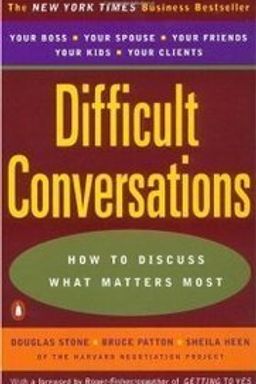
Difficult Conversations cover

Difficult Conversations

by Douglas Stone, Bruce Patton, Sheila Heen

Difficult Conversations offers a practical guide to tackling the conversations we dread most. By focusing on key aspects like curiosity, emotional intelligence, and collaboration, it empowers readers to transform challenging interactions into positive, relationship-building opportunities.

Transforming Difficult Conversations

How can you turn a painful or awkward talk into a moment of genuine learning? In Difficult Conversations by Douglas Stone, Bruce Patton, and Sheila Heen (from the Harvard Negotiation Project), the authors argue that the core of effective communication lies in shifting from certainty and blame to curiosity and understanding. Every difficult conversation is really three intertwined conversations: about what happened, how we feel, and who we are. To handle conflict well, you must learn to navigate all three simultaneously while keeping your balance and focusing on long-term change.

Most people enter tough talks to prove they’re right or to deliver a message. The authors propose a different route: transforming those confrontations into learning conversations built on exploration, mutual contribution, and respect. That shift allows you to stay calm, avoid defensiveness, and uncover the deeper meanings driving behavior. Across workplaces, families, and friendships, they reveal a set of mental frameworks and practical tools that change how you think before you speak.

The Three Conversations Beneath Every Talk

Each difficult moment hides three simultaneous stories. The What Happened Conversation concerns facts, interpretations, and intentions—who did what and why. People often confuse impact with intent. The fix is not to argue over truth but to treat each version as one side of a story to be explored. The Feelings Conversation reveals emotions like anger, fear, and disappointment; ignoring them means they leak out as sarcasm or avoidance. The Identity Conversation runs silently underneath, touching your sense of competence, morality, and worth. Together, they define the terrain you must navigate.

From Certainty to Learning

In most conflicts, arguing about who’s right amplifies defensiveness and closes understanding. The alternative is curiosity—the heart of what Stone, Patton, and Heen call the learning stance. Treat your conclusions as hypotheses, not facts. When Rory stops pushing Aunt Bertha with advice and asks instead, "Help me understand what worries you," her aunt opens up. That curiosity allows you to hold both stories simultaneously—their reasons and your feelings—creating the powerful And Stance: "I see why you did that, and here’s why it hurt me."

Emotions and Identity: Regaining Balance

Feelings shape behavior, but they’re not the enemy. The authors teach you to locate hidden emotions (anger often masks fear or sadness), negotiate with them before speaking, and express them clearly using phrases like "I feel hurt" instead of "You hurt me." Underneath feelings is identity—the inner conversation about what the event means about you. People crumble not from criticism itself but from believing it exposes them as incompetent or disloyal. By accepting complexity—"I make mistakes and I still care deeply"—you regain steadiness. (This mindset closely parallels Brené Brown’s emphasis on vulnerability as strength.)

From Blame to Contribution and Toward Solutions

Instead of fault-finding, look at how both sides contribute to the system. Blame freezes learning; mapping contribution generates change. In Toby and Eng-An’s argument, both reinforce each other’s reactions—his pursuit triggers her withdrawal, which triggers his pursuit again. Once they map that loop, they can choose new actions. Contribution doesn’t absolve responsibility; it reveals leverage points for improvement.

Practical Process: Prepare, Start, Explore, Solve

The book concludes with a practical roadmap: prepare by analyzing the Three Conversations, clarify your purpose (learning, expression, problem-solving), start from the Third Story—a neutral description of differences—and then explore both stories through listening and clear expression. Finally, co-create solutions by testing assumptions and brainstorming options. When Jack reopens his conflict with Michael over a misprinted brochure using this method, he discovers that understanding and mutual adjustment replace blame.

Choosing When to Speak or Let Go

Not every issue must be raised. You evaluate whether talking will add value, or whether you need internal work first. Sometimes action is better than conversation; sometimes the best outcome is releasing futile fights gracefully. Ground your identity, know your limits, and approach each discussion as a chance to learn rather than to win. The result isn’t perfect harmony—it’s genuine connection and capacity for change.


See the Three Conversations Clearly

The authors begin by teaching you to separate and understand the three layers beneath every difficult exchange: what happened, what each person feels, and what the situation implies about identity. Mismanaging these layers is the reason most conversations go wrong. Clarity across all three unlocks emotional stability and insight.

The What Happened Conversation

Facts rarely cause the real conflict—it’s interpretation, intention, and blame. Jack and Michael’s argument about a wrong chart wasn’t about data but meaning: was it serious or trivial? When you stop treating your story as truth and approach theirs as another valid lens, you increase learning and cooperation.

The Feelings Conversation

Ignoring emotions makes them leak out. Hidden hurt, fear, or shame alter tone and behavior. Acknowledging feelings explicitly—“That made me angry and sad”—changes both people’s stance from judgment to empathy. Feelings are not distractions; they are data.

The Identity Conversation

The deepest layer is self-image. A critique can shake your sense of competence, loyalty, or loveability. Understanding identity stakes frees you from panic. Ben’s fear of seeming disloyal when quitting his job mirrors this trap. Once he accepts that good people can change jobs, he regains calm. Separating these three lets you prepare wisely, anticipate emotional triggers, and hold balance during hard talks.

Core insight

Seeing each layer distinctly helps you shift from reaction to reflection. Preparation means naming facts, feelings, and identity stakes before you ever speak.


Adopt the Learning and And Stance

After recognizing the layers of conversation, the next step is adopting the learning stance. You replace assumptions and arguments with curiosity and humility. Instead of seeing the talk as a battle to win, you enter as an explorer of stories—yours and theirs.

Why Arguing Fails

When you argue, both sides push conclusions. The result is defensiveness, not persuasion. Rory pushes Aunt Bertha to follow advice; Bertha sees bossiness and retreats. When Rory switches to curiosity—asking what Bertha values—she learns deeper motives and builds trust.

Curiosity Made Concrete

Ask what shaped their behavior: information, experiences, or implicit rules. In Tony and Keiko’s disagreement about football versus family time, curiosity reveals that Tony’s game serves as decompression after intense work. That small insight opens compromise.

The And Stance

You can hold both truths: “I see why you did that, and it hurt me.” Adopting “and” instead of “but” allows empathy and clarity without surrendering your perspective.

Treat theories about intention as hypotheses. Listen for emotions and identity drivers. When you learn before persuading, you increase the odds that they later listen to you—and transformation begins.


Separate Intent from Impact and Shift from Blame to Contribution

Two of the most powerful shifts in the book are separating intent from impact and replacing blame with contribution. These reframe how you understand responsibility and prevent endless cycles of accusation.

Intent vs. Impact

When someone hurts you, you often assume they meant harm. In Lori and Leo’s ice cream episode, she reads humiliation into his joke; he intended help. By describing actions and impacts first—then asking about intent—you open inquiry instead of battle. Label interpretations as guesses, not facts.

Blame vs. Contribution

Blame asks for fault; contribution asks for patterns. Instead of “Who’s guilty?” you ask “How did our behaviors combine to produce this?” Toby and Eng-An’s communication loop—his pursuit and her withdrawal—illustrates shared creation. Recognizing your own contributions increases agency and humility. (Note: acknowledging contribution is not excusing harmful acts—it’s mapping the system so change is possible.)

Core insight

Understanding impact and contribution replaces moral judgment with practical leverage for learning and repair.

When you live this shift, conflicts turn from autopsies into diagnoses—and from punishment to growth.


Speak and Listen with Authenticity

Listening and speaking well are twin skills. The authors teach not just techniques but mindsets: you listen to understand, and you speak to reveal truth clearly and respectfully.

Listening from the Inside Out

Deep listening quiets your internal commentator—the voice that says “I’m right” or “I’ll fix this.” Replace “I understand” with “Help me understand.” Inquiry, paraphrasing, and acknowledgment are the key moves. Greta’s talk with her mother about diabetes transforms when she moves from persuasion to curiosity; compassion opens cooperation.

Speaking for Yourself

You have full authority to describe your perceptions, feelings, and intentions. Begin with what matters most—“For me, this is really about…”—and drop hints or accusations. Use “I feel,” “I believe,” and explain where your conclusions come from. Stacy’s conversation with her adoptive mother includes a brave Me-Me And stance: “You might be right that it could hurt; and this search is important to me.” That phrasing keeps connection even while disagreeing.

Practical tip

Instead of trying to convince, try to connect. Paraphrase until they feel heard; speak until your truth is respectfully clear.

This dual practice of listening and authentic self-expression builds trust and clarity—the foundation for collaborative problem-solving.


Start from the Third Story and Problem-Solve Together

Opening a tough discussion well determines everything that follows. The authors propose beginning from the Third Story—the neutral viewpoint describing how perspectives differ. From there, you invite partnership and move toward shared problem-solving.

The Third Story Technique

Instead of accusations, describe reality as a mediator might: “We seem to see this differently; can we talk about how?” That frame disarms defensiveness. When Ruth tells Brian, “Can we spend some time trying to figure this thing out?” she invites rather than demands. The tone changes everything.

Reframing and Leading

If the other person stays stuck in blame, you can reframe and name dynamics. Translate “You hurt me on purpose!” to “I hear you’re angry; tell me what happened that upset you.” When frustrations repeat, name the pattern: “I notice we interrupt each other—I want to change that.” Persistent curiosity, not pressure, leads the change.

Problem-Solving Steps

Together, gather facts, test assumptions, brainstorm multiple options, and apply fair standards. These steps—exploration before solution—transform arguments into partnership. Jack and Michael’s reconciliation captures the process: starting neutrally, exploring feelings and stories, and ending with concrete agreements for future work.

Learning conversations don’t guarantee comfort, but they create understanding—and understanding enables durable solutions.


Ground Your Identity and Choose When to Engage

Throughout every conversation you carry invisible identity stakes—your sense of competence, moral worth, and lovability. When these are fragile, any criticism feels catastrophic. Grounding your identity enables balance and makes it possible to choose when to speak and when to let go.

How Identity Gets Triggered

Antonio’s story reveals how childhood lessons—“love equals success”—become adult triggers. You panic not because of the words but because of what they imply about who you are. Notice your inner voice and complexify the narrative: you can be competent and make mistakes, loving and occasionally selfish.

Grounding Moves

Accept imperfection, release control over others’ reactions, and rehearse calm responses. Imagine yourself months ahead—will this still define you? That future lens reduces panic. Enlist allies for feedback when you slip into defensiveness.

Choosing When to Speak

Some issues improve more through action than discussion; others aren’t worth the emotional cost. Before speaking, ask whether your purpose is learning, expression, or problem-solving—not punishment or venting. Letting go isn’t weakness; it’s wisdom. Janet’s experience shows how confronting for revenge worsens relationships, while Walter’s quiet actions toward his mother transform connection without argument.

With a grounded identity and clear purpose, you engage from strength and walk away from futility gracefully—a crucial final skill for emotional maturity.

Dig Deeper

Get personalized prompts to apply these lessons to your life and deepen your understanding.

Go Deeper

Get the Full Experience

Download Insight Books for AI-powered reflections, quizzes, and more.