
Idea 1
Dying With Zero: Living Fully by Spending Wisely
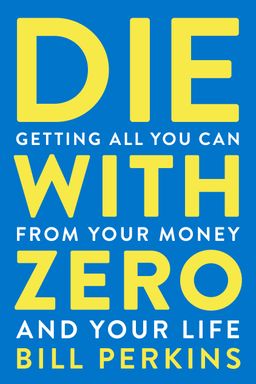
When you think about your life, do you measure success by how much you’ve saved—or by how much you’ve experienced? In Die with Zero: Getting All You Can From Your Money and Your Life, entrepreneur and energy trader Bill Perkins challenges everything society teaches about money, retirement, and fulfillment. He argues that life’s goal isn’t to maximize wealth but to maximize meaningful experiences. Money is only valuable if it’s used—to create memories, relationships, and moments that give life depth, not just financial security.
Perkins contends that we waste countless hours chasing financial growth, all while neglecting what really provides joy and meaning. “You retire on your memories,” he says. At the end of your life, you won’t wish you’d worked harder—you’ll wish you’d lived better. The book’s central message is simple yet radical: plan and spend deliberately so you end up with zero money left at death, but infinite fulfillment from the experiences you’ve accumulated. Dying with zero isn’t about recklessness—it’s about intention.
Breaking the Myth of Endless Saving
Perkins begins with a story about his boss on Wall Street scolding him for saving too much while earning little. That moment cracked open his thinking: saving money for a future self who would be older and richer made little sense. Across the book, he dismantles what he calls the myth of the “ant”—the ever-saving worker who hoards for retirement, forgetting to actually live along the way. In opposition, he honors the “grasshopper,” who plays when the sun shines, though he emphasizes balance: “The ant would live better if he learned to play a little.”
Perkins brings together economic ideas such as the Life-Cycle Hypothesis (from Franco Modigliani) and behavioral insights about consumption smoothing, showing how money should flow through the phases of life to maximize enjoyment. Saving indefinitely, he argues, is irrational when health and ability to enjoy that money naturally decline.
Experiences as Investments
Perkins reframes experiences as investments that yield lifelong “memory dividends.” Like stocks, experiences pay returns over time—not in cash, but in fulfillment and emotional richness. Each time you recall a trip, a friendship, or a milestone, you “cash in” on the mental and emotional dividends of that experience. The more experiences you create early, the more dividends you’ll receive over decades. He urges starting early, especially when young, healthy, and unburdened by responsibilities, because those experiences compound through memory and sharing.
He even quantifies experiences in “experience points,” turning fulfillment into a measurable curve. The height of your curve corresponds to the sum of the positive experiences you’ve lived—its area representing your lifetime fulfillment. Maximizing this curve means deliberately shaping when and how you spend time and money, not leaving your life to autopilot.
Timing Your Life’s “Mini Deaths”
Perkins emphasizes that life happens in seasons—each age brings unique experiences that disappear forever. His “time buckets” approach encourages mapping out your life in five- or ten-year intervals, filling each with experiences suited to that stage. Waiting too long for certain experiences can mean missing them entirely: you can’t backpack through Europe or play sports with your children once your health or their youth has faded. Regret is the ultimate cost of delay.
By illustrating these “mini deaths”—like when your children outgrow watching their favorite movie with you—Perkins drives home the urgency of intentional living. Awareness that time is limited makes every moment worth more. He cites research (also echoed in Bronnie Ware’s The Top Five Regrets of the Dying) showing that people’s greatest end-of-life regrets are failing to live authentically and working too hard. His conclusion: treat time as a finite resource before it’s gone.
Money, Meaning, and Mortality
The idea of dying with zero extends beyond personal spending. Perkins explores how to give to children and charities while alive so your money achieves maximum impact. Late inheritances help least, since older recipients derive less joy or utility from them. Instead, give when gifts enhance lives, not just bank accounts. The same applies to philanthropy: donations do more good now than after death. He cites examples from Sylvia Bloom’s delayed giving and Chuck Feeney’s “giving while living” to show how timing transforms generosity into real impact.
In the end, Die with Zero is not a financial manual but a philosophical statement disguised as one. It merges behavioral economics, personal finance, and existential reflection into one bold idea: optimize your life for happiness, not for money. Perkins’s call to action isn’t just to spend smart—it’s to live deliberately, measure experiences, and plan for the fullness of each stage of life. Because when the curtain falls, the only wealth left that matters is the sum of memories you’ve invested in along the way.