
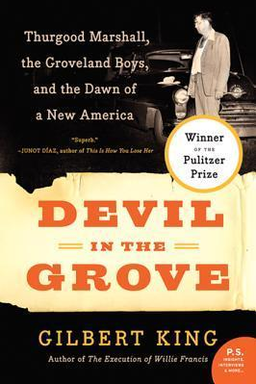
Devil in the Grove cover

Devil in the Grove

by Gilbert King

Devil in the Grove captures the harrowing story of the Groveland Boys and Thurgood Marshall''s courageous battle against racial injustice in 1949 Florida. This gripping narrative reveals systemic biases and the enduring fight for equality in America.

Law, Power, and the Battle for Justice in Groveland

What happens when law itself becomes a battlefield? In this sweeping narrative centered on the 1949 Groveland case, you follow how Thurgood Marshall and the NAACP Legal Defense Fund turned a seemingly local tragedy into a crucible for constitutional change. The book argues that justice in Jim Crow America was neither blind nor neutral—it was shaped by economic hierarchies, political calculations, and acts of extraordinary resistance. Through the intertwined stories of lawyers, sheriffs, journalists, and ordinary citizens, you see how race, power, and law collide in the mid-twentieth century South.

The book does not simply recount legal events; it diagnoses a system where institutions are weaponized against the vulnerable. The Groveland case serves as both a mirror of local corruption and a template for how civil-rights lawyers construct strategies under impossible conditions. Each chapter builds on the tension between grassroots violence and national legal reform, asking how far moral courage and constitutional arguments can reach when a sheriff holds the gun and the public holds its breath.

The Core Conflict

At the heart of the story lies a single accusation—a white woman's claim that four Black men assaulted her—and how that accusation ignited a white mob, unleashed law-enforcement brutality, and triggered racial terror throughout Lake County, Florida. The local sheriff, Willis McCall, embodies state-sanctioned racism: a man both enforcing and exploiting the system. Opposing him is Thurgood Marshall, traveling South despite threats, intent on using the Constitution as both shield and sword. Their struggle charts the limits of law's moral reach when institutions are complicit in injustice.

You come to see how fragile judicial fairness is when rumor becomes evidence and fear becomes verdict. The Groveland events illuminate how local economies dependent on cheap Black labor and segregated hierarchies breed violence as a form of control. (Parenthetical note: This dynamic parallels themes in Richard Wright’s Native Son and Ida B. Wells’s investigative work on lynching, showing how mythmaking sustains racial order.)

Law as Both Weapon and Refuge

Marshall’s strategy—an “appeal-first” playbook—demonstrates that systemic change often starts in the appellate record, not the immediate verdict. His team documents coercion, police torture, jury exclusion, and prosecutorial misconduct, knowing that such evidence will resonate later before higher courts. Cases like Sweatt v. Painter and McLaurin v. Oklahoma reveal Marshall’s dual-track approach: dismantle segregation through education lawsuits while confronting physical brutality in the Deep South. You realize how persistent he must be, haunted by near-lynchings yet convinced that law, properly argued, can reorder society.

Economics and Violence Intertwined

Groveland’s racial flashpoint cannot be understood without its economic backdrop. The postwar citrus boom depended on coerced labor, and Sheriff McCall acted as both enforcer and manager for landowners who prized order over justice. The same networks that controlled gambling (bolita) and grove work also financed political actors and silenced dissent. Violence was not spontaneous—it was systemic, a tool to maintain economic equilibrium. When independent Black farmers like Henry Shepherd gained property, arson and intimidation restored the social “balance.”

(Note: This intertwining of economy and race echoes the structural analyses later made by historians like C. Vann Woodward in The Strange Career of Jim Crow—the economic underpinning of segregation is vital to its endurance.)

Media, Narrative, and the Politics of Truth

The book also unfolds as a contest over narrative authority. Local white newspapers glorify Sheriff McCall, while Black and Northern journalists ignite a competing moral narrative. Reporters like Norman Bunin and Ted Poston risk their safety to publish contradictions in official accounts, showing that justice requires exposure as much as argument. Their work—and later, the Roper poll quantifying local prejudice—demonstrates how facts must compete with emotion in the courtroom of public opinion. Public pressure keeps federal agencies from ignoring state crimes and pushes governors to act when courts remain paralyzed.

Courage and Consequence

The cost of truth-telling is lethal. Activist Harry T. Moore dies in a bombing that shocks the country, his murder underscoring the peril faced by anyone confronting the racial regime. His life connects the legal fight to grassroots mobilization—proof that constitutional reform must be rooted in community resilience. Moore’s death catalyzes the NAACP’s transformation from cautious legalism to public moral crusade, culminating in national pressure that leads Governor LeRoy Collins to exercise clemency. You sense that progress is slow, and victory partial, but each act of defiance—each affidavit, exposé, and petition—chips at the architecture of fear.

The Book’s Larger Argument

Ultimately, the book argues that the Groveland trials prefigure both the triumphs and limits of the civil-rights legal movement. Legal change without local accountability risks hollow victory; yet without law, violence reigns unchecked. You watch Marshall and his allies forge a blueprint for modern civil-rights litigation: document abuses rigorously, fight in both courts and newspapers, and sustain moral conviction even when outcomes fail. The message, distilled, is this: justice is not a static ideal but a tactical pursuit—an act of faith carried out in the shadow of overwhelming odds.


Marshall’s War for Constitutional Justice

You meet Thurgood Marshall at the crossroads of exhaustion and persistence, riding Jim Crow trains with case files in his lap, trading jokes to diffuse pressure, and assembling what would become the most formidable civil-rights legal team of the twentieth century. His life illustrates how brilliance and endurance must coexist when principles confront entrenched power. As head of the NAACP Legal Defense Fund, he treats law as both moral language and practical instrument—a tool to transform not just individual outcomes but institutional frameworks.

Legal Strategy and Tactical Patience

Marshall’s “appeal-first” method defines everything. Knowing local trials are often hopelessly biased, he focuses on preserving procedural errors—corrupt jury pools, coerced confessions, illegal searches—that higher courts can later overturn. In Groveland, his team (Franklin Williams, Jack Greenberg, Robert Carter, and Paul Perkins) deliberately sets traps for appeal. Their success in Shepherd v. Florida proves the method’s power: the Supreme Court reverses the convictions, and Justice Robert Jackson condemns the case as a menace to justice itself. For you, this shows how change often begins in transcripts, not rallies.

(Parenthetical: that calculated patience mirrors Marshall’s mentor Charles Hamilton Houston’s dictum that a lawyer is “a social engineer or a parasite.” Every filing aims at structural reform.)

Selecting Cases That Build Change

Marshall refuses opportunistic causes. His three criteria—clear racial injustice, plausible innocence, and precedent potential—govern LDF’s docket. By choosing cases like Sweatt, McLaurin, and Brown, he connects local crises to constitutional doctrine. In Groveland, the principle at stake is due process under terror: can a confession be voluntary when a man is beaten nearly to death? Each appeal forces the Supreme Court to reiterate that the Fourteenth Amendment protects not just rights but the conditions under which rights can survive.

Building the Record: Law Meets Narrative

Marshall’s genius lies in blending legal and narrative record. He marshals FBI photos, medical data, and press clippings to convert brutality into evidentiary weight. In Groveland, he enlists journalist allies and even pollsters like Louis Harris to illustrate how prejudice saturates community life. (Note: Later decades would see similar use of social-science testimony in Brown v. Board.) You realize that successful litigation requires storytelling calibrated to both jurists and citizens; the moral arc must be documented in exhibits and headlines alike.

Moral Cost and Psychological Strain

Marshall often confides that he is “tired of trying to save the white man’s soul,” revealing weariness beneath composure. He faces assassination attempts, long nights, and political rivalry with Walter White. Yet, despite fatigue, he forges mentorship lines—training Constance Baker Motley, Jack Greenberg, and others—creating a lineage of legal warriors. His story teaches you that systemic change demands collective endurance: victories are slow, but their cumulative force bends national law. Every motion, every late-night brief, becomes an act of faith that justice, however fragile, can be made to function.


The South’s Machinery of Power and Fear

Understanding Groveland means understanding its setting: a region where sheriffs doubled as labor brokers, judges as local patrons, and mobs as political tools. Sheriff Willis V. McCall dominates this world—half cowboy, half politician—whose authority fuses law and violence. His biography, connections to citrus barons, and ties to the gambling economy form the substratum that sustains racial hierarchy. He embodies how “order” and oppression coexist under the cloak of legality.

Economic Foundations of Racial Control

Lake County’s prosperity depends on cheap Black labor. Postwar “work or fight” laws and vagrancy arrests guarantee grove owners a compliant workforce. McCall enforces these informal codes with violent precision, using his badge to maintain a supply of hands during citrus-picking season and to silence collective demands. The economy justifies repression: every arrest sends a message to those considering independence. Independent Black farmers like Henry Shepherd, who buy land, are punished through arson or forced exile—illustrating how economic defiance invites racial terror.

Corruption, Gambling, and Political Cover

Bolita—an illegal numbers game—threads through the county’s shadow economy. Profits circulate from groves to sheriffs to judges; McCall’s tolerance ensures predictable revenue streams. His alliances with plantation owners like L. Day Edge and protection networks tied to Tampa’s underworld make him virtually untouchable. In this environment, law enforcement becomes the enforcement of economic order rather than justice. The Groveland explosion threatens not morality but markets, prompting an orchestrated campaign to restore “peace” by fire and expulsion.

(Note: This collusion resembles many power nexuses exposed in Reconstruction-era peonage cases—where police power substituted for slave patrol logic.)

Sheriff McCall’s Cult of Authority

McCall’s persona—boots, hat, and drawl—masks meticulous political calculation. He quells mobs publicly while enabling nocturnal violence. His later shooting of prisoners Samuel Shepherd and Walter Irvin on a dark Umatilla road: he claims self-defense, yet FBI evidence (a buried bullet and Irvin’s testimony) proves orchestration. The official inquest, presided over by his allies, clears him quickly. Through McCall, you understand impunity as a structural privilege: a man can kill in uniform and remain celebrated.

Everyday Terror and Community Flight

Mob violence during Groveland’s crisis destroys black neighborhoods, turns children into refugees, and erases economic life. Witnesses describe juke joints riddled with bullets and houses torched as deputies look on. The pattern—outrage, arson, silence—repeats generations of Southern racial resets. Yet the flight of families and later testimonies recorded by journalists remind you that even terror leaves documentation. Those fragments, recovered decades later, are how historians reconstruct the anatomy of organized fear.


Torture, Evidence, and the Illusion of Justice

Groveland’s courtrooms rest on confessions extracted through pain. The accused—Samuel Shepherd, Walter Irvin, and Charles Greenlee—endure beatings so severe they barely survive. Deputies Yates and Campbell suspend men from pipes, whip them with rubber hoses, and force confessions that prosecutors later present as legal truth. You witness, in detail, the bodily evidence of injustice: photographs, medical charts, and FBI notes that will later anchor appeals.

Law and Physical Coercion

The gap between constitutional ideals and practice gapes wide. Coerced confessions—categorically inadmissible after Chambers v. Florida—remain common because local juries ignore the brutality behind them. The Legal Defense Fund’s task becomes not merely to contest facts but to expose method: that the state constructs its evidence through torture. You realize that in such a system, truth itself depends on who has the power to record it.

The Federal Response and Its Limits

When the NAACP and FBI intervene, you expect reckoning. Agents Matthews and Quigley collect testimony and physical proof. Yet the Tampa U.S. attorney, fearing unrest, declines to indict deputies. Federal impotence mirrors state complicity. This dynamic—a refusal to challenge local enforcement—illustrates how human rights abuses persist within nominal democracy. (Note: this tension reappears in later civil-rights cases where federal oversight remains politically constrained.)

Force as Narrative Weapon

The most chilling revelation is that violence doubles as storytelling. Torture creates a coerced narrative—signed statements that retroactively justify arrests and placate white voters. The state writes its version of truth onto bruised bodies. For Marshall, dismantling this illusion requires forensic courage: hospital testimonies like Walter Irvin’s, corroborated by FBI forensics, turn pain into legal argument. You see how documentation itself becomes resistance—how scars become affidavits in America’s slow march toward accountability.


Media Warfare and the Battle for Truth

Courts are only half the fight; the other half unfolds in headlines and rumor mills. In Groveland, narrative control determines who lives and dies. Local editors like Mabel Norris Reese craft pro-sheriff mythologies, while the Black and Northern press puncture them. Journalism becomes both safeguard and target—an act of witness and defiance against state power.

Reporters as First Responders to Injustice

Reporters like Ted Poston and Norman Bunin perform investigative labor parallel to the NAACP’s. Poston’s coverage in the New York Post puts national spotlight on Lake County; Bunin’s exposé in the St. Petersburg Times documents the implausibility of Norma Padgett’s story and the inconsistencies in official time lines. They, along with local figures such as Mabel Reese, face threats and harassment for challenging dominant narratives. Their persistence converts journalism into an auxiliary form of trial.

Leaked Reports and Narrative Collision

When Dr. Geoffrey Binneveld’s medical report shows no definitive evidence of multiple rapes, its selective release sparks political fury. Sheriff McCall claims vindication; the NAACP reads ambiguity as doubt. Competing interpretations of a single report exemplify how truth fractures along racial lines. Each camp stages its evidence for public consumption, transforming medical data into propaganda.

Public Opinion as Legal Leverage

Marshall’s team measures bias through Roper polls, proving statistically that impartiality in Marion or Lake County is impossible. Though courts exclude these results, their public release matters politically. National outrage pressures executives and judges wary of America’s postwar reputation abroad. Even the Cold War context exhorts moral performance. You learn that justice succeeds partly when reputational risk outweighs local prejudice.

Truth as Collective Construction

This section underscores that truth is not discovered—it’s negotiated through competing institutions. Journalists, lawyers, and citizens co-create reality from partial evidence. When a single eyewitness or document leaks, it shifts perception and policy. The Groveland saga becomes one of America’s earliest lessons in narrative activism: that storytelling, buttressed by evidence, can realign history itself.


Violence, Martyrdom, and Moral Awakening

The murder of activist Harry T. Moore anchors the emotional climax. His home bombing on Christmas night 1951 transforms outrage into national mobilization. Moore’s story reminds you that local courage fuels systemic change. He had championed fair pay for Black teachers, voter registration, and investigations into McCall’s brutality, refusing silence despite threats.

Sacrifice at the Crossroads of Law and Activism

Moore represents the bridge between courtroom strategy and street-level resistance. His assassination—unsolved despite FBI inquiries—demonstrates the lethal cost of confronting institutional terror. The NAACP, initially divided over his tactics, transforms grief into mobilization: rallies in Harlem, Madison Square Garden benefits, and national fundraising campaigns amplify Florida’s shame into federal concern. (Parenthetical: historians often mark Moore as the first martyr of the modern civil-rights era.)

Federal Inaction and Global Optics

The FBI’s inconclusive investigation exposes America’s contradiction: preaching democracy abroad while permitting racial killings at home. International media coverage forces moral self-examination. Soviet propaganda seizes the hypocrisy, intensifying U.S. pressure to demonstrate reform. You recognize how one crime in a small Florida town becomes a moment of Cold War politics—where civil rights and global reputation intersect.

Moore’s Legacy

His death galvanizes state and national leaders: it accelerates the NAACP’s postwar growth, reinforces the moral authority of figures like Marshall and Roy Wilkins, and sets precedent for later federal inquiries into racially motivated violence. Moore’s story, framed against Groveland’s legal battle, teaches that movements endure because individuals risk everything to force institutions to see themselves. Justice moves forward not on precedent alone, but on the courage of those who defy silence.


Clemency, Memory, and the Incomplete Victory

The Groveland narrative ends not with a verdict but with mercy. Governor LeRoy Collins’s decision to commute Walter Irvin’s death sentence marks a rare triumph of conscience over convenience. Yet even this act underscores the limits of law’s power to heal. Collins acts after reviewing secret reports and receiving letters—from prosecutors, clergy, and citizens—that reveal doubt about the evidence and disillusionment with Sheriff McCall’s conduct.

Politics Behind Clemency

Bill Harris’s investigative memo to the governor exposes inconsistencies: dubious medical findings, conflicting time lines, and the sheriff’s negligence in the shootings of Shepherd and Irvin. Jesse Hunter, the original prosecutor, writes a confessional letter urging mercy. Most astonishing, Norma Padgett herself signs a petition in L. B. De Forest’s book calling for leniency—a symbolic act that dissolves the state’s moral premise. Together, these gestures enable Collins to justify commutation on humanitarian grounds.

(Note: Clemency, while benevolent, functions as a safety valve—it corrects outcomes without altering causes. This paradox defines much of postwar Southern reform.)

Backlash and Public Defiance

Collins’s decision ignites fury. McCall orchestrates public displays of rebellion; Judge Truman Futch summons a grand jury to question the governor’s power; local newspapers denounce “Northern interference.” Yet Collins’s stand earns him enduring historical respect, making him one of the few Southern governors to act against mob consensus. The episode reveals how executive morality can occasionally override institutional inertia when legal mechanisms fail.

The Never-Ending Reckoning

Irvin’s reprieve does not end injustice—he will die young, and McCall will remain in office for decades—but Groveland becomes a touchstone for reexamination. Later exonerations and posthumous pardons vindicate Marshall’s argument that truth, though delayed, outlives repression. The lesson you carry is sobering: justice can be commuted, not completed; memory must finish what courts and politicians leave undone. The true legacy lies in the blueprint Groveland provided—how meticulous evidence, moral clarity, and relentless advocacy can pry open even a closed system, one case at a time.

Dig Deeper

Get personalized prompts to apply these lessons to your life and deepen your understanding.

Go Deeper

Get the Full Experience

Download Insight Books for AI-powered reflections, quizzes, and more.