
Idea 1
Determinism All the Way Down
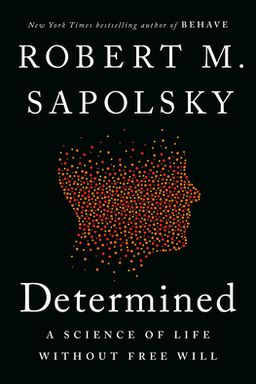
What really causes you to do what you do? In Determined, Robert Sapolsky argues that your choices are not authored by a freestanding inner homunculus but arise from layers of prior causes—biology, development, culture, and context—stacked like turtles all the way down. He contends that once you follow those turtles honestly, the classic notion of free will that grounds moral desert evaporates, and with it the foundations of retributive blame and praise.
You discover how seconds-old sensory cues, minutes-old hormone surges, years-long neural development, fetal exposures, genes, and centuries of cultural evolution shape intent. You then learn why late-breaking neuroscience about readiness potentials (Libet, Haynes, Fried) can’t carry the free-will debate by itself. Finally, you confront the big temptations—chaos, emergence, quantum indeterminacy—and see why unpredictability or micro-randomness doesn’t restore responsible agency, even as the science still leaves room for optimism about change.
The core claim: seamless causation
Sapolsky’s central metaphor is disarming: every behavior rests on prior turtles—determinants that reach back seconds, years, and evolutionary epochs. Swap the genes, uteruses, childhoods, and cultures of a commencement speaker and a groundskeeper, and you likely swap life trajectories. That thought experiment, not Laplace’s demon, is the kind of determinism at stake here—practical, cumulative, and relentlessly biological and social.
He piles on examples to anchor the idea. A tamping rod through Phineas Gage’s frontal cortex rewrote his personality. A judge’s hunger systematically shifts parole decisions across a day. Disgusting smells bias moral judgments via the insula. These are not metaphors; they’re experimentally replicated effects with neural correlates. When you look closely, what felt like uncaused willing turns into context-sensitive neural machinery doing what circumstances have prepared it to do.
Not about prediction, but about control
Determinism here doesn’t mean omniscient prediction. Chaos theory shows deterministic systems can be effectively unpredictable because tiny initial differences blow up over time (Lorenz’s butterfly effect; cellular automata like Rule 22/90). Emergent complexity means simple local rules can yield surprising global patterns (ants, bees, slime molds solving mazes; Tero’s slime-mold rail networks). Unpredictability complicates forecasting, but it doesn’t conjure metaphysical freedom. The parts still follow lawful causes.
Quantum indeterminacy, meanwhile, is a dead end for agency. Even if micro-events are ontically random, decoherence in warm, wet brains (per Max Tegmark’s critiques of Penrose–Hameroff) prevents sustained quantum control. And randomness isn’t authorship—if a quantum coin flip tips your decision, that’s not the kind of control that grounds responsibility.
Why the last seconds mislead
Much debate fixates on the final second before action. Libet’s readiness potentials precede reported intent by ~300 ms; fMRI classifiers predict simple choices seconds ahead at ~60% accuracy (Haynes); single-neuron work pushes to ~80% (Fried). Sapolsky agrees these are provocative but insists they’re the last three minutes of a long movie. These tasks involve trivial button presses, not life-shaping choices, and the data are noisy and context-bound.
Even the cherished “free won’t” veto recruits the same deterministically built frontal circuits (pre-SMA, right inferior frontal gyrus). Inhibitory control is a brain process like any other, molded by your development, hormones, and stress. To ask where intent came from, you must zoom out to minutes, years, and lifetimes of prior shaping.
What this means for praise and blame
If behavior is determined, moral desert loses its footing. You still protect society—incapacitate dangerous people, deter harm, rehabilitate where possible—but you drop retribution as payback for metaphysical guilt. Praise and gratitude become tools to encourage prosocial behavior, not badges of cosmic merit. This shift mirrors historical moves from demonology to medicine in epilepsy and schizophrenia: we learned to replace blame with understanding and safeguards.
Key Idea
“When you behave in a particular way … it is because of the determinism that came just before, which was caused by the determinism just before that, and before that, all the way down.”
Roadmap for the rest of the book
You’ll trace intent across timescales—from instant sensory primes and hormone pulses to adolescent frontal-cortex remodeling and the epigenetics of childhood adversity. You’ll examine why willpower and “grit” are properties of the prefrontal cortex under metabolic and social constraints, not freestanding virtues. You’ll see why chaos, emergence, and quantum strangeness don’t rescue responsibility, even as they enrich how you think about brains near criticality.
Then you’ll learn how real change works mechanistically—through conserved plasticity cascades (cAMP → PKA → MAPK → CREB) from sea slugs to humans—and how the same conditioning machinery can be hijacked for political fear-mongering and later unlearned. Finally, you’ll survey evidence on religion, free-will belief, and morality; reimagine punishment via quarantine and restorative approaches; and translate determinism into a humane social program focused on prevention, rehabilitation, and structural justice. The upshot is sobering but hopeful: you lose metaphysical blame, not meaningful progress.