
Idea 1
Power Transitions and the Logic of the Thucydides Trap
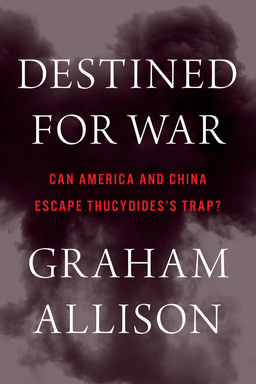
Why do great powers stumble into catastrophic wars even when both sides recognize the risks? Graham Allison’s Destined for War: Can America and China Escape Thucydides’s Trap? asks you to confront that question. Drawing on history, political science, and contemporary policy debates, Allison argues that structural stress—when a rising power threatens to displace a ruling one—creates powerful incentives for rivalry, fear, and miscalculation. The concept takes its name from the ancient historian Thucydides, who wrote that it was “the rise of Athens and the fear this inspired in Sparta that made war inevitable.”
Allison’s central claim is clear: the Thucydides Trap is not a prophecy of doom but a diagnostic pattern. When an existing power faces the accelerating rise of another, systemic pressure builds through fear, honor, and interest. Unless both sides consciously defy that pattern, history shows that war is far more often the rule than the exception.
A Structural Pattern, Not Fate
Through the Thucydides Trap Project at Harvard, Allison and his team examined sixteen historical cases over five centuries where a rising power confronted a ruling one. In twelve of those, the outcome was war. Only four transitions avoided it, proving that violent conflict is not unavoidable but extremely likely without proactive effort. These tendencies arise not just from rational calculation but from fear, pride, and insecurity—the psychological undercurrents that color every strategic choice.
Thucydides’s insight endures because power transitions have recurring anatomy: the rising power demands respect and recognition; the ruling power resists or fears decline. Domestic pressures—the need to project strength, protect allies, or sustain legitimacy—limit leaders’ room for compromise. Small provocations can become triggering sparks. The lesson for you: do not treat crises as random; understand them as symptoms of deeper structural stress.
The Modern Analogue: United States and China
For Allison, today’s defining test is the relationship between the United States, the established world leader, and China, the fastest-rising power in modern history. In 1980, China’s economy was less than one-tenth the size of America’s. By 2015 it overtook the U.S. in purchasing power parity and rivaled it in industrial output, trade, and innovation. China’s rise in wealth and technology, combined with assertive nationalism and military modernization, has produced structural conditions strikingly similar to historic traps.
China’s breathtaking growth—monuments built overnight, a high-speed rail network larger than the rest of the world’s combined, and a growing lead in fields like supercomputing and quantum communication—has dramatically shifted the balance. Alongside this, Xi Jinping’s “China Dream” links prosperity, military power, and political confidence into one coherent revivalist narrative. The rest of the world is feeling the gravitational pull of China’s new status.
Diagnosing the Trap
To diagnose the Trap, you look at the interaction of interests, fear, and honor. The rising power’s expansion of influence provokes anxiety in the ruling one. The ruling power’s defensive moves appear hostile to the challenger. A cycle of suspicion and reactive measures begins. In classical Greece, this dynamic led Athens and Sparta into the Peloponnesian War; in the early twentieth century, it pitted Britain against industrializing Germany. In both cases, leaders tried to manage competition but found themselves boxed in by alliances, arms races, and political pride.
In our time, Allison warns, mistakes can emerge from the same mix: trade conflicts escalating to strategic mistrust, naval skirmishes near contested islands, cyber intrusions misunderstood as prewar signals. As the pace of communication and weapon activation compresses, reaction time shrinks and probability of misreading skyrockets.
Avoiding the Trap
Despite the grim statistics, Allison insists that history also records escapes. Britain made room for America’s rise without war around 1900, largely due to wise diplomacy and resource prioritization. The Cold War between the U.S. and Soviet Union ended peacefully thanks to nuclear deterrence, careful signaling, and negotiated détente. These exceptions reveal what works: strategic imagination, institutional restraint, and patient diplomacy.
To escape the Trap today, leaders must pair competition with accommodation and redesign global institutions to acknowledge new realities of power. They must also resist domestic populism that thrives on xenophobia or “toughness” signals. Awareness is not enough; disciplined policy and structural reform are indispensable. The Trap warns you where the fault lines lie so that policy innovation can defuse them before crisis strikes.
Core message
When rapid power shifts meet rigid political systems and reactive emotions, history tilts toward war. Recognize that pattern early, understand the psychology behind it, and you can still choose a different path.
Allison calls this project “applied history.” It is not an abstract theory but a mirror held up to our time. If policymakers learn from past transitions—combining strategic discipline, mutual recognition, and domestic renewal—then perhaps, unlike Athens and Sparta or Britain and Germany, America and China can make Thucydides’s Trap a lesson rather than a prophecy.