
Idea 1
Designing a Life That Works for You
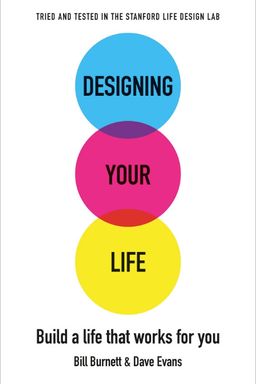
Have you ever wondered if it's possible to design a joyful, meaningful, and well-lived life the way an architect designs a beautiful building or an engineer creates an elegant product? In Designing Your Life: How to Build a Well-Lived, Joyful Life, Stanford professors Bill Burnett and Dave Evans argue that you can—and should. They contend that life, like any great design, is built through creativity, experimentation, and iteration—not through rigid planning or perfect foresight.
The authors draw from their work at Stanford's d.school (the Hasso Plattner Institute of Design), where they teach students how to use design thinking to solve complex, open-ended challenges. Their central insight is that the same methods that produce groundbreaking innovations—like the iPhone or lifesaving medical devices—can help anyone craft a fulfilling life. The challenge, they explain, is to stop searching for the single 'correct' path or 'true calling' and instead learn to build your way forward, prototype by prototype, decision by decision.
Why Life Design Matters
Burnett and Evans begin by pointing out that most of us are trained to solve well-defined problems—math equations, business cases—but not what they call 'wicked problems': those complex, evolving, deeply personal challenges like choosing a career, balancing work and love, or finding meaning. These are problems with no single right answer, only better or worse fits for who you are. Life design offers a new mindset for these messy realities, grounded in five principles: curiosity, a bias to action, reframing problems, awareness of process, and radical collaboration.
The urgency of this approach lies in what they call 'dysfunctional beliefs'—mental traps that keep people stuck. You might believe your major determines your career, that you’re too old to change, or that success equals happiness. In reality, most people’s paths are nonlinear. The authors dismantle these myths and show that designing life means accepting ambiguity as your creative material.
Design Thinking Applied to Life
Design thinking, first pioneered by IDEO and popularized at Stanford, involves understanding users, generating multiple options, building prototypes, and testing ideas quickly. Applied to life, you are both the designer and the user. The process is cyclical: observe your experiences, define what matters, ideate possible lives, prototype them, test and reflect, and iterate continuously. The result is not a fixed plan, but a flexible and generative process of becoming.
In one illustrative story, Ellen, a college graduate who majored in geology because she liked 'rocks,' ends up stuck living at home after graduation, unsure what to do next. Burnett and Evans show how Ellen could use empathy (toward herself), reframe the situation, and build prototypes—perhaps volunteering with environmental groups or exploring work that taps her organizational skills—to test possible directions. Rather than seeking one perfect answer, she can design multiple viable paths.
Core Themes and What You'll Learn
Throughout the book, the authors weave together real-life stories, exercises, and reframing tools. You’ll learn how to build a compass by articulating your Lifeview (your philosophy of what makes life meaningful) and Workview (your assumptions about the purpose of work). You’ll experiment with wayfinding—using engagement and energy as your GPS. You’ll design three parallel versions of your next five years, called 'Odyssey Plans.' And you’ll learn to prototype ideas through conversations and experiences before committing to big changes. Later chapters teach you how to 'choose well' (letting go of fear and perfectionism), build 'failure immunity,' and sustain community through a Life Design Team.
Ultimately, Burnett and Evans want to liberate you from the illusion of certainty. Their argument is not about predicting your future but building it—step by step, prototype by prototype, guided by what energizes you and what aligns with your core values. As they put it, “You can’t know where you’re going until you know where you are.” By learning to think and act like a designer, you can turn confusion into curiosity, failure into feedback, and life itself into a creative work in progress.