
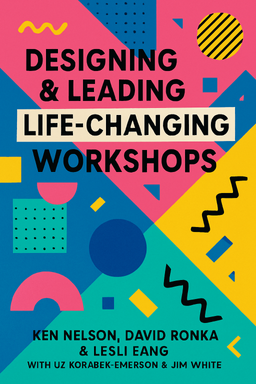
Designing & Leading Life-Changing Workshops cover

Designing & Leading Life-Changing Workshops

by Ken Nelson, David Ronka & Lesli Lang with Liz Korabek-Emerson & Jim White

Designing & Leading Life-Changing Workshops offers transformative insights into crafting workshops that inspire profound change. By understanding group dynamics and creating conducive environments, facilitators can guide participants on journeys of self-discovery, courage, and inspiration, unlocking both individual and collective potential.

Designing and Leading Life‑Changing Workshops

How do you create experiences that truly change people’s lives? In Life‑Changing Workshops by Ken Nelson and David Ronka, the authors argue that workshops can become powerful vehicles for human transformation—not merely for transmitting knowledge, but for awakening self‑awareness, empathy, and compassion. Drawing on decades of experience at the Kripalu Center for Yoga & Health, they contend that any group environment can become a sanctuary for growth when its leader shows up authentically, designs with intention, and leads from embodied presence.

This book combines spiritual wisdom, neuroscience, and practical facilitation techniques into a comprehensive framework for designing and leading what the authors call transformational workshops. They weave together stories from leaders, healers, and participants—from yoga teachers to therapists to managers—illustrating how transformation unfolds within well‑structured, safe, and mindful group experiences. Their central premise is simple but profound: everyone already possesses the capacity for insight and empathy, and the leader’s task is to create the conditions for those inner resources to emerge.

Transformation as a Collaborative Journey

Nelson and Ronka see transformation not as self‑improvement or changing who you are, but as returning to your wholeness—the integration of mind, body, heart, and spirit. A transformational workshop invites a collective process of awakening, where participants learn by experience rather than instruction. The leader’s role, therefore, shifts from being an expert who knows to being a facilitator who co‑creates conditions for participants to know themselves. In their model, transformation happens through cycles of safety, experience, and integration, a rhythm as organic as breathing.

In Part I, the authors define transformation and explain how stories of adversity can birth new purpose—as in Ken’s own story of grief and renewal or Erica’s shift from relentless striving to mindful acceptance. Part II guides you through designing workshops that express your unique calling. And Part III focuses on embodied leadership—learning to hold space, handle conflict, and sustain your work through self‑knowledge and ethical integrity.

Why These Ideas Matter

The book’s relevance extends far beyond yoga or personal growth. In workplaces, classrooms, and communities, people increasingly seek experiential transformation—to not only learn but become. Nelson and Ronka fuse insights from experts like Stephen Cope, Rick Hanson, and Parker Palmer to show that transformation isn’t mystical; it’s neurological and relational. Experience rewires the brain through neuroplasticity, and safe, mindful communities regulate the nervous system, fostering resilience (echoing research from Daniel Siegel’s interpersonal neurobiology).

The authors remind you that designing and leading a workshop isn’t about performance—it’s about presence. Who you are as a leader matters more than what you teach. Effective facilitation arises from inner steadiness, compassion, and an understanding of how people learn through embodied experience. Transformation ripples outward: when one person awakens, communities flourish.

What You’ll Learn Through This Summary

Across the following key ideas, you’ll explore:

  • How transformation begins through self‑awareness and the courage to face disruption.
  • Why workshop design must integrate safety, embodiment, and meaning.
  • How the Transformational Learning Cycle creates lasting impact by balancing experience and reflection.
  • Ways leaders can cultivate mindful presence and ethical care in challenging group dynamics.
  • Methods for sustaining yourself and your purpose while scaling your influence globally.

You’ll also discover vivid stories that illuminate each idea—Ken’s grieving turned into service, Melanie’s newfound voice through mindful communication, and Meira’s two‑year training proving that trust grows through consistency and compassion. Ultimately, this book teaches you that transformation is contagious: when you lead from authenticity and integrity, you help others remember who they really are.


Understanding Human Transformation

Transformation, in Nelson and Ronka’s view, is not a linear path of self‑improvement but a cyclical process of awakening. It begins when you encounter disruption—loss, change, or internal conflict—and are invited to see yourself anew. The book’s opening chapter, “Exploring Transformation,” uses personal stories to show how breakdowns can become breakthroughs.

From Pain to Possibility

Ken’s experience of losing his mother, his marriage, and his sense of identity triggered profound grief but also served as a calling toward mindfulness and service. Similarly, Erica’s story illustrates how relentless striving created inner suffering until she practiced presence through everyday mindfulness—listening to the “bell” that reminded her to breathe and return to now. These examples reveal how awareness transforms suffering into insight. The authors align with spiritual teacher Richard Miller’s idea that “any attempt to change yourself is rooted in self‑hatred,” emphasizing that transformation begins with radical acceptance of what is.

The Conditions for Change

Nelson and Ronka describe transformation as a natural process like a butterfly emerging from the chrysalis: organic, painful, and inevitable. You can’t force it; you can only create the conditions for it. These conditions include safety, curiosity, and community. When people feel safe, they can risk vulnerability. When curiosity replaces judgment, they open to new perspectives. When community holds space, individuals discover belonging and connection (echoing Stephen Porges’s polyvagal theory of safety and social engagement).

Insight and Empathy as Inner Compass

Throughout the chapter, the authors remind you that you already have everything you need—the twin capacities of insight and empathy. Insight allows you to see clearly the nature of your mind and its patterns; empathy connects you with others’ humanity. Together they establish an internal compass for transformation, initiating what the authors call “the ripple effect.” When one person becomes more compassionate, peace radiates outward, touching families, teams, and societies.

Transformation as Integration

Transformation is ultimately about integration—bridging the physical, emotional, mental, and spiritual dimensions. Nelson likens it to yoga’s root meaning: ‘to yoke’ or ‘to unite.’ Neuroscience supports this through studies on mindfulness and emotional regulation showing how attention integrates disparate neural networks. As you bring awareness to sensations, emotions, and thoughts, you dissolve fragmentation and rest into wholeness. You remember, as Ken did while grieving, that healing is not fixing but reconnecting with life.

Key Reflection

Transformation is not becoming someone new—it’s remembering who you already are and acting from that truth. The teacher’s task is to nurture this remembrance, both in themselves and in those they serve.


Creating Transformational Workshops

Once you understand how transformation unfolds, the question becomes: how do you design a workshop that invites it? Nelson and Ronka introduce a framework distinguishing three kinds of workshops—conventional, experiential, and transformational—and explain how leaders move beyond content to create life‑changing experiences.

Three Models of Learning

Conventional workshops focus on knowledge transfer. Participants sit in rows, listen to experts, and absorb information intellectually. Experiential workshops emphasize skills. People actively participate through simulations or role plays, learning by doing. Transformational workshops go deeper—they engage participants at the level of being. Here, participants explore identity, emotions, and meaning itself. While the conventional teaches what to know and the experiential what to do, the transformational teaches how to be.

Conditions That Foster Transformation

Transformation in workshops depends on six interwoven conditions: a holistic view, intentional community, self‑awareness, embodied leadership, mind‑body experiences, and group wisdom. Each condition reinforces the others. For example, a leader grounded in presence helps the group feel safe enough to participate fully; shared agreements nurture cooperation; and experiential techniques awaken awareness through embodiment.

Melanie’s story illustrates these dynamics vividly. Initially anxious about speaking, she found her voice through body‑sensing, mindful dialogue, and compassionate facilitation. The leader’s unwavering presence created a safe container where vulnerability became strength. Through conscious dialogue—a model adapted from Marshall Rosenberg’s nonviolent communication—Melanie learned to express her needs without blame and transformed her fear into connection. This is the workshop at its best: a crucible for self‑discovery held by empathy.

From Leader to Facilitator

In transformational settings, the leader shifts from “sage on the stage” to “guide on the side.” Instead of directing learning, you steward it. You become what the authors call an embodied leader—present, not perfect. You model warmth, clarity, and self‑regulation, showing that authenticity matters more than expertise. When you lead from embodiment, you awaken wisdom that transcends words. As Thich Nhat Hanh once said, “When our hearts expand, we accept others as they are, and then they have a chance to transform.”

Ultimately, creating transformational workshops means trusting the group process. Intentional communities evolve organically when grounded in shared purpose and agreements. Through experiences engaging the mind, body, heart, and spirit, participants cultivate insight and empathy—the universal seeds of compassion. As Nelson and Ronka remind us, this is not about teaching people something new; it’s about helping them remember their innate wholeness.


The Transformational Learning Cycle

At the heart of this book lies one of its most useful teaching tools: the Transformational Learning Cycle. It’s a simple but powerful sequence—Safety, Experience, Integration—that structures every moment of a workshop. Think of it as the DNA of transformation.

Safety: The Starting Point

Safety is emotional, physical, and psychological. No insight can bloom without it. Creating safety begins with clear intentions, warm hospitality, and explicit group agreements. Leaders help participants feel welcome through attentiveness to space—neat circles rather than rows, soft lighting, and music that calms the nervous system. Safety is also ethical: participants must know that confidentiality, respect, and choice are honored. Without this foundation, vulnerability becomes impossible.

Experience: The Embodied Middle

Once safety is established, participants dive into experience—the immersive practices that engage the mind‑body connection. Breathing exercises, movement, journaling, dialogue, and meditation are methods for orchestrated immersion (a term borrowed from brain-based learning). Experience drives change because the body learns through sensation. Rick Hanson’s neuroplasticity research cited in the book reinforces this: what you practice grows stronger. Each mindful experience rewires stress responses into resilience.

Integration: The Meaning‑Making Phase

The final step is integration—making meaning from what just happened. Through reflection, pair sharing, and small group discussion, participants translate experience into insight. Integration prevents learning from dissipating, turning temporary states into lasting traits. The authors suggest allocating almost a third of workshop time to this phase so participants don’t just feel transformed—they understand it.

The Spiral of Learning

Each cycle repeats throughout a workshop, spiraling deeper with every round. Leaders move fluidly between phases, balancing structure and spontaneity. The authors show this difference through a case study of a mindful eating workshop: the conventional version gave information about nutrition, while the transformational version wove meditation, reflection, and shared commitment. Participants not only learned about mindful eating—they experienced it vividly with all senses, integrating wisdom through direct practice.

Practice Reminder

Every moment of transformation follows this rhythm: safe space awakens trust; embodied experience cultivates awareness; integration cements meaning. This cycle—setup, buildup, and payoff—is the architecture of awakening.


Leading With Embodied Presence

Part III examines how leaders translate theory into action. The central idea: transformation depends on your presence. Participants will forget your words but remember how you made them feel. Through mindfulness, self‑regulation, and authenticity, leaders become mirrors that help groups see themselves clearly.

Presencing the Self

Mindful awareness enables you to notice distractions and return to now. The authors cite research showing that the mind wanders nearly half the time; presence anchors attention. Practices like breathing awareness or body scanning synchronize mind and body, making you fully available. Vivian’s story captures this beautifully: during her improvisation workshop, she faced the temptation to control the group as chaos erupted. By pausing, breathing, and trusting the unfolding, she discovered that letting go birthed collective joy. Presence turns fear into faith.

The Twin Roles: Teacher and Facilitator

Leaders wear two hats—teacher and facilitator. The teacher conveys structure, content, and clarity; the facilitator moves energy, emotion, and relationship. Together they harmonize rational and intuitive intelligence. Parker Palmer’s line sums it up: “We teach who we are.” Embodied leaders inform, support, inspire, and guide. They learn to shape‑shift from directing (‘power over’) to negotiating (‘power with’) to delegating (‘power from within’). This dynamic balance fosters autonomy and trust.

Presence as Communication

Nonverbal cues—posture, gaze, and voice—communicate more powerfully than words. Drawing on Albert Mehrabian’s studies, the authors note that only seven percent of meaning comes from content; the rest from tone and body language. Speaking from the belly, grounded in breath, conveys authenticity. Listening with genuine attention fulfills one of Fred Rogers’s great truths: “By listening, you minister to me.” Deep listening and reflective mirroring awaken empathy.

Ultimately, embodied presence is spiritual practice. When you lead with awareness, you model integration for your participants. You become, in effect, the embodiment of the transformation you teach—steady, kind, responsive, and real. As Nelson writes, “Being present, not perfect, is our mantra.”


Attending to Challenges and Group Dynamics

No transformation is smooth. Groups mirror life’s turbulence—conflict, frustration, and unmet needs. The authors dedicate significant attention to handling challenges with compassion and skill. They argue that difficulties are not obstacles but invitations to awaken collective wisdom.

Recognizing Needs Beneath Behavior

Every disruptive behavior hides an unmet need—most commonly for safety, satisfaction, or connection. Barry’s story dramatizes this truth. When a participant named Jack became argumentative and volatile, Barry learned to respond by identifying Jack’s deeper need to feel understood. Through guided inquiry and conscious dialogue, Barry transformed conflict into empathy. Eventually, when Jack could no longer abide by group agreements, Barry asked him to leave—with kindness. His action reinforced safety for all.

Intervening and Clearing

Nelson and Ronka introduce practical skills for facilitators: intervening (addressing behavior) and clearing (restoring harmony). Leaders discern whether to act or bracket an incident, collect information, and stay in relationship. Intervening labels the behavior, not the person. Clearing invites participants to express withheld feelings and reach authentic resolution. Group clearing sessions serve as emotional resets, reaffirming shared values and agreements.

Seasons of the Group

Using the metaphor of seasons, the authors describe group evolution: spring (forming), summer (storming), fall (harvesting), and winter (closure). Challenges arise especially in summer, when boundaries and power dynamics are tested. Leaders cultivate trust by accepting conflict as natural growth. This model aligns with Bruce Tuckman’s stages of group development and with Stephen Porges’s emphasis on safety through social connection.

The deeper message? When dissonance appears, it’s a sign that transformation is working. Your calm presence and ethical integrity model equanimity. Storms may shake the circle, but a well‑held group learns that every wave eventually brings clarity. As Rilke reminds us, “Right away you are always asked to deal with what is most difficult.”


Sustaining the Leader’s Calling

In the book’s conclusion, Nelson and Ronka return to the heartbeat of transformation—the leader’s own journey. Leading workshops is not a job but a vocation, a way of serving humanity. Sustaining this calling requires balance, community, and continual reflection.

Self‑Care and Renewal

Leaders who give deeply risk depletion. The authors urge you to cultivate the practices you teach: mindfulness, breathwork, rest, and presence. Burnout happens when service eclipses self‑connection. True sustainability means nourishing yourself as tenderly as you hold your participants. “Workshops, retreats, and trainings are greenhouses for healing,” they write—but even the gardener must rest.

Partnership and Community

Transformation thrives in partnership. Co‑teaching honors complementary strengths and prevents isolation. The authors recommend clear communication about roles and timing; trust between leaders translates into trust within the group. An assistant can manage logistics, freeing the leader to hold presence. Robin’s story shows how collaboration and mindful preparation helped her overcome social anxiety to lead confidently.

Bringing Workshops to the World

Finally, the authors offer practical advice for expanding your reach: crafting resonant titles, connecting authentically through marketing, and building relationships rooted in trust. Marketing should never feel manipulative—it’s an extension of service. When your message expresses genuine care, doors open naturally. They echo poet David Whyte: “To have a firm persuasion in our work—to feel that what we are doing is right for ourselves and good for the world at the same time—is one of the greatest triumphs of human existence.”

Transformation begins with one person leading from love and ripples outward. As Kabir wrote, “When the flower opens, the bees will come.” Your task is to keep the flower open—tending its roots through integrity, mindfulness, and compassion—so you can continue cultivating spaces where others bloom.

Dig Deeper

Get personalized prompts to apply these lessons to your life and deepen your understanding.

Go Deeper

Get the Full Experience

Download Insight Books for AI-powered reflections, quizzes, and more.