
Idea 1
Design as the Bridge Between Scale and Agility
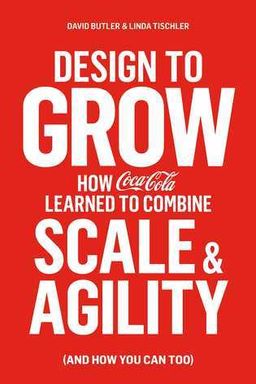
What if your company could grow as efficiently as Coca-Cola yet adapt as quickly as a Silicon Valley startup? That’s the challenge at the heart of Design to Grow by David Butler and Linda Tischler. They argue that the secret to thriving in an era of disruption lies in mastering two opposing capabilities: scale and agility. Scale gives you power and reach, but agility lets you learn, adapt, and survive. The key to achieving both, they insist, is design—not as decoration, but as an organizational capability that connects strategy, culture, and systems.
Butler draws on his experience as Vice President of Innovation and Entrepreneurship at The Coca-Cola Company to show how one of the world’s most established corporations used design not just to beautify products, but to rethink how it operated. Coca-Cola had already mastered scale—it could deliver a consistent experience in over 200 countries. Yet the company struggled to move quickly in a world defined by unpredictability, digital disruption, and shifting consumer expectations. To stay relevant, Coca-Cola had to learn to design for agility.
Why Design Matters Beyond Aesthetics
Most people think design means choosing colors or crafting logos. Butler redefines design as a way of connecting visible and invisible systems—products, supply chains, human behaviors—so that everything works toward growth. As he writes, good design solves problems in ways that make things easier, faster, and better. It’s not about art for art’s sake; it’s about purpose-driven decision-making that improves how an organization learns and operates. This book underscores that everyone is a designer, whether or not the word appears on your business card. Every decision about how to connect elements of a system—from a product to a process to a culture—is a design choice.
From Scale to Agility
The first half of the book explores how Coca-Cola used design to achieve massive scale. Through simplifying, standardizing, and integrating every part of its system—from the contour bottle to its red-and-white logo to consistent brand identity—it built one of the world’s most recognizable companies. Butler calls this approach “designing a Lamborghini,” meaning that every component fits together perfectly for efficiency and consistency. This worked brilliantly for decades but left the company vulnerable to rapid change. As markets fragmented and consumer tastes diversified, those very strengths made it rigid. The second half of the book, therefore, reveals how Coca-Cola learned from startups how to design for agility—using design to create modular systems that could evolve quickly, much like “a box of Legos.”
The Golden Circle of Design
Borrowing from Simon Sinek’s Golden Circle (“Start with Why”), Butler reframes design around three key questions: Why we design (our purpose), How we design (our process), and What we design (our products). The most successful firms align these three levels to their growth strategy. Companies like Apple or McDonald’s have thrived because their design philosophy connects purpose to execution. Coca-Cola, Butler explains, needed to rediscover its “Why”—to refresh the world through adaptable design practices that could scale and flex across markets. Without agility, even a well-oiled giant risks its own “Kodak moment”—that jarring instant when market irrelevance catches up faster than leadership can react.
Lessons from a Design Transformation
The book’s rich case studies illustrate how design thinking reshaped Coca-Cola’s operations. From the twisting eco-friendly ILOHAS water bottle in Japan to modular retail systems in Latin America and manual distribution centers in Africa, Coca-Cola found ways to blend consistency with localized innovation. These weren’t one-off projects; they were experiments in developing a new organizational habit—the ability to learn, iterate, and redesign in real time. Butler’s message is clear: design is not a phase, it’s a process of continuous adaptation.
Why This Matters Now
In a world where startups disrupt century-old industries overnight, both entrepreneurs and corporate leaders face the same question: how can you grow while staying adaptable? Butler offers a framework that applies whether you’re a founder seeking scale or an executive fighting stagnation. Startups need design to scale; big companies need design to stay agile. The convergence of these two worlds—what he calls the next “era of scale-ups”—will depend on organizations that design systems capable of learning. Like a good surfer watching for the next wave, successful leaders must position themselves where opportunity meets design. That’s what Design to Grow teaches you: not to choose between scale and agility, but to design for both simultaneously.