
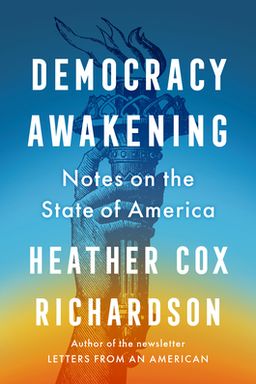
Democracy Awakening cover

Democracy Awakening

by Heather Cox Richardson

Democracy Awakening explores America''s complex relationship with democracy, contextualizing modern political events within a historical framework. Heather Cox Richardson examines the ongoing struggle for equality and the persistent threat of authoritarianism, offering insights into safeguarding democratic principles.

Democracy and its Countermovement

You live in a nation defined by two competing traditions: the expansion of democracy through federal action and the organized resistance that seeks to restrain it. This book argues that American political history can be read as a running contest over whether government should protect collective rights or privilege private power. From the Founders to the present, the struggle has turned on definitions of freedom, equality, and the purpose of government itself.

The Founding contradictions

At the nation’s birth, the Declaration of Independence proclaimed that “all men are created equal,” yet the political system excluded most people—enslaved Africans, Indigenous peoples, women, and the poor. Those excluded turned the Declaration into a weapon for inclusion: freedom suits by Elizabeth Freeman and Quock Walker, abolitionist oratory by Frederick Douglass, and later suffragists’ declarations at Seneca Falls invoked the founding promise to indict the hypocrisy within it. (Note: historians call this dynamic “the usable past”—how excluded voices redeploy national rhetoric to make new claims.)

Reconstruction and the national guarantee of rights

The Civil War and Reconstruction transformed that founding paradox into law. Abraham Lincoln reframed the nation’s moral purpose in the Gettysburg Address and Republican legislators used wartime power to nationalize citizenship through the Thirteenth, Fourteenth, and Fifteenth Amendments. That revolution made equality a federal responsibility. Yet backlash came swiftly: Andrew Johnson’s leniency and violent southern resistance proved how fragile reform is without enforcement. (The creation of the Department of Justice in 1870 to fight the Ku Klux Klan was an early assertion that democracy needed active defense.)

The liberal consensus and its enemies

Franklin D. Roosevelt’s New Deal revived that federal ideal—government as guarantor of opportunity. By regulating labor, finance, and markets, and establishing Social Security, the state was rebuilt as a democratic counterweight to concentrated private power. After World War II, this expanded into a “liberal consensus,” shared across parties: government should secure prosperity and equality. Civil‑rights activists then demanded that the Declaration’s promise become real—pushing Truman, Eisenhower, and Johnson to enforce rights through the courts and Congress.

But every expansion sparked counter‑mobilization. In the 1930s the Conservative Manifesto united business interests, segregationist Democrats, and localists against the New Deal; later, opposition to civil rights invoked “states’ rights” to disguise racial hierarchy. From there emerged the modern conservative movement—a coalition that branded federal activism as “socialism” and turned democracy’s social aims into economic fears.

The long arc of retreat

The book traces the shift from arguing ideas to redesigning institutions. Nixon’s southern strategy reoriented both major parties around grievance and racial resentment. The Reagan Revolution transformed those emotions into policy—tax cuts, deregulation, privatization—widening inequality while styling nostalgia as patriotism. The following decades brought structural maneuvers: gerrymandering, judicial appointment of originalists, voter restrictions, and campaign finance deregulation through Citizens United all worked to entrench minority rule.

Democratic erosion and global entanglements

By the 2000s and 2010s, this project had matured into a global enterprise. Political consultants like Paul Manafort and Roger Stone exported tactical disinformation while importing foreign money. Courts returned power to states through “originalist” decisions in cases like Dobbs and Bruen, re‑opening old fights over rights and governance. The result is a paradox of American democracy: a federal system theoretically capable of enforcing equality, yet repeatedly captured by movements invoking tradition and liberty to justify hierarchy.

Enduring pattern

Across centuries, progress in equality provokes counter‑movements that disguise privilege as principle. Understanding this pattern empowers you to see democratic resilience not as an inheritance, but as work—defending rights through institutions as well as ideals.

The book’s core argument is clear: American democracy expands through federal protection and public mobilization, while an organized counter‑movement repeatedly repackages hierarchy as freedom. To preserve democracy, you must discern that pattern in politics, institutions, and rhetoric—and insist that equality remains the nation’s unfinished project.


Founding Promises and Contradictions

The Founders drafted two overlapping legacies: one visionary in principle, another exclusionary in practice. This section asks you to recognize how the ideal of equality became a political weapon for those left out of it. Thomas Jefferson’s words in 1776 were revolutionary, but incomplete; they gave later generations the moral syntax for demanding what Jefferson himself denied.

The language of inclusion

Early reformers—from Phillis Wheatley’s poetry to Abigail Adams’s letters—extended the logic of the Declaration toward gender and race. Frederick Douglass later turned America’s founding rhetoric against its practices, confronting audiences with his question, “What to the Slave is the Fourth of July?” (Note: these rhetorical inversions made hypocrisy visible and turned patriotism into critique.)

Contested histories—1619 vs. 1776

In the twenty‑first century, this argument reemerged through the tension between the 1619 Project and the 1776 Commission. The first made slavery central to national identity; the second celebrated the Founders while de‑emphasizing injustice. Both show that history itself is political—who defines origin stories also defines belonging and legitimacy. You inherit not just two versions of the past, but two living arguments about what America is for.

Why the founding paradox still matters

The book teaches that reform movements succeed when they claim continuity rather than rupture: civil‑rights leaders, feminists, and abolitionists invoked Jefferson’s words to demand unfinished equality. That strategy—using the nation’s own vocabulary—explains why moral appeals can transcend demographics. When Americans reform, they do so by returning to their founding ideals, insisting those ideals apply universally.

If you want to renew democracy, follow this pattern. It’s not enough to expose hypocrisy; you must claim ownership of the founding promise and force institutions to meet its full moral logic.


Federal Power and Reconstruction

After the Civil War, the U.S. reinvented itself through constitutional reconstruction and national enforcement. Lincoln’s wartime vision—a united democracy built on equality of opportunity—was codified through amendments that transformed the Constitution from restraint on federal power into a tool for protecting rights.

War-making and governance

Lincoln and the Republican Congress built institutions that endure: the Homestead Act, the Land‑Grant College Act, and the Pacific Railway Act opened land and education to millions. An income tax and national currency funded these projects, illustrating how shared taxation underwrites collective security. These innovations made the federal government both financier and protector of public welfare.

Amendments and national citizenship

The Reconstruction Amendments were revolutionary. The Thirteenth not only banned slavery but empowered Congress to enforce freedom. The Fourteenth made every American equal before the law. The Fifteenth sought to protect Black suffrage. Taken together, they established the federal obligation to override discriminatory state power—a promise that later generations used in courts and civil‑rights battles.

Resistance and retrenchment

Resistance came immediately. Andrew Johnson’s approach restored white elites, enabling new Black Codes and racial terror. Congressional Reconstruction fought back but waned by the mid‑1870s, leaving enforcement weak. This back‑and‑forth underscores a key lesson: rights depend not only on law but on the ongoing willingness to use federal authority to defend them.

Key takeaway

Democracy requires national capacity. As Reconstruction proves, ideals must be scaffolded by institutions that act decisively against local oppression. Federated systems distribute opportunity only if the center enforces equal protection.


Building and Challenging the Liberal Consensus

From the 1930s through the 1970s, the United States constructed a “liberal consensus”—a belief that government should regulate markets and guard equality. This era’s success and contradictions define the modern policy debate: whether government empowerment creates liberty or stifles it.

The New Deal and postwar expansion

Franklin D. Roosevelt mobilized relief and reform through policies that rebalanced economic power: Social Security, labor protections, banking regulation, and public works. Wartime mobilization then entrenched national authority, and the G.I. Bill created an educated middle class. These institutions produced what economists called the “great compression”—income equality and broad prosperity.

Civil rights as fulfillment

Activists demanded that liberal ideals apply to all. From Isaac Woodard’s case to Brown v. Board of Education, the civil‑rights movement drove presidents and courts to translate equality into enforceable law. Lyndon B. Johnson’s Great Society extended this moral agenda with Medicare, Medicaid, and anti‑poverty acts, while civil‑rights legislation attacked systemic exclusion. (Note: historians mark this as the apex of federal moral authority.)

The seeds of opposition

Economic elites and segregationists reacted by reframing federal action as “socialism.” They argued that taxes redistributed wealth unfairly and that social programs rewarded dependency. This rhetorical inversion, rooted in post‑Reconstruction propaganda, linked race and taxation—a pattern later amplified in media. Such framing softened resistance to civil rights by masking it as fiscal conservatism.

Lesson

When equality depends on redistributive policy, defenders of privilege will redefine fairness as theft. The sustainability of democracy thus rests on narrative—a people must believe government expands freedom, not threatens it.


Conservatism and the Politics of Identity

From the mid‑century backlash through Reagan’s ascendancy, conservatives mastered identity politics—emotional appeals disguised as principles of freedom. This section explains how grievance, race, and nostalgia became mobilizing tools that outlasted policy debates.

Nixon and positive polarization

Richard Nixon’s southern strategy and media operations discovered a potent formula: emotional division yields loyalty. His advisors coined “the silent majority” and “law and order” to channel anxiety about civil rights and social change. Strategists like Lee Atwater and Patrick Buchanan later refined this technique—"positive polarization"—because emotion converts apathy into militancy.

Reagan’s cultural synthesis

Ronald Reagan turned polarization into optimism. He combined supply‑side economics with moral storytelling, invoking the cowboy and family values to justify deregulation and tax cuts. Religious conservatives joined, transforming moral issues like abortion into partisan identity. This convergence locked business and evangelical interests into a durable alliance, embedding cultural grievance within free‑market ideology.

The emotional economy of politics

Reagan’s success proved a psychological pattern: you remember feelings longer than facts. Narrative replaced statistics, and belonging replaced debate. Later politicians—from Reagan to Trump—used that emotional economy to sustain support even amid inequality. (Political scientists describe this as “affective polarization,” where emotion eclipses policy.)

Key takeaway

Emotion is strategy. When parties make identity their product, democracy shifts from negotiation to survivalism—the opponent becomes the enemy, not the rival.


Engineering Minority Rule

As cultural persuasion hardened, conservatives invested in structural control—changing maps, courts, and money flows to preserve power even without majority support. This section shows how procedural engineering became the decisive stage of modern politics.

Judicial capture

Strategic appointments under Reagan and later presidents installed originalists committed to limiting federal reach. Cases from West Virginia v. EPA to Dobbs v. Jackson Women’s Health demonstrate how constitutional “history‑and‑tradition” tests function: they anchor modern policy in selective readings of the past. This judicial turn transfers authority to states—many already gerrymandered—weakening nationwide protections.

Money and mapping

The Citizens United ruling (2010) unleashed corporate money and dark‑funded super PACs. Simultaneously, Operation REDMAP redistricted states with algorithmic precision, ensuring legislative dominance despite popular vote losses. Voter‑ID laws and registration purges reinforced the effect, often targeting minority and youth voters under the guise of “ballot integrity.”

Electoral mechanics

Building on earlier tactics—the addition of small states for Senate advantage in the 19th century, the winner‑take‑all electoral rule in the 1800s—modern strategies fine‑tune systemic bias. The “independent state legislature” theory even suggests states could choose electors outside constitutional checks. Each lever displaces rule by majority with rule by design.

Core insight

Democracy endures only when procedures align with population. Structural manipulation—more than rhetoric—determines whether equality prevails or decays.


Global Networks and Democratic Vulnerability

In the post‑Cold War era, domestic partisanship merged with global influence. The book shows how American political operatives, consulting firms, and dark‑money channels connected U.S. activism with authoritarian regimes abroad—turning democracy’s erosion into an international business model.

From ideology to transaction

During the Cold War, anti‑communism justified foreign alliances with authoritarian states. After 1991, the ideology shifted from defense of democracy to pursuit of profit. Consultants like Paul Manafort and Roger Stone worked for despots while advising U.S. campaigns, forming what watchdogs called the “Torturers’ Lobby.” Money and strategy circulated freely across borders.

The two‑way exchange

Foreign oligarchs absorbed lessons from American political messaging—microtargeting, disinformation, and emotional framing—while U.S. actors imported cash and influence. The exchange blurred the line between domestic policy and global profit, weakening transparency and oversight. (Comparatively, scholars note it resembles transnational corruption networks in post‑Soviet states.)

Why global entanglements matter

The global project widens democratic vulnerability: economic elites can manipulate information across borders while domestic institutions lag in disclosure laws. It explains why modern reform must address foreign money and consultancy ethics as parts of democratic defense—not peripheral issues.

Essential takeaway

Democracy’s crisis is global: tactics perfected in one country migrate easily to another. Protecting representation today requires transparency provisions that reach beyond borders.

Dig Deeper

Get personalized prompts to apply these lessons to your life and deepen your understanding.

Go Deeper

Get the Full Experience

Download Insight Books for AI-powered reflections, quizzes, and more.