
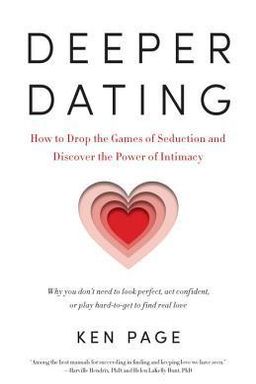
Deeper Dating cover

Deeper Dating

by Ken Page

Deeper Dating by Ken Page provides a transformative roadmap to finding and nurturing deep, fulfilling relationships. By discovering your Core Gifts and fostering genuine connections, this book helps you move beyond superficial attractions to cultivate meaningful partnerships that inspire and fulfill.

Deeper Dating: The Path to Love Through Authenticity and Intimacy

What if finding real love isn’t about improving how you look, flirting better, or playing hard to get—but about embracing your truest self? In Deeper Dating: How to Drop the Games of Seduction and Discover the Power of Intimacy, psychotherapist Ken Page argues that meaningful, lasting love originates not from surface-level strategies but from cultivating authenticity, vulnerability, and self-acceptance. The book offers a transformative roadmap: instead of fixing your flaws or packaging yourself for romantic success, discover and honor what Page calls your Core Gifts—the deepest sensitivities, passions, and vulnerabilities that define who you are.

Page contends that most popular dating advice leads people astray by promoting seduction tactics that sacrifice real intimacy. He sees those approaches as a kind of self-punishment, keeping people trapped in insecurity while chasing approval. The true journey to love, he explains, begins when you stop trying to change who you are and instead learn to lead with the parts of yourself that move, inspire, and even hurt the most. These Core Gifts aren’t flaws; they’re portals into profound connection.

The New Map to Love

Page opens with the concept of a “New Map to Love,” contrasting it with the old cultural map that tells you to get thinner, trendier, or more charismatic. He notes that genuine love flourishes from qualities like kindness and understanding, not physical perfection or charm. Drawing on psychological research by David Buss, Eli Finkel, and Arthur Aron, Page shows that healthy intimacy depends on the capacity for empathy and mutual respect—traits often buried beneath the pursuit of attractiveness. The new map is about cultivating intimacy by being seen, understood, and validated in your deepest essence.

Stages of the Deeper Dating Journey

The book serves as a complete course—in four stages—to help readers transform their approach to love. Stage 1 teaches you to discover your unique Core Gifts, exploring how your deepest wounds often spring from those same gifts. Stage 2 helps you distinguish between two types of romantic chemistry: Attractions of Inspiration—those that lead to growth and love—and Attractions of Deprivation—those that lead to pain and repetition. Stage 3 guides you to apply intimacy-based skills to real-world dating. And Stage 4 focuses on cultivating lasting romantic and sexual passion with people who honor your gifts and see your worth.

Throughout, Page uses personal stories—his own long journey through failed relationships, therapeutic insights, and clients’ experiences—to show that self-compassion and vulnerability are catalysts for intimacy. He recounts moments of loneliness and self-blame, revealing how misinterpreting sensitivity as weakness kept him from love. Only when he learned to honor his tenderness as a strength did he find his husband and a sense of peace in vulnerability. This shift—seeing your sensitivities as assets instead of liabilities—is the book’s emotional core.

A Gift-Based Approach to Love

The heart of Page’s philosophy is simple but radical: the very qualities you try to hide—your emotional depth, your longing, your honesty—are exactly what attract genuine connection. He defines Core Gifts as the parts of us that respond most intensely to love and its absence. These gifts live within what he calls the Gift Zone, the center of our being where authenticity meets compassion. When you live from your Gift Zone, you radiate a magnetic presence that calls loving partners toward you. But when you distance yourself from those gifts, you gravitate toward people who can’t value you—creating cycles of unavailability and heartbreak.

Page introduces the Gift Theory model: at the core of every defense lies a wound, and at the heart of every wound lies a gift. The work of intimacy is to move past defenses and rediscover the gift hidden within. Using exercises, reflections, and “micro-meditations,” Page teaches readers how to recognize the zones of intimacy within their lives—the Gift Zone, the Zone of Protection, and the Zone of Disconnection—and gradually step closer to authentic self-expression.

Why Authentic Intimacy Heals

Page argues that longing for love isn’t weakness—it’s wisdom. Love is oxygen, he writes; human beings wilt without it. His message contrasts sharply with self-help trends that glorify independence or emotional “coolness.” Referencing research in Psychology Today and medical studies, he illustrates how intimacy even affects physical health—holding hands lowers blood pressure and reduces pain. To seek love bravely is an act of strength and self-trust, not dependency.

Essentially, Deeper Dating reframes the entire dating process as a spiritual and psychological journey toward wholeness. Love isn’t something you find by chance—it’s something you build by honoring your humanity and connecting through your gifts. Real attraction comes not from seduction but from courage: the courage to be who you are, the courage to let others see your tenderness, and the courage to choose relationships of inspiration over deprivation.

Ken Page’s central insight

“The amazing paradox is that the parts of our personality we think we must fix in order to find love are usually the keys to finding that love.”

This reorientation—from self-improvement to self-honor—makes Deeper Dating both a dating guide and a roadmap for emotional growth. By learning to value your sensitivities, choose partners who honor them, and practice relational bravery, Page assures readers that love will not only find them—it will transform them.


Discovering Your Core Gifts

Ken Page begins the journey with Stage 1: uncovering your Core Gifts, the cornerstone of his entire philosophy. These gifts aren’t talents or skills—they’re zones of deep sensitivity where you feel love and pain most intensely. They might show up as your empathy, passion, loyalty, tenderness, or truth-telling—qualities that have often caused embarrassment or hurt. Paradoxically, Page argues, your deepest wounds surround your greatest gifts.

The Gift Zone and the Zones of Intimacy

To illustrate this, Page introduces his “target of intimacy.” At the center lies the Gift Zone, where you feel most alive and connected to your authentic self. Surrounding it is the Zone of Protection, where you create safe versions of yourself to avoid rejection. The outermost ring is the Zone of Disconnection, where excessive self-protection leads to numbness and loneliness. The aim: move inward toward the warmth of the Gift Zone without getting lost in fear of vulnerability.

Page’s point is that you can’t reach intimacy through pretense or perfection. You can only reach it through authenticity plus compassion—the definition of intimacy itself. By honoring your feelings instead of judging them, you grow closer to your Gift Zone. This is beautifully illustrated by his own story: raised in a family of Holocaust survivors, Page was taught that tenderness equaled weakness. For decades, he hid that part of himself, mistaking sensitivity for fragility. Only later did he recognize that his tenderness was a profound gift capable of transforming his relationships and attracting his husband Greg.

Finding Gifts in Joy and Pain

You can locate your Core Gifts by answering two questions: what fills your heart, and what hurts it? Page guides readers through journaling exercises—recalling moments of deep inspiration and times of heartbreak—to reveal the emotions and experiences where your gifts live. One client, Pat, discovered her gift of compassion while working as a dental hygienist. She realized her intense feelings of tenderness toward her patients weren’t flaws but signals of genuine empathy. Another client, Susan, uncovered her gift of generosity after recognizing how often she gave too much to unworthy partners. As she learned to protect and treasure that gift, she attracted men who respected her vulnerability rather than exploiting it.

Turning Wounds into Wisdom

Page connects this pattern to psychology (Jung’s idea of the “shadow”) and trauma research. Our rejected qualities reappear as projections—we fall for partners who mirror the parts of ourselves we’ve disowned. Until we reclaim those parts, we’ll be drawn to relationships that repeat old pain. In one striking case, client Debbie realized her anger flared because her tender heart wasn’t being seen. Her myth of lost love—the belief she was too needy to deserve affection—fueled relationships with men who proved her pain right. Naming vulnerability as a gift freed her from that cycle.

Honoring your gifts means acknowledging their cost. Sensitivity demands courage; loyalty invites disappointment; passion risks rejection. Yet those costs are what make your gifts sacred. When you treasure them instead of suppressing them, you attract partners who will treasure them too. And that, Page insists, is the birthplace of intimacy.


Recognizing Attractions That Heal or Hurt

Stage 2 introduces one of Page’s most transformative distinctions: the difference between Attractions of Inspiration and Attractions of Deprivation. Understanding this simple principle, he claims, can change your entire romantic life.

Attractions of Deprivation

An attraction of deprivation draws you toward someone who doesn’t or can’t give you the love you need. These relationships feel intoxicating—they mix desire with insecurity—but eventually spiral into pain. Page calls them “the undertow.” Examples include falling for someone unavailable, critical, selfish, or addicted. His client Meryl illustrates this perfectly: she adored a charming real estate developer who subtly belittled her. The sex was intense, but the emotional balance was off; she spent her days proving her worth to him. When she finally left, she realized she’d been chasing approval, not love.

Attractions of Inspiration

In contrast, attractions of inspiration occur with people whose kindness, stability, and integrity make you feel safe and valued. These relationships grow on mutual respect and emotional generosity. They might begin gently—without the roller-coaster of passion—but deepen into lasting love. The difference, Page says, is that deprivation is fueled by scarcity; inspiration is fueled by connection.

Changing Your Romantic Wiring

Most of us, Page explains, are “wired to want the hard-to-get.” This urge comes from internalized shame around our Core Gifts. When we don’t honor the vulnerable qualities that make us lovable, we’re drawn to partners who mirror that lack of respect. Every attraction of deprivation highlights a gift we’ve failed to value. Healing requires flipping that dynamic—only investing in attractions of inspiration, only. He even proposes the “90 Percent Rule”: 90% of people won’t be a fit for your gifts, and that’s okay. You’re not too picky; you’re learning discernment.

Consider Sandy, a restaurateur who kept dating emotionally evasive men. After applying Page’s lessons, she began treating honesty as her defining gift and refused relationships that dishonored it. Within months she met Ed, a loyal father, and found the peace she’d been seeking. “Each child brings its own luck,” Page later writes—every act of authentic living brings its own grace.

Lesson from Stage 2

Choose only attractions of inspiration. They expand your world instead of shrinking it. They don’t steal your peace—they teach you how to love and be loved fully.

This distinction transforms dating from guesswork into wisdom. Once you know what inspiration feels like—calm excitement, respect, safety—you’ll stop mistaking deprivation for chemistry and start building love that lasts.


Learning the Skills of Intimacy

In Stage 3, Page moves from inner awareness to practical action: seven Skills of Deeper Dating to guide authentic encounters. These are not manipulative tactics—they’re relational muscles that help you lead with your gifts in real-life situations. The goal is bravery balanced by kindness.

The Seven Skills

  • Be kind, generous, and thoughtful. Kindness is seductive. Page shares Wendy Widom’s story of a man whose gentle act—swiping his subway card for her—sparked love. Small, authentic generosity is magnetic.
  • Show your interest. Research by Eli Finkel confirms that expressing genuine liking increases attraction. Page advises: if you like someone, let it show. Vulnerability signals connection.
  • Focus on the quality of connection. Drop the checklist of “Does he measure up?” Instead, feel your body’s response—warmth, fun, calm. Daniel Goleman’s social neuroscience research backs this: intimacy is a “dance of feelings” between two brains.
  • Practice bravery. Like leaping off a trapeze ledge, approaching someone new is terrifying but liberating. Each bold act builds confidence.
  • Discover the art of squinting. Don’t fixate on superficial imperfections. Squint to see essence, not flaws. A bad haircut can hide a beautiful heart.
  • Share your passions. Instead of generic questions, talk about what moves you. Enthusiasm invites authentic reciprocity.
  • Be fiercely discriminating. Protect your gifts. Choose people who value kindness and emotional availability over charm or status.

Turning Practice into Transformation

These skills ask for vulnerability and boundaries at once. Page encourages readers to treat dating as emotional training—mistakes are part of learning. His story of Lisa, who wanted deeper connection with her partner, shows the process in real time: she risked admitting her need for affection during a quiet moment, and her honesty brought the two closer. Each act of bravery invites intimacy.

Collectively, these seven skills rebuild the foundation of dating culture—from games of seduction to acts of humanity. They create the conditions where authenticity becomes attraction.


Taming Fear and the Wave of Distancing

Even with these skills, new love can trigger fear. In chapter nine, Page reveals the greatest saboteur of healthy relationships: the Wave of Distancing. The Wave hits when someone kind and available shows affection—and you suddenly lose interest. Your heart goes cold, flaws magnify, and escape feels urgent. Page insists this doesn’t mean the relationship is wrong; it means you’re touching emotional vulnerability.

“Love holds up a mirror,” he writes, “and when we see ourselves clearly, we panic.” Like the mother bird feigning a broken wing to protect her nest, we push love away to protect our inner core. The secret: the wave always passes. Don’t flee—just pause and breathe through it.

Six Keys to Handling the Wave

  • Don’t panic; your feelings of affection are likely still there beneath fear.
  • Take gentle space—you don’t need to sever connection to find calm.
  • Reject guilt and obligation; pace yourself authentically.
  • Remind yourself of what you appreciate about your partner.
  • Seek perspective from trusted friends—let them bring you back to reality.
  • Work through fear instead of suppressing it; fear is intimacy’s shadow.

Page’s client Danny nearly ended a great relationship under the Wave’s spell until a friend snapped him out of it—“Are you out of your mind? She’s wonderful.” He realized attraction is partly choice; in recommitting, affection returned. Page suggests that experiencing the Wave may actually be a sign you’re finally with someone safe enough to trigger real fear of closeness. In other words: the Wave means growth is happening.

By normalizing fear of intimacy as an inevitable part of love—not a flaw—Page helps you stay present through discomfort instead of sabotaging connection. Fear, he concludes, isn’t cured by control; it’s softened by intimacy itself.


Tapping Into the Source of Self

Beyond psychology, Page integrates spirituality into his framework. He teaches that intimacy has divine roots within what he calls the Source of Self—the place you love from, the center of your being where wisdom and compassion reside. Connecting to this inner source through meditation and reflection accelerates healing and helps you attract love aligned with your gifts.

Guiding Insights and Micro-Meditations

Page introduces practices called Guiding Insights, intuitive flashes that feel like inner instructions—what love is asking of you right now. They might arise as longings, realizations, or quiet nudges, inviting you toward self-honoring actions. For him, one insight led to fatherhood: after watching a film about compassion, he felt an inner call to adopt a child. That guiding insight became the doorway to meeting his partner Greg and creating family.

The Five-Minute Meditation on Love

To connect with your Source of Self, Page suggests a daily five-minute meditation. You simply ask for help and direction in your search for love, repeating heartfelt words like “I open my heart to love.” Through this practice, longing transforms into faith. You can also practice “sloppy spirituality”—perfection isn’t required; persistence is. Even imperfect meditation gradually rewires your emotional circuitry toward warmth and connection.

Ultimately, this spiritual approach reframes vulnerability as sacred. Love becomes less about strategy and more about surrender to your inner light. As you align with this source, Page promises, the people who resonate with your gifts will find you—not through effort but through authenticity’s magnetic pull.


Cultivating Sexual and Romantic Passion

In Stage 4, Page tackles the question every reader asks: how do you sustain sexual spark in healthy relationships? His answer: by discovering your Sexual Core Gifts—the fusion of desire and emotional connection that produces embodied love. Sexuality isn’t separate from intimacy; it’s another expression of authenticity.

The Attraction Spectrum

Page describes a spectrum of attraction from 1 to 10. At the high end are “iconic types”—people who trigger intense longing and insecurity. At the middle range are subtler attractions that can grow into lasting love. Instead of chasing 10s who spark drama, Page suggests exploring the middle range, where connection can transform into passion. He supports this with research by Robert Epstein showing that love often increases over time in arranged marriages, where couples build commitment first and attraction second.

Growing Desire Through Connection

You can grow attraction by noticing what moves you emotionally and physically, without pressure. Loving gestures, shared vulnerability, even laughter feed desire. Janet’s story captures this: when her partner was ill, caring for him ignited deep sexual and emotional arousal—love and lust merged in compassion. Similarly, Carolyn realized she loved her longtime friend only after years of kindness; passion arrived later but stayed permanently.

Integrating Tenderness and Wildness

Page encourages embracing both aspects of sexuality—the softness of emotional connection and the fierceness of erotic play. He references Freud’s “Madonna-whore” paradox and reclaims it: real sexual maturity integrates both tenderness and wildness. To access your Sexual Core Gift, ask two questions: what turns you on most, and what touches you most deeply in sex? These reveal the unique expression of your erotic soul—a blend of physical desire and emotional truth.

In his view, love that lasts emerges when sexual passion and emotional intimacy are intertwined. The more you live from your Gift Zone—even in bed—the deeper your pleasure becomes. Sex becomes knowing, not escaping.


Being Loved into Fullness

Page closes the book by returning to love’s ultimate purpose: healing and wholeness. “We are born in relationship, wounded in relationship, and healed in relationship,” he writes. The culmination of the Deeper Dating journey is learning to be loved into fullness—to allow love to restore the parts of yourself you once hid.

He recounts the astonishing case of Godfrey Camille, studied in the Harvard Grant Study. Raised by cold parents, Camille suffered decades of dysfunction until a year in the hospital—where nurses showed him care—transformed his life. That attention awakened his capacity for love; he became a devoted father and doctor, describing his healing as “connectedness that made me real.” For Page, this story proves that being loved for who you are—not for whom you pretend to be—turns brokenness into strength.

When you share your Core Gifts with those who honor them, you experience that same rebirth. Each relationship of inspiration teaches you worthiness. The process is circular: the gifts that once felt dangerous become the very qualities through which you find joy, meaning, and partnership. “Behind our defenses are our hurts,” Page reminds, “behind our hurts are our gifts, and in the heart of our gifts we find a portal to love.”

Through this lens, love is not an accidental meeting—it’s a conscious becoming. You’re not finding yourself through another; you’re finding your fullest self because another reflects it back. In the end, Deeper Dating is less about dating and more about learning love itself.

Dig Deeper

Get personalized prompts to apply these lessons to your life and deepen your understanding.

Go Deeper

Get the Full Experience

Download Insight Books for AI-powered reflections, quizzes, and more.