
Idea 1
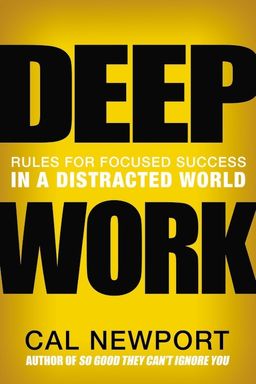
Deep Work: The Power of Focus in a Distracted World
How much of your day is truly focused? If you find it hard to stay off your phone or struggle to concentrate without checking e-mail, you’re not alone. In Deep Work, Cal Newport argues that our modern world has trained us for distraction. But those who cultivate deep focus—what he calls deep work—can achieve remarkable results and stand apart in an attention-fractured economy.
Newport defines deep work as professional activities performed in a state of distraction-free concentration that push your cognitive capabilities to their limit, creating new value and improving skills. Its opposite, shallow work, includes tasks like checking e-mail or attending unproductive meetings—efforts that are easy to replicate and consume attention without driving meaningful output. The book’s core argument is simple but powerful: in an age of constant distraction, cultivating deep work is both rare and immensely valuable.
Why Deep Work Matters
Newport begins by connecting deep work to modern economic realities. As technology automates or outsources many tasks, he identifies two core abilities crucial for thriving in the new economy: the ability to learn hard things quickly and the ability to produce at an elite level. Both depend on your capacity for deep work. This skill allows people like Nate Silver, the data journalist famous for his election predictions, or David Heinemeier Hansson, the programmer behind Ruby on Rails, to stand out by mastering complexity and producing world-class output.
Yet despite its centrality to success, deep work is increasingly rare. Our offices promote open plans that foster interruption, our inboxes never sleep, and social media fragments our mental bandwidth. Even knowledge workers—those hired for their brains—mistakenly equate busyness with productivity. Newport calls this trend “busyness as a proxy for productivity.” To reverse it, he urges a systematic commitment to depth, arguing that focused effort has always been behind humanity’s most valuable achievements—from Carl Jung’s isolated writing retreat in Bollingen Tower to Bill Gates’s week-long “Think Weeks” that reshaped Microsoft’s strategy.
Three Central Arguments for Deep Work
Newport builds his case around three pillars—each answering the question, “Why does deep work matter?”
- Neurological: Drawing on research by science writer Winifred Gallagher, he illustrates that our happiness depends on where we direct our attention. When we focus on valuable, meaningful work, our brains literally construct a richer experience of life—a principle echoed by psychologist Mihaly Csikszentmihalyi’s concept of “flow.”
- Psychological: Csikszentmihalyi’s studies on peak performance show that happiness arises not from relaxation or distraction, but from challenging, absorbed activity. Deep work puts you in this creative zone where productivity and satisfaction align.
- Philosophical: Drawing on philosophers Hubert Dreyfus and Sean Kelly, Newport argues that traditional craftsmanship—like the wheelwright or blacksmith’s devotion to materials—reveals a “sacredness” in skilled work. Deep work restores meaning by reconnecting us to mastery and care.
Why It’s Disappearing
If deep work is so valuable, why isn’t everyone doing it? Newport blames what he calls the metric black hole: shallow activities dominate because they’re easy to measure (e-mails answered, meetings attended), whereas the value of depth is harder to quantify. Combined with an ideology that equates every Internet trend with progress—what Neil Postman once called a “technopoly”—organizations reward visible activity over meaningful contribution.
The result: open offices that “foster collaboration” but destroy focus; instant messaging systems that encourage constant responsiveness; and a cultural belief that being always available equals being valuable. But these habits erode our attention and creativity—the very capacities that define human excellence. “To produce at your peak level,” Newport insists, “you need to work for extended periods with full concentration on a single task free from distraction.”
From Theory to Practice
The book’s second half focuses on turning this philosophy into habit, introducing four rules: Work Deeply, Embrace Boredom, Quit Social Media, and Drain the Shallows. These rules combine discipline with compassion. Newport acknowledges that concentration must be trained, like muscle, and that resisting distraction requires both structure and self-awareness. He offers practical systems—from scheduling techniques and rituals to willpower conservation—that transform deep work from a rare burst of focus into a sustainable daily rhythm.
Ultimately, Deep Work argues for a radical but ancient truth: focus is fulfillment. In a culture of hyper-connectivity and productivity theater, the ability to go deep—to think rigorously, to build, to create—becomes a superpower. If you can cultivate it, you won’t just produce exceptional results; you’ll rediscover the profound satisfaction of mastering something hard and meaningful.
“A deep life is a good life, any way you look at it.” — Cal Newport