
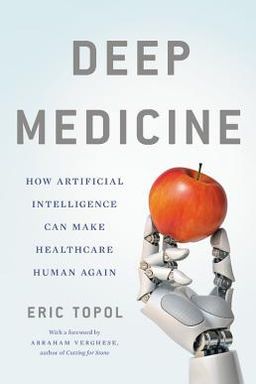
Deep Medicine cover

Deep Medicine

by Eric Topol

Deep Medicine delves into the transformative potential of AI in healthcare, aiming to mend the human connection lost in modern medical practices. Eric Topol explores AI''s ability to enhance diagnostics, personalize treatments, and empower clinicians to offer more empathetic care, ultimately redefining the patient experience.

Deep Medicine: The Union of Data, AI, and Humanity

How can medicine regain its soul in the age of machines? In Deep Medicine, Eric Topol argues that artificial intelligence, when properly designed and governed, can restore the empathy and attention that modern healthcare has lost. The book’s central thesis is that medicine has become shallow—rushed, transactional, and depersonalized—but AI provides the means to make it deep again. Deep Medicine, as Topol defines it, depends on the integration of three elements: deep phenotyping (rich, individualized data), deep learning (pattern-recognition AI), and deep empathy (the human connection that technology should enhance, not replace).

From Shallow to Deep

You begin with the state of “shallow medicine.” Clinicians race through seven-minute visits, technicians fill forms, and electronic health records (EHRs) reduce the doctor–patient dialogue to screen-staring. Despite the U.S. spending over $3.5 trillion yearly, outcomes—life expectancy, maternal mortality—trail peers. Diagnostic errors affect millions; overdiagnosis from screenings—PSA tests, mammograms, thyroid scans—harms countless more. Topol shows how incentives, billing-driven EHRs, and fragmented data cause widespread clinician burnout and poorer care. Medicine, he says, has lost the art of seeing the person behind the patient.

The Deep Medicine Framework

Deep Medicine reimagines this reality by tying together three concepts. Deep phenotyping creates a layered digital twin of you—genomic, physiologic, and environmental data that define your unique biology and context. Deep learning applies machine vision and neural networks to pattern-rich domains such as imaging, signals, and molecular data. Deep empathy restores human presence in the clinic by delegating rote data work to machines, freeing clinicians to listen and connect.

Topol’s stories make this real. A newborn with intractable seizures at Rady Children’s Hospital was saved when rapid genome sequencing revealed an ALDH7A1 mutation responsive to vitamin B6. In cardiology, devices like AliveCor detect arrhythmias and even serum potassium levels from ECGs—patterns invisible to human eyes but learnable by AI. Yet in each case, the outcome depends on clinicians who interpret and act compassionately on machine insights.

AI’s Promise and Pitfalls

Topol’s optimism is tempered by realism. Deep neural networks succeed astonishingly well in domains like radiology, dermatology, and pathology, but they bring “deep liabilities”: black-box opacity, training-data bias, and privacy risk. Algorithms trained primarily on light-skinned images fail darker-skinned patients; genomic risk models built on European data miss non-European populations. Cambridge Analytica and DeepMind controversies underscore the misuse potential of health data. Thus, transparency, fairness, and explicit patient consent become ethical imperatives.

Beyond Gadgets to System Change

Deep Medicine is not about gadgets but about redesigning systems. In hospitals, AI predicts patient deterioration, optimizes scheduling, and reduces administrative cost. At the system level, networks like Tempus build cancer-data ecosystems—sequencing tumors, linking outcomes, and finding “digital twins.” In global contexts, countries diverge: China’s scale and lax privacy laws accelerate deployment, while Western democracies struggle with regulation and ethics. The challenge, Topol insists, is not technical but political—who owns and benefits from medical data.

From Predictive to Compassionate Medicine

Topol’s final message returns to humanity. AI must produce the gift of time. A machine that handles transcription, scheduling, or scan triage should give doctors back presence—the ability to truly see and hear patients. Drawing on Abraham Verghese and Rita Charon’s “narrative medicine,” Topol shows that empathy and listening measurably improve adherence, satisfaction, and even recovery. The promise of Deep Medicine is not machine dominance but human restoration. As he writes, the ultimate measure of intelligence—artificial or human—is the creation of more compassionate care.

Core idea

Deep Medicine unites data, algorithms, and empathy to transcend the shallowness of modern healthcare—machines for analysis, humans for care.

When you accept this framework, your expectations shift. You demand richer data and smarter tools but insist they serve the human relationship at the heart of healing. Deep Medicine, then, is a manifesto for redesigning medicine so AI elevates—rather than erases—the art of caring.


Deep Learning and the New Pattern Recognition

Deep learning—the backbone of AI’s medical revolution—is simply machines learning patterns at superhuman scale. Neural networks ingest images, text, and signals, automatically discovering features that humans cannot explicitly code. This capacity has already produced breakthroughs across radiology, pathology, and cardiology, fields built on pattern recognition.

How Deep Learning Works

You can picture a neural network as a multilayered filter: early layers detect edges, mid-layers discern shapes, deeper layers understand objects or pathologies. Training depends on massive labeled datasets and computational power—an era defined by ImageNet (15 million annotated images) and the surge in GPU-driven computation. The principle is simple: more data and compute yield better models, provided the data are clean and representative.

AliveCor offers a compelling medical case study. Seeking to predict both atrial fibrillation and serum potassium from ECGs, the company’s early model failed because of biased, filtered datasets. Only when researchers included raw, unfiltered hospital data—2.8 million ECGs and 4.28 million potassium values—did the AUC jump from 0.63 to 0.86. The lesson: real-world data diversity matters more than fancy algorithms.

Pattern Specialties

Deep learning’s first major impact lands in “pattern specialties.” Radiologists interpret millions of scans each year—over 800 million globally—while pathologists review countless tissue slides. Machines can assist by triaging, detecting anomalies, and measuring precisely. Google’s Camelyon project reached 92% AUC in metastasis detection on digital slides, outperforming averages of pathologists; Moorfields Eye Hospital and DeepMind achieved 0.992 AUC in retinal triage. The Stanford dermatology network equaled or exceeded 20 dermatologists in skin-cancer classification.

Topol stresses partnership. When Geoffrey Hinton suggested stopping the training of radiologists, Topol countered: radiologists who integrate AI will thrive as interpreters and communicators. Machines handle the deluge of images; humans decide meaning and next steps. The new radiologist is more clinician than technician.

Clinicians Without Patterns

Outside imaging, most clinicians manage integration, not visual data. Here, AI augments rather than replaces: voice assistants transcribe encounters; digital scribes summarize notes; and Augmented Individualized Medical Support (AIMS) systems aggregate EHR, sensor, and genomic data to guide decisions. Tools like Augmedix, Saykara, and Suki demonstrate that NLP can reclaim hours per day from documentation, returning focus to patients.

In sum, deep learning converts chaos into clarity—but its greatest contribution may not be accuracy alone. As systems mature, pattern recognition becomes a quiet ally, letting clinicians practice presence while machines handle perception.


AI Across the Clinical and System Spectrum

Artificial intelligence is already reshaping hospitals and health systems. Beyond the clinic, it predicts deterioration, reduces errors, and optimizes resource use. Yet these improvements only matter when paired with ethical frameworks that value patients over profits.

Prediction in Hospitals

Hospital decisions hinge on timing—when to discharge, escalate, or palliate care. Google’s models trained on 216,000 hospitalizations and 47 billion data points predicted mortality and readmissions with impressive accuracy. Similar deep networks forecast in-hospital death, kidney injury, or bleeding complications. But Topol cautions: predictive accuracy is not wisdom. A system can predict imminent death correctly and still fail the moral test of how to care for those remaining days.

Studies show mixed results across targets. AI detects C. difficile infections (AUC ~0.82) effectively but struggles with early sepsis (AUC ~0.70). Retrospective validations dominate; prospective proof is rare. The core lesson: algorithms travel poorly between hospitals. Each must be retrained, audited, and integrated into human workflows with transparency and accountability.

From Workflow to Virtual Care

AI’s reach extends to administration and operations. With administrative costs near 20% of U.S. healthcare spending, automation—coding, claims, scheduling—offers huge savings. Qventus and Accolade use predictive analytics to optimize staffing and patient flow. Machine vision monitors ICU safety, quantifies radiotherapy planning, and enforces hand hygiene. At St. Louis’s Mercy Virtual Care Center, clinicians watch patients remotely around the clock. Instead of erasing human contact, virtual models increased perceived care through frequent, thoughtful video check-ins.

Expanding such models depends on reimbursement and regulation; without them, innovation stalls. Topol notes that FDA approvals for home-based AI devices lag behind capability, and insurers rarely compensate remote monitoring. The goal is not fewer doctors but empowered teams—nurses, NPs, and assistants—supported by smart systems that elevate efficiency and compassion.

System-Level Coordination

At the macro level, AI redefines data infrastructure. Companies like Tempus create cancer ecosystems tying sequencing, molecular profiles, and therapies to real outcomes. In contrast, IBM Watson’s hyped oncology projects faltered due to poor data quality and overpromising (“ingesting” millions of documents did not yield good judgment). Topol’s analysis is blunt: only transparent, clinically validated models integrated with human insight can achieve durable health gains.

Across these levels—from bedside to global policy—AI’s potential reflects the same truth: systems that embed empathy and clinician control thrive. Those built purely for efficiency risk repeating medicine’s shallow mistakes on a digital scale.


Deep Discovery: Biology and the Data of Life

Deep learning’s power shines brightest in biology’s most complex datasets—genomics, proteomics, epigenomics, and the microbiome. Here, AI acts as explorer, uncovering patterns buried in petabytes of molecular data and helping scientists infer meaning from vast biological systems.

AI for Genomics and Omics

The human genome contains three billion bases, but interpretation—not sequencing—is the bottleneck. Projects like DeepSEA model noncoding DNA to predict gene regulation, while Google’s DeepVariant uses convolutional networks to call genomic variants, outperforming traditional methods. In cancer, deep-learning classifiers built on methylation profiles have redefined tumor taxonomy: David Capper’s team reclassified brain tumors into 82 molecularly distinct groups with 93% accuracy, outperforming human histopathology.

These breakthroughs promise personalized oncology but also expose challenges: non‑white populations remain underrepresented, and interpretation remains probabilistic. Topol’s refrain—validation before hype—applies especially to omics research, where small analytic biases can misdirect entire fields.

Drug Discovery: Searching the Chemical Galaxy

Drug development, once constrained by trial-and-error wet labs, now leverages generative modeling and robotic automation. Companies like Exscientia, Insilico Medicine, BenevolentAI, and Atomwise explore billions of compounds algorithmically. Insilico combined generative adversarial networks with medicinal constraints to design novel molecules free of patent conflicts; BenevolentAI trained networks to predict plausible synthesis routes that fooled expert chemists into thinking they were human-designed.

Automation complements design: Recursion Pharmaceuticals screens compounds by imaging phenotypic changes in cells, while Cronin’s robotic chemist autonomously seeks new reactions. The ATOM consortium compresses the drug-development timeline from years to months using integrated computation and high-throughput synthesis. The frontier is not speed alone but safety—training AI to avoid off-target toxicity before humans ever touch a molecule.

Personalized Nutrition and Microbiome Insights

Eran Segal and Eran Elinav’s Weizmann Institute study illustrates AI’s individualizing power beyond disease. By monitoring glucose responses from 800 people across 47,000 meals, they found enormous interindividual variability linked partly to gut microbes. Machine-learning models predicted personal glycemic responses from microbiome composition, outperforming calorie-based norms. Commercial spinoffs like DayTwo turned this into microbiome-based diet plans promising better control and satisfaction. The idea remains compelling but preliminary—Topol reminds you to demand randomized clinical outcomes before adopting predictive diets as genuine therapy.

This integration—genomics to microbiome to metabolome—encapsulates the “deep phenotyping” ideal: capturing your unique biology dynamically to guide prevention and therapy.


The Digital Mind and Behavioral Health

Mental health represents one of AI’s most humane opportunities and thorniest dilemmas. With worldwide shortages of therapists, digital phenotyping promises continuous, objective insight into mental states—if handled ethically and sensitively.

Digitizing the Mind

Traditional psychiatry depends on episodic, self-reported interviews. AI can instead analyze speech tone, typing cadence, GPS patterns, and social-media behavior to detect subtle mood changes. Tom Insel’s concept of “digital phenotyping” captures this shift—behavioral signals as biomarkers. Mindstrong correlates phone-typing dynamics with depression scores; Reece and Danforth’s Instagram study inferred depression from photo color and brightness long before diagnosis. These methods move from episodic snapshots to continuous behavioral monitoring.

Therapeutic Avatars and Chatbots

Jonathan Gratch’s “Ellie” avatar demonstrated that people often open up more to a virtual listener than to a therapist. Chatbots like Woebot, Wysa, and X2AI provide 24/7, stigma-free conversational support. In a randomized trial, Woebot’s brief CBT sessions improved symptoms among college students. These tools can’t replace therapists, but they may serve as triage or between-session support, extending the reach of care.

Ethical Frontiers

The potential for early suicide prediction excites and alarms: Vanderbilt analysts predicted suicide attempts months in advance with 80% accuracy, but even a small false-positive rate has grave consequences. Privacy breaches are worse here than anywhere—voice, sentiment, and movement data expose fragile human realities. Topol warns that in mental health, how you use data matters as much as accuracy itself.

If done responsibly—with opt-in consent, transparent algorithms, and clinical oversight—digital tools could democratize access to mental health support. If done recklessly, they could magnify stigma, surveillance, and exploitation. The moral burden matches the technical challenge.


Deep Empathy and the Future of Human Care

The culmination of Topol’s argument is not a victory of machines but the revival of human care. Deep empathy—the ability to attend, listen, and connect—becomes medicine’s new currency. The gift of AI should be time and presence, not displacement.

The Gift of Time

Automation can return minutes to clinicians—and minutes matter. Research shows that each extra minute in a home-health visit reduces readmission risk by 8%. Freeing clinicians from EHR typing and administrative chores may produce the most significant improvement in outcomes of all. Studies by the Institute for Public Policy Research estimate potential 25% time gains if AI and automation are carefully implemented. But time is useless if it’s not reinvested in empathy.

From Presence to Purpose

Medicine benefits when clinicians reclaim the physical examination and the act of listening. Narrative medicine (Rita Charon) and the concept of presence (Abraham Verghese) reconnect care to meaning. Art museum–based training programs even boost diagnostic observation, symptomatic of what Deep Medicine seeks: the merger of scientific precision with human attention.

Medical education, Topol insists, must evolve in parallel. Curricula overvalue quant scores and undervalue emotional intelligence. Training for “webside” manner, data literacy, and humility around AI interpretation will define tomorrow’s healer. Selection for compassion—not just cognitive mastery—is the reform he envisions for admissions committees and health systems alike.

Ethics and Data Ownership

Empathy extends to respecting patient autonomy. The future of virtual medical assistants and voice-enabled monitoring hinges on data rights: who owns, controls, and profits from your health data? Estonia’s citizen-led model offers one answer; U.S. fragmentation offers caution. Without rigorous privacy frameworks, even benevolent AI can become exploitative. Topol calls for patient data sovereignty as the moral prerequisite for a humane digital medicine.

Final thought

Deep empathy, not deep learning, is the ultimate frontier. AI’s value will be judged not by its accuracy but by how much more human it allows medicine to become.

In the end, Deep Medicine is less about algorithms than alignment: aligning technology, ethics, and emotion into a care model worthy of human dignity. The future of medicine is not artificial—it’s deeply, deliberately human.

Dig Deeper

Get personalized prompts to apply these lessons to your life and deepen your understanding.

Go Deeper

Get the Full Experience

Download Insight Books for AI-powered reflections, quizzes, and more.