
Idea 1
The Practice of Deep Creativity
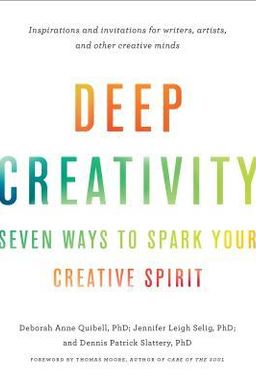
What does it mean to create deeply in a culture obsessed with speed, output, and visibility? Deep Creativity by Deborah Quibell, Jennifer Selig, and Dennis Slattery answers this with a framework that merges depth psychology, mythic imagination, and embodied ritual. The book calls for a shift from surface productivity (“water-strider creativity”) to vertical making (“dolphin creativity”)—a plunge into the unconscious, the archetypal, and the soulful.
The authors define deep creativity as “an idiosyncratic, archetypal, alchemical, receptive, and participatory way of making that pays attention to soul, to the unconscious, and to the reciprocity between you and the world.” Across their seven central themes—Love, Nature, Muse, Suffering, Practice, Sacred, and Art—they offer essays, dialogues, and meditative practices that form both an inner discipline and a moral stance toward creation.
The Architecture of Soulful Making
At its core, the framework insists that creativity is a relational act. Instead of treating the artist as an autonomous genius, the book envisions creation as a partnership between self and world, psyche and image, idea and embodiment. Deborah’s snow-gasp poem, Jennifer’s candle ritual, and Dennis’s 4 a.m. journaling sessions model how showing up, paying attention, and allowing inspiration to surprise you create a rhythm between inner and outer worlds.
The guiding metaphor of depth—diving instead of skimming—echoes Jung’s “spirit of the depths.” To create deeply, you must descend into the terrain of symbol, myth, and feeling. This descent is not purely mystical; it has pragmatic expression through the Fifteen Principles the authors outline: be idiosyncratic (trust your oddities), archetypal (recognize mythic patterns), alchemical (transform lead into gold), participatory (co-create with the world), and ensouled (honor both matter and meaning). These traits mark the texture of deep creative life.
Love, Nature, and the Muse as Gateways
Each thematic “way” explores a facet of creative intimacy. Love is treated not as sentiment but as radical attention—the “gasp” of noticing something so fully that it reshapes you. Nature becomes teacher and collaborator, reminding you that art arises from sensory relation. The Muse, personified or abstract, invites a disciplined hospitality: you set rituals, altars, and times for her arrival. These relationships cultivate patience and receptivity, antidotes to creative haste.
Jennifer’s use of mentor “Fish” and Deborah’s conversations with the Creative Impulse teach that the muse is not a predictable force but a guest who stays when treated respectfully. Rituals—lighting candles, keeping altars, walking in silence—anchor this relationship into daily life. (Note: The book’s conversational structure, with essays by three voices, performs this dialogue among muses itself.)
Suffering, Alchemy, and Healing
A major contribution of the book is its mature reframing of suffering. Drawing from Jung, St. John of the Cross, and Hafiz, the authors describe the “nigredo”—the blackening or dark night—as the necessary crucible for transformation. Dennis distinguishes pain (physical) from suffering (existential), showing how artworks like The Things They Carried or Ken Dornstein’s essays exemplify pathei-mathos—learning through suffering. Deborah’s “soul-bird” metaphor explains how rupture becomes an aperture for new creation if you can bear to stay with it.
In contrast to toxic positivity, the authors argue that expression, not avoidance, restores wholeness. David Vann’s fiction and Mary Oliver’s poetry illuminate two modes: exorcism (releasing demons through symbolic reversal) and salvation (making beauty into sanctuary). Creation reorders chaos; it alchemizes inner lead into communicable gold.
Practice, Reciprocity, and the Sacred Ordinary
To live this way, you must ritualize creativity. Dennis’s 4:00 a.m. sessions, Deborah’s “Humble Nod,” and Jennifer’s “Code of No” form a suite of pragmatic guides for the conditions of inspiration. The text’s recurring lesson: discipline is devotion, not drudgery. Routines—writing one page, walking slowly, checking your senses—lay tracks for the mysterious to find you. Jennifer emphasizes managing both drought and flood through simple systems: prioritization, deadlines, and mindful “no’s” that protect creative space.
The sacred dimension emerges naturally: art itself becomes a sacrament. When you write, paint, or photograph with reverence, you consecrate attention. “The world is our cloister,” Joanna Macy writes, quoted here as a manifesto for turning everyday acts—cooking, teaching, observing—into liturgy. In this light, deep creativity is not a weekend retreat activity but a lifelong spiritual practice of noticing and offering.
Integration Through Principles and Practices
The closing sections synthesize the journey into fifteen orienting principles paired with exercises: Personify the Impulse (when uninspired), Code of No (when overwhelmed), Return, Restore, Repair (when haunted by loss), and Ekphrastic Practice (when you need external conversation). These principles form a dynamic map, not a rulebook. Like a dialogue between the rational and the imaginative, they urge you to balance your creative ecology.
The essence
Deep creativity is not about producing more, but about producing with more soul. When you move slowly, attend lovingly, and let the unconscious speak, you discover that art is less what you make than what is made through you.
In the end, the book is both a philosophy and a set of instructions. It teaches you to approach creation as love-in-action, to mine suffering for meaning, to partner with muse and nature, and to restore the sacred to ordinary life. Its great lesson: creativity is not a lifestyle brand but a way of being fully alive.