
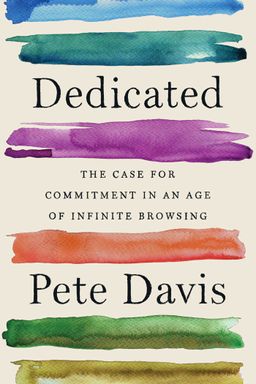
Dedicated cover

Dedicated

by Pete Davis

In ''Dedicated,'' Pete Davis argues that in today''s world of endless options, true fulfillment comes from commitment. Drawing on his Harvard Law School speech, Davis explores how dedication can overcome the superficiality of modern life, providing depth and meaning. This book is a guide to becoming a ''long-haul hero,'' transforming everyday decisions into profound, life-changing commitments.

Choosing Commitment in an Age of Infinite Browsing

Have you ever found yourself endlessly scrolling through Netflix, unable to decide what to watch, and finally giving up? Pete Davis opens Dedicated: The Case for Commitment in an Age of Infinite Browsing with that familiar, late-night scene—not because it’s about entertainment, but because it perfectly captures the mental state of modern life. He argues that many of us today live in what he calls “Infinite Browsing Mode,” a state of perpetual indecision and option-keeping, where we hesitate to commit—to careers, relationships, communities, or causes—out of fear of missing out on something better.

Davis contends that this cultural mindset of keeping our options open has become more than a harmless behavior; it's now a defining trait of contemporary society. We live in what sociologist Zygmunt Bauman describes as liquid modernity—a world so flexible and fast-changing that everything seems temporary and nothing feels safe to latch onto. Davis suggests that while flexibility, choice, and independence sound empowering, they come with enormous costs: paralysis, isolation, and shallowness. We have become experts at starting things, browsing possibilities, and moving on—but amateurs at sticking with anything long enough to build real depth or meaning.

The Core Argument: We Need a Counterculture of Commitment

In response, Davis calls for a radical shift—a return to what he calls the Counterculture of Commitment. This counterculture celebrates the people who “click out” of Infinite Browsing Mode by choosing particular communities, crafts, and causes, and sticking with them for the long haul. Think of icons like Fred Rogers recording nearly 900 episodes of his neighborhood show, Dorothy Day serving the same outcast folks night after night, or Martin Luther King Jr. hosting his thousandth planning meeting when the cameras weren’t rolling. For Davis, these heroes represent courage not in grand, cinematic gestures but in sustained dedication—the slow, steady labor of care, creation, and cultivation.

He argues that changing ourselves—and even changing the world—requires heroic patience. Real transformation doesn’t happen through one decisive act of bravery; it happens through the thousand small, steady acts that follow. If Hollywood celebrates the “dragon slayers,” Davis invites us to admire the “gardeners”—those who fight boredom, distraction, and doubt every day in service of something they love.

Understanding the Tension: Open Options vs. Dedication

The book’s first half examines the tension between two competing cultures: the Culture of Open Options and the Counterculture of Commitment. The former champions freedom, flexibility, and autonomy—the ability to quit, move, and start over. The latter prizes depth, fidelity, and service—the courage to stay put, nurture relationships, and build something enduring. This tension plays out in nearly every area of modern life: dating apps that encourage endless swiping, workplaces that promote job-hopping, and digital feeds that bombard us with new ideas, leaving us too scattered to invest deeply in any.

Davis doesn’t dismiss browsing outright. In fact, he spends early chapters giving browsing its due. Exploration allows us to shed inherited identities, pursue authenticity, and enjoy novelty. But when browsing becomes our default mode, it hollow-outs meaning. We end up paralyzed by too many choices, disconnected from communities, and stuck in shallow experiences. Only by committing—by closing some doors voluntarily—can we rediscover belonging and substance.

Why This Matters Today

In Davis’s view, our inability to commit isn’t just a personal issue; it’s a societal crisis. We face massive problems—climate change, inequality, institutional decay—that demand long-haul dedication. Yet our culture trains us to keep our options open rather than to devote ourselves. Davis warns that when we collectively fail to commit, communities wither, institutions collapse, and superficial politics replace real reform. The antidote isn’t nostalgia for old, rigid hierarchies, nor zealotry that demands blind devotion—it’s voluntary commitment: freely choosing to invest sustained energy into particular relationships, projects, and places.

The Journey Through the Book

Across its three parts, Dedicated unfolds like a guided expedition from uncertainty to solidity. In Part I, Davis explores Infinite Browsing Mode—its pleasures, pains, and its historical roots in liberation from old constraints. In Part II, he introduces the Counterculture of Commitment, profiling people of long-haul heroism: citizens, patriots, builders, stewards, artisans, and companions who demonstrate the many forms commitment can take. In Part III, he expands the lens from individuals to systems, showing how our economy, morality, and education all prioritize advancement and neutrality over attachment and honor—and how we might rebuild a culture that teaches loyalty, responsibility, and craft.

Why Davis’s Message Resonates

Ultimately, Davis invites you to reflect on your own life: Which “hallway” are you wandering? Which “rooms” might you choose to enter and remain in? His message is simultaneously a warning and a hope—that while Infinite Browsing may promise freedom, true peace and joy come from dedication. Commitment, he reminds us, turns fleeting experience into legacy, transforms the ordinary into sacred, and replaces indecision with belonging. In a world obsessed with staccato signals of endless information, Davis’s call to click out of the hallway, shut some doors behind us, and plant roots feels both radical and timeless.


The Pleasures and Pains of Infinite Browsing

Pete Davis begins his argument by acknowledging that browsing feels good at first. In our late teens and twenties, we relish the freedom of moving from one experience to the next: new relationships, new cities, new ideas. Browsing lets us escape inherited roles and limitations—it’s the exuberant phase of trying things on. Davis connects this to Thomas Merton’s concept of the “false self,” noting that browsing helps us shed identities shaped by external expectations and discover what’s authentic within us.

Flexibility and Authenticity

Flexibility is the first pleasure of browsing. You can leave a job, a town, or a relationship whenever it stops serving you. For Davis, this liberty feels intoxicating when we first step into adulthood—after being confined for years by school, family, or tradition. He compares this experience to stepping into a hallway full of doors: an open corridor of endless opportunity. It’s thrilling, yet also fleeting. Flexibility helps us experiment and figure out what fits, but it can also train us to always be half-present, never fully rooted.

Authenticity, the second pleasure, arises when browsing helps us differentiate our true selves from imposed identities. Davis uses college freshmen realizing they don’t enjoy their high school passions as an example. Like Merton’s false self, these inherited commitments can collapse once stripped of external validation, leaving room for genuine self-definition. But without deeper commitments to replace them, authenticity becomes a revolving door of identities, lacking grounding and context.

Novelty and the Thrill of Firsts

The third pleasure is novelty—the endless stream of “firsts” that makes youth exhilarating. From first loves to first failures, browsing immerses us in fresh experience. Davis connects this to the internet’s constant feed of newness, where privilege and technology explode the possibilities of discovery. Yet he warns that novelty, when unanchored, can become addictive. With every scroll, we mistake stimulation for meaning. As psychologist Barry Schwartz argues in The Paradox of Choice, too many options ultimately produce dissatisfaction rather than joy.

Paralysis, Anomie, and Shallow Living

Eventually, the pleasures sour. Flexibility yields paralysis—too many choices erode confidence and satisfaction. Authenticity without structure collapses into isolation, or as sociologist Émile Durkheim described, anomie: the despair that comes from lacking communal norms. Novelty tumbles into shallowness—disconnected bursts of stimulus replacing lasting connection. Davis quotes Maria Montessori and William James to show how sustained attention is a fundamental human need; cultivating it gives life coherence and identity.

To counter these malaise conditions, Davis draws inspiration from slow movements—like Carlo Petrini’s Slow Food revolution—that challenge speed and superficiality. Acting “slowly,” Davis insists, forces us to confront discomfort and rediscover depth. He urges balance, echoing Aristotle’s virtue ethics: courage, wit, friendship—all thrive between extremes. Similarly, the balance between browsing and dedication lies not in drifting endlessly nor locking oneself behind closed doors, but in freely choosing the rooms worth staying in.

The Invitation to Slow Down

Davis’s diagnosis of Infinite Browsing Mode isn’t cynical—it’s compassionate. He understands the allure of flexibility, the need for authenticity, and the excitement of novelty. But he believes real joy—what philosopher Jack Gilbert called “the beauty that is of many days”—comes from the ordinary excellence of long commitment. It’s the Tuesday dinners with lifelong friends, the steady craft honed over years, the cause that survives storms of attention. If Infinite Browsing is the hallway of possibility, Davis’s solution is simple yet profound: pick a damn room, close the door behind you, and discover the richness that only staying can bring.


Long-Haul Heroism: Redefining Courage

When we think of courage, we often picture grand acts—soldiers on battlefields, protesters facing fire hoses. Pete Davis redefines heroism entirely. True courage, he argues, lies not in dramatic moments but in sustained dedication. His concept of long-haul heroism elevates ordinary persistence: the slow labor of gardeners, teachers, activists, and neighbors who build meaning over decades. These are the heroes of the Counterculture of Commitment.

From Dragon-Slaying to Gardening

Davis contrasts Hollywood “dragon-slayers” with real-world “gardeners.” The former face decisive moments; the latter nurture causes over years. He uses the abolitionists celebrating the 1863 Emancipation Proclamation—people like Frederick Douglass, Harriet Beecher Stowe, and William Lloyd Garrison—as examples. Their victory came not from one heroic protest but from decades of organizing, pamphlets, letters, and meetings. As Davis quotes journalist Jacob Riis, every hammer strike matters: “It was not the last blow that split the rock, but all that had gone before.”

Everyday Dragons

Our dragons today aren’t tyrants—they’re boredom, distraction, and doubt. They threaten long-term focus more than physical safety. To slay these dragons, Davis shows how long-haul heroes like Rosa Parks or Nina Otero-Warren embraced routine and repetition. Parks didn’t transform civil rights through one bus ride alone; she had already spent a decade doing community organizing before that moment. Her heroism was cumulative, not sudden.

The Power of Steady Work

Long-haul heroism thrives in slow work—what Davis calls “spadework.” Ella Baker’s phrase “It’s a part of the spade work, so let it be,” captures this perfectly. Davis presents change-makers like Jimmy Carter eradicating Guinea worm disease through forty years of advocacy, and activists such as Ida B. Wells documenting lynchings for decades before Congress acted. Each demonstrates how dedication transforms despair into progress. Heroism isn’t a burst of passion; it’s endurance.

He also argues that persistence isn’t glamorous but essential. As sociologist Max Weber described politics, it's “the slow boring of hard boards.” Commitment means accepting frustration, small victories, and monotony as part of meaningful work. It’s the humility to believe that world-changing progress—whether scientific or social—arises not from genius moments but from the gradual accumulation of human effort.

A Lesson for You

When you face the temptation to quit—whether from boredom, burnout, or impatience—remember Davis’s refrain: change takes time, and meaning emerges through sustained involvement. Heroism isn’t measured in applause but in repetition. It’s the teacher showing up every morning, the activist attending the thousandth meeting, the parent who keeps showing love despite exhaustion. In a world that rewards novelty and performance, Davis’s long-haul heroes remind us that the most courageous thing we can do is simply to stay.


The Counterculture of Commitment

If the modern world celebrates flexibility, Pete Davis celebrates loyalty—to places, crafts, and people. His Counterculture of Commitment is a diverse tribe of citizens, patriots, builders, stewards, artisans, and companions who model how dedication can take many forms. Each represents a different way of saying: I’m staying in this room, and I’m here for the long haul.

Citizens and Patriots

Citizens dedicate themselves to causes greater than themselves—like Evan Wolfson, who spent thirty-two years championing marriage equality from obscure law school paper to Supreme Court victory. This is civic commitment in action: patient advocacy, public trust, and steady belief in progress. Patriots, by contrast, commit to particular places and communities. Davis invokes Wendell Berry, the Kentucky writer-farmer, who celebrates staying put and caring for one’s local soil. For Berry, leaving is easy; nurturing place is holy. Patriotism, Davis clarifies, isn’t nationalism—it’s devoted localism, love for the people and land right in front of you.

Builders and Stewards

Builders create new institutions or projects that embody values of attentiveness and care. Davis tells the story of Irene Li’s Mei Mei restaurant in Boston, where commitment means hospitality, sustainability, and staff empowerment. Her consistency—every dish prepared with thought—turns daily labor into moral practice. Stewards, meanwhile, preserve what already exists. Rabbi Amy Schwartzman’s three decades at her synagogue embody this: tending ritual, mentoring youth, and transmitting traditions generation after generation. Stewardship, Davis writes, is “active care”—improving what’s inherited while keeping it alive.

Artisans and Companions

Artisans represent devotion to craft. Harmonica player Mickey Raphael’s decades with Willie Nelson illustrate how art and loyalty intertwine. Like writers or teachers who refine their abilities through repetition, artisans embody patience—a resistance to the instant gratification of digital creation. Companions, finally, show the deepest form of commitment: human care. Teachers, mentors, and friends make time for others—and through sustained presence, they transform lives. Davis highlights mentors like Ernest Clover’s DC Dream Center, where genuine relationships, not charisma, model compassion that lasts.

This mosaic of roles mirrors Wendell Berry’s metaphor of the bucket: communities accumulate memories, stories, and wisdom, becoming fertile soil for future generations. Each dedicated person fills that bucket further. Whether it’s Dave Eckert preserving streams, a teacher guiding students, or a musician refining tones, commitment cultivates culture itself.

Becoming Part of the Counterculture

You don’t need fame or fortune to join. Dedication begins small—with volunteer work, local activism, teaching, or simply tending to loved ones. Davis insists that collective transformation demands millions of quiet commitments. As historian Joséf Tischner put it, “From those trees grows a forest.” The Counterculture of Commitment isn’t nostalgia—it’s renewal. Its members plant seeds of stability in a liquid world, proving that staying is a revolutionary act.


The Fears That Keep Us Stuck

Pete Davis identifies three fears that keep us wandering the hallway of Infinite Browsing Mode: the fear of regret, the fear of association, and the fear of missing out. Each is psychological, moral, and spiritual. Each explains why we love the idea of commitment but hesitate to make one. Understanding these fears helps you move from indecision to dedication.

Fear of Regret

We worry that choosing one path means abandoning all others and that someday we’ll wish we’d chosen differently. Davis reframes decision-making as an act of courage rather than perfection. He encourages lowering the stakes: commitments are living relationships, not permanent handcuffs. Like Baltimore craftsman Max Pollock, who quit law school to salvage bricks, we can stop overthinking and just start. Once we act, “the net appears,” as John Burroughs wrote. Every commitment begins as a leap of faith—but the leap transforms us into someone capable of belonging.

Fear of Association

This fear stems from anxiety about identity, reputation, and control. Committing to something—or someone—means risking change and vulnerability. Davis cites philosopher Jean-Paul Sartre’s line “Hell is other people” to illustrate how judgment threatens autonomy. Yet the solution isn’t isolation; it’s community. Through association, we discover embedded identity—who we are becomes inseparable from what and whom we love. Sociologist Émile Durkheim and theologian Thomas Merton alike recognized that self-understanding flourishes only in relationship. Davis argues that commitment actually creates identity; by investing deeply, we find coherence, reputation, and belonging.

Fear of Missing Out

Finally comes the fear of missing experiences. We dread boredom and monotony, imagining excitement just outside our current choice. Davis reveals that FOMO’s opposite isn’t denial but joyful depth—the richness that emerges when you slow down. He tells stories of artisans, parents, and teachers whose repetitive work brings transcendence. Depth, he writes, is the ultimate novelty. Like Ken Burns discovering meaning through sustained film editing, long-term dedication converts repetition into revelation. Once we dive fully into a commitment, the anxious question “What if there’s something better out there?” fades—because there’s something great right here.

From Fear to Freedom

Together, these fears maintain our hallway paralysis. But Davis insists that commitment is liberation, not confinement. When we attach ourselves to causes and communities, we gain purpose, solidarity, and peace. Like Karen Washington turning a garbage lot into the Garden of Happiness, you can transform fear into creation. The antidote to missing out, associating badly, or choosing wrong isn’t avoidance—it’s faith in growth. Commitments don’t close your world; they make it real.


Commitment as World Repair

Pete Davis extends his call from personal commitment to collective renewal. In Part III of Dedicated, he shows how the Culture of Open Options infects not only individuals but systems—our economy, ethics, and education—and how reintroducing commitment could heal them. The ultimate vision is civic reforestation: a world of solid people in a liquid age.

Economy: Reclaiming the Particular

In an era ruled by money, Davis laments that everything has become liquid. Financialization and commodification melt our loyalty to particular jobs, neighborhoods, and institutions. Businesses serve shareholders instead of workers or communities; cities lose character to chain stores. Davis draws on Michael Sandel’s and Michael Walzer’s works on market morality to argue that true justice is local and particular. To save our economy, we must revive attachment—small craftsmanship, community ownership, and stewardship of place—where love and skill outweigh efficiency.

Morality: From Indifference to Honor

Modern ethics have become “indifference cultures,” hesitant to judge moral failure. Davis calls for restoring honor cultures—where accountability and celebration coexist. He explains that healthy judgment, like a coach challenging a player or a counselor guiding a student, affirms shared values. Honor doesn’t mean moral superiority but collective responsibility. We need prophets, he argues—figures like Benjamin Lay, Ida B. Wells, and Mother Jones—who call us back to our principles with unapologetic moral clarity.

Education: Beyond Advancement to Attachment

Schools, Davis argues, increasingly train students for advancement—abstract skills and resume items—rather than attachment to crafts or communities. He proposes “attachment pedagogy,” inspired by religious educator Alfred North Whitehead and the Catholic Schoenstatt movement: learning as relationship, not transaction. Great teachers spark reverence for subjects and introduce students to mentors and heroes. Education, at its best, cultivates duty and love, teaching the art of settling into vocations and becoming professionals—members of communities of competence, not just careerists chasing prestige.

Reforesting the World

Davis ends with a metaphor of reforestation. Like Elzéard Bouffier in Jean Giono’s story The Man Who Planted Trees, each committed person plants seeds—projects, relationships, communities—that grow into forests of solidarity. When enough people commit, ecosystems of trust and meaning reemerge. Our task, Davis says, is to become gardeners of society: nurturing living commitments one seed at a time. In a world drowning in floods of choice and distraction, planting forests of dedication is how we become solid people again.

Dig Deeper

Get personalized prompts to apply these lessons to your life and deepen your understanding.

Go Deeper

Get the Full Experience

Download Insight Books for AI-powered reflections, quizzes, and more.