
Idea 1
Decisive Thinking in an Uncertain World
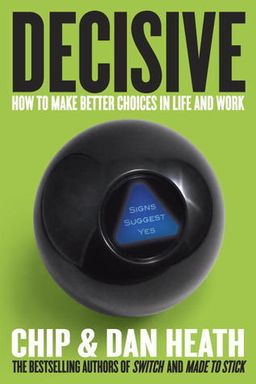
Why do smart people make poor choices? In Decisive, Chip and Dan Heath argue that our decision-making is routinely undermined by predictable mental traps—the authors call them the “four villains”: narrow framing, confirmation bias, short-term emotion, and overconfidence. Each villain represents a distortion in how we see and act on information, and together they shrink the spotlight of our attention so that we mistake a small circle of evidence for the full truth.
When Shannon faced whether to fire her IT director Clive, she instantly zeroed in on his flaws and skipped alternative explanations or creative fixes. That reflex—the spotlight effect—defines much of human decision error. Like psychologist Daniel Kahneman’s principle “What you see is all there is,” it means we confuse what’s in focus with what’s real. The Heaths’ solution is a counter-process called WRAP—a four-step framework to systematically widen our lens, test reality, gain distance, and prepare for uncertainty.
The Four Villains
Each villain is a habit of mind that leads us astray. Narrow framing turns complex situations into “whether or not” questions—firing Clive or keeping him—when the better question is “How could we improve this situation?” Confirmation bias makes us seek only those facts that affirm our preferred option (corporate executives “selling” their pet projects are classic examples). Short-term emotion clouds judgement with temporary excitement or fear, as when Andy Grove at Intel had to detach from sunk-cost obsession with memory chips. And overconfidence convinces us we can predict the future, despite experts themselves misjudging probabilities again and again (as Phil Tetlock’s research confirms).
The WRAP Framework
To combat each villain, the Heaths propose a practical discipline structured as WRAP: Widen your options (fight narrow framing), Reality-test your assumptions (disarm confirmation bias), Attain distance before deciding (dampen short-term emotion), and Prepare to be wrong (deflate overconfidence). These four moves transform decisions from impulsive one-offs into deliberate processes that generate learning as they unfold.
You can think of WRAP as shifting from “auto spotlight” to “manual spotlight.” Instead of staring only at what’s lit up first—your gut feel, your first option—you sweep the beam deliberately across the whole stage. Each step broadens your field of vision while preserving the energy of action.
Seeing the Whole Picture
The authors emphasize that WRAP does not guarantee perfect results. Life’s uncertainty makes prediction unreliable. What it does guarantee is better calibration—fewer unforced mistakes, more robust learning, and a higher ratio of “good outcomes.” You will recognize echoes of Kahneman’s Thinking, Fast and Slow and Dan Lovallo’s work on decision processes: intelligence helps little unless you redesign the way decisions are made.
The WRAP process is slow thinking made practical.<\/h4>
Instead of battling bias abstractly, you use tools—horse races, premortems, tripwires—that structure awareness into behavior.<\/p><\/blockquote>
Across the book, case studies—from Quaker Oats’ disastrous Snapple buy to Zappos’ tripwire hiring offers—show a consistent theme: wise decision-makers accept uncertainty but tame it by process. They widen choices, cross-check reality, cool emotions, and engineer safeguards. In doing so, they regain control of the spotlight and ensure their decisions serve not just the loudest impulse but their longest values.