
Idea 1
The Death of the Liberal Class
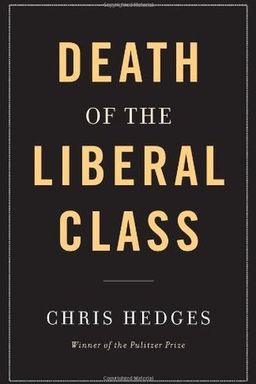
What happens when the institutions that once defended democracy join the forces eroding it? In The Death of the Liberal Class, Chris Hedges argues that the liberal establishment—journalists, academics, clergy, artists, and politicians—has surrendered moral authority by aligning with corporate and state power. Once mediators between the elite and the public, these institutions now function as apologists for the system they were meant to critique.
Hedges traces how the liberal class historically served as a safety valve: since the Enlightenment, figures like Locke and Mill framed liberalism as a way to moderate capitalism through reform and protect rights through reason. Through the Progressive Era and New Deal, teachers, clergy, journalists, and intellectuals channeled social anger into policy—labor laws, social programs, and civil rights improvements. They gave ordinary people both voice and the moral language of justice.
The Process of Assimilation
By the late twentieth century, that safety valve collapsed. The liberal class became reliant on corporate money and careerism. Universities turned into vocational training centers driven by grants and endowments; newsrooms optimized for access to advertisers; clergy replaced social critique with consumer spirituality. Hedges references the Lewis Powell memo (1971), which mapped out how corporations should fund think tanks, reshape universities, and flood media with market-friendly narratives. The plan worked. Corporate patronage reshaped the once independent institutions of social conscience.
Political examples reinforce this narrative. Bill Clinton’s signing of NAFTA, the repeal of Glass-Steagall, and Barack Obama’s continuation of war and healthcare concessions to private insurers exemplify liberal betrayal—language of compassion wrapped around policies of deregulation. The liberal class no longer defends working people; it manages them.
Cultural Consequences
This collapse ripples through culture. Art that once challenged power—seen in Hallie Flanagan’s Federal Theatre Project or Orson Welles’s radical plays—has been replaced by entertainment that flatters wealth. Universities retreat into jargon and textualism, trading moral engagement for linguistic virtuosity. Academic poststructuralism turns political economy into language games, disconnecting ideas from action. Similarly, media reduces dissent to spectacle, preserving “objectivity” as neutrality rather than truth-seeking. The moral passion necessary for reform withers under the pressure of professionalism.
The Moral Vacuum and Its Perils
When institutions cease to mediate suffering, grievance finds other outlets. Hedges recounts extreme examples: a veteran marching 90 miles with an “End the Fed” sign or Joe Stack flying a plane into an IRS building. These acts of despair arise from a vacuum left by a liberalism that no longer speaks for the disempowered. In historical context (as Hedges, Noam Chomsky, and Sheldon Wolin note), such vacuums breed reactionary demagogues who exploit fear—echoes of late Weimar, where disillusionment with liberal democracy paved the way for authoritarianism.
Core insight
When the liberal class trades truth for comfort, democracy loses its moral compass. The death of this class is not just institutional but cultural—an abdication that opens space for cynicism, radical inequality, and authoritarian revival.
Toward Renewal
The book ultimately asks you to reclaim moral clarity. That means acknowledging structural corporate power, defending dissent, and reviving class language that locates responsibility rather than appealing to empty technocracy. As Hedges puts it, reform begins not in courtiers of comfort but in local communities, independent art, and civil courage willing to speak truth even at personal cost.
Understanding the death of the liberal class helps you see why social anger increasingly bypasses liberal institutions. Only by rebuilding moral, civic, and cultural mechanisms of accountability can you hope to restore democracy’s ethical foundations.