
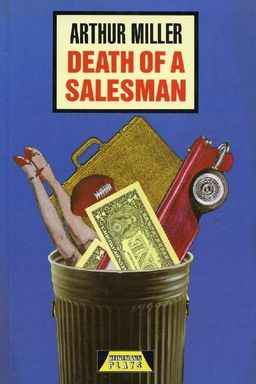
Death of a Salesman cover

Death of a Salesman

by Arthur Miller

Arthur Miller''s Death of a Salesman is a compelling exploration of the American Dream''s illusions and its tragic impact on Willy Loman and his family. This masterful play delves into themes of ambition, identity, and the dissonance between reality and aspiration.

The American Dream and the Tragic Illusion of Success

What happens when a person builds their entire identity on a dream that never comes true? In Death of a Salesman, Arthur Miller confronts one of the deepest myths of modern America: that success—measured in wealth, charm, and popularity—is the only path to meaning. Through the slow unraveling of Willy Loman, a traveling salesman in his sixties, Miller exposes the cost of chasing an illusion wrapped in hope, denial, and self-deception.

At its heart, the play asks whether the American Dream is a source of inspiration or destruction. Willy believes that being “well liked” guarantees prosperity and fulfillment. Yet his faith in this dream—one that equates charm and optimism with success—becomes a trap that suffocates not just him but his entire family. You begin to see how a culture so focused on achievement can rob people of connection and authenticity. Miller’s contention is devastatingly simple: identity built on false promises cannot survive contact with reality.

The Promise and Betrayal of the Dream

Willy’s tragedy unfolds against the backdrop of 20th‑century America, a society defined by endless optimism and faith in upward mobility. Born of immigrant hope and postwar expansion, the American Dream promised opportunity for anyone with ambition and charisma. But Miller positions Willy at the moment this dream turns toxic. His belief that success is purely personal—that failure must mean moral weakness—leads him to destroy himself while clinging to illusions of greatness.

Miller shows how this kind of faith becomes almost religious. Willy’s neighbor, Charley, tells him, “A salesman is got to dream.” It sums up not only Willy’s life but the ethos of his world: people must keep dreaming because reality offers no comfort. When the dream fails, they blame themselves, not the system. Willy stands as both victim and worshipper of that creed, chasing validation he’ll never earn.

A Man Lost in Time and Self

Miller builds the play around Willy’s mental collapse, a psychological time machine in which memory and present intertwine. Willy can’t distinguish between past triumphs and current failures. This fractured structure mirrors his internal chaos — his longing for youth, hope, and recognition. Memory doesn’t comfort him; it mocks him. Scenes shift fluidly as Willy relives moments of promise (his sons as adored high‑school athletes, his early career confidence) alongside reminders of ruin (job loss, infidelity, rejection).

This temporal layering—what Miller calls “social and psychic time”—serves a moral purpose. It forces viewers to recognize that success and failure are never isolated events; they echo through relationships, generations, and collective beliefs. Willy’s death becomes not just personal tragedy but cultural commentary. The salesman’s life, lived on charm and performance, turns out to be a stage act with no audience left to applaud.

The Family Prison

Willy’s obsession infects his household. Linda, his loyal wife, loves him fiercely but remains bound to his delusions. She endures humiliation and fear, especially as she discovers his suicidal impulses. Yet she never abandons the same logic of material achievement—her final word “free” (after the mortgage is paid) carries haunting irony. The sons, Biff and Happy, inherit their father’s divided soul: Biff, the idealist yearning for authenticity, and Happy, the opportunist addicted to empty success. Their conflict represents two sides of the American self—one chasing genuine work and meaning, the other trapped in vanity and denial.

Through these painfully intimate interactions, Miller transforms domestic realism into national allegory. The Lomans are ordinary people crushed by extraordinary expectations. Their tragedy lies not in greed but in belief—in the faith that being likable and ambitious will guarantee dignity and happiness.

Why It Still Matters

Decades later, the play remains urgent because its dream still burns in American life. We are taught to equate worth with work, charm with success, and recognition with love. But Death of a Salesman reminds you that living by those equations leads only to exhaustion and self-loss. Willy’s suicide for insurance money—the final transaction of his career—symbolizes ultimate irony: he achieves material success only by destroying his life. Miller’s play insists that true value lies not in social validation but in human connection and honest self-knowledge. It asks you to reconsider how much of your own narrative belongs to the dream, and how much to the life unfolding beneath it.

Key thought: The salesman’s death is not just an ending—it is America’s mirror, reflecting a world where hope and denial coexist, and where success is pursued even at the price of the soul.


Willy Loman’s Identity Crisis

Arthur Miller’s portrait of Willy Loman is a study in self‑constructed illusion. Willy defines himself through others’ approval, believing that charm and appearance outweigh substance. His life revolves around performance—his smile, shoeshine, and jokes. Beneath it, though, lies terror: the fear that he’s invisible in a society that only values winners.

The Performance of Self

Willy treats everyday existence like show business. He sells not products but his own personality. His stage is the road; his props are his briefcase and car; his audience is whoever might validate his self‑worth. As Miller explains in his introduction, “these men lived like actors whose product is first of all themselves.” Willy keeps believing he can “make it big” through popularity. Even when his health fails, he rehearses success in front of his sons and boss, worrying about how the world sees him.

Denial as Survival

Because facing failure would shatter his identity, Willy rewrites reality. When bills pile up, he imagines prosperity; when rejected by his boss, he recalls imagined friendships. His oscillating speech reflects internal contradiction—Biff is lazy, then not lazy; appliances are wonderful, then junk. These reversals mirror his desperate need to believe he matters. Denial becomes his armor against existential despair.

(Note: This psychological defense recalls the irony of other literary figures like Jay Gatsby or F. Scott Fitzgerald’s protagonists, who transform memory into shield against truth.)

The Unseen Tragedy

Miller warns that Willy’s failure is not pure victimhood; it reveals society’s moral rot. A culture that worships success leaves no room for aging or imperfection. Willy’s worth evaporates when he stops selling. Howard, his young employer—once a child he named—fires him without hesitation. This moment exposes the brutal logic of capitalism as Miller saw it: human connection replaced by profit, age erased by efficiency. Willy’s cry, “You can’t eat the orange and throw the peel away—a man is not a piece of fruit!” still cuts deep as critique of disposable humanity.

The Flawed Dreamer

Despite his delusion, Miller grants Willy tragic dignity. Though blind, he fights to maintain meaning. His lies and fantasies are “little swords with which he wards off the devils around him.” The tragedy lies in what he fights for: not truth, but illusion. His final act—suicide for insurance money—is his last sale, his desperate bid to prove his life worth something. In this, he mirrors the countless dreamers who confuse life with performance and love with applause. Willy’s downfall teaches that without reality’s acceptance, ideals become poison.


The Family: Love, Guilt, and Denial

If Willy Loman embodies the fractured dream, his family provides the emotional fallout. The Lomans are bound by love yet imprisoned by guilt and false hope. Arthur Miller uses them to illustrate how denial seeps through generations, turning affection into blame and loyalty into blindness.

Linda Loman: Strength in Submission

Linda’s devotion to Willy is immense and tragic. She sees his weaknesses but protects him from the truth, insisting that “attention must be paid.” Her patience transforms into quiet despair, especially as she hides his suicidal intent. Critics like Rhoda Koenig misread her as passive, but Miller’s stage directions and dialogue reveal her toughness. She sustains the household, mediates family tension, and defends Willy’s dwindling dignity. In the end, when she whispers “we’re free,” paying off the house, the freedom is hollow—material security without emotional life.

Biff and Happy: Two Failed Mirrors

Biff and Happy reflect their father’s divided soul. Biff, once his pride, rebels after discovering Willy’s affair, seeing his father’s dream as hypocrisy. His moral awakening—“I’m a dime a dozen and so are you!”—is the play’s climax of truth. He accepts failure as reality rather than shame. Happy, conversely, becomes the compliant dreamer, repeating Willy’s illusions with bravado: “I’m staying in this city and I’m gonna beat this racket!” The brothers represent choice: authenticity or self‑deception.

Denial as Family Language

Throughout the play, conversation becomes evasion. Arguments end with promises of future success instead of honesty. The Lomans can’t speak truth without collapsing their identity. Even Linda measures security in payments—mortgage, refrigerator, insurance—all tokens of accomplishment. They talk of dreams because reality hurts. Miller shows how families often adopt comforting lies to preserve love. Yet such protection kills intimacy; genuine compassion requires seeing pain, not glossing over it.

Willy’s death forces the Lomans to face this dynamic. Linda’s inability to cry symbolizes numbness produced by years of endurance. Biff’s tears, meanwhile, signify healing—the painful acceptance of truth. Love, in Miller’s vision, survives only when illusion dies.


Memory and the Architecture of the Play

Miller revolutionized stage form by collapsing past and present into one continuous stream. Death of a Salesman unfolds like a mind scan—what he called a “CAT scan” of the soul. Instead of linear scenes, memory intrudes on reality, creating a dreamlike texture that mirrors Willy’s mental fragmentation.

Designing the Invisible

Stage designer Jo Mielziner realized this concept through transparency and shifting light. Walls dissolve when memory takes over; characters walk through them as though entering thought. This innovation allows the audience to witness inner life externally. When Willy converses with his dead brother Ben or relives his sons’ high‑school glory, those ghosts appear not as flashbacks but as living memories erupting in real time. In later productions—like the 1996 National Theatre version—designers continued this approach with open stages and symbolic props, showing that physical space can translate psychological truth.

Temporal Fluidity and Moral Echo

The play’s fragmented chronology deepens its moral argument. Past and present coexist, forcing cause and consequence to appear simultaneously. Willy’s affair in Boston echoes through Biff’s present rage; his youthful hopes contrast with his elder despair. By eliminating scene breaks, Miller turns time into conscience. You watch denial replay itself until it implodes, just as Willy’s memories repeat his errors even in remorse.

Art as Emotional X‑Ray

This technique influenced generations of playwrights, from Tennessee Williams to modern figures like David Mamet. It invites you to feel disorientation—the way memory haunts experience. The structure doesn’t just tell Willy’s story; it lets you inhabit it. You sense how nostalgia blinds him and how time offers neither redemption nor escape. That innovation transforms realism into poetry, turning an ordinary salesman’s tragedy into universal reflection.


Social Critique Behind Personal Tragedy

While deeply psychological, Miller’s play doubles as social indictment. Death of a Salesman exposes the hollowness of post‑Depression capitalism—a system that sells hope while discarding people. Willy’s world worships business yet ignores humanity. His exhaustion symbolizes millions striving within a machine that rewards youth, novelty, and charm over integrity.

Capitalism’s Cruel Arithmetic

Willy’s firing is emblematic. Howard Wagner, the son of Willy’s former boss, embodies a corporate culture detached from loyalty. Though Willy named him, Howard treats him as obsolete machinery. The line “Business is business” becomes moral shorthand for dehumanization. Miller shows how economic logic erodes empathy. Even success stories—Ben, who becomes rich through ruthless ventures—represent moral compromise: wealth equated with conquest.

America as Religion

Miller argues that America turned ambition into faith. The salesman’s creed—that hard work ensures divine prosperity—echoes Puritan theology merged with advertising. Willy, possessing almost religious devotion, cannot see failure as systemic. He blames himself, shouting his name into silence, searching for personal sin. This belief mirrors a national ethos where self‑worth equals achievement, leaving no space for grace or limitation.

Human Need vs. Social Myth

Against this backdrop, Miller stages resistance through Charley and Bernard. Unlike Willy, they succeed quietly through competence and kindness, not showmanship. Charley’s generosity—continually lending money without judgment—contrasts with Willy’s prideful poverty. Bernard’s success before the Supreme Court reveals that moral clarity, not charisma, earns lasting respect. By juxtaposing these figures, Miller distinguishes genuine human values from hollow aspiration. The tragedy is that Willy never learns the difference.


Tragedy Redefined for the Common Man

Miller reshaped the very definition of tragedy. Classical tragedy belonged to kings, heroes, and nobles; Miller gave it to the ordinary citizen. Willy Loman is no Oedipus or Hamlet—yet his downfall, born of self‑delusion and moral blindness, carries equal gravity. Miller argued that when ordinary men fight for dignity within oppressive systems, their struggles become epic.

The Tragic Pattern

Like ancient heroes, Willy pursues meaning until destruction. His “hamartia,” or fatal flaw, is misplaced faith. He believes goodness is measured by popularity, ignoring reality until collapse. But unlike Oedipus, Willy never attains full insight. His failure to recognize truth—his denial until the end—is what both diminishes and humanizes him. Biff inherits the understanding his father lacks, becoming the play’s conscience. Self‑knowledge, Miller suggests, is the modern path to redemption.

Why a Salesman?

The choice of profession is symbolic: a salesman sells hope itself. He promises tomorrow, not today. His product is optimism. When the optimism dries, he vanishes. This occupation embodies America’s metaphysical identity—always moving, never arriving. Willy’s death, then, is not futile. It reveals the sacredness and peril of dreaming in a world that values the dream more than life.

The Common Man’s Tragic Dignity

Miller’s declaration that “tragedy…is the consequence of man’s total compulsion to evaluate himself” reframes heroism. We all seek acknowledgment of worth. When denied, we collapse under psychological weight. Willy’s suicide becomes symbolic act—the struggle to affirm significance in a world that denies human depth. Thus, tragedy is not about greatness achieved but dignity pursued. For everyday dreamers like Willy, that pursuit is painfully universal.


Illusion, Responsibility, and Redemption

The closing sections of the play deal with reckoning—between illusion and truth, between guilt and forgiveness. Miller refuses tidy moral closure; instead he presents self‑knowledge as fragile, brief, and redemptive only through others.

Biff’s Awakening

When Biff shouts, “Will you take that phony dream and burn it before something happens?” he crystallizes the play’s ethical lesson. He sees that ambition without authenticity destroys. His tears and plea for truth mark emotional maturity—the acceptance of ordinariness as liberation. In Miller’s words, “It’s not what a man makes but what he tries to make that reveals his soul.” Biff’s rejection of deceit is the only moment of grace the family experiences.

Linda’s Silent Catharsis

After Willy’s death, Linda’s inability to cry reveals both relief and incomprehension. “I made the last payment on the house today,” she says, “and there’ll be nobody home.” This final irony—material freedom amid emotional emptiness—underscores the Dream’s futility. Only by confronting sorrow without illusion can healing begin. Her whisper “We’re free” echoes as elegy, not victory.

Charley’s Eulogy: The Dreamer’s Fate

At the graveside, Charley delivers the play’s moral synthesis: “A salesman is got to dream. It comes with the territory.” His compassion reframes Willy’s failure as inevitable human condition. To dream is to live; to lose the dream is death. But Miller wants you to see the cost of that terrain—the loneliness of those riding on “a smile and a shoeshine.” The salesman’s dream grants motion, but not destination.

Through these final scenes, Miller weaves a bittersweet redemption: truth glimpsed through pain, love surviving ruin, and memory serving as warning. The illusion dies, but humanity remains—flawed, striving, and real.

Dig Deeper

Get personalized prompts to apply these lessons to your life and deepen your understanding.

Go Deeper

Get the Full Experience

Download Insight Books for AI-powered reflections, quizzes, and more.