
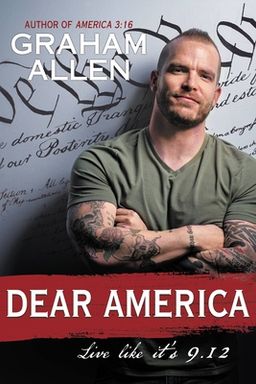
Dear America cover

Dear America

by Graham Allen

Dear America urges citizens to transcend differences and unite as Americans to preserve their nation. Drawing on the spirit of September 12, Graham Allen advocates for a return to core values, emphasizing community, diversity, and active engagement in democracy to heal cultural and political divides.

The Fight for America’s Soul

What happens when a nation once defined by courage, community, and faith begins to lose its reflection? In Dear America, Graham Allen argues that the United States is in a moral and cultural freefall driven by fear, entitlement, and cancel culture. Allen contends that America’s decline is not the result of a single political moment but of decades of small choices eroding personal responsibility, faith, and freedom. To reclaim our identity, he urges Americans to rediscover truth, reject victimhood, and become what he calls “uncomfortable patriots”—citizens willing to stand up for what is right, even when it’s unpopular.

Allen’s core argument hinges on a bold assertion: the United States has been infected not by a virus of biology but by a virus of ideology. In his words, “we are the virus”—a generation addicted to self-interest, false validation from Big Tech, and fear-driven compliance rather than courage. Drawing from his experiences as a soldier, entrepreneur, and commentator, Allen paints a picture of an America that traded faith, family, and freedom for convenience, entertainment, and comfort. But this is not a book of despair; it is a rallying cry. Through personal stories, fiery commentary, and historical reflection, Allen tries to wake readers up from cultural complacency and inspire a return to resilience.

America’s Drift from Truth

Allen opens with a challenge: most people prefer comfort over truth. He insists that real progress begins only when individuals stop asking for easy answers. He argues that postmodern America has replaced truth with “your truth,” a relativistic conception of morality that leaves society rootless. By using examples like political polarization, Big Tech censorship, and public fear during the COVID-19 pandemic, he shows how institutional manipulation thrives on citizens’ unwillingness to question narratives. For Allen, truth may be uncomfortable, but it is the only path to freedom.

Fear and Complacency as Modern Shackles

He describes fear as “the most contagious virus of all”—spreading faster than any disease and paralyzing the spirit of independence. Allen points to the global pandemic as a real-world metaphor for how hysteria, media bias, and obedience turned free citizens into submissive ones. The problem, he claims, is not the government’s rules alone but how easily Americans accepted them. As people seek safety in surrender, they lose liberty in silence. (In similar fashion, Jordan Peterson’s 12 Rules for Life connects personal chaos with societal decline, emphasizing courage over conformity.)

Faith, Family, and Freedom—Forgotten Pillars

Allen’s nostalgic tribute to mid-20th-century America underscores his lament: that citizens once valued faith, family, freedom, community, and hard work but now idolize comfort, validation, and digital fame. Through anecdotes about TV dinners and locked garages—the symbols of isolation—he contrasts the past’s communal strength with today’s detachment. Technology, he argues, was meant to connect us but instead atomized us into bubbles of ego and outrage. His grandfather’s decision to choose and raise him when no one else would becomes the moral backbone of his philosophy: true love is chosen, not convenient. That applies to patriotism as well.

The Role of Responsibility and Choice

At the center of Allen’s message is choice. Freedom is impossible without the courage to choose truth over comfort. He invites readers to take responsibility for personal agency: stop expecting the government, corporations, or social movements to fix problems that only individuals can confront. This echoes Viktor Frankl’s claim in Man’s Search for Meaning that liberty without responsibility degenerates into chaos. Allen emphasizes that every American must decide between two options—to keep sleeping through history or to wake up and fight for the nation’s moral backbone.

Why These Ideas Matter Today

Allen’s firebrand tone may polarize, but his urgency speaks to a time of peak societal tension. His argument for truth, courage, and faith frames political discourse as moral combat rather than mere policy debate. He warns that government overreach, Big Tech censorship, and progressive ideologies are pushing America into a counterfeit version of itself—one that prioritizes equality of outcome over equality of opportunity, virtue signaling over virtue, and emotion over evidence. The battle for America’s soul, he insists, begins not in Congress or Silicon Valley but in the mirror.

Key takeaway

Allen’s Dear America is ultimately an invitation—to live like it’s September 12, 2001, the day after tragedy when race, politics, and ideology were eclipsed by unity. He insists America isn’t gone; it’s waiting for its citizens to remember who they are. Truth is not a comfort—it’s a call to stand. The choice, he says, is simple: keep wishing or start fighting.


Be Careful What You Wish For

Allen begins his first major section, “The Fall,” with the warning that America’s slow decay is the direct result of its own desires. He frames this as a cautionary parable: be careful what you wish for, because you just might get it. Seventy years of convenience culture, technological isolation, and self-centered ideology have traded hard-earned freedom for easy living. We wished for comfort—and comfort eroded character.

From Faith to Selfishness

Allen contrasts mid-century America’s moral compass with today’s landscape. In his view, post-war citizens prioritized faith, family, freedom, community, and self-defense. They raised sons who lied about their age to fight in World War II—a generation defined by sacrifice. Today, he claims, the five dominant values are self-interest, free handouts, medical entitlement, relativism, and government dependency. Faith, in particular, has fallen from priority to irrelevance. Allen points to movements seeking the removal of “In God We Trust” from currency and athletes kneeling during the national anthem as symbols of this spiritual drift.

The Softening of American Resolve

He blames incremental cultural indulgence—from TV dinners to electric garage doors—for unraveling community ties. Families that once ate together replaced conversation with television; neighborhoods that once exchanged greetings replaced openness with closed doors. The “softening” began with convenience, not conspiracy. Every push toward ease chipped away at resilience. It’s reminiscent of Neil Postman’s warning in Amusing Ourselves to Death, where entertainment quietly becomes society’s anesthesia.

The Rise of Fear and Entitlement

Allen claims this erosion birthed a generation that believes prosperity is guaranteed, not earned. Fear of effort now outweighs fear of failure. When crisis struck—COVID-19, social unrest, digital censorship—Americans begged for protection rather than rising to face adversity. “We deserved better,” Allen writes, capturing the entitlement mindset he believes replaced responsibility. Where early Americans saw freedom as duty, modern citizens treat it as therapy.

Lessons in Decline

Allen uses history to reinforce his argument. The Revolutionary War was not unanimous; only about ten percent of colonists fought. The Greatest Generation braved near-certain death to defend liberty. Each era’s strength was forged in struggle. Good times create weak men, he repeats—a maxim for every cultural cycle. The soft generation of today, he warns, is breeding fragility that rivals political tyranny.

Key takeaway

Freedom fades not by force but by comfort. “Be careful what you wish for,” Allen admonishes, because luxury without discipline becomes weakness without awareness. When citizens stop choosing conviction, they choose decay. America’s decline began the moment its people decided to make life easy instead of meaningful.


Fear Is the New Virus

In “Fear Is Contagious,” Allen reframes the pandemic not merely as a health crisis but as a psychological revelation. COVID-19, he argues, exposed how fear can enslave an entire society faster than any pathogen. From lockdowns to masks, he saw obedience outpacing responsibility. “We’re never going back,” he declares—because many learned to prefer the safety of submission over the risk of freedom.

Fear as Social Control

Allen recounts the early 2020 descent from public rallies to shuttered churches and businesses. Audiences, he says, were hypnotized by politicians and pundits swapping facts for fear. Drawing parallels between virus hysteria and political manipulation, he identifies Big Government and Big Tech as symbiotic forces that thrive on panic. Fear, in his view, built an entire compliance economy—from mask manufacturers to media sponsors—that profited off insecurity.

From Faith to Woke Christianity

As churches closed their doors in fear of offending congregations or losing donations, Allen saw spiritual leadership replaced by “woke Christianity.” Citing books like Eric Mason’s Woke Church, he condemns the trend of rebranding moral conviction as social justice activism. “Socialism may threaten our country,” he writes, “but woke Christianity will kill it first.” For Allen, true faith means strength under conviction—not comfort under compromise.

Fear of Opinions and Failure

Beyond religion and politics, fear has crept into daily life. People now fear digital criticism more than physical danger. Allen’s story of his son's brief disappearance in a hotel elevator symbolizes how panic spreads instantly and irrationally. He extends the metaphor to social media mobbing: a nation terrified not of dying but of being disliked. Fear has reengineered behavior—from corporate policy to personal silence—by rewarding conformity.

Key takeaway

Fear thrives when truth hides. Allen calls for courage not as defiance but as medicine. “Fear consumes faster than any virus ever could,” he warns, because fear demands obedience while freedom demands risk. The cure isn’t a vaccine—it’s backbone.


We Are the Virus

Allen’s next diagnosis is blunt: the most dangerous infection in modern America isn’t biological—it’s social. “We are the virus,” he writes, describing citizens addicted to the dopamine of outrage, self-righteousness, and online validation. Social media, originally designed to connect, became an accelerant for narcissism and polarization.

Social Media’s Double Edge

Allen calls social media both blessing and curse: the power to speak globally has also given power to destroy globally. Platforms like Facebook and Twitter, he argues, turned public discourse into ideological warfare. Quoting statistics that billions spend hours daily “sharing, liking, tweeting,” he shows how connection became contagion. (Jonathan Haidt’s The Coddling of the American Mind similarly exposes the emotional fragility born of social networking.)

Moral Inversion and Online Rage

The digital revolution, Allen claims, rewired morality. Without face-to-face accountability, cruelty masquerades as virtue. He recounts examples of friendships dissolving over opposing votes and marriages breaking under political disagreement. Algorithms reward anger, not understanding. In this environment, everyone becomes both victim and villain—infected by indignation but unwilling to seek cure.

The Solution Begins in the Mirror

Unlike many commentators, Allen refuses to outsource blame. His closing insight in this chapter is personal responsibility: “Look in the mirror—there’s the problem.” Echoing Andy Frisella’s advice to control oneself before controlling others, he insists redemption starts internally. Only disciplined individuals can rebuild national character. Until then, technological freedom without moral foundation will remain a viral disease.

Key takeaway

Social media made every citizen a broadcaster but also a bully. Allen’s cure for this digital virus is humility—remembering that opinions are not truth and identity is not ideology. Freedom lives only when reflection replaces reaction.


Division Is a Strength

Moving into “The Divide,” Allen confronts what he sees as America’s greatest misunderstanding—that division is inherently bad. He reframes division as the natural state of a free republic. Conflict of ideas, not uniformity, built American growth. The danger, he argues, arises when division is weaponized into hatred or when cancel culture forbids disagreement.

Disagreement as Democracy

Allen reminds readers that from independence to civil rights, every advance emerged from dissent. Like the Founding Fathers’ debates over liberty, division forces self-examination and progress. He uses a dinner-table thought experiment—ask friends about abortion, race, or human trafficking, and you’ll find discord. That’s not dysfunction; that’s freedom. What matters is civility, not unanimity.

Cancel Culture and Manufactured Outrage

Allen’s examples of “cancellations,” from Dr. Seuss to gender-reveal parties, illustrate moral absurdity. He cites Demi Lovato’s claim that gender celebrations are transphobic as proof that society now searches for offense where none existed. “We’ve decided that differences must be extinguished,” Allen laments. Division is weaponized not by ideology itself but by refusal to tolerate complexity.

Division vs. Destruction

For Allen, disagreement should build checks and balances, not destruction. When opposing sides refuse discussion, unity morphs into manipulation. He contrasts healthy debate with riots or censorship. True unity, he writes, is standing together as Americans despite our discord—like family members who argue fiercely but defend one another when outsiders attack.

Key takeaway

Division is not America’s disease—it is its heartbeat. Allen urges readers to stop fearing disagreement and start defending dialogue. Civil discord keeps democracy alive; cancel culture kills it.


Equality vs. Equity

In “Equality Doesn’t Always Equal Being Equal,” Allen tackles the philosophical confusion between equality of opportunity and equality of outcome. He argues that the Left seeks the latter—a utopian uniformity that contradicts both nature and the Constitution. Real equality, he insists, is moral, not material.

The Constitutional Meaning of Equality

The Declaration of Independence promises equality under God, not identical results. Using Kamala Harris’s animated campaign ad comparing climbers starting from different points, Allen explains why equal starting lines don’t guarantee equal finish lines. To him, equality of outcome demands wealth redistribution—a form of socialism. It denies merit and incentive, replacing effort with entitlement.

Hard Work and Hierarchies

Allen draws from his own story: quitting the Army, risking failure, and building his company from nothing. He distinguishes fairness from fantasy—success follows sacrifice. Hierarchy, he says, is unavoidable; not everyone can lead. This echoes Jordan Peterson’s defense of competence hierarchies as essential for civilization.

Economic Consequences of False Equality

Allen critiques movements like the push for a $15 federal minimum wage or leveling all income as destructive to innovation. Raising wages artificially, he predicts, will bankrupt small businesses and hurt workers in the long run. Equality of opportunity means freedom to excel or fail—not immunity from consequence.

Key takeaway

Equality of opportunity motivates growth; equality of outcome enforces mediocrity. Allen teaches that when you remove the chance to fail, you remove the chance to succeed. Freedom demands risk, not guarantees.


The Pursuit of Happiness and Duty

Allen turns philosophical in “The Pursuit of Happiness,” dissecting one of America’s founding ideals. He insists the Founding Fathers never promised happiness itself—only the right to pursue it. Happiness, therefore, is earned through contribution, not received through entitlement.

Context from the Founders

Drawing on Jefferson, Locke, and Mason, Allen interprets “life, liberty, and the pursuit of happiness” as a moral framework that links freedom with work. The Founders envisioned citizens pursuing purpose and productivity—not passive comfort or government dependency. He warns that modern readings distort happiness into leisure, stripping it of duty and faith.

Freedom Without Responsibility

Allen rebukes a generation that wants liberty without labor. Freedom, he argues, only has meaning when paired with moral responsibility. Like Viktor Frankl, he connects purpose with endurance—human strength comes from striving for meaning, not escaping hardship. Government handouts, he says, erode purpose and dull the pursuit.

Happiness as Action

He asks readers to redefine happiness through faith, persistence, and gratitude. Use whatever gifts and grit you have to build, serve, and create. The Founders did not write “life, liberty, and happiness”—they wrote “the pursuit of happiness.” The chase, not the cushion, was the point.

Key takeaway

Happiness is not a gift—it’s a grind. Allen reclaims Jefferson’s intent: the pursuit matters more than possession. Joy that costs nothing is worth nothing.


Live Like It’s 9/12

Allen closes his book with a personal charge: live as Americans did on September 12, 2001—the day unity erased division. He steps back from polemic to confession, sharing the exhaustion, depression, and faith required to fight for principle in a cynical world. His plea is not for politics but for courage.

Reclaiming Purpose Through Action

Allen urges readers to abandon complacency and take first steps—run for local office, protect children from digital harm, stand unapologetically for truth. He rejects waiting for a “safe time,” insisting that purpose never arrives prepackaged. You must act even when promised nothing. Plan B is failure disguised as caution.

Faith, Legacy, and Accountability

His Christian worldview reinforces civic responsibility. He imagines facing two judgments: one for knowing God, another for what you did with the life He gave you. His prayer is that readers stop hiding behind comfort and face hardship with conviction. As he says, “America is worth dying for.”

Unity Beyond Politics

The metaphor of 9/12 captures his vision. After tragedy, race, class, and ideology collapsed into shared identity. Allen’s mission is to recapture that unity before crisis forces it again. His closing mantra—America over everything—returns full circle to his introduction: a call for uncomfortable patriots who stand for truth even when the culture mocks it.

Key takeaway

Patriotism isn’t nostalgia—it’s endurance. To live like it’s 9/12, Allen says, is to value courage over convenience, duty over division, and faith over fear. America can be healed only when its citizens decide to remember who they are.

Dig Deeper

Get personalized prompts to apply these lessons to your life and deepen your understanding.

Go Deeper

Get the Full Experience

Download Insight Books for AI-powered reflections, quizzes, and more.