
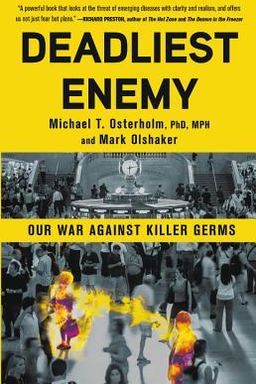
Deadliest Enemy cover

Deadliest Enemy

by Michael T Osterholm and Mark Olshaker

Deadliest Enemy delves into the escalating threat of infectious diseases in our interconnected world. Authors Michael Osterholm and Mark Olshaker explore past pandemics, potential future outbreaks, and the critical need for global cooperation and innovative solutions to safeguard humanity.

Public Health as Detective Work and Global Defense

Why does infectious disease continue to surprise humanity despite centuries of scientific progress? The book argues that public health is a mix of detective work and defense strategy—an interplay of observation, prevention, and preparation. You learn that controlling epidemics means understanding not only microbes but also human behavior, economics, and politics. The story flows from cholera maps to molecular labs, from field shoe-leather work to global threat matrices; each era demonstrates the same principle: you must act quickly on uncertainty and build durable systems before disaster hits.

From Observation to Prevention

Public health began with observation. John Snow’s 1854 map of cholera in London and Edward Jenner’s cowpox experiment for smallpox vaccination laid the foundation for modern epidemiology. Their lesson still applies: careful observation and decisive action, even when evidence is incomplete, can save millions. The author extends this idea through William Foege’s principle that “public health is social justice practiced through science.” Preventive acts such as sanitation, immunization, and surveillance create fairness because they protect everyone, not just the wealthy or powerful (Note: Foege was key in the smallpox eradication program).

Epidemiologists as Detectives

You experience investigative epidemiology firsthand through case studies like AIDS and toxic shock syndrome (TSS). In the early 1980s, CDC teams—Dr. James Curran, Dr. Mary Guinan, Dr. Bill Darrow—used detective logic to link strange clusters of Pneumocystis pneumonia and Kaposi’s sarcoma to a new virus, HIV. Their rapid case definitions and active surveillance turned confusion into coordinated response. Likewise, Dr. Jeffrey Davis’s TSS investigation taught that biases in data collection and premature press releases can mislead science. Both examples illustrate that epidemiology is not elegant; it is urgent.

The Expanding Threat Map

From Ebola to influenza, from mosquitoes to antibiotic resistance, you learn how modern globalization amplifies every vector. Air travel moves pathogens faster than ever. Urbanization and deforestation push humans closer to reservoirs like bats and livestock. The author introduces the Threat Matrix—a framework ranking pathogens by impact, likelihood, and preparedness—to help governments allocate resources wisely. Influenza and antimicrobial resistance top that list because they combine global reach with high social disruption. You’re reminded that preparedness is more than stockpiles—it’s maintaining production capacity, logistics, and trained human systems.

Science, Economics, and Politics Intertwined

Scientific breakthroughs mean little without funding and governance. Vaccine development stalls in what researchers call the “valley of death”—the financing gap between discovery and manufacturing. Organizations like CEPI (Coalition for Epidemic Preparedness Innovations) aim to bridge that valley. Similarly, antibiotic innovation suffers from poor market incentives; stewardship to reduce misuse also shrinks demand. The author compares this to climate-policy economics: public goods require public funding. Only sustained, coordinated investment can prevent repeated cycles of panic and neglect.

Preparing for the Unthinkable

The book’s fictional “Shanghai flu” scenario reveals systemic fragility—global supply-chain dependence, inadequate PPE stocks, overwhelmed hospitals, and competing narratives. It mirrors reality: pandemics exploit bureaucratic inertia and underfunded health systems. The solution, the author insists, is leadership akin to the Manhattan Project or NASA’s Apollo program—leaders who command resources and translate scientific insight into decisive national and global policies.

“Observation plus action turns chaos into control.”

Across eras—from the Broad Street pump handle to genome sequencing—the core principle stays constant: act early, act empirically, and communicate honestly.

Ultimately, you finish understanding that public health is humanity’s defense line. It demands curiosity as sharp as a detective’s, courage as strong as a soldier’s, and patience as steady as an engineer’s. Your task is not just to watch for pathogens but to build systems resilient enough to withstand both nature’s accidents and humanity’s own engineered risks.


Detective Epidemiology in Action

When you practice epidemiology, you become a detective. The book shows this vividly through AIDS and toxic shock syndrome (TSS)—two investigations that reshaped how science handles uncertainty. You piece together case clusters, compare clues, and learn how public health transforms scattered data into unified action.

AIDS: From anomaly to recognition

In June 1981, CDC scientists noticed rare Pneumocystis pneumonia and Kaposi’s sarcoma among young gay men. Through vigilant case definition and active surveillance, they uncovered a global epidemic. When HIV was identified as the cause in 1983–86, it confirmed the detective model: define, observe, expand, act. The lesson remains timeless—move on early signals before confirming all hypotheses, or the outbreak will outpace you.

Toxic shock: epidemiology meets industry

The 1980 TSS outbreak among tampon users in several states became a master class in interviewing, bias control, and lab collaboration. State epidemiologists (led by Dr. Jeffrey Davis) found that highly absorbent tampons increased oxygen exposure, allowing Staphylococcus aureus to produce toxin. Procter & Gamble’s Rely brand drew headlines, but wider analysis showed tampon absorbency itself as the main risk factor. The investigation revealed how premature media focus distorts evidence, an enduring warning for crisis communicators.

“Good science is gritty.”

You learn to trust interviews, enlist lab partners, and triangulate sources under time pressure. Epidemiology is part detective work, part psychological endurance.

Every clue—from AIDS clusters to tampon chemistry—shows that empirical persistence matters more than elegant theory. If you map cases, ask the right questions, and communicate with transparency, you turn biological mysteries into practical prevention.


Outbreaks and Systems Under Stress

Modern outbreaks—SARS, MERS, Ebola—expose how fragile global systems remain. Despite technology and travel, success still depends on early detection and courageous people who act decisively. The book weaves these narratives to teach you what global responses look like under stress.

SARS: the birth of modern coordination

SARS began in Guangdong and spread via one hotel—Room 911 at Hong Kong’s Metropole. Investigators including Carlo Urbani, Klaus Stöhr, and David Heymann transformed scattered reports into a global network through ProMED and WHO calls. Superspreaders shattered assumptions about predictable transmission; hospitals became both sanctuary and amplifier. SARS showed that isolation, quarantine, and infection control—centuries-old tools—still stop pandemics faster than technology alone.

MERS: zoonosis meets cultural complexity

MERS, discovered by Ali Mohamed Zaki in 2012, proved that animal reservoirs can make diseases politically intractable. Camels are economically sacred in Arabia, so culling is impossible. A South Korean traveler in 2015 generated 186 cases, closing hospitals and schools. The author urges One Health approaches: vaccinate camels, strengthen infection control, and fund vaccine research despite uncertain markets. You realize politics can shape disease trajectories as much as biology.

Ebola: context transforms a virus

Ebola’s 2014 epidemic wasn’t new biology—it was new ecology. Deforestation, urbanization, and cultural burial practices turned isolated flare-ups into regional calamity. Heroes like Ameyo Adadevoh in Nigeria and Carlo Urbani in Hanoi show that individual recognition can halt chains of transmission. Yet vaccine funding once again faded when headlines did, confirming the pattern: the world reacts, then forgets.

“Epidemics exploit weaknesses—human, political, and industrial.”

You must address systems and sustain them, not just chase pathogens.

From SARS’s civets to MERS’s camels to Ebola’s bats, each outbreak proves that rapid global coordination, One Health strategies, and enduring infrastructure—not panic-driven reaction—decide whether a spark becomes a conflagration.


Transmission and Ecology of Disease

Understanding how microbes move—by air, water, contact, or vector—shapes all prevention. The book divides transmission into four categories and reveals ecological lessons behind each.

Reservoirs and vectors

Reservoirs like bats store viruses such as Ebola and Marburg. Vectors like mosquitoes (Aedes aegypti, Aedes albopictus) function as biological syringes. Global trade moved Aedes from Asia to every continent. You trace Duane Gubler’s “four drivers” of modern vector crisis—urbanization, globalization, plastic waste, and collapsed control programs. Ecology and convenience become enemies.

Airborne and sexual routes

Airborne viruses—measles, influenza—spread through invisible jets of shared air, as the 1991 Special Olympics measles event proved. Sexual or direct-contact transmission, exemplified by HIV and occasional post-Ebola semen persistence, adds social complexity and stigma to control efforts. Each mode demands tailored defenses: sanitation, masks, vector control, or behavioral change.

The Aedes saga

Mosquitoes teach humility. La Crosse encephalitis struck the author’s own family, proving hyperlocal ecology can be deadly. Meanwhile, dengue, chikungunya, and Zika exposed how overlapping viruses sharing one vector can create global “syndemics.” The Zika crisis—causing microcephaly and sexual transmission—redefined what vector-borne disease means. GAAD and CEPI initiatives aim to build integrated mosquito control and vaccine capacity.

“Ask always: how does it move?”

Once you answer that, you know where to intervene—air, water, soil, sex, or bite.

Disease ecology reminds you that prevention must match transmission. Whether banning raw milk in Brainerd or developing Zika vaccines, control starts with understanding how human choices shape microbial pathways.


Vaccines, Markets, and Preparedness

Vaccines are the sharpest arrow in your public-health quiver. Yet their success hides economic frailty. The author maps the science, markets, and politics that decide whether vaccines reach people before crises strike.

The long legacy and the hard science

From Jenner’s cowpox to Salk’s polio shots and Foege’s ring strategy for smallpox eradication, vaccination transformed civilization. But vaccines are biologics—grown in eggs, cell cultures, bioreactors. They demand time, skill, and heavy capital. Flu vaccines must be reformulated yearly, guessing which strain will dominate months ahead, often yielding modest effectiveness. The CCIVI report showed many flu seasons hover around only 40–60% protection.

The valley of death

Between lab proof and licensed product lies a funding abyss. Private investors flee diseases with no market—Ebola, MERS, Nipah—creating a global preparedness vacuum. CEPI emerged to bridge that valley, funding platform technologies and stockpiles. But sustainability matters: after each epidemic, enthusiasm fades and budgets shrink. Learning from SARS and Ebola, the author calls for continued investment during calm times.

Economic models and institutional fixes

Project BioShield, BARDA, and AMR initiatives show public-private partnerships can fund defensive biotechnology. A defense-contractor model—guaranteed purchase contracts—could make vaccine sustainability realistic. The author proposes international coordination for R&D pipelines, faster regulatory consistency, and equitable distribution. Vaccine economics thus becomes part of national-security planning, not just health budgeting.

“Vaccines save lives—but only if they exist when needed.”

Preparedness means investing before sales, not after the outbreak hits the headlines.

Understanding vaccine economics helps you see that science needs business models as much as molecules. Without stable funding and coordination, hope alone will never immunize humanity.


Antimicrobial Resistance and Stewardship

Antimicrobial resistance (AMR) may be slower than pandemics but ultimately graver. The book calls it a 'slow-motion pandemic'—a creeping collapse of modern medicine. You learn how resistance spreads, what drives it, and how human behavior can reverse it.

The ancient enemy

Microbes in million-year-old caves already resist modern antibiotics. Evolution ensures resistance will emerge; misuse makes it faster. The mcr-1 and NDM-1 genes—found in livestock and humans—spread resistance globally via plasmids. Bacteria now cross species and continents with ease, rendering once-standard drugs useless. The British O’Neill report estimated 300 million deaths and $100 trillion in losses if AMR continues unchecked.

Behavioral and economic roots

Doctors overprescribe out of fear; patients demand antibiotics for viral colds. Farmers use antibiotics on animals to accelerate growth. These small actions scale into global tragedy of the commons. Stewardship—“right drug, right dose, right time”—works when reinforced socially. Clinics displaying commitment posters reduced misuse by 25%; transparency and public reporting drive accountability.

Repairing the pipeline and the planet

AMR demands twin fronts: prevention via sanitation and vaccination, and innovation via new drugs, diagnostics, and alternative therapies. BARDA and Wellcome collaborations begin this process, but only global effort on the scale of a defense project will buy time. Diagnostics and bacteriophage research are promising adjuncts that cut antibiotic demand while sparing efficacy.

“Stewardship is moral as much as medical.”

Preserving antibiotics means changing incentives, habits, and global cooperation before the era of cure becomes history.

Through AMR you grasp a paradox: the same tools that built modern medicine now threaten to undo it unless human behavior evolves in time.


Bioterror and Gain-of-Function Risks

Beyond nature, human intent and curiosity introduce new microbial dangers. The book explores bioterrorism, dual-use research, and gain-of-function experiments to show why scientific freedom must coexist with rigorous safety and ethics.

Bioterror realities

The 2001 anthrax letters—five deaths, billions in cleanup costs—proved that small-scale biological attacks can disable governments. Anthrax spores, durable for decades, became metaphors for how fear alone can paralyze institutions. Smallpox’s theoretical resurrection through synthesis adds global concern: forgotten vials, published genomes, and advancing synthetic biology make re-creation conceivable.

From curiosity to catastrophe

Gain-of-function and dual-use research occupy contested ground. Fouchier’s and Kawaoka’s experiments making H5N1 transmissible among ferrets alarmed the National Science Advisory Board for Biosecurity. The debate reflected science’s duality—greater knowledge vs. greater risk. You must question whether benefits like improved vaccines justify potential misuse or accidental release. Historical evidence (1977 H1N1 likely from a lab leak) insists that accidents happen even in elite facilities.

Governance and responsibility

Policies could restrict such work to vetted labs, classify sensitive results, and require international oversight. Creating an NSABB-style global body for biosafety mirrors arms-control treaties. The goal isn’t censorship—it’s trust through transparency and control. The book frames this not as anti-science but as pro-survival.

“Curiosity needs guardrails.”

Without ethical frameworks and leadership, the line between research and risk blurs quickly.

Understanding bioterror and gain-of-function reminds you that the most dangerous pathogens may not be born—only built. Governance is therefore the ultimate vaccine against human-engineered pandemics.


A Global Crisis Agenda for the Future

The book concludes with a call to action—a global Crisis Agenda combining science, economics, and leadership. You see how the author integrates lessons from every outbreak to design a roadmap capable of preventing the next catastrophe.

Nine priorities for resilience

Top priorities include a billion-dollar “Manhattan Project” for game-changing influenza vaccines, a global AMR panel akin to the IPCC, CEPI expansion for emerging pathogens, GAAD for vector crisis management, and creation of international biosafety governance for DURC research. Other elements sustain funding for HIV, TB, and malaria, anticipate climate impacts, and institutionalize One Health across species.

The leadership gap

Even the best agenda fails without leadership able to manage complex projects and budgets. Comparing epidemic defense to military or space programs, the author argues for empowered directors—scientists with strategic and political skill—to execute global coordination, similar to NASA or the Manhattan Project. Without long-term accountability, crises repeat.

“Leadership is the vaccine against fragmentation.”

Institutions must command authority, budgets, and speed—not rely on voluntary cooperation.

For you as a citizen, supporting these priorities means demanding sustained health funding, truthful communication, and global governance reform. Epidemic preparedness is not charity—it’s survival infrastructure. The future depends on turning lessons into laws, heroes into systems, and temporary vigilance into permanent resilience.

Dig Deeper

Get personalized prompts to apply these lessons to your life and deepen your understanding.

Go Deeper

Get the Full Experience

Download Insight Books for AI-powered reflections, quizzes, and more.