
Idea 1
Seeing and Surviving: The Evolution of Deception
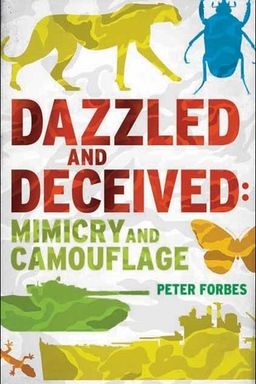
Camouflage and mimicry began as natural history puzzles and grew into a scientific language for understanding survival, perception and even art. The book traces this journey—from Bates’s butterflies in the Amazon to camouflage nets at El Alamein—and shows how deception evolves when seeing becomes survival. You discover how colour, form and behaviour act as vocabulary in a dialogue between predator and prey, scientist and soldier, nature and culture.
From Natural Resemblance to Evolutionary Proof
Henry Walter Bates’s study of Amazonian butterflies gave Darwin a crucial experiment. He realized that edible species could mimic the warning colours of distasteful ones—a survival ruse now called Batesian mimicry. Fritz Müller expanded the idea with Müllerian mimicry, showing that genuinely unpalatable species benefit when they share a consistent warning pattern. These insights turned mimicry into quantitative evolutionary evidence: predator behaviour became the selective test of hypotheses.
Vision, Art, and Countershading
Artists soon entered the story. Abbott H. Thayer, painter-turned-naturalist, understood concealment as optics. He argued that animals painted dark above and pale below use countershading to cancel real shadows. Later Hugh Cott tested Thayer’s claims with military precision: in 1940 aerial photos of countershaded coast guns proved the method. Thayer’s and Cott’s ideas connect art’s manipulation of light with nature’s manipulation of survival.
From Butterflies to Bombers: Culture and Conflict
Through the world wars, camouflage became institutional art. Cubist painters and naturalists collaborated to disguise ships and airfields. Norman Wilkinson’s dazzle painting shattered ship outlines into geometric confusion; Geoffrey Barkas and Dudley Clarke in the desert used deception theatrically—turning tanks into trucks and creating fake armies. The same perceptual rules guiding animal prey now controlled war strategy.
Genetic Foundations and Developmental Maps
Behind every pattern lies heredity. Mendel’s rediscovery and Morgan’s chromosome theory gave scientists tools to deconstruct wing design. Breeders like Punnett, Poulton, Clarke and Sheppard uncovered supergenes—tight clusters of linked loci orchestrating entire mimetic patterns. Developmental studies revealed a structural grammar, the Nymphalid groundplan, showing that wing motifs are modular rearrangements shaped by genes and environment. Hot or cold shocks during pupation could revise patterns instantly, proving developmental flexibility long before molecular biology arrived.
Chemical and Sensory Dimensions
Chemical ecology deepened the story. Miriam Rothschild and collaborators found that monarchs sequester cardenolides from milkweeds, giving real toxicity behind bright colour. Pyrazines and odours add multimodal signals—smell as well as sight. Studies from crab spiders to octopuses show that camouflage depends on predator perception: UV vision, colour-blindness, or behaviour determine what deception succeeds. The famous peppered moth returns as evidence tested by field, not theory alone.
Developmental Evolution and Modern Camouflage
Evo‑Devo later closed the circle. Small regulatory tweaks—like those affecting Distal‑less in butterfly eyespots or Ectodysplasin in sticklebacks—produce large visible effects without new genes. This mirrors Goldschmidt’s old question of “hopeful monsters” with molecular precision. Engineers replicated these biological design laws in fractal and digital camouflage (CADPAT, MARPAT), which merge microscopic and macroscopic patterns for multispectral invisibility. The book thus binds Darwinian selection, Thayer’s optics, Cott’s fieldwork and modern pattern algorithms into one continuum: deception as adaptation, art and information engineering.
Core Message
Whether on a butterfly’s wing or a battlefield map, mimicry and camouflage work by exploiting the limits of perception. Natural selection and human creativity meet in the same principle: survival depends on what an observer believes they see.