
Idea 1
The Hidden Power of Underdogs
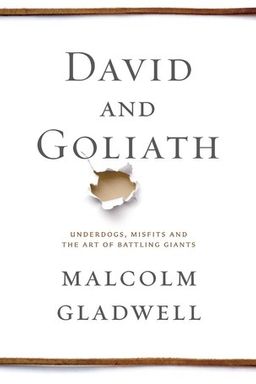
Have you ever felt outmatched, facing challenges so big they seemed impossible to overcome? In David and Goliath, Malcolm Gladwell invites you to rethink what it means to be at a disadvantage. He argues that many of the factors we assume make people strong or weak are misunderstood. What looks like strength can become a fatal weakness, and what looks like weakness can be a surprising strength. Gladwell’s central claim is that we’ve told the story of David and Goliath wrong for thousands of years — not as a miracle of faith or luck, but as an example of how unconventional strategy can turn weakness into advantage.
Gladwell contends that the qualities commonly associated with giants — wealth, power, size, privilege — often conceal vulnerabilities. Meanwhile, constraint and adversity, which are thought to limit and crush the underdog, can instead train resilience, creativity, and courage. Just like David, underdogs find ways to redefine the game itself rather than playing by the giant’s rules. His book explores this idea through stories of innovators, misfits, rebels, and survivors who thrived despite daunting odds.
The Story Behind the Metaphor
Gladwell begins by reexamining the biblical battle. Goliath, the legendary giant, was expected to crush the young shepherd David in hand-to-hand combat. Yet David refuses the king’s armor, chooses his sling instead, and defeats Goliath with a single stone to the head. Gladwell, drawing on historical analysis, explains that Goliath likely suffered from acromegaly — a disease that causes abnormal growth but limits vision and mobility. Goliath’s apparent strength was his weakness: his size made him slow and near-sighted, dependent on the rules of traditional battle. David, a slinger used to defending his flock from wild animals, simply changed the terms of engagement. He used speed, precision, and distance.
The battle wasn’t miraculous; it was strategic. David’s courage and faith mattered, but so did his understanding that advantage depends on context. Gladwell’s reinterpretation reframes not only the legend but our entire understanding of power. We assume giants always win, but the battlefield may be tilted toward the nimble, the desperate, and the creative — those who have learned from hardship how to adapt and innovate.
Underdogs Who Redefine the Rules
From this starting point, Gladwell explores modern battles between Davids and Goliaths. He introduces Vivek Ranadivé, a Silicon Valley executive who had never coached basketball until he led his daughter’s underdog team to national championships. By refusing to play conventionally — using a full-court press, forcing opponents into frantic mistakes — Ranadivé turned effort and relentlessness into a winning strategy. Gladwell parallels this with military studies showing that underdogs win wars nearly half the time when they ignore convention and fight asymmetrically, using guerrilla tactics (as T. E. Lawrence did against the Turks). The key lesson: playing by the dominant side’s rules ensures defeat. Changing the rules creates possibility.
Adversity as a Source of Strength
Gladwell expands the metaphor beyond conflict. He introduces scientists, dyslexics, orphans, and activists who developed extraordinary skills because of — not despite — their disadvantages. From lawyer David Boies’s listening acumen sharpened by dyslexia to pediatric oncologist Jay Freireich’s courage forged through childhood trauma, Gladwell shows how adversity can become “desirable difficulty.” Struggle, he argues, cultivates resilience and unconventional thinking. Like psychologist Robert Bjork’s concept of desirable difficulty, these hardships force deep learning and adaptation.
The Limits of Power
Yet if disadvantage can empower, Gladwell warns, advantage can corrupt. In later chapters, he investigates how excessive power — political, legal, or social — backfires when legitimacy fades. From the British occupation of Northern Ireland to California’s punitive “Three Strikes” law, he shows how authority that ignores fairness and empathy loses moral force. Too much power turns into blindness, just as Goliath’s height made him blind to the shepherd’s sling. Giants fall when they misunderstand how those below them see the world.
Throughout David and Goliath, Gladwell asks you to consider what kind of giant or underdog you are. If you’ve faced struggles, perhaps those experiences have given you unconventional tools and insights that others lack. If you hold privilege and power, maybe those advantages limit your understanding of risk and make you prone to complacency. His stories teach that struggle and compassion are far more transformative than strength and dominance.
Ultimately, Gladwell’s message is hopeful. Humanity’s greatest breakthroughs often begin with disadvantage. Underdogs win not because they’re stronger, but because necessity makes them inventive and brave enough to rewrite the rules. The question he leaves you with is timeless: in your own battles with giants, are you still trying to wear the king’s armor — or have you learned to pick up your sling?