
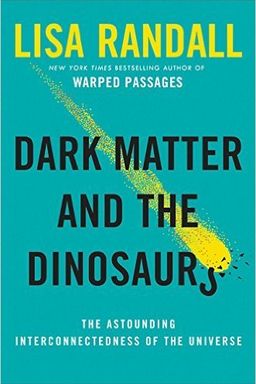
Dark Matter and the Dinosaurs cover

Dark Matter and the Dinosaurs

by Lisa Randall

Dark Matter and the Dinosaurs unravels the mysteries of the universe''s invisible forces and their impacts on Earth. Discover how dark matter possibly orchestrated cosmic events that led to life and mass extinctions.

Cosmic Structures, Impacts, and the Hidden Universe

Why do some cosmic events reshape life while others quietly sculpt the Universe's architecture? Lisa Randall’s integrated narrative connects two grand investigations: the invisible dark matter shaping galaxies and the visible scars of cosmic impacts that redefine life on Earth. In her exploration, cosmology meets geology — from the Big Bang to the extinction of the dinosaurs — revealing that the Universe’s hidden components not only organize structure but may also influence biological history through subtle, measurable forces.

Randall’s central argument is twofold. First, you live in a Universe dominated by components you cannot see: dark matter and dark energy control its geometry, expansion, and structure. Second, these invisible phenomena have tangible consequences, perhaps even shaping Earth’s history. The book unfolds like a detective story about the unseen — linking cosmic dark matter to familiar planetary events through rigorous observation and theoretical reasoning.

The Known and the Unknown Universe

You begin with what astronomers know: only about 5% of the Universe consists of ordinary atoms. Roughly five times more matter exists as dark matter, a silent mass known only by its gravitational pull. Evidence from Fritz Zwicky’s galaxy-cluster observations, Vera Rubin’s flat rotation curves, and cosmic microwave background results make clear that invisible matter outweighs all stars and gas combined. Randall insists this is not speculative mythology — it’s the logical inference from multiple, independent data sets, all converging on one robust conclusion: unseen mass dominates reality.

The Big Bang and Its Aftermath

You trace the Universe back to the Big Bang — a hot, expanding beginning validated by Edwin Hubble’s discovery of cosmic redshifts and the microscopic patterns in the cosmic microwave background (CMB). Inflation theory, pioneered by Alan Guth, provides the missing piece: a brief burst of exponential growth that flattens space and seeds tiny density variations. These primordial ripples become the framework for galaxies, amplified by gravity, with dark matter serving as the gravitational scaffolding on which luminous matter later accumulates.

Randall reminds you that the CMB’s acoustic peaks (as measured by WMAP and Planck) encode the precise fractions of normal and dark matter, transforming cosmology into a precision science. The Big Bang and inflation models verify how structure arose from quantum fluctuations — the smallest of beginnings leading, through dark matter’s influence, to the largest structures imaginable.

Cosmic Evolution Meets Geological History

The second half of Randall’s story turns inward, to Earth and the solar system. Asteroids, comets, and meteoroids embody leftover matter from planet formation; they occasionally strike Earth, leaving craters that chronicle the Solar System’s violence. From Barringer Crater in Arizona to the 180‑kilometer Chicxulub structure buried beneath the Yucatán, impact evidence links celestial mechanics to biological history. The Alvarez team’s iridium anomaly and the precise dating by Paul Renne confirm that 66 million years ago an asteroid impact caused the mass extinction that ended the dinosaurs’ dominance.

This geological detective work mirrors cosmology’s methodology: both rely on independent lines of evidence — chemistry, physics, and statistical consistency — to reconstruct unseen events. Randall extends that reasoning to ask if astronomical cycles might periodically enhance impact rates by disturbing the distant Oort cloud, injecting comets inward toward Earth on predictable timescales.

Toward a Connected Universe

In her dual narrative, Randall situates the human story within cosmic dynamics. Just as dark matter invisibly orchestrates galaxies, it might indirectly sculpt Earth’s trajectory through subtle gravitational effects. If the Milky Way hosts a thin dark disk — an unseen sibling to the ordinary matter disk — the Sun’s periodic passage through it could rhythmically disturb the Oort cloud, sending comet showers that raise the odds of catastrophic impacts. The novel hypothesis exemplifies science at its boundary: speculative yet grounded, testable through data from the GAIA mission and modern geological dating.

From the Invisible to the Measurable

What unifies the story is method, not mystery. Across cosmology, geology, and evolutionary biology, you see the same logic: careful observation reveals extraordinary connections. Invisible matter, ancient impacts, and the origins of life are not disconnected curiosities—they are evidence of one continuous, natural universe where hidden forces leave measurable traces.

Randall’s work teaches you to read nature’s subtle signals with humility and precision. From the CMB maps that tell you about the first seconds after the Big Bang to the Chicxulub crater that shaped the course of evolution, every discovery depends on seeing what is no longer visible. The book is ultimately about insight—learning to see the unseen, whether in the cosmos or inside the Earth’s buried layers—and to appreciate that the same physics governing galaxies may also govern the fate of life itself.


From the Big Bang to Cosmic Structure

Randall begins from first principles: the Universe is expanding, structured, and comprehensible through physics. Einstein’s general relativity permits space itself to expand, and Hubble’s redshifts prove it. But the Universe’s uniformity and structure require inflation—a fleeting period of rapid expansion that smoothed out irregularities and stretched tiny quantum fluctuations into seeds of cosmic architecture.

Inflation and the Cosmic Microwave Background

The inflationary model explains why space appears flat and isotropic. COBE’s discovery of CMB ripples, and WMAP’s and Planck’s refined temperature maps, confirmed inflation’s predictions. Each minute temperature variation reflects a density contrast that gravity later amplified into galaxies and clusters. The pattern of acoustic peaks records how much matter, dark matter, and radiation populated the infant cosmos — yielding the now-iconic composition: 5% normal matter, 26% dark matter, and 69% dark energy.

Precision Cosmology

By matching theory with detailed CMB data, scientists transformed cosmology into a data-driven field. Inflation plus Big Bang physics produces testable forecasts—an extraordinary shift from metaphysical cosmology to quantitative astrophysics.

Structure Formation and Dark Matter’s Role

As the Universe cooled, ordinary matter remained coupled to radiation for hundreds of thousands of years. Dark matter, immune to light, began clumping earlier, making gravitational wells that later trapped baryons. After recombination, gas cooled and condensed inside these dark halos, forming galaxies. You learn how angular momentum and cooling physics shaped disks like the Milky Way’s, showing that luminous matter is only the visible frosting on a massive, dark foundation.

By connecting early-universe microphysics to present-day galactic patterns, Randall shows that cosmic history is coherent—a long chain from subatomic fluctuations to starry islands of light spanning billions of light-years.


The Nature of Dark Matter

You already know dark matter exists, but not what it is. Randall surveys the best candidate theories and the experiments pursuing them. The most famous are WIMPs (weakly interacting massive particles): relics of the early Universe whose frozen abundance conveniently matches the observed density — the so-called WIMP miracle. Yet, despite decades of underground detectors (LUX, XENON, CDMS) and collider searches, no decisive detection has occurred.

Alternative Candidates

Axions, tiny particles linked to the strong CP problem, are searched for with resonant microwave cavities (ADMX). Asymmetric dark matter models suggest that the visible and dark sectors share a common origin, explaining why their mass densities are similar. MACHOs and regular neutrinos, once contenders, have been largely ruled out: microlensing and particle data leave no room for them as dominant components.

Three Experimental Pathways

Randall instructs you to view discovery strategies in three groups: direct detection (recoiling nuclei underground), indirect detection (cosmic products of annihilation observed by Fermi or AMS), and collider production (missing energy signals). Each probes different couplings — gravitational, weak, or hypothetical dark forces. Continued null results don't invalidate dark matter; they merely narrow its possible parameter space and highlight the need for creative models.

Key Perspective

Randall urges curiosity over disappointment: the absence of WIMP evidence invites a broader imagination about dark sectors—ones that might carry their own interactions, forces, and even hidden structures.

The search continues, blending particle physics, astrophysics, and galactic dynamics. Understanding what dark matter is—rather than just that it exists—remains one of science’s defining frontiers.


Double Disks and Partially Interacting Darkness

One of Randall’s most intriguing contributions is the idea that not all dark matter must be inert. With collaborator Matthew Reece and others, she proposes that a small, interacting fraction could cool via its own 'dark electromagnetism' and form a thin disk aligned with the Milky Way’s baryonic plane. This 'double‑disk dark matter' (DDDM) behaves analogously to ordinary matter — radiating, cooling, and collapsing — while the majority of dark matter remains the diffuse, collisionless background.

The Physics of Cooling and Collapse

In this dark sector, heavier and lighter particles could bind into dark atoms, emitting dark photons as they lose energy. Similar to how electrons and protons formed hydrogen, these dark analogs would settle into a dynamically thin layer. Because the constituent masses are higher, the resulting disk would be colder and thinner than the visible one — potentially amplifying local gravitational effects without violating large-scale cosmological constraints.

How to Look for It

A dark disk would slightly alter stellar motions near the galactic plane. Hipparcos hinted at possible anomalies, and GAIA’s billion-star survey is now precise enough to confirm or rule out such an extra midplane mass. Even a few percent of the total dark matter, when compressed into a thin disk, would have measurable dynamical consequences — a clear experimental signature.

Why It Matters

Unlike abstract particle conjectures, the dark‑disk idea bridges astronomy and particle physics; it turns galactic kinematics into a laboratory for new physics and provides a testable link between cosmic structure and local observation.

Randall’s proposal exemplifies science’s creativity: instead of asking if dark matter exists, she asks what forms it might take — and how small departures from simplicity could produce measurable results and explain phenomena as local as impact periodicity on Earth.


Impacts, Craters, and Earth’s Violent Archives

Randall guides you through the planetary record of impacts — each crater a frozen explosion. Simple craters form from kinetic impacts that melt, vaporize, and eject rock in a fraction of a second. Larger ones rebound to create central peaks and rings. Diagnostic features such as shocked quartz, tektites, and iridium anomalies distinguish impacts from volcanic processes.

From Meteorites to Extinction

The Meteor Crater in Arizona (Barringer Crater) provided early proof; Shoemaker’s identification of shock metamorphism ended debates about its origin. The most famous impact — Chicxulub — provides the clearest link between celestial physics and life’s evolution. Walter and Luis Alvarez’s 1980 discovery of a global iridium spike, followed by Renne’s high-precision dating and the Pemex drilling data revealing shocked quartz, confirmed that the event coincided with the Cretaceous–Paleogene extinction.

Scientific Coordination and Evidence

Finding Chicxulub required decades of cross-disciplinary sleuthing: magnetic and gravity anomalies identified by Glen Penfield, Haitian tektites found by Maurrasse’s team, and Argon–Argon dates aligning impact and extinction within tens of thousands of years. This convergence illustrates how industrial data, field geology, and astrophysical reasoning combine to decode Earth’s catastrophic past.

Insight

Every impact record is a reminder that Earth's life and astrophysical environment are interwoven; studying them strengthens planetary defense and deepens our humility about fragility and survival.

You finish this section aware that craters are not just scars—they are Earth’s archives, recording both destruction and the material delivery that may once have seeded life itself.


Life’s Ingredients from Space

The book broadens from physics to chemistry. How did lifeless matter become alive? Randall reexamines experiments and meteorites showing that organic chemistry flourishes far beyond Earth. The classic Miller–Urey experiment proved amino-acid synthesis is easy under reducing conditions. The Murchison meteorite (1969) provided evidence that carbonaceous chondrites carry amino acids and nucleobases, implying that life’s feedstock rains through the cosmos.

Water and Its Origins

Water’s abundance on Earth puzzled scientists because the early Sun was dimmer, yet liquid oceans existed. Randall discusses isotopic tests: cometary D/H ratios often differ from Earth’s oceans, while certain asteroidal sources match better. The likely story combines asteroidal delivery and volcanic outgassing. Resolving the “Faint Young Sun paradox” involves greenhouse gases and internal heat — mechanisms that kept early oceans stable.

Chirality and Selectivity

Meteorites show a slight bias toward left-handed amino acids — the same handedness life uses. Whether this bias seeded biological asymmetry remains uncertain. Randall uses it to illustrate cautious reasoning: coincidence, selective chemistry, or asymmetric radiation could all explain the observation.

Double-Edged Impacts

Asteroid collisions could deliver both destruction and creation — sterilizing surfaces yet spurring hydrothermal chemistry that fosters prebiotic molecules. The same processes that end epochs may also spark beginnings.

The origin-of-life discussion thus links planetary bombardment to molecular self-organization — reminding you that biology may owe as much to cosmic violence as to terrestrial stability.


Cycles, Statistics, and the Dance with the Galaxy

Why might catastrophic impacts appear periodically through history? Randall explores claims of periodic extinctions and the astrophysical mechanisms that might produce them. Researchers from the 1980s onward noted apparent 26–62 million‑year cycles, but such regularity teeters on statistical uncertainty. Geological dating errors and small samples easily create illusions of periodicity.

The Statistical Caution

Heisler and Tremaine’s analyses revealed that even modest (~13%) timing uncertainties drown real signals. Randall stresses the 'look‑elsewhere effect': searching across many possible periods virtually guarantees finding spurious alignments. Instead, she and Reece advocate narrowing predictions using physical models — for instance, the Sun’s measured vertical oscillation through the galactic plane defines a narrow plausible period (~30–35 Myr), sharply reducing statistical bias.

Galactic Motion and Comet Triggers

Ordinary galactic tides gently modulate Oort‑cloud dynamics, but not sharply enough to cause sudden comet storms. Traditional ideas like passing stars or molecular clouds occur too rarely, and the “Nemesis” companion star has been ruled out. The only consistent, testable mechanism remaining is an enhanced midplane density — possibly the hypothesized thin dark disk. Each solar crossing could sharply increase tidal stress, sending loosely bound comets sunward in bursts.

Connecting the Cosmic and the Biological

If the timing checks out, the Sun’s oscillation could weave cosmic and terrestrial chronologies together — an elegant, testable example of physics unifying events across vastly different scales.

In tying dark matter to periodic comet showers, Randall transforms speculative correlation into falsifiable astrophysical hypothesis, inviting GAIA’s data to decide whether the pattern reflects deep galactic truth or chance repetition in Earth’s geological record.

Dig Deeper

Get personalized prompts to apply these lessons to your life and deepen your understanding.

Go Deeper

Get the Full Experience

Download Insight Books for AI-powered reflections, quizzes, and more.