
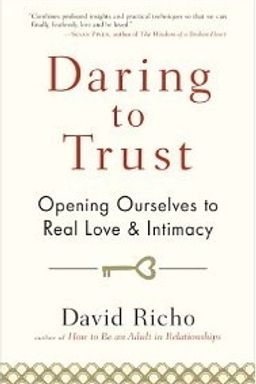
Daring to Trust cover

Daring to Trust

by David Richo

Daring to Trust by David Richo offers a transformative guide to rebuilding trust in yourself and others. Through overcoming past trauma and embracing mindfulness, this book provides practical tools to cultivate authentic relationships and a fulfilling life. Discover how childhood experiences shape your ability to trust and learn to live with confidence and resilience.

Daring to Trust: Opening Yourself to Real Love and Life

Can you really trust again after being hurt? Can you trust yourself when your emotions feel unpredictable? In Daring to Trust, psychotherapist David Richo invites you to explore one of life’s most elusive and profound experiences: trust. He argues that trust is both our deepest need and our greatest fear—something that begins in infancy and continues to shape every relationship we form. To love fully, Richo says, is to learn the art and practice of daring to trust—not naively or recklessly, but consciously, intelligently, and wholeheartedly.

Richo contends that trust isn’t about blind faith in others; it’s a skill rooted in how much we can trust ourselves, the world, and even forces beyond our control. Drawing from psychology, Buddhism, theology, and mythology, he maps out the eight directions of trust—from self-trust and interpersonal trust to core trust in life and faith in a higher power. Each dimension reflects a lifelong dance between vulnerability and courage, fear and acceptance, pain and growth.

The Fragile Vessel of Human Trust

Trust, Richo explains, is the glue of existence. We depend on it not only in intimate relationships but also when we drive down a highway, cross a street, or hand our paycheck to a bank teller. Yet every betrayal, whether from a parent’s neglect or a lover’s deceit, chips away at our capacity to believe that connection can be safe. “Our history of trust,” Richo writes, “is the ship’s log of our life.” Each time trust breaks, our inner compass shakes—and rebuilding it requires grief and self-awareness, not denial or revenge.

The Four Directions of Trust

Richo organizes human growth around four directions. We must learn to trust ourselves—our feelings, body, and judgment. We must learn to trust others—those who prove reliable and kind. We must learn to trust reality itself—what he calls “core trust,” a surrender to life’s unfolding even when it hurts. Finally, we must develop faith—a trust in powers beyond ego or explanation. These forms, he says, interlink like a compass. When one falters—say, distrust of others—we tend to overburden another, often expecting too much from ourselves or a higher power.

Why Trust Breaks and How It Heals

In ordinary life, trust collapses through lies, betrayals, or emotional unavailability. But Richo reminds us that broken trust isn’t always fatal; it can “hibernate like a bear,” ready to awaken under the right conditions. Healing begins when we grieve—not just current pain but past wounds. Then we rebuild gradually, through consistent truthfulness and integrity. True change, he warns, never cancels the shadow side—our unconscious aggression, addiction, or fear. We must daily work with these forces so trust doesn’t again dissolve into illusion.

Every betrayal, Richo writes, is also an initiation. It tests whether we can transcend our ego’s demands for permanence and fairness. To the spiritually awake person, betrayal becomes a teacher: what collapses our fantasy of control opens us to humility and impermanence. The journey from mistrust to renewed trust is thus not about forgetting pain but evolving through it.

Love, Integrity, and the Five A’s

At the center of Richo’s psychology of connection are the “five A’s”—Attention, Acceptance, Appreciation, Affection, and Allowing. When these are present, trust flourishes. When missing, fear takes root. You learn to give the five A’s to yourself and others; to remain trustworthy means to practice them even when others fail you. As he says, the foundation of adult trust isn’t “You will never hurt me,” but “I trust myself with whatever you do.”

The Larger Arc: Trust in Reality and Spirit

Ultimately, Richo raises trust from a psychological concept to a spiritual path. In his chapter on “Core Trust,” he blends Buddhist acceptance with existential realism: life may hurt, but it doesn’t aim to harm. This “yes” to reality—mirroring the Serenity Prayer—is the antidote to despair. Later, in “Trust in Powers Beyond Us,” he shows how faith evolves from childish obedience to an adult realization that the divine lives within—the Jungian Self, the Buddha-nature, the higher consciousness that sustains wholeness. To trust life itself is to say yes to uncertainty; it is an act of courage, not belief.

Through stories, therapy examples, and spiritual reflections, Daring to Trust becomes both a manual and meditation. Richo doesn’t offer safety; he offers consciousness. We learn to trust not in guarantees but in our inner resourcefulness—to stay open to love, to reality, and to grace itself, the mysterious synchronicity that keeps guiding us when control fails. The journey, he reminds us, is lifelong: “What a complex and enigmatic challenge it is to understand—and to become—fully human.”


What Trust Really Means

Richo begins by dissecting the meaning of trust itself. He argues it’s not simply a passive feeling or naïve belief—it’s an active verb, a chosen way of relating. To trust is to rely on reliability; it's the confidence that others will act with fidelity and integrity, even when there’s risk involved. We may think trust means absolute safety, but Richo warns that adult trust lives on the edge between knowing and risking. You cannot build intimacy without accepting uncertainty.

Intelligent Distrust

One of Richo’s most nuanced ideas is intelligent distrust. He reminds us that blind faith is not maturity—it’s gullibility. “Where humans are involved,” he writes, “trust must be conditional.” Intelligent distrust doesn’t mean cynicism; it’s discernment based on experience. Just as governments need checks and balances, relationships need awareness and boundaries. Healthy suspicion protects trust—it ensures that belief isn’t built on illusion. This echoes Krishnamurti’s insight that “to trust is to see clearly.” You can open your heart without closing your eyes.

Conditional vs. Unconditional Trust

Richo distinguishes between two forms of trust. Conditional trust, appropriate for everyday human interactions, depends on evidence—kept promises, reliable actions. Unconditional trust, by contrast, arises in spiritual consciousness: trusting truth, justice, and love themselves, regardless of human failings. This is similar to M. Scott Peck’s distinction in The Road Less Traveled between “cathected love” (based on feelings) and “real love” (based on will and commitment). When we act with integrity even in the face of betrayal, we embody unconditional trust.

The Roots of Trust

Infant trust starts when caregivers respond reliably. If a parent soothes or feeds promptly, a child learns the world is safe. Inconsistent care, however, plants doubt. Richo notes that early trust relies on both biology (oxytocin pathways, mirror neurons) and relational attunement. When parents neglect or abuse, the body itself learns mistrust—its muscles remember danger rather than safety. But he insists healing is always possible. Later relationships or therapy can “reinstall” trust by rewriting our inner expectations through repeated experience of safety and presence.

Adult Trust and Self-Reliance

Adult trust means transferring safety from others into our own psyche. We learn to handle disappointment gracefully because we no longer rely on guarantees. Richo’s motto—“I trust myself with whatever you do”—captures this maturity. When trust shifts from dependency to integrity, betrayal can hurt but not destroy. You stop asking for certainty and start cultivating faith in your capacity to respond. Such trust is disciplined courage, not sentimental hope.


The Five A’s: Foundations of Loving Trust

Richo identifies five vital nutrients for trust—what he calls the Five A’s: Attention, Acceptance, Appreciation, Affection, and Allowing. These are how love and trust show up in action. When they flow between partners, you feel safe enough to open. When they falter, fear takes over. The Five A’s shape every healthy relationship and act as daily practices for keeping intimacy alive.

Attention and Acceptance

To pay attention is to look truly at another person—seeing their feelings, moods, and needs. Attention is the opposite of indifference. Acceptance then builds on that awareness: letting someone be who they are without rushing to fix or criticize. Parents who mirror their child’s emotions are modeling these two A’s; adults do the same when they listen without judgment. “Love is not about approving,” Richo writes. “It is about allowing.”

Appreciation and Affection

Appreciation means expressing genuine gratitude, not manipulation. It lets others know they matter. Affection, meanwhile, includes physical warmth and emotional kindness. Touch, smile, and presence—these make the body feel what the soul knows: “I am cherished.” Richo ties affection to oxytocin, the neurochemical of trust. Without affectionate connection, we default to fear or control—our cortisol-fueled stress responses overwhelm relationship harmony.

Allowing: The Crown Jewel

The last A, Allowing, is perhaps the hardest. It means giving freedom—to feel, to choose, to change. A parent allows a child to outgrow her; a partner allows space for autonomy. Control, Richo argues, is fear’s poor substitute for trust. True love surrenders its grip, trusting that connection doesn’t require coercion. In his words, “Allowing confirms us in our right to our own choices.” This echoes Erich Fromm’s view that mature love is rooted in freedom, not fusion.

Practicing the Five A’s

Richo invites readers to audit their relationships: Are you showing these five forms of love reliably? Are you receiving them? He suggests seeing the Five A’s as spiritual commitments, not emotional whims. They rewire how you relate. When consistently practiced, they convert fear-based attachment into fearless intimacy. You stop negotiating safety and start living from trustworthiness itself.


Trust Lost and Found Again

What happens when trust breaks? Richo calls betrayal “a shock to our entire system”—as painful as the symbolic punishments Dante imagined for traitors. It feels isolating, disorienting, and ego-shattering. But he insists recovery is possible if we approach it with both courage and compassion. His chapter “Trust Lost, Trust Regained” offers one of the most practical roadmaps for healing betrayal, infidelity, and deceit.

Facing the First Wave

Betrayal awakens fear, anger, sadness, and despair. We must grieve not only the lost relationship but also our lost innocence—the belief that love could be safe forever. Richo encourages facing these feelings without blame or retaliation. Self-pity, rage, or scheming revenge deepen suffering. A mindful “yes” to feelings—naming them, breathing through them—transforms pain into resilience. When we stop protesting “this shouldn’t have happened,” we begin healing.

The Work of Both Partners

Richo divides recovery into two tracks. The betrayer must admit wrongdoing, express empathy, and make amends through long-term transparency. The betrayed must mourn fully and release fantasies of control. If both engage sincerely, the relationship can be reborn on new footing. “Repairing trust,” he writes, “is like starting a relationship over.” It demands patience—no guarantees, only the steady record of trustworthy action. (Compare this to Esther Perel’s The State of Affairs, which similarly views infidelity as a portal into self-knowledge rather than condemnation.)

Forgiveness and Boundaries

Forgiveness here doesn’t mean condoning or forgetting. It means releasing attachment to the offender—creating freedom both from resentment and from false hope. True forgiveness, Richo says, maintains boundaries: “We let go of blame and the need to get back at the person, while keeping our self-respect intact.” Sometimes, the most loving choice is goodbye. “Better alone than badly joined,” he quotes.

Growing Through Betrayal

Ultimately, betrayal becomes an initiation into humility. It dismantles ego fantasies of permanence. Richo draws on Rumi and Buddhist teachings to show that the pain that breaks us also reveals impermanence and grace. He writes, “Imagine giving ego-dismantling such priority that we might even welcome the chance to let it happen!” People who emerge from betrayal more compassionate and discerning haven’t just recovered—they’ve evolved their capacity to trust reality itself.


Trusting Yourself: The Inner Compass

Before you can trust anyone else, Richo says, you must trust yourself. Self-trust is the foundation for all other forms—without it, you drift in dependence or control. He explores how self-trust manifests in feelings, body, sexuality, and crisis. The self is both the safe haven and the secure base; learning to trust it means learning to listen deeply.

Trusting Feelings and the Body

Our feelings are not enemies, Richo insists—they’re guides. Many of us suppress emotions out of fear, confusing intensity with danger. Trusting feelings means allowing sadness, anger, fear, and joy as they arise without judgment. “We will not die from feeling,” he reassures. The body carries truth as sensation—the tightening of the chest, the warmth of affection. By breathing, relaxing, and observing, we turn the body from battleground to teacher. He quotes Shakespeare: “Go to your bosom; knock there, and ask your heart what it doth know.”

Facing Crises and Powerlessness

In times of helplessness or hopelessness, Richo invites a paradoxical move: trust even your powerlessness. He offers the practice of “befriending the three witches”—weakness, helplessness, and hopelessness. When you inhabit these states mindfully, they transform into serenity and strength. “Letting ourselves go into discomfort invests us with a power we might never have guessed was ours.” This echoes Pema Chödrön’s teaching that fear is the doorway to compassion.

Self-Respect and Boundaries

To trust yourself also means to assert boundaries. Richo outlines practices like speaking truth without aggression, asking for what you need, refusing abuse, and stopping the pursuit of approval. “Control is fear’s poor man’s version of power,” he writes. Real power arises from integrity. When you act from truth rather than fear, you earn your own trust—a far deeper freedom than pleasing others.

Loving Who You Are

Richo ends this chapter with a simple but radical exercise: ask a friend, “What do you love about yourself?” and take turns answering. It feels awkward at first; many people fear acknowledging their worth. But repeating this practice dissolves shame and deepens intimacy. Self-trust, ultimately, is loving yourself enough to stay on your own side—especially when life tests you.


Core Trust: Saying Yes to Reality

Beyond personal and relational trust lies what Richo calls core trust: a radical acceptance that reality itself is trustworthy. This isn’t optimism or superstition—it’s a spiritual orientation that sees everything, even suffering, as material for growth. Core trust means believing that life may hurt but will not harm us. The universe, he writes, “may not satisfy, but it will fit our needs.”

Control vs. Surrender

Most of us struggle because we confuse managing with controlling. Healthy ego management helps us face challenges; compulsive control rejects life’s flow. Core trust replaces control with surrender—a serene “yes” to what is. Inspired by Buddhist and Twelve-Step wisdom, Richo aligns this with the Serenity Prayer: accept what cannot be changed, change what can, and know the difference. He writes, “The frightened ego picks a quarrel with life’s givens; fear of reality replaces trust in reality.”

Reality as Teacher

Suffering, in this view, isn’t punishment—it’s curriculum. Reality continually gives us opportunities to evolve. Our job isn’t to prevent pain but to extract wisdom from it. “Core trust is confidence that whatever happens offers a chance to grow,” Richo says. This resonates with Viktor Frankl’s belief that meaning arises from how we respond to life’s challenges, not from being spared them.

Comfort and Challenge

Richo’s dual theme of comfort and challenge reappears—life is both a nest and a launchpad. To trust reality is to balance these poles: to feel held and still dare flight. We stop seeing discomfort as an error and start reading it as guidance. Marilyn Monroe’s line that “I just trust the next thing that happens” becomes his mantra of faith in unfolding life.

Living the Yes

When we surrender to life as trustworthy, even loss becomes revelation. Richo calls this the “supreme attunement”—aligning with the rhythm of existence itself. In this state, we don’t need reasons; presence is enough. The world stops being an opponent and becomes a partner in consciousness. “We are wound with mercy round and round,” he quotes Hopkins. That mercy is the fabric of existence—and core trust is learning to feel it.


Trusting in Powers Beyond Us

In his final chapters, Richo turns from psychology to spirituality. Having explored trust in self, others, and reality, he examines our relationship to the transcendent—trust in a higher power, divine intelligence, or inner enlightenment. Whether or not you believe in God, he says, you can cultivate faith as the mature expression of trust.

From Childhood Faith to Adult Consciousness

Children often picture God as a parent in the sky—a projection of early caregiving. If our parents were reliable, the divine feels benevolent; if they were abusive, religion becomes fear-based. Growing up spiritually means outgrowing punitive myths and realizing that godliness resides within as compassionate presence. Richo quotes Thomas Keating: “God and our true self are the same thing.”

Buddhist Faith and the Three Refuges

Drawing on Buddhist thought (especially Sharon Salzberg and Shunryu Suzuki), Richo emphasizes non-dogmatic faith: trust in direct experience. In Buddhism, one takes refuge in the Buddha (our enlightened nature), the Dharma (teachings of wisdom), and the Sangha (spiritual community). These refuges represent trust in inner goodness, guiding truth, and shared compassion. Faith, here, means “trusting ourselves to discover the deepest truths on which we can rely.”

Jung’s Higher Self and Individuation

Richo integrates Carl Jung’s concept of the Self—the divine archetype within. Our ego and Self are two ends of one axis; individuating means aligning ego fear with Self love. When the ego surrenders arrogance and control, wisdom flows through us spontaneously. This union of psychology and spirituality transforms trust from belief into embodiment: “We participate in the Self whenever our love becomes unconditional, our wisdom transcendent, our forgiveness effortless.”

Awakening through Practice

Richo closes with practical steps for awakening trust. He invites reflection on how we rely on three sources: inner potentials, grace from beyond ego, and community support. Like the Twelve-Step model, these echo Buddhist refuges—personal awareness, higher power, and fellowship. Asking for and giving thanks for grace, he says, keeps faith alive. “We trust that no force on earth can obstruct our path to love.” That is the spiritual essence of trust: unconditional confidence in life’s unfolding goodness.

Dig Deeper

Get personalized prompts to apply these lessons to your life and deepen your understanding.

Go Deeper

Get the Full Experience

Download Insight Books for AI-powered reflections, quizzes, and more.