
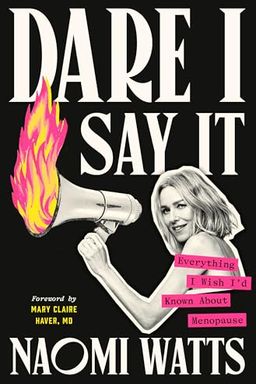
Dare I Say It cover

Dare I Say It

by Naomi Watts

The Academy Award-nominated actress demystifies occurrences and unpacks stigmas related to menopause.

Menopause, Stigma, and Taking Up Space

How can you move from feeling blindsided by midlife changes to feeling like the protagonist of your own second act? In Dare I Say It, Naomi Watts argues that the silence around menopause has done real damage—to women’s health, relationships, workplaces, and sense of self—and that the cure is knowledge, community, and unapologetic advocacy. Watts contends that menopause isn’t a cliff you fall off; it’s a long transition with a wide spectrum of symptoms and options. But to navigate it, you need clear information on what’s happening to your body, how to treat it, and how to speak up at home, at work, and in the doctor’s office.

In this guide, you’ll discover what perimenopause and menopause really look like in daily life: not just hot flashes, but UTIs, GI issues, migraines, anxiety, frozen shoulder, and brain fog. You’ll then learn what actually helps—from hormone therapy (HT/HRT) and local vaginal estrogen to strength training, sleep skills, and communication scripts with family and physicians. Finally, you’ll learn how to reclaim sex and partnership, redesign work and identity, and build a menopause-literate care team. Along the way, we’ll examine why the 2002 Women’s Health Initiative (WHI) study sparked decades of fear about hormones—and what updated science says today.

What Watts Is Really Saying

Watts opens with a gut-punch: told at 36 she was “close to menopause,” just as she was trying to conceive. Night sweats had been dismissed for years. Periods grew erratic. She realized she wasn’t alone; we’ve normalized women’s suffering (as ob-gyn Sharon Malone says) and undertrained doctors receive scant hours on menopause. Watts positions herself as a connector and curator—bringing together leading experts (Malone, Jen Gunter, JoAnn Manson, Avrum Bluming, Lisa Mosconi, Mary Claire Haver, Stacy Lindau, Somi Javaid) and real women’s stories to replace shame with practical know-how.

Two throughlines run beneath every chapter. First: the body-wide reach of estrogen. Its decline doesn’t just affect temperature regulation; it touches sleep, mood, sexual function, pelvic tissues, the microbiome, and even brain metabolism. Second: your agency matters. You can choose HT or not. You can customize delivery (patch, gel, pill, ring; systemic vs. local) and dosage. You can also get nonhormonal help (Veozah for vasomotor symptoms, CBT-I for insomnia, strength training for bone and muscle, nutrition upgrades for visceral fat). What you shouldn’t do is suffer in silence.

Why This Matters Now

Two million U.S. women enter menopause every year—nearly 6,000 a day—and yet many still get misdiagnosed with everything from IBS to depression. The midlife years are also a perfect storm: teenagers at home, aging parents, high-stakes careers, changing bodies and identities. Watts shows how gaps in training and stigma at work (“unfuckable” is a term she heard in Hollywood) magnify real symptoms into loneliness and fear. By elevating stories—her own emergency C-section, the estrogen patch she ripped off before first sleeping with Billy Crudup, UTIs that finally yielded to vaginal estrogen—she translates science into lived relief.

What You’ll Take Away

You’ll leave with a symptom map (hot flashes are only the tip), sexual health tools (bulbocavernosus muscle, dilators, Ohnut rings, vibrators, HSDD meds), a demystified view of hormones (what went wrong with the WHI rollout and what’s true now), a brain-sleep-mood toolkit (false vs. true anxiety, CBT-I, alcohol and sleep), and care strategies (how to prepare for appointments, red flags, which tests to ask for). You’ll also get concrete lifestyle pivots: protein targets, fiber for visceral fat, probiotics, intermittent fasting, and the primacy of strength training (echoing Amanda Thebe’s Menopocalypse and Mary Claire Haver’s The New Menopause).

The Book’s Promise

Menopause can be a portal—not a disappearance. With the right care, you can sleep, think, desire, and work again. Watts reframes this era as one of “menopausal zest” (anthropologist Margaret Mead’s term), a time to reclaim pleasure, power, and purpose. The path is practical: less musturbation (psychologist Albert Ellis’s term for shoulds), more scripts, science, and support. And, crucially, less shrinking: you’ve earned your stripes.


Decoding Symptoms: From Hot Flashes to UTIs

Watts expands the symptom list far beyond “hot and bothered.” Her own saga began with night sweats in her 30s, brushed off as stress. By her early 40s, daytime hot flashes ambushed her on planes and boats—heat surges accompanied by shame and a panicked urge to escape. But flashes were just the headline. Behind them: UTIs that turned into an antibiotic spiral, GI blockages, migraines, heart palpitations, hair loss up top and hair growth elsewhere, dry skin, sleep fragmentation, anxiety-rage cycles, and even frozen shoulder.

The Estrogen Thread

Declining estrogen is the common denominator. Ob-gyn Sharon Malone explains that estrogen affects blood vessels (vasomotor symptoms like flashes), sleep, mood, urinary tissues, vaginal moisture and elasticity, and even the gut microbiome. Social psychologist Carol Tavris (coauthor of Estrogen Matters) adds that women often bounce between specialists—rheumatologists for joint pain, cardiologists for palpitations, psychiatrists for mood—without anyone naming menopause as the hub. The result: misdiagnosis, polypharmacy, and demoralization.

UTIs, GSM, and the “Bouncer” Analogy

Watts’s most dramatic spiral was recurrent UTIs. Multiple antibiotics wrecked her gut, led to yeast infections and pain, and landed her in imaging that showed she was “a filled-up bucket.” What finally helped? Vaginal estrogen. Urologist Kelly Casperson reframes this as genitourinary syndrome of menopause (GSM): low estrogen raises vaginal pH, thins tissue, and shifts the microbiome—so GI bacteria sneak into the bladder more easily. “Think of a healthy vagina like a bouncer at a bar,” she says. With vaginal estrogen (plus basics like peeing before/after sex), studies show 50–60% fewer recurrent UTIs. That could have saved Watts months of pain.

Heart Palpitations, Migraines, and Frozen Shoulder

Perimenopause can amplify palpitations (often with a negative cardiac workup), migraines, and musculoskeletal issues like adhesive capsulitis (frozen shoulder). Watts had to push back—twice—to get doctors to consider a menopause link. Her point isn’t that every symptom is hormonal, but that estrogen receptors are everywhere, so midlife patterns deserve a menopause lens before sending you on a sub-specialty scavenger hunt. (Note: Research is catching up—Dr. Mary Claire Haver cites emerging links between menopause and conditions like tinnitus, vertigo, joint pain, and palpitations.)

Vasomotor Symptoms: Not Just a Nuisance

Yes, dress in layers, use fans, avoid triggers like spicy food, alcohol, and caffeine. But Malone cautions that frequent, severe flashes correlate with poorer sleep, depression, cardiovascular risk, and potentially increased dementia risk. In other words, they’re canaries in the coal mine, not a punchline. When lifestyle adjustments aren’t enough, hormone therapy (HT/HRT) remains the most effective treatment.

Field Notes: What Helps

  • Hot flashes/night sweats: Track triggers; layer breathable fabrics; try HT if eligible; consider nonhormonal Rx like Veozah if you can’t/won’t take hormones.
  • UTIs/GSM: Local vaginal estrogen, hydration, pre/post-sex peeing. Break the antibiotic cycle.
  • GI issues: Moderate alcohol/sugar/caffeine/wheat; consider probiotics/fermented foods; address constipation early; note that HT can help GI symptoms too.
  • Palpitations/migraines: Rule out cardiac/neurologic causes; if negative and peri timing fits, discuss HT.
  • Frozen shoulder: PT, anti-inflammatories, possible cortisone; recognize peak incidence in women 40–60.

(Context: Jancee Dunn’s Hot and Bothered and Jen Gunter’s The Menopause Manifesto reach similar conclusions: get a menopause-aware clinician early. Don’t let suffering be normalized.)


Sex After 40: Pleasure, Pain, and Proof

Watts tells a tender, funny story about ripping off her estrogen patch before first sleeping with actor Billy Crudup—panicked he’d see she was menopausal. When she blurted out the truth, he smiled: “I’ve got gray hairs on my balls.” That moment—compassion over secrecy—became the template for reclaiming midlife sex: knowledge, communication, and the right tools.

Desire Is Biopsychosocial

Ob-gyn Somi Javaid underscores that female sexuality is an interplay of biology (hormones, pelvic floor, pain), psychology (stress, trauma, body image), and social context (relationship quality, caregiving load). In the menopausal transition, estrogen drops and testosterone slowly declines—so arousal signals, lubrication, and orgasm intensity can change. Add sleep loss, flashes, and pain, and of course desire dips. (Note: Emily Nagoski’s Come As You Are echoes this “dual-control” model of excitation/inhibition.)

The Pain Loop No One Names

The most actionable section: Stacy Lindau, MD (PRISM program, University of Chicago) spotlights the bulbocavernosus muscle, a sphincter around the vaginal opening that “talks to the brain.” Past pain (from dryness or tearing) conditions the brain to keep that muscle braced; attempts at penetration then hurt more, which strengthens the pain loop. The fix: lube and vaginal moisturizers, local estrogen if eligible, bearing-down techniques, pelvic floor PT, and graduated vaginal dilators (those rainbow sets you may have seen) to retrain easy opening. Many women say “it feels like a wall”—this is usually spasm, not a tumor.

Tools, Not Taboos

Watts treats lube and vibrators as oral hygiene for the pelvis: why not? (She jokes she owns two “vibrators” for her mouth—electric toothbrush and water flosser—so one for the vulva seems fair.) Ohnut buffer rings can reduce deep pain by customizing penetration depth. Local estrogen supports tissue elasticity, lowers pH, and reduces UTI risk. And remember the orgasm reality check: fewer than 30% of women climax from penetration alone; most need direct clitoral stimulation, and with a partner it commonly takes 10–20 minutes. You’re not broken; you’re normal.

When Libido Feels MIA

Two FDA options target low desire (HSDD): Addyi (daily, nonhormonal) increases excitation/decreases inhibition over weeks; Vyleesi (on-demand injectable) acts in 45 minutes. Testosterone therapy—though not FDA-approved for women in the U.S.—has consensus support (2019 International Menopause Society) in carefully dosed transdermal forms for low desire, improving frequency of satisfying sexual events and self-image. Dosing matters: one friend in the book accidentally took ten times her dose and became irritable and “psychotic”—a cautionary tale about medical guidance and follow-up labs.

Communication Is Foreplay

Many couples need a reset. Men may get Viagra without anyone asking if their partner is comfortable or lubricated; as Casperson quips, “Where is this penis going to go?” Align on pacing, lube, foreplay, and shared definitions of good sex (pleasure over performance). Normalize solo arousal as a way to “warm up” your own physiology. And question myths: “use it or lose it” is bunk—painful sex in menopause stems from hormones and tissue changes; the fix is restoration, not forcing.

A North Star Story

Liz, 70, had been denied HRT for years due to a maternal breast cancer history. With a knowledgeable doctor, she finally tried low-dose HRT: “My clit was pounding again!” She reframed late-life sexuality as adventure, connection, and confidence. The moral isn’t that everyone needs hormones; it’s that no one should be shamed out of seeking pleasure, whether that’s sex, cuddling, or opting out altogether.

(Context: Laurie Mintz’s A Tired Woman’s Guide to Passionate Sex and Emily Morse’s Smart Sex align with this: define your values, use tools, expect and design generous foreplay, and treat sexual health like any other health domain.)


Hormone Therapy Without the Hype

If menopause had a PR nightmare, it was 2002. The Women’s Health Initiative (WHI) halted a trial and announced, via press conference, that HRT raised breast cancer and other risks. Millions of women quit overnight. As oncologist Avrum Bluming and psychologist Carol Tavris later documented (Estrogen Matters), the messaging was deeply misleading: the trial wasn’t designed to assess symptom relief, enrolled older women (average age 63, many years past menopause), and its absolute risk findings were small and context-free. The nuance never made the headlines.

What Updated Evidence Says

Harvard’s JoAnn Manson (who led major WHI analyses) emphasizes a balanced view: for women under 60 or within ~10 years of menopause with moderate-to-severe symptoms, the benefits of HT generally outweigh small risks. Estrogen-only therapy (for women without a uterus) was associated with lower breast cancer incidence and mortality in WHI follow-up. Combination estrogen-progestin showed a slight uptick in breast cancer signals—but even those results have been debated for overinterpretation. Across the board, HT reduces flashes, night sweats, GSM, and improves sleep and quality of life; it lowers osteoporosis and hip fracture risk and can reduce type 2 diabetes risk.

Routes and Risks, Practicalized

You can take estrogen as a pill, patch, gel, spray, or vaginal ring; add progesterone (pill, some IUDs, or combined products) if you have a uterus to protect the lining. Endocrinologist Rocio Salas-Whalen notes that oral estrogen is metabolized by the liver and can slightly raise clot risk; transdermal routes (patch/gel/spray) bypass the liver and are preferred for lower thrombotic risk. The most common short-term side effects (breast tenderness, headaches) often settle within weeks. Gallbladder events are the most common adverse effect reported—still rare in absolute numbers (about 8 per 1,000 women per year on HT vs. 5 per 1,000 on placebo in one study).

Local vs. Systemic: Two Different Tools

“Systemic” HT (patch/gel/pill) treats whole-body symptoms. “Local” vaginal estrogen (creams, tablets, Estring) treats GSM and doesn’t meaningfully raise blood estrogen levels; leading societies state it’s safe for most women, including many cancer survivors, in consultation with their oncologists. Don’t conflate these: if sex hurts, a local product may be all you need.

Finding Your Fit Is Normal

Watts road-tested it all: spray (Evamist), patches, pills, gel, and ring—adjusting doses over years as symptoms changed. That trial-and-error isn’t failure; it’s personalization. Her tip: comparison-shop prescriptions (GoodRx, Amazon Pharmacy, Cost Plus) because coverage varies wildly. And yes, shortages happen—because more women are finally seeking treatment.

When Hormones Aren’t an Option

For vasomotor symptoms, the nonhormonal medication Veozah is a newer option (data are early, cost can be high). For GSM, prasterone (Intrarosa) is a non-estrogen vaginal insert. For sleep, CBT-I is first-line; for anxiety/depression, evidence-based psychotherapies can be paired with or without medications. And lifestyle matters no matter what: exercise, protein and fiber intake, alcohol limits, and good sleep hygiene amplify any medical treatment.

Doctor Visit Cheat Sheet

  • Clarify goals (sleep, flashes, sex pain, brain fog) and your history (migraines, clots, cancer).
  • Ask about timing (within 10 years of menopause?) and route (patch/gel for lower clot risk).
  • If sexual pain/UTIs dominate, ask about local vaginal estrogen first.
  • If your doctor won’t discuss HRT, consider a Menopause Society clinician search by ZIP code.

(Context: Susan Dominus’s widely read NYT Magazine piece “Women Have Been Misled About Menopause” mirrors Watts’s framing; Manson, Malone, and Bluming’s positions converge on individualized, risk-balanced care that prioritizes symptom relief and life quality.)


Brains, Moods, and the 3 a.m. Spiral

Why does midlife sometimes feel like puberty in reverse? Because it is—hormonally. Psychiatrist Ellen Vora calls the perimenopause/postmenopause years a “perfect storm” for anxiety and depression: hormones shift, sleep fragments, responsibilities peak, and culture undervalues aging women. Watts shares accounts of “panicky rage,” closet hideouts from kids, and a veteran ob-gyn (Suzanne Gilberg-Lenz) realizing her own team could predict her cycle by her mood—proof that clinicians aren’t immune.

False vs. True Anxiety

Vora’s helpful split: “false anxiety” is body-based and fixable (blood sugar crashes, caffeine, sleep debt, hangovers). “True anxiety” is your inner compass flagging a misaligned life (overwhelm, grief, values not met). Start by stabilizing the body—protein-forward meals, steady glucose, morning light, magnesium glycinate/L-threonate if helpful, and far fewer late-night scrolls. Then make space for true feelings: journaling, breathwork, therapy, and what Vora calls “free therapy”—crying. You can’t course-correct if you’re running on fumes.

Sleep Is a System, Not a Switch

Watts uses an Oura Ring to spot patterns (limited deep sleep, frequent wakings) and consults sleep medicine expert Suzie Bertisch. Top-line advice: build a routine (consistent wake time and morning light), wind down earlier (last meal/drink/screens 2–3 hours pre-bed), move your body in the day, keep a cool room (~65°F), and use CBT-I for persistent insomnia. If you can’t sleep, get out of bed until you feel sleepy again—retrain your brain that bed = sleep. Melatonin can help jet lag; sedatives and “Z-drugs” (e.g., Ambien) carry dependence, cognition, and safety risks—especially with alcohol. And yes, progesterone at night can be a gentle sedative for some on HT.

Alcohol: Choose Sleep or Wine

Mary Claire Haver is blunt: if you drink at night, you may be choosing not to sleep. Alcohol fragments sleep, increases early-morning wakeups, worsens hot flashes and anxiety, and can aggravate apnea. Watts’s rule of thumb: if she wants more than one drink, she accepts she’ll be up at 3 a.m. Consider “dry weekdays” or earlier spritzes, and watch your Oura/Fitbit validate the difference.

Brain Fog Has Biology

Neuroscientist Lisa Mosconi scans women’s brains before and after menopause and finds, on average, ~30% dips in activity in the frontal, cingulate, and temporal cortices during the transition. That’s not doom; it’s a metabolically expensive system adapting to less estrogen. The encouraging part: estrogen begun in midlife is associated with a ~30% reduced Alzheimer’s risk in meta-analyses (neutral if started more than a decade later). And lifestyle matters: manage BP, cholesterol, insulin resistance; move daily; eat more plants; and surprisingly, floss—oral and gut microbiomes talk to the brain.

When Panic Meets the Teleprompter

News anchor Tamsen Fadal had a live, on-air panic attack after weeks of poor sleep. Her first doctor waved it off—“most women just get through it.” A menopause-literate clinician connected the dots, started HT, and her fear of freezing vanished. She later left TV to build a menopause media platform. The lesson: name it, treat it, then decide what the moment is asking you to become.

(Context: Lisa Genova’s Remember and Mosconi’s The Menopause Brain both advocate for midlife risk-reduction strategies; Watts’s take adds the everyday scripts and the honesty about grief that often go unnamed.)


Skin, Hair, and Wearing Yourself

Midlife skin can feel like a paradox: drier overall yet still breakout-prone; thinner yet reactive; duller yet rosacea-flush at random. Watts reframes “anti-aging” as “pro-comfort, pro-confidence.” Her triggers: itchy, inflamed skin that no longer tolerated harsh regimens, plus public-facing work lights and makeup. The shift: gentler products, maximal hydration, strategic actives, and a dermatologist’s guidance before you DIY ten serums and a peel.

Hydration First, Then Target

Turnover slows with age (think ~50 days vs. monthly in your 20s). Retinoids and exfoliants can help—but overdo them and you’ll shred your barrier. Build a simple sequence: gentle cleanse (double-cleanse if you wear makeup), toner or essence to dampen, serum (hyaluronic acid; niacinamide), and moisturizer with SPF by day; moisturizer at night, with tretinoin (Retin-A) only as tolerated. Dry, itchy skin often calms with fewer fragrances and more ceramides and occlusives. And drink more water than feels cool to say out loud.

Procedures: Eyes Wide Open

Botox can soften dynamic lines but may dampen expressions if overused (Watts learned this the hard way before a horror film). Laser resurfacing, Thermage, and microneedling/RF (e.g., Morpheus8) can improve texture/tightness, but expect cost, pain, and recovery. Chemical peels can be powerful—or disastrous—depending on your skin; Watts spent Christmas with a “crusted-over” face after a too-strong peel. Homework: ask friends about downtime, choose conservative first passes, and consider whether great lighting and a new highlighter might be all you needed.

Hair: Thinning Is Common, Fixes Are Targeted

Dermatologist Amy Wechsler sees low iron as a frequent culprit in women’s hair loss—check ferritin and don’t donate blood during heavy-cycle years. Address thyroid issues, stress, and protein intake. OTC support (Nutrafol, Vegamour) helps some; fill-in powders camouflage widening parts; extensions can be a bridge (Watts uses micro-beads). PRP may swell your face (it did hers) and outcomes vary; tread carefully with expensive series. Big truth: no one naturally ages into thicker hair; compassion beats comparison.

Nails and Sun Lamps

Gel manicures require UV exposure—protect with fingerless gloves and high-SPF; avoid aggressive cuticle trimming to reduce infection risk. Choose salons that bleach-sanitize foot baths or use disposable liners; fungal and wart infections are real.

What You Wear Is a Wellness Tool

Stylist Stacy London’s mantra: style must evolve as you do. Swap “age appropriate” for “self-appropriate.” Shift palettes as hair/skin tones change; lean into separates and breathable fabrics for thermoregulation; let tailoring be your best friend; and divert attention with great frames, brows, and a lipstick that lights you up. Many women downsized heels during the pandemic—consider sleek flats and suits with fashion sneakers. Clothes should serve joy and comfort, not a dress code from a decade ago.

Makeup, Optimized

Keep skin dewy, powders light, brows defined, lashes curled, and liner tight to open the eyes. Cream blush beats powder for bounce. A travel oil stick (Bobbi Brown’s tip) rescues midday dryness. And if you’re squinting at menus and dashboards, graduated progressive lenses can be a delight once you adjust.

(Context: The beauty advice here harmonizes with long-time pros like Bobbi Brown and Mary Wiles: moisturize more, strip back what irritates, and learn one glow-boosting trick you enjoy.)


Fuel, Muscle, and the Metabolism Midlife Needs

If your old “eat less, run more” playbook stopped working, you’re not broken—you’re in a new physiology. Estrogen’s decline pushes fat storage inward (visceral fat), which is more metabolically active and inflammatory than the subcutaneous fat that once lived on hips and thighs. Ob-gyn and culinary medicine specialist Mary Claire Haver translates this into clear targets: more protein, more fiber, fewer added sugars, and consistent strength training.

Protein Is Not Optional

To slow age-related muscle loss and keep glucose stable, Haver cites WHI data suggesting menopausal women benefit from roughly 1.2–1.6 g protein/kg/day (many target ~100 g/day). Protein drives muscle protein synthesis (MPS), which estrogen used to help. As trainer Amanda Thebe notes, protein also blunts the midafternoon crash—choose turkey and veg over blueberry muffins when the slump hits.

Fiber vs. Visceral Fat

Aim for 25–32 g of fiber daily (most women get ~10 g). More fiber correlates with lower visceral fat, improved insulin sensitivity, and a happier gut microbiome. Keep carbs, but pick complex sources—oats, quinoa, berries, beans, sweet potatoes—rather than sugar-laden “naked carbs.” Hold added sugars to ~25 g/day (watch yogurt labels). Probiotics from food (plain Greek yogurt, kimchi, miso, kombucha) matter; supplement if needed, but try food first.

Intermittent Fasting, Thoughtfully

A gentle time-restricted window (e.g., 10 a.m.–6 p.m.) can calm inflammation and improve metabolic markers, but widen your window if you can’t hit protein needs. The goal is not deprivation; it’s rhythm. Pair with alcohol downshifts: the CDC advises no more than one drink per day, and your sleep will thank you for even less.

Strength Is the Strategy

Cardio is heart-healthy; strength training is non-negotiable. It preserves muscle, supports joints, and loads bone to reduce osteoporosis risk (the “silent thief”). Thebe is clear: exercise doesn’t replace missing hormones, and hormones don’t replace exercise—they’re complementary levers. Watts’s weekly mix skews realistic: weights, stretching, dance in a dark room for joy, and a Scientific 7-Minute Workout on the road. Begin simple: squats, lunges, planks, push-ups, deadlifts. Progress gradually; celebrate consistency over heroics.

What About New Weight-Loss Drugs?

GLP-1 medications (e.g., Ozempic, Mounjaro) can help some women with high health risk from obesity, especially after 3 months of HT + nutrition changes. Haver monitors muscle mass bi-monthly to ensure fat—not muscle—is what’s dropping. If appetite plummets, you must intentionally meet nutrient and protein needs. Long-term data are still evolving; weigh benefits and tradeoffs with a clinician.

Measure What Matters

Retire sole reliance on BMI. Track the waist-to-hip ratio (WHR): divide waist by hip. ≤0.80 is lower risk; ≥0.86 signals higher cardiometabolic risk. WHR often rises in menopause—but it’s modifiable with protein, fiber, strength, and sleep.

(Context: Peter Attia’s Outlive and Thebe’s Menopocalypse align on strength and metabolic health as the foundation of healthy longevity; Watts supplies the “how this actually fits in a life” layer.)


Work, Family, Reinvention—and How to Advocate

Menopause lands in the busiest corridors of life—teens at home, parents aging, careers cresting. Rather than shrinking, Watts argues for reinvention and self-advocacy. She left secrecy behind and launched Stripes Beauty; she took roles that matched her age and depth (Feud: Capote vs. The Swans), and she designed new scripts for partners, kids, and doctors. Your version will look different—but the levers are similar.

Designing the Next Chapter

Midlife is a moment to bet on yourself again. Watts recalls quitting a rising fashion-editor job to return to acting; later, she moved to the U.S. with $2,000 and a single phone number. In midlife, she took another reputational risk by speaking openly about menopause in Hollywood. Journalist Mariella Frostrup notes that as men “head to the golf course,” many women double down on ambition and advocacy. Chip Conley frames it as the “U-curve of happiness”: after a dip in the late 40s, satisfaction climbs with each decade, especially when you align work with values and legacy.

Redistributing the Mental Load

Eve Rodsky (Fair Play) names what drains many women: two thousand tasks of unpaid cognitive labor. Her script reframes time as equal currency: “We both get 24 hours. I’m not available on Sundays until we rebalance.” Menopause symptoms worsen under unequal loads. Start with equality in leisure time, then reassign household domains with full conception–planning–execution ownership, not “just tell me what to do.”

Parenting Teens While You’re Changing

Developmental psychologist Aliza Pressman offers five “R”s that apply to partners and teens alike: Relationship (feeling seen), Reflection (pause before reacting), Regulation (self/co-regulation), Repair (conflict is inevitable; mending is the skill), and Rules (clear boundaries). Use her script to name menopause at home: “You might notice hot flashes or irritability. It’s not your fault; I’m working with my doctor.” Normalizing the biology prevents kids and partners from personalizing your symptoms.

Be the CEO of Your Care

Watts is candid about medicine’s constraints: 7–15 minute visits, clinicians leaving the field, and thin menopause training. Prepare like a boss. Track cycles and symptoms, bring test results (mammogram, Pap, labs), list meds/supplements, and state goals clearly (“I’m exploring HT to treat night sweats and GSM”). Red flags: a clinician who dismisses symptoms, refuses to discuss HT (“dangerous” without nuance), or won’t give you 10 minutes for basics. If so, search the Menopause Society directory and switch.

Screening & Signals to Heed

  • Colon cancer screening from 45; shingles vaccine at 50.
  • Bone density (DXA) if at risk (family history, small frame, early menopause).
  • Postmenopausal bleeding or deep sexual pain warrants transvaginal ultrasound ± biopsy.
  • Remember: heart disease is the #1 killer of women—know your BP, lipids, WHR.

(Context: The practical stance here sits alongside Stacy London’s style reinvention, Haver’s metabolic playbook, and Jen Gunter’s science-forward myth-busting—a composite of advocacy, agency, and adaptation.)

Dig Deeper

Get personalized prompts to apply these lessons to your life and deepen your understanding.

Go Deeper

Get the Full Experience

Download Insight Books for AI-powered reflections, quizzes, and more.