
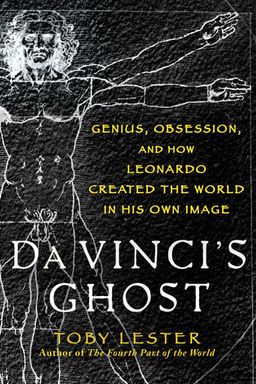
Da Vinci’s Ghost cover

Da Vinci’s Ghost

by Toby Lester

Explore how Leonardo da Vinci''s iconic Vitruvian Man encapsulates Renaissance ideals, blending art, science, and philosophy. Toby Lester unveils the historical and intellectual journey behind this masterpiece, revealing how curiosity and self-education propelled Leonardo to redefine human understanding and cosmic harmony.

The Human Body as the Measure of the World

What if the shape of your body could explain the structure of the universe? That question lies at the heart of Toby Lester’s Da Vinci’s Ghost, a masterful reconstruction of how Leonardo da Vinci’s Vitruvian Man—the image of a man inscribed in a circle and a square—came to embody one of the most powerful ideas in Western thought: that the human body is a microcosm of the cosmos. Lester argues that Leonardo’s famous drawing was not a spontaneous act of genius, but the culmination of more than two millennia of artistic, scientific, and philosophical exploration about how human beings fit into the grand design of nature.

The book tells two interwoven stories. One is Leonardo’s personal journey—from his illegitimate childhood in Vinci to his training in Florence, his work in Milan, and his restless efforts to understand everything from art and architecture to anatomy and the movement of water. The other is a sweeping history of ideas that stretches back to the ancient world, where Romans, Greeks, and early Christians imagined the proportions of the human body as a divine language, mirroring order and balance in the natural world. Together, these stories reveal that Leonardo’s drawing was not just about anatomy or geometry: it was a philosophical statement about humankind’s place in the cosmos.

Vitruvian Origins: Architecture as a Model for the Universe

The point of departure is the Roman architect Marcus Vitruvius Pollio, who, in his Ten Books on Architecture (written around 15 BCE), claimed that the principles of good building came from nature, particularly the human body. A well-designed temple, he argued, mirrored the proportions of a well-proportioned man, because both were products of the same divine geometry. For Vitruvius and his patron Augustus, this idea connected architecture to political order: just as the emperor’s perfect body symbolically united Rome’s empire, so the perfectly proportioned building reflected cosmic harmony and divine favor. The image of the man in a circle and a square was therefore not art, but ideology—the body politic visualized through mathematics.

Medieval and Mystical Transformations

Centuries later, in the medieval world, Christian theologians and mystics reinterpreted Vitruvius’s vision through a spiritual lens. Hildegard of Bingen (c.1150), the Benedictine abbess and visionary, reimagined the human body as the divine microcosm—Adam, Christ, and humanity fused in cosmic wholeness. Her drawings of a human figure surrounded by celestial spheres and divine light powerfully anticipated the posture of Leonardo’s man. For her, as for later thinkers, geometry became theology: the circle signified heaven, the square the earth, and man stood between them as both creature and co-creator. The pattern recurs in European cathedrals, which rose as stone embodiments of cosmic order. Their cruciform plans, ribbed vaults, and measured geometries transformed theology into architecture, representing the human form of Christ as the architecture of the world.

Renaissance Rediscovery and Human Centrality

When Renaissance humanism blossomed in fifteenth-century Italy, this inherited tradition met the rediscovery of Vitruvius’s lost text. Scholars such as Leon Battista Alberti and Francesco di Giorgio Martini translated its principles into modern architectural theory, emphasizing the harmony between art, proportion, and nature. Human reason, they argued, was a microcosmic reflection of divine order, capable of understanding creation through geometry and design. Among these ideas walked Leonardo, a restless artist-engineer who took the analogy literally. He measured bodies, dissected corpses, studied architecture, and read Vitruvius to uncover the mathematical structure of life itself. His Vitruvian Man, drawn around 1490, distilled centuries of inquiry into a single, haunting image: the human form as bridge between heaven and earth, body and mind, science and art.

Why It Matters

Lester reminds you that Vitruvian Man symbolizes more than a Renaissance ideal. It embodies a recurring human impulse—to see our own bodies as keys to understanding the universe. The drawing fuses religion, politics, and science into one act of self-inquiry: Know thyself. By tracing its lineage, Lester offers a new way to look at both Leonardo and Western thought. The “naked man in a circle and a square” becomes an archive of two thousand years of attempts to reconcile matter and spirit, self and cosmos. In that sense, Da Vinci’s Ghost is as much about you as it is about Leonardo. It invites you to imagine that the lines traced by his compass and pen were meant not only to measure man’s body, but also to chart the boundaries of human understanding itself.


Vitruvius and the Roman Body of Empire

Lester begins his historical narrative in Augustan Rome, where Vitruvius wrote his Ten Books on Architecture. Vitruvius was more than an architect—he was an engineer, surveyor, and veteran of Caesar’s campaigns. After years of service, he sought to immortalize Rome’s power through his book. His goal: to codify not just architecture, but the building of empire itself. To do that, he combined technical instruction with philosophy, politics, and metaphysics. His message was plain—buildings, cities, and human institutions must imitate the harmony of the human body and cosmos.

Augustus the Embodiment of Order

The rise of Emperor Augustus offered Vitruvius a living symbol of perfection. After decades of civil war, Augustus sought to heal Rome’s moral and physical decay through rebuilding. He embarked on massive public works—temples, aqueducts, theaters—and framed the effort as divine restoration. “I found Rome brick; I leave her marble,” he declared. In this vision, Augustus himself became the body of empire, embodying both political order and cosmic harmony. His statues, particularly the Augustus of Prima Porta, modeled on the Greek Spear Bearer of Polykleitos, depicted him as a faultless physical ideal—even though in life he was short, frail, and blemished. Art and architecture remade the man, just as the emperor remade Rome.

Lester interprets this fusion of body, art, and empire as one of the earliest expressions of the idea that geometry governs civilization. The emperor’s perfection validated political power: from head (Rome) to limbs (provinces), the empire functioned as an integrated organism. Later writers like Seneca and Manilius echoed the metaphor—Rome was a human body, its soul the emperor, its harmony a reflection of the universe.

Architecture as Divine Geometry

In Vitruvius’s own theory, geometry was sacred, revealing the laws of creation. The circle symbolized divine unity, the square earthly stability. The ideal architect, he claimed, must be not just a craftsman but a philosopher familiar with music, medicine, astronomy, and law—what later ages would call a Renaissance man. To build well was to think cosmically. The same proportions that define a man’s limbs defined temples and cities. This belief would echo through Christian and Islamic architecture for the next two millennia.

The Birth of a Metaphor

Vitruvius’s idea of the body of empire was more than metaphor; it laid a blueprint for Western thought. Order in the state mirrored order in nature, which reflected divine law. From this seed grew medieval visions of the Church as Christ’s “body,” Renaissance cityscapes designed on human proportions, and eventually Leonardo’s own synthesis of anatomy and geometry. When Leonardo would later write that “man is a model of the world,” he was reviving what Vitruvius and Augustus had already intuited: that human design and divine design are one.


The Medieval Microcosm and the Christian World

After the fall of Rome, the body of empire splintered, but Vitruvius’s text survived thanks to medieval monks who copied it by candlelight. Yet it was interpreted through a Christian lens. Lester shows how the metaphor of the human body as a world in miniature—the microcosm—became central to medieval theology and art. In this worldview, God was the architect of the universe, Christ the cosmic man, and Earth His body. To know oneself was to know creation.

Hildegard of Bingen’s Visionary Body

In the 12th century, Hildegard of Bingen experienced luminous visions that gave the microcosmic metaphor new life. She saw a radiant figure—part man, part cosmos—whose limbs stretched to the edges of creation, encircled by divine fire. Her Book of Divine Works depicted this vision as a wheel of the universe containing a human form at its center, representing Adam, Christ, and humanity itself. These images, drawn decades before Leonardo, shared the same circular composition and spiritual ambition as his Vitruvian Man. Hildegard’s goal was not architectural precision but mystical union: to show that the structure of the body and the structure of heaven mirrored one another.

The Gothic Cathedral as Cosmic Body

This same theology of the body took form in stone throughout Europe. The Gothic cathedrals of Chartres, Saint-Denis, and Reims were conceived as human-divine structures—mathematical prayers that lifted the soul heavenward. Abbot Suger described his rebuilt Saint-Denis (c.1130) as a place where one might pass “from the inferior to the higher world in anagogical manner.” The nave was the body, the transept the arms, the apse the head. Geometry was not simply a builder’s tool; it was revelation. Every arch and spire embodied harmony between earth and heaven. When you entered, you were walking inside the body of God.

Lester points out that this translation of metaphysical proportion into physical form prepared the conceptual ground for the Renaissance. Even though medieval builders lacked Vitruvius’s precise formulas, they shared his conviction that all beauty derives from geometry and divinity. The circle and the square—symbols of the sacred and the earthly—appeared in stained glass, church ground plans, and illuminated manuscripts alike.

Why Medieval Christians Matter to Leonardo

When Leonardo revived Vitruvius, he was also inheriting Hildegard and Suger’s spiritual geometry. His faith was empirical, not ecclesiastical, but his art still sought the same revelation: to understand divine design through human form. Da Vinci’s Ghost thus bridges science and mysticism, showing how the line between the monk’s prayer and the scientist’s experiment was often thinner than we imagine. The medieval microcosm gave Leonardo both a language and a sacred task—to rediscover in flesh and bone the architecture of God.


Leonardo’s Renaissance Education

Before Leonardo could reinvent Vitruvian Man, he had to reinvent himself. Born in Vinci in 1452, illegitimate and largely self-taught, he entered Andrea del Verrocchio’s Florentine workshop at fourteen. Lester paints this as Leonardo’s formative world—a place of noise, color, and craft rather than abstract theory. Artisans there learned painting, sculpture, metallurgy, optics, and mechanics. It was a university of the hand. Leonardo prepared pigments from chicken bones, built mechanical devices, and copied human figures from model books. In this environment, measurement, anatomy, and geometry were practical arts, not academic abstractions.

The Florentine Ideal: Art as Knowledge

Renaissance Florence was itself a living laboratory of Vitruvian ideals. The guild-based republic translated civic pride into monumental form. The Florentines saw their cathedral dome, engineered by Filippo Brunelleschi, as both symbol and substance of the city’s intellect—a vast brick microcosm uniting heaven’s curve with earthly order. In this context, artists were engineers and theorists. Leon Battista Alberti’s On Painting and On Sculpture insisted that art was a science of proportion and perspective, capable of revealing divine harmony through vision. Alberti’s call to unite mind and hand profoundly shaped Leonardo, who later wrote, “The divine character of painting means that the mind of the painter is transformed into an image of the mind of God.”

Art, Architecture, and the Study of Man

Verrocchio’s studio taught Leonardo that the artist was also an anatomist and mathematician. He learned how light, structure, and proportion interacted. Copying classical statues, he absorbed Polykleitos’s Greek canon of ideal proportions—the same ones that Polykleitos had sculpted in the Spear Bearer. Yet Leonardo diverged from his Greek models: for him, perfection was not an abstraction but a living system. Every vein, muscle, and motion mattered. He began sketching human figures not only to depict beauty but to discover law. His future notebooks, filled with mirrored writing and fluid sketches, would grow out of this Renaissance fusion of art, observation, and philosophy.

The Emerging Ideal of the Artist-Engineer

By the 1480s, Leonardo sought to transcend painting to become l’ingegnere—the artist-engineer. This aspiration mirrored the new humanist conviction, shared by Alberti and Brunelleschi, that the artist could equal the philosopher and the priest. When Leonardo moved to Milan, he offered Duke Ludovico Sforza his services not as painter but as architect, military engineer, and designer of machines. Yet all these roles were branches of the same pursuit: understanding the proportions of nature. His early designs for domes and siege engines show him using Vitruvian geometry to unite form, function, and metaphysics, just as Roman and Gothic builders had done centuries before.


The Anatomy of Knowledge

For Leonardo, learning meant dissecting—ideas, machines, or bodies. Lester brings this to life in vivid scenes: Leonardo hunched over frogs and flayed corpses, studying them like machines built by divine engineering. As early as 1487, Leonardo pursued anatomy not to cure disease but to decode life’s architecture. When he opened a human skull, he was searching for what Saint Augustine had called the “harmony” of the body—the proportional laws that joined flesh to spirit.

Challenging the Scholars

At a time when university professors read aloud from Galen and Aristotle while barber-surgeons cut silently beside them, Leonardo was privately performing dissections of his own. He mocked the scholastic method, writing that “those who study merely from the words of others are similar to a mirror that reflects another man’s face.” Experience, not authority, was his gospel. He considered the body a microcosm—its bones the mountains of Earth, its veins the rivers, its breath the wind. This analogy, borrowed from ancient Stoics, became the scaffold of his worldview.

The Soul in the Skull

In 1489, Leonardo dissected a human head to locate the sensus communis—the “Common Sense,” believed to be the seat of the soul. He treated the skull like an architectural model, cutting windows into its side and drawing perfect geometric sections. These drawings, Lester notes, were the first in history to map the brain with scientific accuracy, yet they were also metaphysical: by assigning coordinates to the soul, Leonardo was merging spirituality with measurement. In his rendering, “where the line AM intersects line CB will be the confluence of all the senses.” It might as well describe how his art connected intuition and analysis.

Toward a New Cosmos

Leonardo’s dissections made him both inheritor and revolutionary. He extended medieval theology’s love of order into the empirical age. For him, the body was the universe in miniature—a “cosmography of the lesser world,” as he called it—and the artist’s job was to map it like Ptolemy’s Geography. In turning dissection into design, Leonardo transformed Vitruvius’s philosophy into a scientific method: to comprehend the world, you must uncover the proportional relationships that govern it from within. In doing so, he reinvented what it meant to know.


Drawing the Divine: Creating Vitruvian Man

Around 1490, in Milan, Leonardo took up his compass and pen to translate centuries of inherited wisdom into one image. Vitruvian Man was likely drawn after Leonardo met the Sienese architect Francesco di Giorgio Martini and the Ferrarese scholar Giacomo Andrea, both devoted to Vitruvius. Their discussions about proportional harmony inspired Leonardo to correct and complete Vitruvius’s formulas. Whereas earlier medieval or Renaissance drawings only hinted at the concept, Leonardo achieved a true mathematical synthesis: a man perfectly inscribed within both circle and square.

A Technical and Philosophical Solution

Vitruvius had described the navel as the body’s center, but anatomically that made the figure too short for the square. Leonardo solved this by displacing the square downward so that the circle and square shared the same figure but different centers—a brilliant act of empirical geometry. The result was both mathematically precise and symbolically profound. The circle (soul, heaven) and the square (body, earth) intersected through humanity itself. The drawing’s accompanying notes, full of measurements and ratios, transformed aesthetic philosophy into scientific data—as if the act of measuring man could measure the universe.

A Self-Portrait of the Cosmos

Lester suggests that the figure may even be a veiled self-portrait. The man’s face bears Leonardo’s familiar features, and his steady gaze mirrors the artist’s introspection. More importantly, the image’s essence—the union of perfection and curiosity—captures Leonardo’s lifelong search for unity between art and nature. The compass marks visible on the original sheet, now preserved in Venice’s Gallerie dell’Accademia, show how deliberately he worked. For Leonardo, the act of drawing was an act of creation, imitating God’s own geometric art.

From Image to Icon

The drawing disappeared for centuries before resurfacing in the 18th century, but its symbolic power only grew. Today it adorns coins, NASA spacecraft, and corporate logos—a modern relic of the belief that human reason reflects cosmic order. Yet as Lester’s title reminds you, “Da Vinci’s Ghost” still haunts the figure. Behind its serene geometry lies the restless mind of its maker—the “ghost” of a man forever measuring himself against the infinite. Understanding that legacy means seeing in Vitruvian Man not just symmetry, but a question echoing across ages: how much of the universe can one human body contain?

Dig Deeper

Get personalized prompts to apply these lessons to your life and deepen your understanding.

Go Deeper

Get the Full Experience

Download Insight Books for AI-powered reflections, quizzes, and more.