
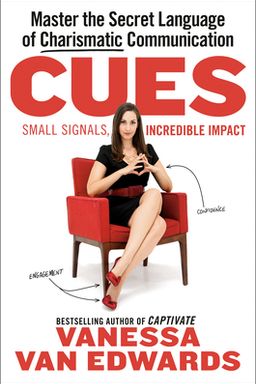
Cues cover

Cues

by Vanessa Van Edwards

In ''Cues,'' Vanessa Van Edwards reveals how mastering nonverbal communication can transform your professional life. Learn to balance warmth and competence, interpret body language, and use intentional cues to build trust and achieve success.

Mastering the Hidden Language of Charismatic Communication

Have you ever shared a brilliant idea only to find that people didn’t really listen? In Cues: Master the Secret Language of Charismatic Communication, behavioral researcher Vanessa Van Edwards argues that success, influence, and trust depend less on what you say and far more on the signals you send. She contends that charisma isn’t magic—it's science. Everyone, she writes, can learn to look, sound, and act more persuasive by mastering cues: those subtle nonverbal, vocal, verbal, and visual signals that shape how others perceive you.

Van Edwards begins by asking a deceptively simple question: What makes people charismatic? The answer lies in two dimensions—warmth (trustworthiness and likability) and competence (capability and confidence). Through research from Princeton and her own Science of People lab, she reveals that 82% of our impressions come from these traits. Leaders, professionals, and communicators who balance warmth and competence are perceived as both trustworthy and powerful—people want to follow them. But imbalance leads to trouble: too much warmth makes you likable but forgettable; too much competence makes you respected but cold.

The Hidden Power of Cues

From body language to tone, gestures to fonts, cues are the invisible language that tells the world who you are. We send and receive hundreds of them every minute, often unconsciously. Van Edwards defines four channels of cues—nonverbal, vocal, verbal, and imagery—each communicating warmth, competence, or danger. She explains that mastering them is really about aligning what you say with how you say it. The right combination projects authenticity, confidence, and clarity. The wrong combination—as in the author’s analysis of inventor Jamie Siminoff’s failed “Shark Tank” pitch—can sabotage even billion-dollar ideas.

Why Charisma Matters

Charisma, Van Edwards argues, is not innate—it’s learned. Doctors who fail to show warmth cues get sued more; entrepreneurs who neglect competence cues lose investors; leaders who can’t balance both fail to motivate teams. Every professional interaction, presentation, or first impression silently answers two questions: Can I trust you? and Can I rely on you? When people sense both yes’s, you fall into the “Charisma Zone”—the sweet spot of trust and credibility. When they don’t, you slip into the “Danger Zone,” where people feel uneasy and disengaged.

To build charisma, you must learn to decode cues in others and encode them in yourself. The book introduces the Cue Cycle: Decode → Internalize → Encode. You interpret others’ signals (decode), they affect your internal emotions (internalize), and you project corresponding nonverbal behaviors (encode). This loop influences not only relationships but also performance and morale (research at MIT showed positive cues spread inclusion and productivity).

The Science Behind the Magic

Van Edwards blends classic behavioral psychology (Paul Ekman’s facial expression research, Edward Hall’s proxemics, and Matthew Lieberman’s neuroscience on labeling) with relatable stories from Shark Tank, Disney, and Netflix. She uses examples like Leonardo da Vinci’s Last Supper to show how great communicators—from Christ to Coco Chanel—have visually encoded competence and warmth cues for centuries. Da Vinci painted Christ with one palm up (trust) and one down (power), head tilted (engagement), and body expanded (confidence)—a timeless mastery of signifying charisma through art.

The Roadmap of the Book

After revealing these foundations, Van Edwards guides readers through each cue channel in depth. She teaches the nonverbal charisma of open posture, fronting, eye contact, space management, and gestures. Then she transitions to the vocal cues of power and warmth—controlling pitch, volume, pauses, and tone to sound authoritative but approachable. Later, she unpacks verbal cues, showing how word choice (“together,” “efficient,” or “innovative”) drastically alters perception. Finally, she explores imagery cues—color, symbols, and design choices that visually convey confidence and trust.

Ultimately, Cues is a manual for social intelligence in the modern world. It teaches you to read behind the words—to sense when a colleague’s crossed arms mean anxiety, when your own distancing gestures kill influence, or how a smile changes memory and emotion. These skills can transform how people respond to you in meetings, relationships, and leadership. Van Edwards reframes charisma as a learnable system, not an innate gift. Mastering cues, she concludes, isn’t about performing—it’s about aligning who you are with how you show it.

“Balance warmth and competence cues to be charismatic.”

That’s Van Edwards’s core message—be authentic, intentional, and aware. When your signals match your substance, charisma becomes your natural language.


The Body Language of Leaders

Van Edwards argues that body language is the fastest and most visible expression of charisma. In Chapter 3, she uses examples ranging from pediatrician Dr. Kofi Essel to basketball player John Stockton to demonstrate how small physical cues—posture, gesture, and space—build trust and connection before a single word is spoken.

Lean Like a Leader

The simple act of leaning forward, she writes, activates motivation in the brain’s left frontal cortex. When you lean in, you signal engagement and curiosity; when you lean back, you appear detached. Dr. Essel leans down to meet children at their eye level, instantly signaling that he respects and understands them. This cue helped him build trust both with young patients and their parents. (In contrast, lean-back gestures often appear cold or uninterested—a finding that echoes Albert Mehrabian’s classic studies on posture and attraction.)

Open Body, Open Mind

Crossed arms and blocked torsos communicate defensiveness. Van Edwards recounts how entrepreneur Brian Dean boosted online conversions by swapping a photo of himself with arms crossed for one with open body posture—leading to a 5.4% increase in customer engagement. The lesson: a closed body signals a closed mind. Removing barriers, like moving a computer aside when speaking to colleagues, improves rapport and creativity. (Amy Cuddy’s power poses similarly link openness and confidence.)

Front Forward

In her concept of fronting, turning your “toes, torso, and top” toward someone shows attention and respect. Basketball legend John Stockton used fronting to nonverbally signal passes, enabling an uncanny connection with teammates. In everyday life, fronting tells someone “I’m listening fully.” Failing to front—like talking while facing your phone—creates emotional distance.

Space and Respect

She draws on anthropologist Edward T. Hall’s proxemics to explain our “space bubbles”: intimate (within 18 inches), personal (to 4 feet), social (up to 7 feet), and public (beyond 7). Leaders manage these zones skillfully. In meetings, sitting close signals collaboration; sitting far signals authority. Van Edwards encourages strategic “nonverbal bridges”—like passing a pen or leaning slightly forward—to safely enter someone’s personal space without threat.

Engage with Gaze

Eye contact isn’t just politeness—it’s biochemical. Mutual gaze triggers oxytocin, the bonding hormone. It even helps synchronize brain waves between people. Quoting neuroscientist Simon Baron-Cohen’s “Reading the Mind in the Eye” test, Van Edwards shows how recognizing emotion from minimal eye cues builds empathy and trust. Gaze direction also cues attention—looking up and to the right signals optimism, while darting eyes cue avoidance.

“Turn toward is tuning in.”

Leaders, Van Edwards stresses, communicate purposefully with their bodies: lean in, open up, front forward, and gaze with intention to radiate trust and confidence.


The Wow Factor: Using Warmth Cues

Van Edwards describes warmth cues as the invisible glue of human connection. Drawing lessons from Disney’s “Wow Factor” training, she shows how small gestures—smiling, nodding, tilting, touching, and mirroring—create delight and trust. For Disney employees, these cues generate the park’s 70% customer return rate; for you, they can create loyalty and rapport in any relationship.

Head Tilts and Nods

Tilting the head exposes the neck’s carotid artery—a subconscious cue of openness and interest. Used sparingly, it expresses curiosity and empathy. In contrast, excessive tilting can lessen authority. Similarly, Van Edwards calls nodding the “ultimate warmth cue.” Research on juries and interviews shows that slow, deliberate nods increase agreement and encourage others to talk up to 67% longer. A triple nod—“I hear you, I hear you, I hear you”—signals deep listening and patience.

Eyebrow Raises and Smiles

Raised eyebrows signal curiosity and engagement (“tell me more”). They’re universal indicators of interest. Van Edwards even cites astrophysicist Neil deGrasse Tyson, who tested readers’ eyebrow raises in conversation to decide which facts to include in his bestseller. Meanwhile, “savor smiles”—those that slowly bloom across the face—are rated as most attractive and memorable. Genuine smiles activate eye crinkles and the orbitofrontal cortex, stimulating our brain’s reward system. Fake smiles, Disney warns, are useless.

Touch and Mirroring

Touch releases oxytocin—the ‘chemical of warmth.’ Van Edwards notes that teams who physically high-five win more games, and servers who simply touch a customer’s arm get 23–40% higher tips. Touches must fit cultural zones: hands and forearms are safest in professional settings. In digital spaces, she recommends “verbal touches”: saying “virtual hug” or “air high five” to cue connection even remotely.

Mirroring, another warmth cue, means subtly matching posture, tone, or gestures. Research from MIT shows mirrored negotiators earn 20–30% higher salaries. Done subtly, mirroring tells others “you belong here” and creates empathy; done excessively, it feels manipulative. The goal is to mirror positive energy, not negative moods.

Warmth cues inspire creativity, openness, and trust. When you tilt, nod, smile sincerely, and mirror thoughtfully, you spark loyalty and cooperation—the essence of the Wow Factor.


Looking Powerful: Competence Cues

In contrast to warmth cues, competence cues project capability, intelligence, and leadership. Van Edwards dissects nonverbal behaviors that signal command—posture, gaze, gesture, and control. Her case study of the 1960 Kennedy–Nixon presidential debate captures the impact perfectly: Nixon’s nervous gestures, shifty eyes, and sweaty self-soothing made him lose credibility; Kennedy’s calm posture and direct gaze helped him win America’s trust.

Power Posture

Taking up space—rolling shoulders down, widening stance—instinctively communicates confidence. When participants used expansive posture, they felt more powerful and less stressed (a finding similar to Amy Cuddy’s “power pose” research). The more grounded your stance, the more credible you appear. Van Edwards advises subtle adjustments: inch-wide feet stance, hands relaxed, shoulders lowered.

Steepling and Lid Flex

The steeple gesture—palms facing, fingertips touching—embodies quiet confidence and focus. Politicians like Angela Merkel and Theresa May use it to signal thoughtful authority. It’s expansive but relaxed, combining openness (visible palms) and control (composed hands). By contrast, the lower lid flex—hardening your lower lids—shows determination and critical thinking. It says, “I’m analyzing this.” But holding it too long may appear judgmental.

Gestures That Explain

Her concept of “explanatory gestures” reveals how hand movement clarifies thought. Psychologist Susan Goldin-Meadow’s work backs this up: people who gesture while speaking think more clearly and communicate better. Van Edwards found that popular TED Talk speakers used an average of 465 purposeful gestures—almost twice as many as less successful speakers. Gestures showing numbers, size, or direction make messages more memorable.

Palm Power and Interrupt Control

Palms grab attention. Open palm flashes cue honesty and confidence—leaders like Evita Perón used them historically to move crowds. Palms up invite participation; palms down quiet a room. Van Edwards even prescribes cues to stop interruptions, such as the “bookmark” (raising a finger to hold the floor) or “anchor touch” (lightly touching a forearm to reclaim attention). These techniques turn chaos into clarity.

Competence cues aren’t aggression—they’re composure. Stand tall, gesture wisely, and speak through your presence. Power isn’t louder; it’s steadier.


Sound Powerful and Likable

Your voice is a charisma instrument. Van Edwards explores how tone, pitch, volume, and pauses alter perception more than content. Across chapters 7 and 8, she demonstrates how vocal power builds competence and vocal warmth creates likability—each crucial for influence.

Confidence Through Pitch and Pauses

Low, calm pitch communicates authority. When nervous, pitch rises and credibility drops. Lowering to your “lowest comfortable note” boosts both confidence and cognition. Similarly, purposeful pauses signal control and allow ideas to land. She warns against vocal fry (crackly rasp from low breath) and filler words (“um,” “you know”)—both erode authority. Pausing for a breath instead creates power and clarity (echoing Nancy Duarte’s recommendation for silent emphasis in speeches).

Volume and Question Inflection

Speaking slightly louder than average indicates emotional control; whispering often signals insecurity. However, variation is key—lower your volume for secrets, raise it for enthusiasm. Beware of accidentally asking your statements with uptalk (“It’s $500?”). Van Edwards shows this subtle mistake cost a salesperson named Elliott his commissions; fixing tone fixed his sales record.

Vocal Warmth and Emotion

Warmth is the soul of your tone. Saying “hello” on an exhale—relaxed and genuine—immediately sounds friendlier. Margaret Thatcher famously retrained her voice to balance command with empathy, slowing pace and deepening tone to become Britain’s “Iron Lady” without losing human connection. Smiling while speaking infuses warmth into your voice, literally shifting its acoustic properties.

Inviting and Mirroring Vocally

Van Edwards introduces “vocal invitations”: subtle listening sounds (“mm-hmm,” “aha”) and verbal nudges (“go on,” “really?”) that cue engagement. Mirroring how others speak—tone, rhythm, vocabulary—builds faster rapport. She references the Starbucks barista who encouraged a customer’s order through joyful vocal affirmations until both felt energized. Charismatic speakers, she concludes, move flexibly between vocal power and warmth, sounding both credible and kind.

“Speak on the out breath.”

Your voice carries your confidence—when it flows calmly and warmly, people don’t just hear you, they feel you.


Communicating with Charisma: Verbal Cues

Words are visuals in disguise. Van Edwards teaches how language itself cues warmth and competence. The right phrasing transforms dull communication into charismatic leadership. Her opening story—Hotmail’s viral “PS: I Love You. Get Your Free Email”—illustrates that a single sentence balanced emotional warmth (“I love you”) and practical competence (“Get free email”), triggering a $400 million acquisition.

Warm vs. Competent Words

Warm words express collaboration, optimism, and trust: connect, together, happy, share. Competent words convey skill and results: effective, strategic, research, power. Charismatic words like “creative” or “confident” blend both. When paired intentionally, they prime positive neural maps in listeners—the same subconscious emotional associations that marketers exploit (like in The Human Brand by Fiske and Malone).

Emails, Meetings, and Openers

Van Edwards demonstrates how sterile phrasing (“I’m all set for the meeting”) can be revived with charisma cues (“I’m looking forward to collaborating next week”). Small adjustments—adding joy, gratitude, or teamwork—change tone and openness. She encourages charisma audits: count warm versus competent words in your last five emails. Balanced messaging sustains both trust and authority.

Inspiration and Information

Warm audiences crave inspiration—stories, humor, metaphors. Competent audiences crave information—data, studies, facts. Companies like Casper blend both with taglines such as “Obsessively engineered. Outrageous comfort.” Balancing emotional appeal with practical proof attracts diverse listeners. Private conversations follow similar rules: high-warmth personalities open to laughter and empathy, high-competence ones to precision and efficiency.

Verbal Mirroring and Compliments

Finally, being a “verbal chameleon”—subtly mirroring others’ phrasing—boosts connection. Servers who repeat customers’ exact words earn 70% higher tips; negotiators who mimic tone achieve better outcomes. Compliment people in their charisma language: tell warm people “You make everyone feel comfortable,” and competent ones “You always know what to do.” Truthful, tailored praise builds trust faster than flattery.

Your words cue emotions. Every sentence can either open or close the door to connection—choose the ones that invite curiosity and respect.


Creating a Powerful Visual Presence

In the final section, Van Edwards illuminates how visual imagery—color, design, environment, and nonverbal branding—communicates charisma before you speak. Every choice, from font to lighting to wardrobe, sends psychological cues to others’ brains.

Neural Maps and Visual Metaphors

Seeing the moon over the ocean makes people think of “tide.” That’s how imagery activates related concepts. Brands like Sugarfina designed candy boxes resembling Tiffany jewelry packaging to trigger associations with luxury. Fonts create personality too: serif fonts like Times New Roman signal seriousness; handwritten fonts like Northwell cue creativity and warmth. (Research shows aesthetics reduce facial tension and improve idea retention.)

Nonverbal Branding

Your wardrobe, props, and background are your “nonverbal brand.” Comedian David Nihill accidentally created his when he rolled up his sleeves to hide shrunken shirts; colleagues saw him as a “problem solver.” Accessories—from glasses to bow ties, pearls to fedora hats—define recognizable identities (think Prince, Sinatra, Coco Chanel). Choose props, décor, and attire that consistently communicate your values.

Color Psychology and Bias Cues

Colors subconsciously cue emotion. Red signals action and power; blue triggers calm and trust; green suggests eco-consciousness and vitality; yellow evokes joy but can cause fatigue. Strategic use of brand colors builds recognition and emotional consistency. But beware “bias cues”—unconscious associations tied to gender, race, or appearance. Van Edwards recommends being aware of biases (via Harvard’s Project Implicit) and using counter-cues—like professional attire and confident body language—to reshape perception.

Principle: Visuals Shape Attention

Netflix found 82% of viewers choose shows based on thumbnails—images with few characters and complex expressions perform best. Visual presentation matters everywhere: slides, offices, Zoom backgrounds. A lawyer’s “shark head” sign outside his door says “I’m fierce”; a dermatologist’s spa décor says “I’m gentle.” Pick cues deliberately: competency symbols (certificates, books) or warmth symbols (plants, family photos) depending on message.

Every environment is a silent communicator. When your surroundings, colors, and objects align with your intention, they speak powerfully for you—even before you say a word.


Charisma in Practice: Becoming Intentional

In her conclusion, Van Edwards ties all cues together into a blueprint for intentional communication. Charisma isn’t performing—it’s aligning your cues with your goals. She distills her research into practical rules.

Expect the Best

Interpreting cues isn’t about judging others but understanding them. She cites studies showing that people who assume good intent read emotions more accurately. Context always matters: folded arms might mean cold, not defensive. When you approach cues with empathy, accuracy improves.

Don’t Fake It—Align It

Authenticity outlasts performance. You can’t fake competence or warmth for long; it’s exhausting and transparent. True charisma requires believing in your message and feeling genuine respect for others, which makes alignment natural. Van Edwards echoes Dale Carnegie’s timeless principle: “Become genuinely interested in others.”

The Rule of Three

Try every cue three times—decode it, encode it, internalize it—to see what fits you. She provides charts mapping cues by category: leaning, fronting, nodding, steepling, speaking tone, gesture, and visual setups. Over repetition, cues become habits of authenticity. The goal is not perfection but mindfulness.

Ultimately, Cues teaches you to control your first impression, connect deeply, and communicate intentionally. Charisma is teachable—but mastery takes practice. Van Edwards ends with gratitude and encouragement: expect the best, express the truth, and use cues to highlight who you already are.

“The most charismatic people move flexibly within the Charisma Zone.”

Warmth and competence are dials, not labels. Adjust them consciously and the world tunes in with you.

Dig Deeper

Get personalized prompts to apply these lessons to your life and deepen your understanding.

Go Deeper

Get the Full Experience

Download Insight Books for AI-powered reflections, quizzes, and more.