
Idea 1
Building Wealth Through Simple, Disciplined CRE Investing
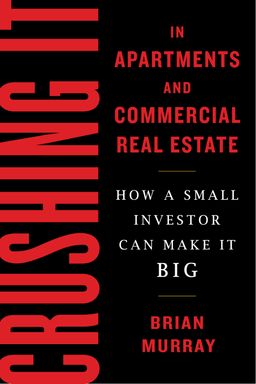
How can you turn modest beginnings into a growing portfolio of commercial real estate (CRE) assets? In Crushing It in Apartments and Commercial Real Estate, Brian Murray argues that long-term wealth in property is not built on complexity or luck, but through disciplined management of a few core principles: mastering fundamental financial metrics, exploiting your local and informational advantages, preserving cash, and operating with integrity. His central claim is simple but profound—financial independence comes from understanding the math of real estate and having the grit to apply it consistently.
To thrive in CRE, you must first understand how properties make money. Murray’s shorthand is NOI—Net Operating Income—which distills each building into a single, comparable performance number. Once you master NOI and its companions—cap rates, leverage, DSCR, and LTV—you gain the language lenders, buyers, and sellers use to evaluate deals. The goal isn't advanced math—it’s clarity. Cash flow, leverage, and compounding are the rocket fuel; understanding them lets you bootstrap your way to scale.
The Simple Formula Behind the Business
At its core, commercial property is valued by its ability to generate income. NOI equals a property's revenue minus operating expenses (excluding loan payments). That number, when divided by a market capitalization rate, gives approximate market value. Murray’s 30‑unit example demonstrates how a $100,000 NOI at a 10% cap rate equals a $1 million valuation. The insight is transformational: to increase value, you must increase NOI—by boosting income or cutting expenses.
That mechanical relationship between income, expenses, and value demystifies CRE. Value-add strategies—renovations, operational efficiencies, or retenanting—work because they increase NOI. A $10,000 renovation that earns an extra $6,000 per year at a 9% market cap adds roughly $66,000 in appraised equity. Once you internalize this connection, every decision becomes a strategic lever for creating equity. (Comparable lessons appear in Ken McElroy’s The ABCs of Real Estate Investing, but Murray grounds them in his own small-town case studies.)
Bootstrap, Persist, and Protect Cash
Murray’s philosophy intertwines financial prudence and personal grit. Early in your journey, you become your own staff—leasing agent, maintenance tech, and bookkeeper—not because it’s glamorous but because every saved dollar can fund the next deal. His own story—working out of a basement cubby and keeping his teaching job for seven years—reflects this principle. Bootstrapping, he insists, is about resourcefulness, not deprivation: use what you have, redirect revenue back into your properties, and let the snowball build.
Grit ties the entire narrative together. You win not by brilliance but by surviving long enough to let compounding work. Murray references Angela Duckworth’s definition: passion and perseverance for long-term goals. Persistence—shoveling snow yourself at dawn, reinvesting every spare dollar, and tolerating long feedback cycles—is what separates enduring investors from speculators chasing quick wins.
Local Knowledge and Underwriting Discipline
Being local creates an “unfair advantage.” You spot opportunities others miss—small retail plazas, self-storage gaps, neglected downtown assets—because your relationships and proximity provide real-time data. Murray’s Solar Building story illustrates this beautifully: his familiarity with the neighborhood and prior ownership history allowed him to buy a troubled but fixable property at auction while institutional buyers avoided it. The takeaway: proximity and information become tangible financial edges.
Yet local insight is useless without underwriting discipline. Murray translates lender logic so you can align with it. Banks focus on two numbers: Debt Service Coverage Ratio (NOI divided by debt payments) and Loan‑to‑Value ratio. Keep DSCR above 1.2 and LTV below 80%, and you’ll stay bankable. These thresholds serve not just lenders—they’re your defense against overleverage in market downturns.
Operate Like a Business, Not a Hobby
Real estate is a living business, not a vending machine spitting out rent checks. Run it with intention: track expenses monthly, know every tenant, and treat your properties as brands that serve customers. Murray’s operational mantra—disintermediate middlemen and standardize processes—turns management from chaos into repeatable systems. By creating documented workflows for maintenance, leasing, and accounting, he builds a “factory” that can scale. When done right, this allows you to transition from owner-operator to CEO.
Tenant strategy—selecting compatible tenants, pricing correctly, and retaining the good ones—is central to this business mindset. In his Winston vs. Judy comparison, Murray proves that fast lease-up at fair rents beats holding out for higher rents and prolonged vacancies. Complementary tenants create ecosystems that compound value through stability and word-of-mouth.
Integrity and Balance as Competitive Advantages
Finally, the book closes on ethics and sustainability of effort. Murray argues that integrity and kindness pay long-term dividends: returning a tenant’s misplaced cloth diapers overnight built trust that no marketing budget could buy. In this business, reputation compounds as powerfully as interest. Fairness with contractors and respect for tenants reduce churn and conflict—the silent killers of NOI.
Yet success means nothing if you burn out or neglect your health and family. Recounting his own near burnout, Murray invokes Brian Dyson’s analogy: work is a rubber ball; family and health are glass. Protect them, and your business will benefit. Sustainable wealth arises when financial mastery, ethical practice, and personal balance coexist.
Core takeaway
Learn the math, respect the relationships, protect your cash, and play the long game. Murray’s story and principles fuse technical discipline with human values—proving that the simplest, most ethical path in real estate is usually the most profitable one.