
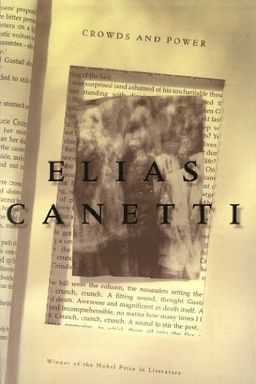
Crowds and Power cover

Crowds and Power

by Elias Canetti

Elias Canetti''s ''Crowds and Power'' provides a prophetic analysis of human groups and power dynamics. This erudite study explores why individuals seek crowd membership and how leaders exploit this instinct, using wide-ranging historical and cultural references.

The Human Crowd and Its Transformations

Canetti’s book revolves around a daring claim: crowds are the most revealing form of human behavior. Every order, ritual, panic, and collective act is, at its root, a transformation of crowd feeling. To understand society, you must first understand what happens when people cease being individuals and merge into one living mass.

Canetti traces this phenomenon from prehistoric hunting bands to parliaments and modern revolutions, showing how small packs mutate into massive crowds that shape religion, nationalism, and power. His method moves from anthropology (Aranda, Pueblo, Shiite rituals) to psychology (Delirium Tremens, paranoia) to politics (Weimar inflation, fascism). Everywhere, he reveals the same pulse: survival through collective density and direction.

Four attributes of the crowd

The crowd, Canetti says, can be diagnosed by four attributes: growth, equality, density, and direction. Crowds always want to grow; they annihilate hierarchy; they treasure bodily closeness; and they orient themselves toward a goal. These traits appear in open crowds that recruit endlessly and closed crowds that preserve themselves through ritual limits. Open crowds risk explosion or disappearance; closed ones create traditions, churches, and institutions that delay discharge.

From pack to society

Before there were crowds, there were packs—the proto-crowds of hunters and warriors. Packs are small but intense; their members act with identical purpose and imitate one another’s movements. From these small circles come the larger patterns of crowd and religion. Canetti traces this evolution through ritual transmutations: hunting becomes lamenting, lament becomes increase, and religious processions emerge as descendants of the pack frenzy. Every human institution conceals an ancient choreography of pursuit, killing, mourning, and renewal.

Emotion, rhythm, and discharge

Crowds can be classified by feeling: baiting (killing), flight (escape), prohibition (refusal), reversal (revenge), and feast (abundance). These emotional patterns recur in revolutions, strikes, pilgrimages, and sports. Their energy builds through rhythm—the synchronized feet of dancers or soldiers—and through patient stagnation, as in pilgrim crowds awaiting revelation. The moment of discharge, when equality is felt in a flash, becomes both ecstasy and danger. Every eruption of violence or communal joy repeats this ancient mechanism.

Symbols and nations

Crowds imagine themselves through symbols. Fire spreads like contagion; the sea embodies inclusion; forests stand as upright formations; cornfields mirror harvest and war. Nations, too, adopt crowd symbols: Germany found itself in army and forest; England in the sea; France in the revolutionary crowd; Spain in the bullring; and the Jews in the Exodus. These images orient collective behavior—they dictate how people march, worship, fight, and recall their unity.

Power, commands, and survival

Canetti’s second major theme explores how crowds consolidate into systems of power. Commands, he argues, originate as the predator’s roar—the threat that causes flight. Every obedience leaves a “sting,” a psychic imprint that drives cycles of domination and revenge. Rulers institutionalize this by controlling bodies, secrets, and speech. In extreme cases, power becomes literal incorporation—the devouring of subjects by the sovereign’s hand and mouth. Survival then becomes power’s final logic: whoever remains alive after the catastrophe gains authority. The survivor, whether king, despot, or hero, monopolizes life itself.

Transformation and its limits

Beyond power lies transformation: the dream of becoming other without dying. From Bushman presentiments where hunters feel an animal’s wounds in their own flesh, to totemic myths where ancestors birth and consume their doubles, Canetti follows transformation as a continuity from ritual to delirium. Linear and circular metamorphoses—flight and confinement—reveal the psychological rhythms of mania and hysteria. Masks and figures freeze these transformations into art and authority; unmasking exposes their truth, often destructively.

Modernity and non-lethal warfare

Modern institutions translate crowd instincts into safe rituals. Parliament and voting transform lethal battle into numeric measurement. The ballot’s secrecy performs the ancient function of the protected fighter who counts rather than kills. Similarly, production crowds and inflation crowds reveal desire for infinite growth—now expressed through money and machines. Yet these forms hide massive humiliation and the peril of survival-based leadership that prizes endurance over empathy.

Why it matters

Canetti’s analysis is both anthropology and warning. The crowd’s energy built civilization, but its instincts—growth, equality, and discharge—can destroy it when exploited by paranoia or technological amplification. When you study crowds, you recognize the threads binding ritual, economy, and politics; you learn that power feeds on the same rhythms that once drove hunters and mourners. The challenge is not to eliminate the crowd impulse, but to domesticate it—to create forms of togetherness that build without devouring.


The Anatomy of Crowds

To grasp Canetti’s central tool—the crowd typology—you need to read the four core attributes and the open/closed distinction together. These notions are diagnostic instruments that let you decode any collective, from a pilgrimage to a riot.

Growth and Equality

A crowd always wants to expand; this hunger reflects its fear of dissolution. Its members feel safety only in increase. Equality emerges simultaneously—status and distinction fade when bodies press together. A head is simply a head. That equality produces the temporary joy people seek; it neutralizes social wounds. (Note: Modern gatherings like stadiums showcase this—the shared chant fuses thousands into numerical sameness.)

Density and Direction

Physical contact anchors crowd feeling. As density grows, the group feels real, immune to dispersal. Direction then converts sensation into aim—marching, killing, worshipping. The crowd’s morality depends less on its goal than on its collective cohesion; any shared aim will suffice.

Open vs Closed

Open crowds recruit freely: they flood streets and feed on new arrivals. When their growth halts, they collapse or erupt destructively. Closed crowds guard boundaries: churches, theatres, stable rituals. They trade expansion for endurance. When tension exceeds limits, closed forms erupt into open frenzy—a mechanism that explains revolutions born from religious or social institutions.

Discharge and Eruption

The discharge is the ecstatic instant of equality—the climax when division evaporates. It resembles lightning striking across hierarchy. This energy both fulfills and imperils crowds: once discharged, they either dissolve or seek repetition through violence or new gatherings. Eruptions signal a shift from containment to exposure, as closed crowds break their boundaries, filling streets or history with sudden transformation.

Key takeaway

Every crowd oscillates between hunger for expansion and fear of loss; the discharge temporarily resolves this tension, revealing the deep emotional core that drives collective life.

These mechanisms persist from ancient rites to modern protests. When you watch any mass event, ask: is it open or closed, rhythmic or stagnant, and how is equality produced? Canetti’s anatomy gives you a lens for understanding where unity turns into chaos.


From Pack to Ritual

The pack is Canetti’s origin point—the compressed, immediate form of human association. Small groups of hunters, mourners, warriors and celebrants embody the instincts later expanded by crowds. Packs act with coherence and intimacy, and from their dynamics, culture arises.

Pack types and their logic

Hunting packs chase and distribute kills, forming rules of sharing; war packs apply these to enemies; lamenting packs channel grief through self-wounding; increase packs ritualize fertility and growth. Each enacts direction and equality in concentrated form. Their transformations feed history: a hunt becomes a lament when a man dies; a lament becomes a rite for increase; over time these evolve into religion.

Pack transmutations and religion

Canetti shows this through the Aranda and Pueblo examples. The hunted kangaroo Ungutnika’s four resurrections fuse killing with fertility; the Pueblo rain ceremonies translate increase into agricultural patience. Shiite lament rituals for Husain demonstrate the opposite: grief crowds becoming institutions of faith. These transformations reveal how religion stores and domesticates instinctual crowd energy.

Crowd crystals and social permanence

Packs endure as crowd crystals—small, organized nuclei like priesthoods, fraternities and military corps. They carry formulas of excitation; when broader society needs mobilization, these dissolve into open crowds. Monks, soldiers and processional teams are modern continuations of ancient packs that catalyze collective eruption.

Insight

Religion and ritual are not moral phenomena first; they are techniques evolved from pack behavior to store, rechannel and safely release crowd impulses.

By tracking the pack’s metamorphoses, you see how human collectivity developed continuity: hunger becomes prayer, lament becomes liturgy, increase becomes production. The pack is the embryo of all group forms, and its structure still animates armies, corporations, and cults today.


Symbols and National Crowds

Crowds express themselves through symbols—natural, material, and national. These are metaphoric bodies that mirror collective attributes like density, continuity and movement. Recognizing them helps you decode the psychic identity of entire societies.

Natural crowd symbols

Fire spreads fast and consumes boundaries, imaging contagious passion. The sea stands for endlessness and constancy. Forests evoke vertical density and discipline; cornfields echo harvest, repetition and mortality. Rain and sand signify discharge and infinity—clouds gathering and dissolving into drops, countless particles symbolizing progeny.

National applications

Germany’s forest becomes its army—upright trunks as disciplined soldiers; England identifies with the sea’s boundlessness; France relives the Revolution annually; Switzerland locates unity in mountain chains; Spain crystallizes its feeling in the bullring with the matador as hero; the Jews preserve the Exodus—a moving crowd under law—as perpetual memory. Each nation’s rituals and politics stem from its chosen symbol.

Symbolic psychology

Symbols dictate how a people gathers and defends itself. The forest teaches unity through discipline, the sea through isolation and exploration, the revolution through renewal. Canetti warns that nations with conflicting crowd symbols—like Italy torn between Colosseum and St. Peter’s—suffer identity dissonance that breeds social vulnerability.

Key insight

Crowd symbols are collective mirrors; by reading them, you uncover how nations imagine their unity, endurance and threat.

When you recognize symbols as embodied crowd emotions, you see that patriotism, religion and art are not separate fields but shared technologies for reproducing collective identity.


Power, Command, and Domestication

Crowd energy condenses into command when one voice or body controls others. Canetti reconstructs command as a remnant of the predator’s roar—a condensed moment of threat and obedience. From that primal act, all hierarchy unfolds.

Sting and obedience

Obeying a command installs a sting in the psyche—a precise mimic of the compelled action. The sting never disappears; it can only be discharged by imposing a similar order on others. This self-perpetuating cycle explains how domination reproduces itself across generations, from slaves to soldiers.

Domestication and secrecy

Power tames the sting through reward and protection. Domesticated commands are wrapped in food, pay or favor. But secrecy multiplies fear: rulers hoard knowledge, distributing fragments among subordinates. Control of secrets becomes modern royal prerogative—seen from ancient monarchs to bureaucratic surveillance states.

Extreme obedience and pathology

Executioners kill to rid themselves of stings; castrates ritualize obedience; psychiatric cases overloaded with commands become negativists, resisting or reversing orders. In these extremes you see command’s origin in terror and its end in fragmentation.

Take-away

Commands are echoes of ancient death-threats. Wherever you see obedience, secrecy, or promotion, you are watching stings being transferred and temporarily soothed.

Understanding this helps you read politics not as policy but as ritualized sequences of predator and prey—the human inheritance of survival turned into rule.


Transformation, Masks, and Identity

Transformation, for Canetti, is the psychic counterpart to crowd fusion—the act of changing form to gain power or escape death. He examines mythical, ritual and clinical cases to expose transformation’s structure and its misuse by rulers.

Presentiments and nodes

Bushman hunters sense animals through bodily equivalence—feeling a wound or mark precisely where the prey bears it. These nodes show transformation as local and controlled: point-by-point correspondence rather than mystical unity. Transformation begins as learned mimicry.

Linear and circular metamorphoses

Flight myths alternate pursuit and escape—mouse versus cat, fish versus net. These “linear” transformations mirror mania: restless motion and creativity. “Circular” ones, like Proteus held by Menelaus, mirror hysteria—frantic variation within constraint. Shamans use circular transformation to master spirits, while melancholics turn it inward, imagining dissolution and consumption.

Masks, figures and unmasking

Figures crystallize transformation into worshipped form—man-gods, totem ancestors. Masks mediate between living and figure, freezing expression. Rulers use masks for benevolence and unmasking for purge. The donkey in tiger skin parable shows dissimulation’s logic: disguise grants momentary power; exposure brings death. Paranoia arises when unmasking becomes obsession, reducing all difference to threat.

Core insight

Transformation is humanity’s oldest survival tactic. Masks preserve its gains; paranoia exposes its costs.

By connecting mythic transformation to political disguise, Canetti teaches that identity management—the art of appearing and revealing—is power’s most subtle instrument.


Money, Survival, and Modern Crowds

Modernity inherits crowd instincts through economics and politics. Inflation and voting embody continuation of growth and measurement impulses within controlled frameworks.

Inflation and humiliation

Money acts as a crowd symbol—coins and millions represent collective quantity. Inflation enlarges numbers while eroding value, producing collective humiliation. Germans after World War I experienced moral collapse as their currency lost worth; that wound was exploited politically to redirect humiliation toward scapegoats. Inflation thus replicates the crowd’s destructive discharge in economic form.

Voting as non-lethal battle

Parliaments ritualize conflict safely. The vote measures numerical strength without bloodshed. Immunity of members preserves the exclusion of death—a modern miracle turning slaughter into counting. When secrecy or fairness weakens, lethal logic returns, threatening democracy’s crowd equilibrium.

Survival and paranoia

Ultimately, power distills into survival—the ruler’s obsession to remain standing while others fall. Historical despots and Schreber’s delusions reveal how survival breeds paranoia: the fear of rivals, the isolation of kings, and the desire to erase other survivors. In nuclear modernity, this impulse escalates—a single survivor could end humanity while fearing his own extinction.

Final reflection

The modern world is a domesticated battlefield; numbers, votes, and currencies continue ancient crowd instincts for growth and dominance. Recognizing them is vital to prevent their return as real destruction.

Canetti’s conclusion warns you: crowd energy—once sacred in ritual—is now mechanical in politics. Only awareness of its origins can stop it from devouring its creators again.

Dig Deeper

Get personalized prompts to apply these lessons to your life and deepen your understanding.

Go Deeper

Get the Full Experience

Download Insight Books for AI-powered reflections, quizzes, and more.