
Idea 1
Bridging Innovation and the Mainstream
Have you ever wondered why some groundbreaking technologies—brilliant, useful, and hyped by experts—never manage to reach ordinary customers? Geoffrey Moore’s Crossing the Chasm answers that question with laser-like precision. He argues that high-tech products don’t fail because they’re poorly designed or overpriced; they fail because innovators and marketers misunderstand how different groups of customers adopt new technology. The gap—or “chasm”—separates early enthusiasts from the pragmatic majority, and building a bridge across it is the defining challenge of every tech startup that hopes to go mainstream.
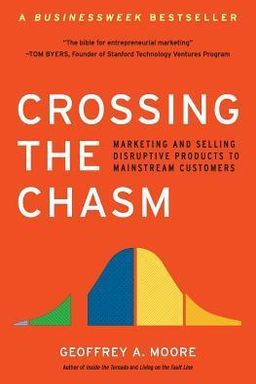
Moore contends that technology adoption unfolds along a predictable curve, often called the Technology Adoption Life Cycle. At one end are the optimistic “visionaries” who love bold new ideas. At the other are “pragmatists” and “conservatives” who only buy once the technology feels safe, easy, and proven. In theory, you might expect innovation to flow smoothly down this curve—from innovators to early adopters to the masses. But Moore’s key insight is that this flow almost always breaks down halfway. The visionary buyer and the pragmatic buyer have fundamentally different expectations, creating a yawning gap that swallows even brilliant products. Hence, “crossing the chasm” becomes the single greatest challenge in high-tech marketing.
Why the Chasm Exists
To understand the chasm, Moore explains that early adopters—the visionaries—buy for opportunity and change. They’re willing to take a risk on new, untested products to gain a competitive edge. Pragmatists, on the other hand, buy for stability and reliability. They want proven solutions backed by references from peers. When a company tries to sell a visionary product to pragmatic customers using the same approach, it almost always fails. The result is a technology stuck in limbo: admired by innovators but ignored by the mainstream. AI tools, blockchain projects, or early VR systems all illustrate this gap perfectly—products with visible promise but uncertain benefits for average buyers.
A Roadmap to Cross Safely
Moore’s whole book is a battle guide for crossing this treacherous stretch, borrowing metaphors from military history—especially the Allied invasion of Normandy on D-Day. “Pick the beachhead,” he advises. Instead of aiming for everyone, a company must focus all its resources on a single, small, well-defined target market niche. By winning that niche decisively—meeting all its unique needs, ensuring every user succeeds, and becoming the de facto standard—a company creates the credibility needed to attack larger markets step by step. Like D-Day forces, success depends on concentration, clear objectives, and follow-through.
To execute this strategy, Moore introduces concepts such as the whole product (the complete solution customers actually need to succeed, not just the gadget you ship), the “bowling alley” model for progressive niche expansion, and the “D-Day landing” metaphor for invasion strategy. His examples—Lotus 1-2-3 in spreadsheets, Oracle in databases, Cisco in networking, PalmPilot in personal devices—illustrate how focus, timing, and simplicity separate market leaders from forgotten inventors.
Why It Matters for You
This book matters because its lessons transcend technology. Whether you’re launching a product, a movement, or an idea, the dynamics Moore describes explain why early success often turns into midlife stagnation. You might win over enthusiasts who share your excitement, but scaling to skeptical, risk-averse groups is an entirely different skill. Moore’s model shows you how to make that leap—how to build “whole products,” unite teams around a focused goal, manage investor expectations, and craft a strategy for sustainable growth instead of flash-in-the-pan hype.
In short
Crossing the chasm isn’t just about products—it’s about empathy. It’s about understanding what different people value in innovation and designing your marketing, pricing, and distribution strategies accordingly. When you master that empathy, you don’t just sell a product—you create a movement from early enthusiasm to lasting adoption.