
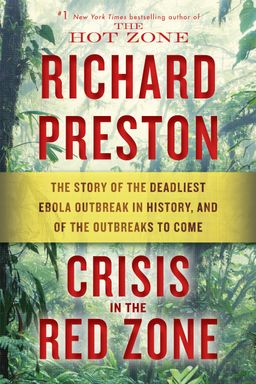
Crisis in the Red Zone cover

Crisis in the Red Zone

by Richard Preston

Crisis in the Red Zone offers a harrowing yet hopeful account of the 2014 Ebola outbreak in West Africa. Richard Preston vividly captures the virus''s deadly impact, the courageous efforts of healthcare workers, and the scientific breakthroughs that emerged, providing crucial insights into managing future epidemics.

Ebola: The Human Story Behind the Virus

How does a microscopic filament become a global crisis? In Richard Preston’s account, Ebola is not only a biological phenomenon but a mirror held to human care, fear, and courage. The narrative spans from the first known outbreak in Yambuku, Zaire (1976), to the devastating West African epidemic (2013–2014), showing that science, emotion, and ethics always intertwine when humanity faces an emerging virus.

The dual lens: science and humanity

Preston writes with two lenses—a scientific one that reveals Ebola’s molecular nature and an emotional one that captures the people who confront it. You learn the biology: a filovirus with six structural proteins and an RNA genome shorter than a tweet by comparison to human DNA, yet capable of replicating a thousandfold within eighteen hours. You also meet the humans in its path—nurses, priests, doctors—who touch, comfort, and die because they act with compassion without protection.

From Yambuku to Makona: how history repeats

The Yambuku outbreak of 1976 reveals the pattern of first contact: a hemorrhagic mystery, improvised clinical care, reused syringes, and the tragic infection of caregivers like Sister Beata and Father Germain. Decades later, the virus reappears in the Makona Triangle region—where a two-year-old boy named Émile Ouamouno plays by a hollow tree filled with bats. That simple act, possibly involving saliva or blood from wild animals, ignites a cascade that kills thousands across Guinea, Sierra Leone, and Liberia.

(Note: Preston mirrors David Quammen’s approach in Spillover, showing how human encroachment into wild habitats bridges viruses into our species.)

Science meets ethics

The book explores not just what the virus does but how people respond when knowledge and morality collide. Laboratory breakthroughs—like Jean-François Ruppol’s dry-ice transport and Fred Murphy’s electron micrograph identifying the filovirus—stand beside ethical decisions, such as whether to give Dr. Humarr Khan an experimental drug (ZMapp) during the 2014 epidemic. These stories force you to ask: What is justice when medicine is scarce? Who decides who lives and who dies?

The invisible infrastructure of outbreak control

Behind the scenes are logistics and genomics—the invisible backbone of outbreak science. Ruppol’s cold-chain ingenuity allowed the first samples to reach Atlanta intact; decades later, Pardis Sabeti’s War Room at Harvard used sequencing to track Ebola’s genetic evolution, watching a single amino acid change (A82V) improve its ability to infect human cells. These technical feats link science to survival, turning invisible RNA into concrete maps of transmission.

What this story teaches you now

The unifying idea is simple but profound: outbreaks are human events shaped by biology, behavior, and belief. Gloves, cold-chain logistics, and genomic data matter—but so do cultural rules about touch, burial, and trust. From Yambuku’s unsterilized syringes to Kenema’s nurses dying to save their colleagues, every act of care becomes both a moral and biological decision. Preston’s chronicle offers a timeless lesson: containment is not only scientific; it is social.

Core message

Ebola is an instruction in humility. It shows that life, science, empathy, and ritual are inseparable—and that the effort to contain a virus tests not only the limits of biology but the boundaries of what it means to be human.

As you move through each chapter—from the discovery of the virus to the genomic war rooms and moral crossroads of treatment—you realize that every pandemic is a mirror. It reflects how humans live, care, mourn, and adapt. Preston’s work reminds you that the smallest biological agent can reveal the largest truths about civilization itself.


The Birth of a Lethal Virus

The modern history of Ebola begins in 1976 at Yambuku Catholic Mission Hospital, Zaire. It starts with a midwife’s bare hand and ends with the discovery of a new viral species. The outbreak opens a window onto how ignorance, routine, and misplaced compassion can amplify contagion.

From clinical confusion to catastrophe

At Yambuku, a nun delivers a stillborn infant, reaches in without gloves, and begins a ripple of infection that kills nearly 90% of those exposed. The symptoms resemble severe malaria and yellow fever, leading caregivers to misdiagnose. J.J. Muyembé, a young virologist, enters the mission hospital to find abandoned wards soaked in blood. With no gloves or equipment, he takes samples using a pocket knife—acts as brave as they are fatalistic.

Discovery under duress

Muyembé’s samples nearly rot in transit. Only the logistic ingenuity of Jean-François Ruppol—who rents CO₂ tanks to generate dry ice—saves the mission’s scientific work. At the CDC, Fred Murphy’s electron microscope reveals a snake-like filament: an entirely new type of virus, a filovirus. Patricia Webb and Karl Johnson confirm the infection via monkey cell cultures. The unknown becomes known, and humanity earns its first look at Ebola.

Lessons learned—and still relevant

The Yambuku story defined the rules of hemorrhagic outbreak control: protect hands and mucous membranes, isolate the sick, and secure samples under cold conditions. It also exposed the spiritual peril of caregiving without protection—Father Germain’s gentle act of wiping a nun’s tears costs his life. The epidemic burned out only when villagers invoked the 'Ancient Rule': quarantine huts, burn corpses, and stop touching the sick.

Takeaway

The world’s first Ebola encounter proves how small, unguarded gestures—handwashing a patient, reusing a syringe—can cascade into catastrophe. It’s why today’s outbreak playbook begins with gloves, gowns, cold-chain logistics, and cultural adaptation.

By revisiting Yambuku, you understand that the discovery of Ebola was not just a scientific milestone but a moral lesson: in crises, compassion must be paired with caution, and every gesture of care must be reimagined as both salvation and possible infection.


Crossing Species in Meliandou

In 2013, a child’s simple play in a village called Meliandou reopened the world’s dialogue with Ebola. The Makona Triangle—where Guinea, Sierra Leone, and Liberia meet—was a living map of porous borders and shared traditions. Émile Ouamouno’s death reveals how a virus’s jump from nature to humanity can begin in a single breath, bite, or touch.

Ecology of a spillover

Meliandou sits at the intersection of cultivated land and shrines of forest that harbor bats. Children play under hollow trees filled with small mammals—'flying mice' that carry viruses across generations. When the tree burns, villagers harvest dead bats for food, folding ecology into culture. Investigators led by Fabian Leendertz find fragments of this scene, confirming no direct proof but strong likelihood that human contact with bat fluids seeded the Makona epidemic.

From single child to global waves

Émile’s illness killed his family in days; funerals spread viral particles across villages. Because borders were open and kinship rituals demanded touch, the virus rode affection from house to house. What looks like geographic coincidence is actually social continuity—the same behaviors that comfort the dying amplify the epidemic.

Lessons from the first case

The investigation ends without a definitive reservoir but with a clear moral: viruses occupy our blurred space between wilderness and humanity. Children’s curiosity and the human need to interact with animals create spillover events continuously. The Meliandou story is not about one unlucky family; it’s about a predictable ecological interface that exists wherever forests are fragmented and bushmeat persists.

Operational insight

Mapping risk means mapping relationships: between people, land, and animals. Prevention starts not in the lab but in how we live at the edges of ecosystems.

The Makona case teaches you that humanity’s frontier with the wild is not distant—it runs through backyards and children’s games. Each contact is a doorway, and viruses wait for moments of curiosity and tradition to walk through it.


When Ritual Becomes Transmission

Ebola spreads not through the air but through intimacy. The Menindor funeral in Kpondu shows how love and ritual can become epidemiological highways. When communities gather to mourn, they often construct perfect conditions for viral amplification.

Why corpses are dangerous

Ebola multiplies relentlessly until death—and remains alive within the body after it. The fluids of the dead—blood, sweat, vomit—contain millions of particles per square inch. When mourners wash bodies or collect ritual wash water, they literally pass infectious fluid from the dead to the living. Menindor’s funeral attracted hundreds; epidemiologists later traced over 300 cases to that single event.

Cultural blindness and data failures

Local reports mislabeled Kpondu as “Gbandu,” and an email alert to Kenema’s health team went unread due to power outages. Poor communication let the funeral proceed unhindered. The result was one of West Africa’s largest super-spreading events—born from love and ritual misunderstanding.

Cultural reengineering

Successful interventions later involved training locals in safe burial and creating surrogate rituals (symbolic cleansing, burial prayers without contact). These adjustments were painful but effective. They preserve dignity while destroying the virus’s human bridge.

Core lesson

Ebola exploits human affection. You cannot fight such a virus with medicine alone; you must reimagine the rituals of compassion that transmit it.

Whenever you design outbreak responses, treat funeral culture as virology in disguise. It’s where emotion and biology merge, determining whether grief heals or spreads death.


Kenema Hospital: Courage and Collapse

Kenema Government Hospital became both a stronghold and graveyard of resistance. Its Lassa Fever program, led by Dr. Humarr Khan and nurse Mbalu Fonnie, transformed overnight into an Ebola defense post. Their story captures the frontline’s mixture of heroism, exhaustion, and tragic contagion.

A system stretched to breaking

Built for Lassa fever, Kenema’s facilities lacked the scale for epidemic care. Power flickered, PPE ran short, and nurses reused Tyvek suits in the heat. Staff worked one-hour rotations because the suits suffocated them. When supplies dwindled, rules bent and infection slipped in through sweat-soaked fabric.

The chain of sacrifice

An ambulance driver enters a home without protection, infects nurse Lucy May, and the hospital’s moral center begins to unravel. Colleagues like Princess Gborie and Alex Moigboi fall while tending the sick; eventually, Dr. Khan himself succumbs. Genomic sequencing later proved that staff infected staff through acts of caregiving—a cruel echo of Yambuku’s first nurses.

Why hospitals fail first

Hospitals amplify outbreaks when protective systems and morale collapse. As nurses die, wards shut down, and fear replaces order. Even global partners—MSF and WHO—can only stabilize temporarily. Ethical dilemmas abound: should IVs be restricted to limit needle exposure? Should experimental drugs be given to leaders first? These are the choices that define medicine under siege.

Moral truth

An outbreak’s first casualties are often caregivers. Protecting and trusting them is not secondary—it is the foundation of containment.

Kenema reminds you that courage alone cannot sustain a hospital. You need communication, logistics, and the moral weight of shared protection. Without those, honor itself becomes deadly.


Genomic Science and the Makona Variant

The most modern dimension of Preston’s story occurs not in hospitals but in data labs. Pardis Sabeti’s War Room—an improvised coordination hub between Sierra Leone and Harvard—showed how genomics can turn invisible infection lines into maps of human behavior.

Sequencing as storytelling

Each viral genome carries its transmission history. The War Room built these stories by sequencing 78 samples from the Makona outbreak, discovering that all descended from one spillover event. They found the now-famous A82V mutation—an amino acid swap that made Ebola better at infecting humans. A molecular diary unfolded, proving evolution in real time.

Why genomics matters

Sequencing reveals direction—who infected whom, how fast mutations appear, and whether diagnostic tools remain accurate. The War Room released data publicly so other labs could adapt tests and track transmission. This transparency transformed genomics from academic pursuit to life-saving intelligence.

Coupling diagnostics with humanity

PCR tests from Kenema confirmed infection; sequencing explained how it spread. Together they formed a model of modern outbreak work: fast diagnostic confirmation followed by genetic tracing. Biotech and compassion connected across continents—couriers carried samples in coolers while scientists mapped deaths into data.

Scientific reflection

Viruses evolve while we hesitate. Genomics shortens that lag—turning molecular change into human response. The sooner we decode, the fewer people die.

The Makona variant teaches you that data can be empathy in action. Every sequence is someone’s final story, read so the next person might live.


Ethics of Experimental Hope

When science produces hope faster than supply, morality becomes the next frontier. ZMapp—the antibody cocktail born from plant biotechnology—arrived as salvation for a handful. The story of who received it and who didn’t exposes global inequalities and ethical paralysis under crisis.

From plants to patients

ZMapp’s antibodies originated in tobacco leaves engineered to produce viral-neutralizing proteins. Gary Kobinger’s experiments cured 18 dying monkeys—a stunning breakthrough. Yet production was slow: only seven full courses existed worldwide. That scarcity made decisions about distribution moral minefields rather than medical ones.

The impossible choice

At Kailahun’s MSF camp, leaders debated whether to give ZMapp to Dr. Humarr Khan. Fear of backlash and uncertainty about safety led them to withhold it—not even informing Khan of its presence. Elsewhere, Americans Kent Brantly and Nancy Writebol received the drug and survived. The contrast triggered outrage and introspection about distributive justice versus pragmatic triage.

What ZMapp revealed

ZMapp worked for some, failed for others, but ultimately spotlighted systemic issues: unequal access to experimental therapies, slow production, and moral hesitation in humanitarian organizations. It also proved that innovation can arise anywhere—even small labs and private improvisations can produce world-saving molecules.

Ethical reflection

In outbreaks, justice and compassion collide. You must balance fairness with urgency—and accept that sometimes there are no perfect choices, only human ones.

ZMapp’s story reminds you that medical breakthroughs are inseparable from production lines and morality. To save lives, science must expand not only its knowledge but its capacity and conscience.


Community Wisdom and Containment

No epidemic ends without social adaptation. The 'Ancient Rule'—villagers’ instinct to isolate, burn huts, and avoid the dead—helped stop Ebola long before modern medicine arrived. Preston’s narrative shows how traditional wisdom often outpaces bureaucracy.

The rediscovery of the rule

In 1976, Ruppol invoked memories of smallpox containment: 'Don’t touch the sick; don’t embrace the dead.' Villagers obeyed. They stopped contact, isolated houses, and refused mission hospital visits. Infection chains ended without technology—only social will.

Echoes in modern times

During the 2014 epidemic, Kissi communities replicated similar behaviors spontaneously. They banned outsiders, built handwashing stations, and buried quickly. These acts—painful and countercultural—were acts of ancient memory made new.

Behavior as medicine

Once people understand that viruses travel via touch and fluids, containment becomes cultural rather than clinical. Community-led interventions outperform decrees from distant ministries because they speak the language of belief, not bureaucracy.

Enduring insight

Community behavior—when informed and empowered—can halt outbreaks faster than medicine. Culture is a survival technology.

The Ancient Rule endures because it recognizes a truth that science sometimes forgets: you stop viruses not only with microscopes but with collective memory, behavior, and courage to isolate love for the sake of life.

Dig Deeper

Get personalized prompts to apply these lessons to your life and deepen your understanding.

Go Deeper

Get the Full Experience

Download Insight Books for AI-powered reflections, quizzes, and more.